
The Virgin Mary ( Polish. Bogurodzica ) is the oldest Polish religious song recorded in the letter and the oldest poetic Polish text that has come down to us.
This work was written in the Middle Ages , most likely at the junction of the XIII and XIV centuries. [1] . The first record of the text that has come down to us is known from a source from the beginning of the 15th century , but the archaic language forms of the song testify that it was composed much earlier.
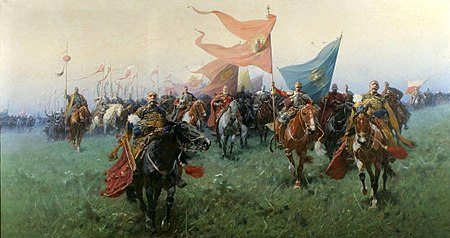
Virgin Mary played a role - according to modern concepts - the national anthem . It was performed before the battles of the troops of the Grand Duchy of Lithuania , at ceremonies and festivals, funerals and during the consecration of Christian saints [2] . In 1529 it was included in the main legal document of Lithuania - the first Statute of the Grand Duchy of Lithuania [3] .
In the XV century, the anthem was adapted to the Polish language [2] . In 1506, the text was included in the “Statutes” of Jan Laksky with an explanation that its author is St.. Wojciech . Most modern researchers reject this version [4] . Soon became the official anthem of the Polish Crown.
Content
Origin
Virgin in the original version contains 2 stanzas . The first refers to the Virgin , and the second to Christ . The song is put on the melody of a love knightly song already existing in the West. This melody was recorded by Benedictines (who previously invented sheet music ), and from their monastery in St. Gallen, she came to Poland. Virgin Mary is a counterfeit . Her melody has the form of choral singing, performed by a cappella . The Virgin Mary appeared as a trope [1] , that is, a song performed by a group of people during the Mass , as a kind of commentary on the Latin text of the liturgy . The song is richly decorated with melism , so, most likely, it was not performed by all believers, but by a specially trained choir ( schola cantorum ).
Only later the Mother of God became a song of chivalry and even the unofficial national anthem of Poland.
Some Polish researchers point out that the “Mother of God” was written in Cyrillic : “Bogurodzica pisana jest cyrylicą w przedziwnej mieszaninę językowej polsko-białoruskiej ...” [5]
Authorship
The author of the Virgin is unknown. There is a legend about the authorship of St.. Wojciech , but she is currently not recognized by scientists seriously [6] . In addition, it is known that Wojciech belonged to supporters of using only Latin in the church. However, Józef Birkenmayer, in a monograph in 1937, listed missionaries, Wojciech's confreres (who arrived in Poland as a Benedictine monk), as well as their (unknown today, but appeared in the 10th century) songs as a possible model for the Virgin Mary . In the hypothetical period of the emergence of the Virgin , Plock , the capital of the diocese, which also housed a lively Benedictine monastery, was an important religious and literary center in northern Mazovia . The surviving descriptions of liturgies in the Płock cathedral testify to the early performance of other songs in Polish there. However, there is no unequivocal evidence that the Virgin Mary appeared there. Interestingly, Galician scholar V. Shchurat considered the song “Boguroditsa ...” to be a Western Russian monument of the end of the 14th century, preserved only in several Polish transcriptions of the 15th and 16th centuries. [7]
Ideological text content
R. Mazurkevich points to the similarity of the images of the anthem with the sermons of Cyril of Turov [8] .
Text entry and history
The oldest known recording of the text of the Virgin - including 2 stanzas and equipped with notes - was made in 1407. The text was recorded on the back inset of a collection of Latin sermons copied by the vicar in Ktsin ( Kuyavia ) by Matthew of Grochow [1] . Now this insert is stored in the Jagiellonian Library (cipher code 1619).
From the middle of the XV century. to the original text added new stanzas. The second surviving record of the Virgin is the Decisiones rote code Wilhelmi Horborg , in which this work was inscribed in 1408 on the reverse side of the 87th page [9] . This manuscript is also stored in the Jagiellonian library (cipher 408).
In accordance with the theme, Alexander Bruckner called lines 12-34 a Christmas song ( Polish pieśń wielkanocna ), and lines 35-48 - a song of the passions of Christ ( Polish pieśń pasyjna ) [9] . This division was also adopted by later researchers. In the XVI century. occasional prayer stanzas were added to the text, thereby creating a long but not too coherent text.
Virgin Mary in the history of literature and culture
Virgin Mary is the first recorded song in Polish. It does not have a real name: the commonly used Mother of God is just the first word of the text (in the oldest record, it even contains two separately written words: “Bogu rodzica”). In essence, the work is more a prayer than a song.
In time, the Theotokos became a battle song of Polish knighthood: as Jan Długosz asserts, they sang before the battle of Grunwald , and later, for example, before the battle of Varna . It was performed during the coronation of Vladislav III . The entire coronation ceremony took place in Latin, only the Mother of God was performed in Polish.
During the 15th century, the Mother of God was the royal hymn of the Jagiellonian dynasty .
Symbols of the Virgin used composers of the XX century. Andrzej Panufnik based on this melody wrote the final with his Sinfonia sacra (1963), which he wrote for the 1000th anniversary of the baptism of Poland. In 1975, Wojciech Kilyar wrote the Mother of God for choir and orchestra. Theme of the slow part of the Polish Symphony by Krzysztof Meyer , written under the impression of martial law (1982), is also the Mother of God [10] .
Language Archaisms
The text of the Virgin contains numerous archaisms. Some of them were already in the XV century .
Some lexical archaisms:
- Bogurodzica - as suggested by T. Lehr-Splavinsky, this is a very ancient Church Slavonic borrowing in Polish, which came to Poland with Czech mediation with the first missionaries [11] . In modern Polish, Matka Boża or Matka Boska is used ;
- dziela - Sovrem. polish dla ;
- bożyc - Sovrem. polish syn Boga ;
- Gospodzin - Sovrem. polish Pan .
Morphology is characterized by the preservation of the ending -i in the imperative mood of a part of the verbs (with a final stress):
- raczy - Sovrem. polish racz ;
- ziści - Sovrem. polish pozyskaj ;
- spuści - Sovrem. polish ześlij .
An interesting syntactic feature of the text is the use of the active, active case - a structure common to the Church Slavonic language, but not used in modern Polish:
- Bogiem sławiena - Sovrem. polish sławiona przez Boga .
A comparative example of the old Belarusian ( 1529 , Statute ON ) and Polish ( 1506 , Lacky statutes) versions of the hymn:
|
|
Notes
- ↑ 1 2 3 Korolko M. Średniowieczna pieśń religijna polska. - Zakład Narodowy im. Ossolińskich. - Wrocław, 1980. - p. 3. - ISBN 83-04-00737-1 .
- ↑ 1 2 Slavonic Paradise of the Kingdom of the Kingdom of the 16th-18th Centuries / National Academy of Sciences of Belarus , Іn-t movy i lіt. ya Y. Kolas and y. Kupala; way of life., pradm. i kament. A. U. Brazgunov. - Mn. , 2011. - p. 840. - 901 p. - (Pomnіkі daўnyaga of the Belarus Belarus). - 400 copies - ISBN 978-985-08-1291-9 .
- ↑ Nescerava, G. Tsі spyavalі we Bagarodzіtsu // Lidskі letapіtsets. - No. 27-28 .
- ↑ Michałowska T. Średniowiecze. - Wydawnictwo Naukowe PWN. - Warszawa, 2002. - p. 280. - ISBN 83-01-13842-4 .
- ↑ "Bogurodzica". J. Woronczak, E. Ostrowska, H. Feicht, 1962.
- ↑ Edmund Kotarski - Bogurodzica
- ↑ Nekrashevich-Korotkaya, Zh. V. Artistic interpretation of the historical significance of the Battle of Grunwald in the heroic poem Prussian War (1516) by Jan Vislitsky. // STUDIA SLAVICA ET BALCANICA PETROPOLITANA. - № 2. - 2010.
- ↑ Roman Mazurkiewicz. "Bogurodzica" w świetle tradycji chrześcijaństwa wschodniego
- ↑ 1 2 Korolko M. Średniowieczna pieśń religijna polska. - Zakład Narodowy im. Ossolińskich. - Wrocław, 1980. - p. 4. - ISBN 83-04-00737-1 .
- ↑ Przewodnik koncertowy PWM Kraków 2003
- ↑ Lehr-Splavinsky T. Polish language .. - Publishing house of foreign literature. - M. , 1954. - pp. 83-84.
Links
- "Virgin" on the site of Wolne Lektury
- "Mother of God" on Staropolska OnLine
- About the “Virgin” on the website Culture.pl . The date of circulation is January 17, 2017.
- “Mother of God”, file in Real Audio format (inaccessible link)
- “Mother of God”, Real Audio format file - another performance (inaccessible link)