Millioktava ( mO ) is a dimensionless logarithmic unit of the ratio of two frequencies or a musical interval . 1000 millictavs are equal to an octave . The two frequencies a and b with a difference of one milli octave relate as
a / b = 2 1/1000 = 1.0006934 ...
If the frequencies of two sounds ( a ) and ( b ) are known, then the number of millictaves ( m ) in the interval between them is calculated by the formulas:

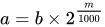
If the sound frequency ( b ) and the interval in millictaves ( m ) are known, then the frequency of the second sound is calculated as follows:
The term "millioktava" was first found in the book of the German physicist and music theorist A. Oettingen Das duale Harmoniesystem (1913) [1] . The division of the octave into 1000 parts, proposed back in the 19th century by the English physicist J. Herschel , is the basis of a 10-tone uniformly temperament system that has not received further development in modern music.
See also
- Cent (music)
Notes
- ↑ Arthur von Oettingen , Das duale Harmoniesystem, Leipzig, 1913