STS-117 - MTKK Atlantis space flight under the Space Shuttle program. The purpose of the flight is to continue the construction of the International Space Station and to partially replace the ISS crew. This flight is the 21st shuttle flight to the ISS.
| STS-117 | |
|---|---|
 | |
| General information | |
| Organization | |
| Ship flight data | |
| Ship name | Atlantis |
| Shuttle Flight No. | 118 |
| Flight Atlantis No. | 28 |
| Launch pad |  Cape Canaveral LS-39A Cape Canaveral LS-39A |
| Launch | June 8, 2007 23:38:04 UTC |
| Docking | June 10, 2007 19:36 UTC |
| Undocking | June 19, 2007 14:42 UTC |
| Ship landing | June 22, 2007 7:50 p.m. UTC |
| Flight duration | 13 days 20 h 12 min |
| Number of turns | 219 |
| Distance traveled | 9.3 million km |
| Orbit height | 225 km (122 miles ) |
| Apogee | 230 km |
| Perigee | 155 km |
| Mood | 51.6 ° |
| Circulation period | 91.6 min |
| NSSDC ID | 2007-024A |
| SCN | 31600 |
| Crew flight data | |
| Crew members | 7 |
| Crew photo | |
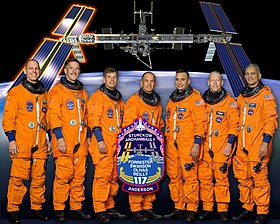 from left to right: Clayton Anderson, James Reilly, Stephen Swanson, Frederick Starkow, Lee Arshambo, Patrick Forrester, John Olivas | |
| Associated Expeditions | |
If Atlantis suffered damage at launch, which would pose a threat to a safe landing, the crew would remain on the ISS and wait for the rescue expedition (STS-318), which would set off on the shuttle Shuttle Endeavor. Such a precaution was provided in accordance with the recommendations of the commission, which investigated the circumstances of the death of the shuttle Columbia .
Crew
- Frederick Sturckow, 3rd Space Flight, crew commander
- Lee Archambault (1), pilot
- James Reilly II, 3, Flight Specialist
- Steven Swanson, 1, Flight Specialist
- Patrick Forrester, 2, Flight Specialist
- John Olivas , 1 Flight Specialist,
- Clayton Anderson (1), Flight Engineer-2 of the 15th ISS Expedition 15
Clayton Anderson joined the ISS 15th long-term expedition as flight engineer-2. Instead, Flight Engineer-2 of the 1st stage of the 15th long-term ISS expedition, Sunita Williams, returned to Earth.
The Discovery crew has four spaceflight recruits: Lee Arshambo, Stephen Swanson, John Olivas and Clayton Anderson.
Flight Options
- Weight :
- Start weight: ?? kg
- Landing Weight: ?? kg
- Perigee : 155 km
- Apogee : 230 km
- inclination : 51.6 °
- Circulation period : 91.6 min.
EVA
- Exit 1 - Railay and Olivas
- Purpose : S3 / S4 truss installation
- Start : June 11, 2007 - 20:02 UTC
- End : June 12 - 02:17 UTC
- Duration : 6 hours 15 minutes
This is the 4th spacewalk of James Reilly and the 1st spacewalk of John Olivas.
- Exit 2 - Forrester and Swanson
- Goal : Complete S3 / S4 Farm Installation
- Start : June 13, 2007 - 18:28 UTC
- End : June 14 - 01:44 UTC
- Duration : 7 hours 16 minutes
This is Patrick Forrester's 3rd space exit and Stephen Swanson's 1st exit.
- Exit 3 - Railay and Olivas
- Purpose : repair of damaged shuttle casing, installation of a hydrogen valve, monitoring and assistance in convolution of solar cells of the P6 segment
- Start : June 15, 2007 - 17:24 UTC
- End : June 16 - 01:22 UTC
- Duration : 7 hours 58 minutes
This is the 5th spacewalk of James Reilly and the 2nd spacewalk of John Olivas.
- Exit 4 - Forrester and Swanson
- Goal : Prepare the S3 / S4 segment solar system rotation system
- Start : June 17, 2007 - 16:25 UTC
- End : June 17 - 22:54 UTC
- Duration : 6 hours 29 minutes
This is Patrick Forrester’s 4th space exit and Stephen Swanson’s 2nd exit.
Purpose
Delivery and installation of truss segments S3 / S4. Dismantling temporary solar panels and deploying a new set of solar panels that will provide 25% of the energy for the ISS. Replacing flight engineer of the 15th long-term expedition of the ISS .
Flight Preparation
- On February 7, the Atlantis shuttle was transported from the hangar to the vertical assembly building . Movement began at 11:19 UTC (6:19 am EST, 14:19 Moscow time) and ended at 12:24 UTC (7:24 am EST, 15:24 Moscow time). The transportation of Atlantis to launch pad 39A is scheduled for February 14.
- On February 15, the Atlantis shuttle was transported to its starting position. The transportation of Atlantis began at 13:15 UTC (8:15 am EST, 16:15 Moscow time) and ended at 19:09 UTC (3:09 pm EST, 22:09 Moscow time). Atlantis is installed on launch pad 39A. The last time this platform was used to launch the shuttle four years ago.
- On February 27, NASA management decided to postpone, at least until April 22, the start of the STS-117 mission. This decision was made after assessing the damage that the external fuel tank and the left wing of the shuttle itself received after a hail storm that swept through February 26 (approximately 5 p.m. U.S. east coast , 10 p.m. GMT ) over Cape Canaveral . From February 15, the Atlantis shuttle was on the launch pad and preparing for the STS-117 mission. Initially, the start of Atlantis was planned for March 15. To eliminate all damage, it was decided to transport the shuttle back to the vertical assembly building. Transportation to the vertical assembly building is scheduled for March 4.
- On March 4, the Atlantis shuttle was returned to the vertical assembly building. The shuttle transportation started at 13:47 UTC (8:47 am EST , 16:47 Moscow time) and ended at 21:49 UTC (5:49 pm EST, March 5, 00:49 Moscow time).
- On April 10, a decision was made to postpone the launch date to June 8. Extra time was needed to continue repairing the external fuel tank that had been damaged during the storm on February 26. Shuttle transport to the launch position is scheduled for May 12.
- On April 26, NASA management decided to return the flight engineer of the 15th long-term ISS expedition Sunita Williams to Earth on the Atlantis shuttle STS-117 in June. To replace Williams, the crew of the Atlantis included Clayton Anderson. It was originally planned that Anderson would fly to replace Williams on the shuttle Endeavor STS-118 . However, due to the postponement of the start of the STS-117 mission to the month of June, the launch date of the Endeavor shuttle STS-118 moved to August. Sunita Williams has been in space since December 10, 2006, if the replacement arrived only in August, then the duration of her continuous stay in space would be 8 months. NASA experts believe that a space flight lasting more than six months, due to the accumulating total dose of radiation received by astronauts in space, as well as due to an excessively long stay in zero gravity, is a danger to the health of astronauts. Therefore, Williams Clayton Anderson was transferred from the Endeavor STS-118 crew to the Atlantis STS-117 crew. Anderson's surname was attributed to the emblem of the expedition below, and Anderson himself was added to the crew photo on the left.
- On May 15, the Atlantis shuttle was transported from the vertical assembly building to the launch pad. Where he will prepare for the STS-117 mission, the launch of which is scheduled for June 8. The removal of Atlantis from the vertical assembly building began at 9:02 UTC (5:02 am EDT ). At 15:47 UTC, Atlantis was installed on the launch pad. The transportation time was 6 hours and 45 minutes.
The initial launch date for Atlantis was March 15th. Atlantis was on the launch pad from February 15 to March 4. He was then returned to the vertical assembly building to repair the surface of the external fuel tank, which was damaged on February 26 during a hail storm.
- On May 31, NASA management made an official decision to launch the Atlantis shuttle STS-117. The official start date and time is June 8, 7 hours 38 minutes after midday summer time, on the east coast of the United States (23:38 UTC). Shuttle flight will last 11 days. The shuttle will deliver to the International Space Station a seventeen-ton truss segment with solar panels. The crew of the shuttle will mount and deploy this design to the ISS.
To carry out this work, astronauts have to complete three spacewalks. The installation of new solar panels is a decisive step towards providing the energy necessary for the further expansion of the station at the expense of European and Japanese scientific modules. “We cannot control the weather, but we did our best to ensure maximum flight safety,” said Bill Gerstenmaier, NASA's flight director.
- On June 3, the Atlantis crew STS-117 arrived at Cape Canaveral Cosmodrome in Florida. Crew members flew to the spaceport from Houston , from the Space Center. Johnson, on four T-38 aircraft.
Flight Description
June 8 (start and first day of flight)
All prelaunch operations were successfully completed, and at 20:50 UTC the crew began to take their places in Atlantis. At 20:58, the landing was completed and at 21:40 the hatch of the ship was closed. Meteorologists gave an 80% chance of launching. The control center was concerned about the weather at the emergency sites . However, the Air Force base in Istra ( France ) gave the green light to the launch time, and the meteorological situation at another site in Zaragoza ( Spain ) began to show a tendency to improve. The third emergency landing site, the Air Force base in Moron, was closed due to repair of the runway until June 15. The MTCC launch was carried out in accordance with the schedule at 23:38:04 UTC (19:38 EDT ).
Like all the remaining scheduled shuttle launches to the ISS, the launch was from launch pad 39A. (Site 39B is used for emergency launches to rescue scheduled missions, in particular STS-125 , which will not be visited by the ISS.) STS-117 was the first launch from site 39A after the crash of the shuttle Columbia in 2003.
June 9 (second day of flight)
The shuttle crew, using the camera, which was mounted on the extension of the robotic arm, examined the heat-resistant coating of the shuttle. Damage to the heat-shielding coating on the most critical parts of the surface of the shuttle: on the edges of the wings and on the bow, was not found.
However, 10 × 15 cm (4 × 6 in ) damage was detected in the heat shield of the OMS / RCS unit on the port side of the shuttle. This did not cause serious concern, since the damaged area is not exposed to excessively high temperatures during planting (540 ° C, while in other areas the “landing” temperature reaches 1600 ° C).
June 10 (third day of flight)
The docking of the Atlantis orbiter with the International Space Station occurred at 19:36 UTC . Before docking, the shuttle successfully performed the so-called RPM maneuver (Rendezvous Pitch Maneuver - oncoming oblique maneuver), during which the station crew performed a control survey of the shuttle's heat-protective coating with high-resolution cameras. The hatch between the shuttle and the ISS was opened at 21:20 UTC. Using the shuttle robotic arm, the truss section S3 / S4 with solar panels was lifted from the Atlantis cargo compartment and transferred to the ISS robotic arm. An official partial replacement took place in the 15th long-term expedition of the ISS . In the Soyuz TMA-10 spacecraft , which is docked to the ISS and which serves as a lifeboat for the ISS crew, the individual Sunita Williams lodgement was replaced by the Clayton Anderson lodgement. From that moment, Anderson transferred to the ISS crew, and Williams to the Atlantis crew.
June 11 (fourth day of flight, first spacewalk)
At 12:49 UTC, the installation of the S3 / S4 truss segment began. The S3 / S4 segment, with the help of a robot manipulator station, was attached to the S1 segment.
At 20:02 UTC, the first spacewalk began. The beginning of the exit was delayed by an hour due to the short-term failure of orientation control gyroscopes .
During spacewalk, astronauts James Reilly and John Olivas fastened the S3 / S4 segment to the S1 segment, connected the power and data cables, removed the transport brackets and retainers from the solar array rotator of the newly installed S3 / S4 segment, prepared the solar panels of the S3 / segment S4 to deployment. The exit ended at 2 hours 17 minutes on June 12. The duration of the first exit was 6 hours and 15 minutes.
June 12 (fifth day)
The solar panels of the newly installed S3 / S4 segment were successfully disclosed, which significantly increased the power generation capacity of the station. Disclosure of panels began at 15:43 UTC. The total length of the S3 / S4 segment solar panels is almost 73 meters (240 feet ).
Problems continued with torque control gyroscopes, the station’s main orientation system. At times, it was necessary to use a shuttle to control orientation, but all problems were resolved by the end of the day.
Astronauts Stephen Swanson and Patrick Forrester began preparations for the launch into space, scheduled for Wednesday, June 13, at 18:03 UTC.
NASA management has decided to conduct a fourth spacewalk to eliminate damage to the protective coating of the Atlantis shuttle.
Damage to the protective coating was found near the engines of the orbital maneuvering system. The fourth spacewalk is scheduled for Sunday, June 17. All work on repairing the shuttle lining will take from 90 minutes to two hours. In connection with the fourth spacewalk, it was decided to extend the Atlantis mission for two days. The return of Atlantis to Earth was postponed to June 21; landing at 17:54 UTC.
There were problems in the Russian segment of the ISS - the orientation system computers (DMS-R) turned off. Despite numerous attempts to restart the computers failed. Station orientation control was switched to orientation gyroscopes of the American station segment, which were connected to the Atlantis shuttle docked to the station orientation systems. Thus, the orientation of the station was supported by the shuttle engines. Specialists at the Russian Mission Control Center have made numerous, but unsuccessful attempts to restart failed computers. It was suggested that the failure of the computers was caused by the addition of a new S3 / S4 segment to the station. However, the reason for the failure of computers remained unknown. It was also not clear exactly where the failure occurred: in the software or in the hardware itself. The problem was also that the software in Russian computers could only be downloaded from the Russian Mission Control Center, and only at a time when the station was in direct radio visibility from the territory of Russia. A favorable opportunity to restart computers could appear only on Thursday, June 14.
June 13 (sixth day of flight, second EVA)
At 10:47 UTC, the process of convolving the solar panels of the P6 segment of the station began. Considering previous experience, when in December 2006, during the Discovery expedition STS-116, difficulties arose when minimizing the first part of the solar panels, the panels jammed. To overcome these difficulties, astronauts were forced to make an unscheduled exit into outer space. This time, anticipating possible difficulties when folding the second part of the solar panels, control and support of the process of folding the solar panels was planned in advance.
At 18:28 UTC, astronauts Patrick Forrester and Stephen Swanson went into space from the Quest module of the International Space Station into outer space. Forrester and Svenson controlled the process of folding the P6 segment solar panels and, if necessary, using special tools, corrected the folding segments of the solar panels. Although the astronauts spent 45 minutes more on this work than planned, they managed to roll only 45 out of 115 feet of the solar panel. The process of folding solar panels continued during the next spacewalk, which took place on June 15.
Then, the astronauts continued to activate the S3 / S4 segment solar cells mounted on the ISS. Astronauts removed transport locks and mounts from the rotation mechanism of solar panels. However, astronauts were not able to complete this work to the end. Experts suspected that the two motors of this device are not connected correctly. Therefore, astronauts did not begin to remove the last transport locks from the rotary device to avoid uncontrolled rotation of the solar panel.
The astronauts returned to the Quest gateway module on June 14 at 1:44 UTC. The duration of the output was 7 hours 16 minutes.
Problems continued with Russian computers responsible for orienting the station. Fedor Yurchikhin and Oleg Kotov, with the help of specialists at the Russian mission control center, continued to try to restore the computer system in the Russian segment of the station.
June 14th (seventh day of flight)
The specialists of the American flight control center made several attempts to completely curtail the solar panels of the P6 segment. From the flight control center, commands for folding and unfolding the panels were alternately transmitted, with the hope that after the next shake-up, the panels could still be minimized. However, these attempts did not lead to complete success. Solar panels remained rolled up only to half their length. It was decided to continue folding the solar panels, under control from astronauts, during the third spacewalk the next day.
The ISS crew members continued their attempts to restore the operability of computers in the station’s orientation system in the Russian segment. Some success was achieved in this work - one of the three orientation computers was temporarily launched. At this time, the orientation control of the station was carried out using the systems of the Atlantis shuttle. The situation was such that the operability of the control computers of the orientation system of the station had to be restored before undocking the Atlantis. The options for extending the stay of Atlantis as part of the ISS were considered, at least for a day.
June 15 (eighth day of flight, third EVA)
The third spacewalk took place. The second time during the current flight in outer space, astronauts James Reilly and John Olivas worked. Exit started at 17:24 UTC. The end time is 01:22 minutes, June 16th. The duration of the output was 7 hours 58 minutes.
During the release, John Olivas was repairing the shuttle casing in the area of the engines of the shuttle maneuvering system. With the help of a robotic arm, the astronaut was moved to the site of damage in the area of the tail of the shuttle. Olivas straightened up the bulging corner of the sheathing and closed the hole formed by him. Then Olivas secured the casing with special brackets. At the same time, James Reilly installed a hydrogen outlet on the outer surface of the American Destiny module. Hydrogen generated by the new oxygen generator will be discharged through this outlet.
To complete the second mission, the astronauts moved to the P6 segment of the station truss. Reilly and Olivas controlled the process of folding the solar panels of the P6 segment, and, if necessary, intervened in this process and, using special tools, corrected the jammed sections of the solar panels. This task has been completed successfully. The segment's solar panels were completely folded. During the Discovery flight STS-120 , which is scheduled for October, the P6 segment will be moved from its current temporary position, above the Node 1 module, to its permanent position on the left end of the truss to the P5 segment. Then the solar panels of the P6 segment will be deployed again.
Astronaut Patrick Forrester, located inside the station, coordinated the work of astronauts in outer space. The robotic arm was controlled by Lee Arshambo and Steve Swanson.
It was, in total, the fifth exit for Reilly and the second for Olivas.
The ISS crew continued to work with station orientation and control computers. The astronauts managed to restore the work of four of the six computers. This was possible after the astronauts excluded one of the voltage switches from the power circuit. The astronauts suspected that this switch failed. It was decided to leave the computers in working condition until Saturday, and then analyze their functioning on Saturday (June 16). The orientation of the station was continued to be controlled by gyroscopes and the orientation engines of the Atlantis shuttle.
June 16 (ninth day of flight)
Shuttle astronauts had a less busy day. Preparations were made for the fourth, final, spacewalk. A press conference was held for the American media. Astronauts were engaged in the transport of goods delivered by the shuttle to the station and the transport of garbage and waste materials in the opposite direction.
ISS flight crew flight engineer Sunita Williams, who had been in space since December 10, 2006, at 5:48 UTC surpassed the women's record for space stay. Until that moment, the record belonged to the American Shannon Lusid, and was equal to 188 days and 4 hours. This record was set by Shannon Lusid in 1996, during a long stay at the Russian Mir station.
It was possible to restore the functionality of all six computers in the Russian segment of the station. Four computers were included in the work, and two remained in standby mode.
June 17 (tenth day of flight, fourth EVA)
Astronauts Patrick Forrester and Stephen Swanson made the last spacewalk. Exit started at 16:25 UTC and ended at 22:54 UTC. The duration of the output was 6 hours 29 minutes.
During the launch, the astronauts checked the correct connection of the motors of the rotation system of the newly mounted solar panels of the S3 / S4 segment and prepared the rotation system for regular operation as part of the ISS. Astronauts also installed another video camera, a computer network cable on the Unity module, and an anti-meteor panel on the Destiny module.
The coordination of work overboard was carried out by James Reilly. Lee Arshambo controlled a robotic arm. James Reilly was assisted by Oleg Kotov, who also studied the process of coordinating work overboard the station, as he would perform this work during the next spacewalk of the ISS astronauts.
This is the fourth exit for Forrester and the second for Swanson.
June 18 (eleventh day of flight)
The astronauts on board the ISS tested the operation of the station’s navigation system. The navigation system is switched from the shuttle's navigation system to computers in the Russian segment of the station. The performance of computers and navigation systems is fully restored.
The crew of the Atlantis shuttle packed and said goodbye to the ISS crew. At 22:51 UTC, the passageway between the shuttle and the station was closed. The undocking of the shuttle was scheduled for June 19 at 14:42 UTC. The shuttle's landing was scheduled for June 21 at 17:54 UTC. However, the weather forecast for Thursday and Friday at Cape Canaveral was not favorable. It was possible to land at Edwards Air Force Base in California.
June 19 (twelfth day of flight)
At 14:42 UTC, the Atlantis shuttle undocked from the International Space Station. The flight of Atlantis in conjunction with the ISS lasted eight days and nineteen hours. After undocking, the shuttle made a traditional flyby and photographing of the ISS. Astronauts, using a camera mounted on a robotic arm, once again examined the heat-protective coating of their spacecraft.
June 20 (thirteenth day of flight)
Ship's commander Rick Sterkou and pilot Lee Arshambo checked the readiness for landing of all shuttle systems. All shuttle systems were in order. Only the weather at Cape Canaveral was not favorable. In Florida it was cloudy, it rained with thunderstorms.
Shuttle crew members were giving orbit interviews to American media.
June 21 (fourteenth day of flight)
On June 21, there were two opportunities for Atlantis to land at the Kennedy Space Center in Florida. The first opportunity - at 202 turn at 17:55 UTC, the second - at 203 turn at 19:30 UTC. Both of these features were not used due to bad weather at the landing site. The shuttle remained in orbit for one more day. NASA’s leadership is taking every opportunity to land shuttles at Kennedy Space Center to avoid the extra cost of shuttles from California to Florida when it lands at Edwards Air Force Base.
June 22 (fifteenth day of flight)
On June 22, the opportunity to land at Kennedy Space Center (at 218 turn at 18:18 UTC) was not used. Bad weather in Florida forced flight control to transfer the landing to Edwards Air Force Base in California.
At 18:43 UTC, Atlantis braking engines were turned on. At this time, the Atlantis was over the Indian Ocean . The engines worked for 2 minutes and 33 seconds. Atlantis left orbit and at 19:49 UTC successfully landed at the Edwards base.
The flight duration of the Atlantis STS-117 was 13 days 20 hours 12 minutes. During this time, the shuttle circled the Earth 219 times.
The length of stay in space of Sunita Williams was 194 days, 18 hours and 58 minutes. This is a new female record for the duration of continuous stay in space.
After landing, the Atlantis crew made a traditional tour and inspection of their ship. The crew also briefly addressed the meeting. “During the mission, various unforeseen problems arose. But, they were all allowed. It was a very successful flight. Thanks to everyone, ”said crew commander Frederick Sterkow.
Sunita Williams, the long-lived space survivor, did not leave the shuttle, she immediately fell into the hands of doctors and was taken away for examination.
After the flight
On June 23, the Atlantis crew astronauts returned to Houston , the Johnson Space Center, where he hosted a gala meeting. Sunita Williams was already moving independently and also participated in the celebration.
On July 3, the Atlantis shuttle returned to Kennedy Space Center at Cape Canaveral. The flight from California lasted two days. On June 22, after nearly fourteen daily space flights, the Atlantis landed at Edwards Base. In preparation for the next space flight, Atlantis needed to be transported to the Kennedy Space Center in Florida. For a flight from the west coast of the USA to the east, Atlantis was fixed on a specially equipped Boeing 747. The flight of a Boeing with a shuttle on its back began July 1 at 13:04 UTC and ended July 3 at 12:27 UTC. During the flight, the Boeing made three intermediate landings: the first for refueling in Amarillo ( Texas ), the second for the first overnight stay, at Affet Air Force Base in eastern Nebraska, and the third to Fort Campbell ( Kentucky ). In Kentucky, the Boeing was forced to linger for a day due to adverse weather conditions at the final destination, at Cape Canaveral. Boeing took off from Fort Campbell at 10:15 UTC and landed at the Canaveral Cosmodrome at 12:27 UTC. After 25 days, the Atlantis returned to its starting point at the Canaveral Cosmodrome, from where it launched into space on June 8 to begin preparations for the next launch into space. The next launch of the Atlantis STS-122 into space is scheduled for December 6 at 21:30 UTC. The main objective of the STS-122 mission will be the delivery and installation of the European Columbus Research Module on the ISS.
See also
- Timeline of manned spaceflight
Links
| Shuttle spacecraft series | ||
| Previous Flight: Discovery STS-116 | STS-117 | Next flight: Endeavor STS-118 |