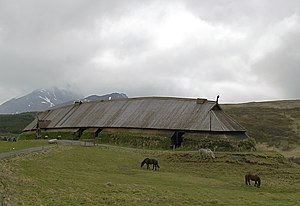
The Honey Hall ( other scand. Mjöð-rann, possibly also mjöðsalʀ or mjöðhöllu , dr.-eng. Meoduhealle ) - in Scandinavia of the Viking epoch and from Germanic peoples, the honey or bastard hall was originally a long structure with a single space. Such buildings belong to the category of so-called long houses . From the 5th century to the early medieval period, the halls of harassment were used as the residence of the rulers and their courtiers. The name itself comes from the name of the alcoholic drink honey , which had widespread use at feasts and religious ceremonies .
Content
Archeology
In 1986-1988, Tom Kristensen of the Roskilde Museum discovered the remains of a Viking-era hall in southwest Lyra , Denmark [1] . Radiocarbon analysis dated finds 880 year. Later it turned out that the hall was built on top of a more ancient hall, dating back to 680. In 2004–2005, Christensen unearthed the third hall of the sixth century north of his previous finds. All three finds were 50 meters long [2] .
Two more similar structures were found in 1993 in Güdme, Denmark. The existence of the so-called “Gudme Kongehal” is indicated only by pillar pits . Gold items found at the excavation site date back to between 200 and 550 years. The largest of the two buildings has a length of 47 meters and a width of 8. Probably, the halls were part of a religious and political center and served as a venue for royal feasts [3] .
A similar room was found on the Kungsgårdsplaton Plateau ( ancient Scand. Kungsgårdsplatån ) near the church in Old Uppsala , Sweden. This was the hall for the Swedish kings peers. Together with the Temple of Uppsala , the Property of Uppsala and the Great Barrows of Uppsala, the hall was part of the political and religious center of Sweden.
Other similar structures can be found in Høg and Borg in the Lofoten Islands , Norway. One of the finds from the Iron Age was 67 meters, and the length of the later finds of the Viking era is 83 meters.
From 500 until Christianization (XIII century), these halls were important political centers.
Construction
The length of the building was 40–60 meters, and its width was about 10 meters. There were also larger buildings. Thus, the “ long house ” of one of the landowners from the Lofoten Islands (northwest Norway ) reached almost 80 meters in length. The contours of the walls formed rows of wooden poles dug into the ground, the gaps between which were filled with clay wattle plastered from inside and outside. Sometimes the clay was replaced by a lining of peat from the outside. The height of the walls was usually the height of a person or slightly exceeded it.
The basis of the high, four-slope roof was a frequent “lattice” of numerous lags and light longitudinal beams, fastened with wooden pins and a bandage made of wicker rods or belts. From inside, the structure was supported by two longitudinal rows of pillars connected at the top by a transverse bar. The slopes of the roof were covered with shingle, reed or sod .
There were no window openings. There were usually two entrances, and they were located at the ends of the buildings, traditionally oriented to the west and east, the first one being called “male” and the second one - “female”.
The transverse rows of pillars with light partitions divided the internal area into three compartments. The side rooms were used for household needs: in one they kept livestock and food supplies for it, in the other they threshed and stored grain. The central compartment was residential and at the same time served for cooking. Here, in the center, there was an open hearth (sometimes two), lined with a stone, during which the smoke went through the hole left in the roof.
In Scandinavia, the "Viking Age" on the basis of the traditional construction of "long" residential buildings developed their special variety - the house " " type. Their sizes usually did not exceed 30 meters in length and 7–8 meters in width. The pillars, which outlined the long walls, were installed in rows in the form of arcs, which gave the structure a navicular shape. This resemblance was underlined by roof-ridge-like ship stems. The lags of the roof with their base rested against the ground, and low eaves formed something like covered galleries along the walls, which in Iceland , Greenland and the Norman settlements of North America were filled with earth powder or peat. A pair of doorways could be placed both at the ends of the building, and in long walls, closer to their edges. Often the entrances were made out in the form of a small vestibule , which significantly improved the insulation.
The inner area was divided by transverse rows of pillars with light bulkheads into 3–4 compartments. The unification of residential and business premises in the houses of the “Trelleborg” type under the same roof was a rather rare phenomenon, and foci (a clear sign of housing) could be located in all compartments [4] .
Legends
There are several testimonies about the huge honey halls, built on special occasions when noble people were invited. Snorri Sturluson in one of the stories from the Circle of the Earth talks about how the Vermish leader Aki invited King Harald the Beautiful Haired and the Swedish King Eric Eymundsson to the feast . However, Aki settled Harald in a new and luxurious hall, since he was younger and showed great promise, and Eric - in the old honey hall. The Swedish king found himself so humiliated that he killed Aki.
Sometimes the construction of the honey hall was carried out only for the purpose of destroying their enemies. In the Ingling Saga , which is also part of the Circle of the Earth , Snorri tells the story of the VIII century, when the legendary Swedish king Ingyald built a huge honey hall only to burn it together with his vassal rulers late at night when they sleep.
In the Ingvar Traveler's Saga, Odd the Wise describes a holiday on the occasion of Erik the Victorious's wedding and the daughter of the Norwegian jarl Hakon , where Erik killed another Aki and his 8 accomplices in the hall that they had built for themselves for Weizla. Erik, though he made peace with Aki to Weizly, did this because he harbored a grievance against Aki, who, against Erik's will, married his daughter, killing her rightful husband.
Myths
Starting from the 10th century in German-Scandinavian mythology, there are various examples of halls, where deities and the dead dwell. The most famous is Valhalla - the hall where Odin gets its half killed in the battle. Freya gets his half in Sessrumnir ( dr. Scand. Sessrúmnir ) in Folkwang ( dr. Scand. Fólkvangr ). In these halls, warriors who have fallen in battles gather, where they daily feast, enjoy the maidens and cut them to death.
In the ancient Anglo-Saxon poem " Beowulf " more than once mentioned a huge hall, the so-called " long house " called Heorot (translated as "The House of the Deer"), in which they regularly feasted. The man-eater Grendel came to this house at night for 12 years and killed its inhabitants, until the glorious hero Beowulf volunteered to destroy the monster. [five]
Notes
- ↑ Lejre Beyond Legend - The Archaeological Evidence. - Christensen, Tom. Journal of Danish Archeology 10 , 1991.
- ↑ Beowulf's Great Hall - Niles, John D., History Today , October 2006.
- ↑ Hal på hal Skalk 1993: 6. −1994. Gudmehallerne. Kongeligt byggeri fra jernalderen. - Sørensen, Palle Østergaard, 1993. Nationalmusees Arbejdsmark.
- ↑ Georgiy Viktorovich Laskavy. Vikings. Hikes, discoveries, culture. - Minsk Color Printing Factory, 2004. - 322 p. - ISBN 985-454-218-1 .
- ↑ Beowulf - Different Texts - Texts - Northern Glory