The Hutsul Republic ( Ukrainian: Gutsulska Respublika ) is a state entity that existed for several months (from the end of 1918 to the beginning of 1919) in the Hutsul region , on the territory of the modern Rakhiv district of Transcarpathian region of Ukraine.
| Republic Since January 21, 1919 as part of the ZUNR | |||
| Hutsul Republic | |||
|---|---|---|---|
| Ukrainian Gutsulska Republic | |||
| |||
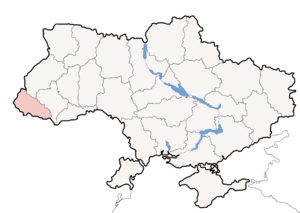 Transcarpathia on the map of Ukraine  Approximate territory of the Hutsul Republic on the map of Transcarpathia Approximate territory of the Hutsul Republic on the map of Transcarpathia | |||
←   → → → → → →November 8, 1918 - July 11, 1919 | |||
| Capital | Yasinya | ||
| Languages) | Ukrainian [1] | ||
| Form of government | Republic | ||

History
At the end of 1918, the collapse of Austria-Hungary began .
In early November, a detachment of local militia ("People’s Defense") was created in Yasiny to prevent robberies by Hungarian soldiers returning home from the East. “National defense” (initially up to 250, subsequently up to 1000 [2] soldiers) was led by an officer of the Austro-Hungarian army Stepan Klochurak .
November 8, the feast of St. Dmitry , during a mass demonstration in Yasinyi, the national assembly of the residents of Yasinya and surrounding villages declared the Hutsul region independent of Austria-Hungary and elected the Hutsul People’s Rada (PLR), whose head was Stepan Klochurak. It included 42 deputies. It was a legislative body. An executive body, the Main Administration, was also formed. Its commissions (military, administrative, food, forestry, trade, school) served as "ministries." The Hungarian administration, the gendarmerie and the border guard were disbanded.
The Hutsul Republic had the intention to join the Western Ukrainian People's Republic (ZUNR) [3] and actively collaborated with its government. The ZUNR government was conveyed the desire of the Yaschins [4] to reunite with the West Ukrainian People’s Republic. [5] Despite the fact that the ZUNR was then at war with Poland on the territory of neighboring Galicia , the Yasins were promised assistance.
Representatives of the Hutsul People’s Council took part in the Budapest ( December 10 ) and Szeged ( December 18 ) congresses, which were convened by the Hungarian government to determine the future of Transcarpathia. The Yasinchans most sharply opposed attempts to leave the region as part of Hungary.
Such a position pissed off the Hungarian government of Mihai Karoyi . On December 22, a Hungarian gendarme battalion entered Yasinia. The Hutsul People’s Council went underground and raised an uprising on Christmas Day.
At the request of the Hutsuls, a detachment of the Ukrainian Galician Army (UGA) was sent from the ZUNR to the Hutsul region to liberate Yasinya from the Hungarian troops, in which the Yasiniy People's Council was also to participate.
On the night of January 7-8, 1919 , during the carols, the people gathered in armed groups. The Hutsuls managed to capture almost the entire Hungarian garrison (504 soldiers) and its colonel commander.
The People’s Defense faced the task of liberating Transcarpathia . Assistance from volunteers and weapons came from ZUNR. The offensive began on January 13 along the Yasinya-Szeged railway. The infantry was covered by two trains armed with guns and machine guns. In a few days, all Ukrainian settlements of modern Rakhov region and the left bank of the Tisza (now in Romania) were liberated. In the liberated settlements, elders were elected, military commandants were appointed. The institutions introduced the Ukrainian language. We started the restoration of bridges, roads, forests. Social policy was aimed at maintaining the poor. In particular, cattle and products from military depots were handed over to soldier widows and large families.
On January 13, the Hutsul army went on a campaign through Kvasy and Berlebash . A new territorial border of the Hutsul Republic lay here.
In the evening of January 16, after the battle in the suburbs - at the Comoros railway station - the city of Sighet was taken. The Ukrainian-Hungarian-Jewish population of the city hung white and blue-yellow flags in the windows. The army moved further to impede the Magyars' intentions to disperse the All-Carpathian Assembly, which was planned to be convened in Khust on January 21 (the meeting nevertheless took place: 420 delegates managed to vote for Transcarpathia joining Ukraine). However, on the front lines of the People’s Defense, 10-12 kilometers from Sighet, on January 17, the Romanian division, which was based in Baia Mare , attacked. Stubborn fights began. The forces were unequal. On the morning of January 18, one echelon with the Hutsul military was evacuated from Sighet, and the second stopped in Comor, as the Romanians made their way. In the battle, 18 were killed, 39 Ukrainians were wounded, many were captured.
Encouraged by the events in Sighet, local Hungarians rebelled. On January 19, headman P. Popenko was killed in Rakhiv and the city center was captured. But at that time a train arrived with a Hutsul army from under Sighet. The rebels were dispersed. True, soon the Hutsuls had to leave Rakhov: it became a buffer zone between the territory occupied by the Romanians and the Hutsul Republic. Her advanced posts were on the outskirts of Rakhov - Usteriki .
The Hutsul Republic began to build a peaceful life. Forestry was conducted, trade with ZUNR. From there and from the Ukrainian People’s Republic , in exchange for forest, as well as on credit, food, kerosene, matches, books, etc. were received. The poorest residents were allocated them for nothing. Trains went to Stanislav and Kolomyia every day. Schools taught in their native language, retirees received a pension.
During the Polish-Ukrainian war, Poland gained an ally - the Kingdom of Romania . Romanian troops were advancing rapidly in Northern Bukovina , the UGA was not able to stop them. After the occupation of Northern Bukovina, the Romanian army turned to Transcarpathia. A threat from the Romanian side loomed over Hutsulia.
The subsequent Hutsul expedition to Sighet ended in the defeat of the Hutsul army.
In May 1919, the Poles threw the ZUNR troops behind Zbruch , and the Hutsul Republic lost cover from the east. Then the Romanian troops moved into its territory, which, according to the decision of the PLR, the Hutsuls surrendered without a fight. Romanians occupied the entire Maramarosh committee . They entered Yasinya on June 11, 1919 .
The decision to surrender without a fight paid off - the Romanians did not begin to use repression at first. The repressions began on June 11, 1919, when the Romanians learned that the Main Administration adopted a memorandum to the Russian Council in Uzhgorod , asking that Hutsul and Transcarpathia join Czechoslovakia (reunification with Ukraine was technically impossible). Then most of the leaders of the PLR and the General Council were arrested. But the authority of these people was so high that the Romanians had to release them (except Stepan Klochurak), and they worked in the local administration.
On August 30, 1920, the Czechs replaced the Romanians, who had already occupied the territory of the neighboring Ruska Krajina , renamed Subcarpathian Rus . But for some time there was a self-government in Yasinya from the former leaders of the Main Directorate.
Members of the People’s Council and S. Klochurak were arrested. Although the history period of the “Hutsul Republic” was small, it played an important role in the struggle of the Hutsuls for the independence of their native land.
Notes
- ↑ Weaver M. Із of the past - on a Christmas day. “Hutsulska Respublika” // Website of the Dilovets'kі sіlsko biblical library (dilovebiblioteka.blogspot.com) 29 chervnya 2012. (in Ukrainian)
- ↑ Klochurak S. Until freedom. - New York: The Carpathian Alliance, 1978. (Ukrainian)
- ↑ Magocsi Paul Robert, Pop Ivan I. Encyclopedia of Rusyn History and Culture. - Toronto: University of Toronto Press, 2002. - S. 237–238. - ISBN 9780802035660 .
- ↑ A Brief History of Yasin // Website "yasinya-ukr.narod.ru" (Retrieved February 1, 2014)
- ↑ Hutsulska Republika // Dovidnik z istorії Ukraine : 3 t. / As amended. І. Pidkovi and R. Shusta. // Website "History of Ukraine" (history.franko.lviv.ua) (Retrieved April 21, 2014) (in Ukrainian)
Literature
- Zhukovskiy A., Subtelny O. Naris History of Ukraine / Ed. Y. Gritsak, O. Romanov. - Lviv: View of the Science Partnership of imeni T. Shevchenko at Lviv, 1992. - 230 p. (Ukrainian)
- Pagіrya O. Gutsulsky Zriv // Site "Tizhden.ua" (tyzhden.ua) 14 fall, 2010. (Ukrainian)
- Pipash V. Gutsulska republic - a unique side of the state power // Newspaper “Voice of Ukraine”, 11 fierce 2009. - cited. on Zakarpattya Online Website (zakarpattya.net.ua) (Retrieved February 1, 2014) (Ukrainian)
- http://www.golos.com.ua/article/1234275730.html (inaccessible link)