} })(document, window, "yandex_metrika_callbacks");Chinese painting
📜 ⬆️ ⬇️

Chinese art

Chinese painting , as a type of fine art, and one of the few living oriental traditions of painting, originated in ancient China, and has been continuously evolving from the Neolithic to the present day.

Content

The Origin of Chinese Painting

Regarding the time of the origin of this art, there are different interpretations. Tradition itself attributes the creation of Chinese painting to the four founding fathers: Gu Kaizhi (Chinese 顧 愷 之) (344–406), Lu Tanwei (Chinese 陆 探微 ser. V century), Zhang Senyao (c. 500 - c. 550 g. .) and Wu Tao Tzu (Chinese 吴道子, 680-740), who lived from the 4th to the 8th centuries of our era.

 
Lady with dragon and phoenix
 
A painting found by archaeologists in 1972-1974 in the graves of the family cemetery Mavanduy .

However, as a result of archaeological research, today's scholars delay the birth of Chinese painting 1000 years earlier, in the era of the fighting kingdoms of Zhan Guo [1]

The second well-known representative of the “painting of intellectuals”, the famous landscape painter Guo Xi in his treatise “On Painting” [2] , considers the painting a kind of psychological portrait of the author, emphasizing the high meaning of the personality and nobility of the artist. The artist emphasizes the need for perfection of the personality of the master. He considers poetry to be another important aspect of a painting, citing a phrase belonging to an unknown author: “Poetry is a formless painting; painting is a form of poetry. ”

Since the days of the artist Van Wei (VIII century), many “intellectual artists” have preferred monochrome ink painting over flowers, believing that: “In the middle of a painter’s path, mascara is simple above all. He will reveal the essence of nature, he will end the deed of the creator. " [3]

It was during this period that the main genres of Chinese painting were born:

  • The genre of plant painting, in particular bamboo painting. The founder of bamboo painting was Wen Tong.
  • Painting flowers and birds .
  • Mountain landscapes (山水 , shan shui , that is, "mountains and waters").
  • Animalistic genre (翎毛. Ling mao . That is, "feathered and fluffy").
  • The genre of the portrait.

In the era of Tang and Song, the most famous works of Chinese painting are created. The wizards appear:

  • At Tao Tzu (680-740).
  • Li Sysyun (651-716) (founder of the landscape direction of Chinese painting).
  • Li Zhaodao (675-741)
  • Wang Wei (701-761)
  • Han Huang (723–787)
  • Han Gan (c. 706 - 783)
  • Zhang Xuan (714-742)
  • Xia Gui (1195-1224)
  • Ma Yuan (1190-1279)
  • Mi Fei (1051-1107)
  • Van Ximen (1096 -?)
  • Huizong (1082–1135)
  • Zhang Zeduan (1085-1145)
  • Wen Tong (1019-1079)
  • Go Xi (1020-1090)

Since the inception of Chinese painting on silk and paper in the 5th century AD e. many authors attempt to theorize painting. Perhaps the first among all was Gu Kaizhi, from the filing of which six laws were formulated - "loofah":

  • Shants - spirituality,
  • Tianqui - naturalness,
  • Goutu - a composition of a painting,
  • Gusyan is a permanent basis, that is, the structure of the work,
  • Mose - following tradition, ancient monuments,
  • Yunby is a high ink and brush technique.

They will form the ideological framework around which Chinese painting will develop over the next centuries.

Chinese painting after the Song era

 
Zhao Mengfu, “A man with a horse in the wind”
 
Ni Zan, "Trees and valleys of the mountain"
 
Ren Renfa, “The hawk grabbing the sparrow”

The reigns of the Tang and Song dynasties are considered the highest peak of Chinese culture . The same can be said about Chinese painting. Over the subsequent dynasties of Yuan, Ming, and Qing, artists focused on samples of the Suna period. Under the Sung Emperor Hui Zong (1082–1135), Chinese culture reached its zenith and began to decline. In 1127, the forces of the northern barbarians of Zhurzheni besieged and captured Kaifeng, the capital of China and the largest city on earth at that time. The emperor himself, an artist, was also captured. This event marked the beginning of the era of northern barbarian conquests in the history of China. 150 years after the Jurchen conquest, the era of the Mongol conquerors arrived. From 1271 to 1368, the Mongol Yuan Dynasty ruled in China. In 1368, the last Chinese (Han) Ming dynasty came to power in China.

Unlike the artists Tan and Song, the painters of subsequent eras did not strive to create new styles, but rather imitated the styles of bygone eras in every possible way. And often they did it at a very good level, like artists from the Mongol Yuan dynasty that followed the Song era.

  • Zhao Mengfu (1254-1322)
  • Van Meng (1308–1385)
  • Ni Tsan (1301–1374)
  • Ren Renfa (1255-1327)
  • Guan DaoSheng (1255-1327)
  • Ke Jiuxi (1290–1343)
  • Zhao Yong (1289–1360)

Among the artists of the Yuan era, it is worth noting the spouses Zhao Mengfu and Guan Dao Sheng. It was a union of two prominent artists, while Zhao Mengfu's wife, Guan DaoSheng, who lived in 1262–1319, was one of the first women artists to have known. Zhao Yong, born from the marriage of Zhao Mengfu and Guan DaoSheng, also became one of the prominent Chinese artists. The Mongol Yuan Dynasty was replaced by the Ming era. Among the many artists of the Ming era, four artists are distinguished: Shen Zhou, Wen Zhengmin, Tang Yin and Qiu Ina . They went down in history under the name "Uska Four".

In general, artists of the Minsk era were guided by samples of the Song era, as did the largest master of the Ming era Wen Zhengmin (1470-1559). But there were innovations. A great impetus to the development was the painting of figures. A distinctive representative of the Minsk art tradition can be considered the original artist Qiu In (c. 1475 - c. 1552). He painted in several genres at once and became famous both as a great landscape painter and as a brilliant representative of the painting of figures. Qiu Ying also wrote in the genre of erotic painting, often portraying not only nudity, but also sexual intercourse. Erotic painting was one of the achievements of artists of the Ming era.

Another famous artist of the Ming era - Tang Yin (1470-1524) was also famous as a great landscape painter and as the luminaries of painting figures. In the Ming era, the animal genre also developed, the great master in the depiction of monkeys was the emperor Zhu Zhanji (1398-1435). The Ming Dynasty ruled China at the same time as the Renaissance flourished in Europe. It is interesting to note that at different ends of Eurasia, synchronously and independently from each other, interest arose in the image of the human body, including nudity.

In 1644, the Ming Dynasty fell. China was again conquered by the Manchu barbarians who ruled the Celestial Empire up to the Xinhai Revolution of 1911.

And although the newcomers, the conquerors, soon after the conquest, “self-cited” and adhered to Confucian orders, each subsequent invasion created a new split in society, affecting, among other things, the development of painting. Since the Mongol conquest in the 13th century, “provincial” painting of artists who did not want to enter the service of the imperial court of conquerors began to develop. The first known hermit artist was Ni Zan (1301–1374). He belonged to a noble family, but, not wanting to join the Mongols and transferring most of his property to the Taoist monastery, he spent the rest of his life in wanderings. Many other artists from the Yuan era followed his example, such as Huang Gongwang, Wu Zhen and Wang Meng.

A similar situation was repeated again, 400 years after the Mongol conquest, when China came under the rule of the new Manchu conquerors, who proclaimed the beginning of the Qing Dynasty. The internal political situation of the “troubled” period of the Ming dynasty, the Manchu Qing dynasty caused a sharp change in the life and work of Chinese artists. In order to express their rejection of Manchu rule and to remain faithful to the Mines, many cultural figures categorically refused to cooperate with the new rulers. When it turned out that the rule of Qing was established firmly and for a long time, many artists became discouraged, some took tonsure and imprisoned themselves in the monastery. So did the artists Hong Ren , Kun Tsan, Zhu Da and Yuan Ji, who went down in history as "four monks."

At the same time, some of the hermit artists chose not only the traditional Buddhist or Taoist "religion" for China as a monastery, but also Catholicism. So the artist and poet Wu Li (1631-1718) became the very first Catholic Chinese bishop.

However, many talented Han Chinese artists continued to serve at the court of the Jurchen and the Mongols or the Manchu. So, during the Mongol Empire, the family of artists headed by Zhao Mengfu became famous at court, and during the Qing Dynasty, painting flourished in the city of Yangzhou, where tens of thousands of artists worked and worked, the most famous of them were the artists who made up the so-called “eight Yangzhou originals . "

  • Gao Fenghan (1683-1749)

During the reign of the Qing Dynasty, one of the founding theoretical books on Chinese painting, Zetsziyuan Huazhuan , 芥子 園 畫 傳 (Word about painting from the garden “mustard seed”) was written.

Chinese painting of the XVIII — XX centuries. Age of Change

 
Giuseppe Castiglione, “ Emperor Qianlong in Ceremonial Armor on a Horse
 
Xu Beihong, Galloping Horse
 
Qi Baishi, "Autumn cicada on lapin flowers"
 
Zhao Shi, Dragonflies on Okra Flowers. 1929

The sixteenth and seventeenth centuries turned into an era of great change for China, and not only because of the Manchu conquest. With the beginning of the colonial era, China is becoming increasingly exposed to the cultural influence of Europeans. A reflection of this fact was the transformation of Chinese painting. One of the most interesting Chinese artists of the Qing era is considered to be Giuseppe Castiglione (1688-1766), an Italian Jesuit monk, missionary and court painter and architect in China. It was this man who became the first artist to combine Chinese and European traditions in his drawing.

Through his works, as well as painting lessons, Castiglione demonstrated the features of the European drawing technique, which required the observance of the laws of perspective and chiaroscuro, he introduced the Chinese to such genres of European fine art as oil painting and copper engraving, thanks to him, ceiling painting and still life were spread . From the time of Castiglione to the present day, oil painting, as well as the western style of painting, have become increasingly popular in China.

XIX and XX centuries became for China a great test of strength. China has entered an era of change, an unprecedented scale. During the nineteenth century, China lost 2 opium wars to the European colonialists and suffered considerable ruin by the Europeans. In 1894-1895, China loses the war in Japan and is divided between European colonial empires (including Russia), the United States and Japan into zones of influence.

At the turn of the nineteenth and twentieth centuries, the Manchu Qing dynasty finally discredited itself by suppressing a Chinese national uprising against European influence (Boxer Uprising) with the help of soldiers from European and Japanese armies. Soon, China is the scene of the battle of the colonialists: Japan and Russia, and is again ruined. The consequence of all these events was the Xinhai revolution of 1911, which led to the fall of the empire and the proclamation of the Republic. The Xinghai revolution was followed by half a century of political chaos, weighed down by a new war with Japan (World War II), which led to new incredible destruction. In the wake of the devastation of World War II, the cultural revolution of Mao Zedong followed.

All these events could not but have an impact on the cultural life of China and on Chinese painting in particular. Among the Chinese intelligentsia, the number of Westerners was growing. In the 19th century, the provincial city of Shanghai became a center of trade with European states. Shanghai soon became one of China's largest trading ports. After this, many Chinese artists rush here, wishing to earn and study the European traditions of painting. Thus was born the Shanghai School of Painting, now the most famous.

The fall of the empire also became one of the most important events in the history of Chinese painting. Previously, the imperial court was one of the main sources of orders for paintings, and when the emperor was gone, many artists were left without work. In addition, as noted above, before the revolutions of the 20th century, most Chinese artists belonged to the circle of the court nobility, and after these events the painting finally "went to the masses." Due to great social upheaval, many lines of artists were interrupted: with the beginning of the 20th century, the period of “100 schools” began in Chinese painting, which is sometimes characterized by a radical departure from traditions and incredible genre improvisation. And all this happened against the backdrop of the increasing influence of European artistic traditions in Chinese painting. Thus, the famous Chinese artists of the 20th century, Xu Beihong (1895-1953) and Lin Fengmyan (1900-1991) studied in Europe. [four]

However, the most prominent person in Chinese painting of the 20th century was Qi Baishi (1864-1957), combining two previously incompatible biography features for a Chinese artist, he was an adherent of "painting of intellectuals" and at the same time came from a poor peasant family . Qi Baishi also received wide recognition in the West, in 1955 he was awarded the International Peace Prize.

Qi Baishi went from a simple carpenter to a world-famous painter. Outwardly, his paintings continued the traditions of intellectual artists, for example, they combined painting, calligraphy, poetry and engraving, but at the same time, they clearly felt the originality and originality of the author, whose life was so unlike the life of an ordinary intellectual. Having lived for a long time in the village, Qi Baishi painted rural landscapes, vegetables, fruits, insects, fish with pleasure. Today, Chinese painting is undergoing a new period of transformation. After the discovery of China to the Western world at the end of the 20th century, interest in Chinese painting has grown in Europe, America and Russia, and nowadays, more and more Europeans, Russians and Americans appear among the masters of Chinese painting.

Painting and Calligraphy

The most important feature of the Chinese fine tradition is the inextricable unity of painting, graphics and calligraphy - the art of beautiful writing of hieroglyphs. Brushes and ink on paper or silk, poets write poetry, and artists - paintings. In painting and graphics, preference is given to the line. It is able to connect and disconnect, to be a connecting thread and border. Of particular importance in Chinese graphics was the curved line - the sign of the cycle of the Great Way. Before the advent of paper, inscriptions were made on narrow bamboo plates, which largely explains the peculiarity of writing Chinese characters from top to bottom. In the VII-XIII centuries. painting has won a leading place among other forms of art. Artists painted the walls of temples and palaces. In the paintings of great masters, you can see traditional objects: fragrant orchid, evergreen pines and cypresses, indestructible rocks, the embodiment of vitality - bamboo, animals, birds, etc. Chinese painting is based on a delicate ratio of delicate mineral colors in harmony with each other. The foreground was usually separated from the back by a group of rocks or trees with which all parts of the landscape corresponded. The compositional structure of the picture and the features of perspective were designed so that a person would feel that he was not a center of the universe, but a small part of it. Since ancient times, China has been painting on silk. Artists created miniature paintings on fans, screens and screens, painted scenes of city and palace life, landscapes on multi-meter scrolls. The plots were myths about heroes - ancestors, wonderful birds and the afterlife. The works of Qi Baishi, one of the most famous Chinese artists who lived at the turn of the 19th and 20th centuries, reflected classical traditions and experimental searches. He copied samples of classical painting and calligraphy, and at the same time worked a lot from nature in search of his own, unique means of expression. The first carcass and stick of carcass, both old and cracked, were presented to the young Qi Baishi by his grandfather. Then he bought him a brush and some copy paper. From this time began the years of hard work and the path to glory. Particularly popular were the artist's paintings made in the genre of "flowers - birds." He liked to depict peonies, lotuses, wild plum flowers, grass bunches, etc. The artist was especially fond of aquatic inhabitants: fish, shrimp, crabs, frogs were appreciated by the master as objects of extreme artistic expression. Qi Baishi did not cease to be amazed at the beauty of the world, juiciness, freshness and brightness of pomegranate fruits, peaches, grapes, cherry berries, which he wrote masterfully.

Painting and Serving the State

It is interesting that most of the great Chinese artists of the Tang, Song Yuan, and Ming eras combined their art classes and service to the state. Almost every prominent artist, calligrapher and poet was also a respected official.

Moreover, often great artists served in positions completely unrelated to creativity. Wang Wei, as mentioned above, served as secretary of the civil chamber, and then secretary of the imperial court in the Tang empire.

The two most famous artists of the Yuan era were also prominent administrators. Ren Renfa served as deputy chief inspector of irrigation facilities, while Zhao Mengfu's government posts included provincial governor of Zhejiang, Jiangxi, and head of the Hanlin Academy.

In general, it must be said that in China, from time immemorial, an extremely respectful attitude has been cultivated towards painting and calligraphy. The prestige of painting was so great that many emperors were not only interested in painting, but also were excellent artists, such as the Songan emperor Hui Zong (1082–1135), or the emperor of the Ming dynasty, Zhu Zhanji (1398–1435).

Chinese oil painting

Today, many Chinese artists prefer European oil and canvas, instead of traditional ink, watercolors and thin bamboo and rice paper. The beginning of Chinese oil painting was laid by the Italian monk Jesuit D. Castiglione .

Sumi-e

Sumi-e painting is a Japanese kind of Chinese painting. Initially, Sumi-e, like Se-e, was monochrome and was written only with the help of ink, but over time, Japanese artists began to write with colored mineral paints. Sumi-e painting received a great impetus not only in Japan but also in other countries of the world, in particular in the USA and Russia. In Moscow today, there is a Sumi-e school of painting, supported by the Japanese Embassy.

Genres of Chinese Painting

Among the genres of Chinese painting are the following [5] :

  • landscapes "mountains - waters" ,
  • flowers and birds
  • bamboo painting,
  • animal painting
  • painting of figures and portraiture.

Symbolism in Chinese Painting

Chinese painting is also characterized by an extremely elegant language of images. Often portraying something, a Chinese artist lays a certain subtext in a drawing. Some images are particularly common, for example, four noble plants: orchid, bamboo, chrysanthemum, meihua plum. In addition, each of these plants is associated with a certain quality of character. The orchid is tender and refined, associated with the tenderness of early spring. Bamboo is a symbol of inexorable character, a real husband of high moral qualities ( Xun-tzu ). Chrysanthemum is beautiful, chaste and modest, the embodiment of the triumph of autumn. Blooming wild plum meihua is associated with purity of thoughts and resistance to the hardships of fate. In the vegetative plots, there is another symbolism: thus, painting a lotus flower, the artist talks about a man who has kept his thoughts pure and wisdom, living in a stream of everyday problems.

Traditional Chinese Painting Tools

To write traditional Chinese paintings, a limited set of tools is used, the so-called “four treasures” of the artist: a Chinese brush, paint, an inkjet for grinding carcasses and mineral paints, paper.

Notes

  1. Great China. Culture and art. Silk paintings from the time of the Warring States and Western Han
  2. A treatise published in the book “Masters of Art about Art” Volume I, M. Art, 1965
  3. Wang Wei. Poems. Moscow, “Fiction”, 1979. Translation by Academician V. M. Alekseev.
  4. Great China. Culture and art. Chinese painting 19-20 centuries
  5. Art of Japan, China and Korea / Irina Novikova. - Litres, 2014 .-- S. 13. - ISBN 9785457596566 .

Literature

  • "The word about painting from the garden with Mustard Seed" - M .: Nauka, 1969.
  • Samosyuk K. "Go Xi". - M .: Art, 1978.
  • Open Chinese art. Exhibition catalog. SPb., 2007. ISBN 978-5-9501-0121-2
  • Postrelova T. A. "The Academy of Painting in China in the X — XIII centuries." - M .: Nauka, 1976.
  • Vinogradova N. A. "Chinese landscape painting." - M.: Fine Arts, 1972.
  • Guo Jo Xu "Notes on painting: what he saw and heard." - M.: Science, 1978.
  • Zavadskaya E. V. "Aesthetic problems of painting in old China." - M.: Art, 1975.
  • "Three Thousand Years of Chinese Painting." Yale University Press, 1997.
  • "Chinese treatises on the portrait." - L .: Aurora, 1971.
  • Fong, Wen (1973). Sung and Yuan paintings. New York: The Metropolitan Museum of Art. ISBN 0870990845 .
  • Liu, Shi-yee (2007). Straddling East and West: Lin Yutang, a modern literatus: the Lin Yutang family collection of Chinese painting and calligraphy. New York: The Metropolitan Museum of Art. ISBN 9781588392701 .

Links

Source - https://ru.wikipedia.org/w/index.php?title=China_painting&oldid=101472363


All articles
Boy Meets Curl
📜 ⬆️ ⬇️

Boy meets curl

"Boy Meets Curl" ( Eng. - "Boy Meets Curling") is the twelfth episode of the 21st season of the Simpsons animated series, which premiered on February 14, 2010.
"Boy Meets Curl"
"The boy matches curling"
The Simpsons episode
Boy Meets Curl.jpg
Episode Promo
Season21
Episode number453
Episode codeMABF05
First broadcastFebruary 14, 2010
Executive producerAl Jin
ScreenwriterRob LaZebnik
ProducerChuck Sheets
Screensaver FlightThe whole Simpsons family in a rare English car
Scene on the couchAbraham Simpson at the fortune teller in the session. The fortuneteller shows him a card with Death in the form of Maggie . Abe passes the card to the fortuneteller herself and she dies.
Guest starBob Costas as himself (sports commentator)
SNPP capsule

Story

In Springfield, an evening of lovers. Marge is getting ready at home, and Homer is at the plant (they will have a date). But Mr. Burns comes in and says that a radiation leak has been detected at the nuclear power plant. Homer tries to take time off from work, but nothing comes of it. When Homer returns home, he tells Marge that they will go to the movies and it will be so romantic that a walk along the beach will seem like a blow to the face. But the movie is too noisy and interferes with Marge. Homer leaves when he sees that Ben Affleck starred in the film. Riding in the car, they see the ice rink and decide to "skate" romantically. But as it turns out - there is a curling tournament. Homer and Marge decide to participate. They make a good team. Seeing how they play, Seymour Skinner and his mother invite them to the team. The next day, Skinner comes to them and says that they were invited to the qualifying mixed curling competition at the 21st Winter Olympics in Canada - Vancouver 2010!

During the game they almost win, but on the last throw Homer throws a stone so hard that he flies at a very high speed. Everyone already thinks that the US team lost, but Marge rubs the stone path for so long that she can get past all the buffets. And finally, Marge brings the stone to the middle and the team wins. Meanwhile, Lisa saw that one girl had a badge. Lisa picks it up and in “thanks” the girl gives her this badge. It seemed to Lisa that he looked lonely, and she was buying another one. So she crouches on collecting badges, and the girl turns out to be a dressed-up dwarf who encourages buyers to buy more badges. At the opening of the Olympics, music from the movie “ Ghostbusters ” sounds, teams from different countries begin to leave, and a voice from the microphone says “Who will you call? .. Albania!” Etc. in alphabetical order. By the end, the voice is already hoarse. At the end of the opening, women in fairies are releasing a Canadian dove - beaver .

In the semifinals, Homer throws a stone too weakly, and Marge has to rub very hard on the ice and the stone still falls into the middle, but Marge breaks his right hand. And Lisa at this time changes her beads to a rare badge and starts performing on the street to earn money for new badges. Bart decides to help her get rid of addiction and return Lysina's beads. At night, Bart cuts out his stubble from Homer's driver’s license and draws his eyes. Bart gives this thing out for the first mascot of the Sochi 2014 Winter Olympics named Zhirnov and offers them a badge seller in exchange for Lysines beads. The seller gives him the beads, and Bart returns them to Lisa. At the hotel, it turns out that Marge is left-handed and the next day the US team refuses to lose. And finally, they win. Bob Costas says it's the only U.S. gold medal at this Olympics.

The end credits are accompanied by Tchaikovsky's “Russian Dance,” which also refers to the 2014 Olympics in Sochi.

Interesting Facts

  • When the Simpsons enter Vancouver, Homer meets an old acquaintance, the heroine of the feature film The Simpsons at Cinema , an elderly woman in a traditional Alaskan costume who taught Homer to enter the astral plane. Homer told Marge that this was his former therapist.
  • In order to take Lisa’s beads from the seller, Bart cut out part of Homer's face from the photograph, drew eyes on his chin, and passed it off as the first badge of the Winter Olympics in Sochi, naming the received character Zhirnov. According to Bart, he personifies "The Spirit of Russian Sloth and Alcoholism"
  • Despite the evil banter in this series over Russia, it was the Russian team that won the bronze medal in the mixed curling demonstration competitions.
  • In this series, the Canadian counterparts of Milhouse and Nelson appear.

Links

Source - https://ru.wikipedia.org/w/index.php?title=Boy_Meets_Curl&oldid=95746176


All articles
Brigadere, Anna
📜 ⬆️ ⬇️

Team Brigade, Anna

Anna Krishyanovna Brigadere ( Latvian: Anna Brigadere ; 1861-1933) - Latvian writer, playwright.
Anna Brigadere
Anna Brigadere
A Brigadere.jpg
Date of BirthSeptember 19 ( October 1 ) 1861 ( 1861-10-01 )
Place of BirthBallyas Farm, Kalnamuiza Parish , Doblensky County , Courland Province , Russian Empire
Date of deathJune 25, 1933 ( 1933-06-25 ) (71 years old)
Place of deathTervete, Jelgava county , Latvia
CitizenshipLatvia
Occupationplaywright
Genrefairy tales
Language of WorksLatvian
Debut1896
Awards
Three Star Commander

Content

Biography

She began to write in 1896. In her work, she often turned to folklore motifs. She wrote fairy-tale plays and satirical comedies, poems and short stories (“Marais”, “Mother-in-law”, “Victory”). Brigadere's plays were staged most often in the Latvian Theater (Riga). Autobiographical trilogy “God, nature, work” (Dievs, daba, darbs).

Fairy Tales

  • “Spriditis” (“ Little Finger ”; 1903) - filmed in 1982 ( cartoon ) and 1985 ( film )
  • "Princess Gundega and King Brusubard" (1911)
  • Maya and Paya (1922)
  • The Wonderful Bird of Lolita (1927)

Literature

  • Raksti I — XX. Riga, 1912-1939.
  • Anna Brigadere un Tervete / sastadijis Janis Rapa. Riga: Preses Nams, 1996. ISBN 9984-00-226-8 (in Latvian)
  • Zenta Maurina. Baltais cels: studija par Annu Brigaderi. Riga: Zvaigzne ABC, 1996. ISBN 9984-04-304-5 (in Latvian)

Links


Memorial house-museum of Anna Brigadere "Spridisha" in Tervet.The house in Riga where Anna Brigadera lived.
Source - https://ru.wikipedia.org/w/index.php?title= Anna&oldid = 82989739


All articles
Steppe (film)
📜 ⬆️ ⬇️

Steppe (film)

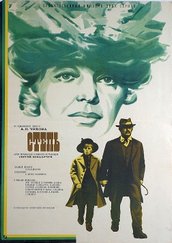
“Steppe” is a film by the Soviet director Sergei Bondarchuk , shot in the Khomutov steppe based on the novel by A.P. Chekhov .
Steppe
Movie poster
Genredrama
ProducerSergey Bondarchuk
Author
script
Sergey Bondarchuk
In the main
cast
Oleg Kuznetsov
Nikolay Trofimov
Sergey Bondarchuk
OperatorLeonid Kalashnikov
ComposerVyacheslav Ovchinnikov
Film companyThe film studio "Mosfilm" .
The first creative association
Duration134 min
A country the USSR
TongueRussian
Year1977
IMDbID 0076761

Content

Cast

  • Oleg Kuznetsov - Egorushka
  • Vladimir Sedov - Kuzmichev
  • Nikolay Trofimov - Father Christopher
  • Sergey Bondarchuk - Emelyan
  • Ivan Lapikov - Pantelei, the wanderer
  • George Burkov - Vasya
  • Stanislav Lyubshin - Konstantin Zvonyk
  • Innokenty Smoktunovsky - Moysey Moiseevich
  • Anatoly Vasiliev - Dymov
  • Valery Zakharyev - Styopka
  • Igor Kvasha - Solomon Moiseevich
  • Lilian Malkin - Rose
  • Victor Mamaev - Deniska
  • Irina Skobtseva - Countess Dranitskaya
  • Elena Savchenko - Nastasya Petrovna
  • Natalya Andreichenko - a girl on sheaves
  • Mikhail Gluzsky - Varlamov
  • Mikhail Kokshenov - Kiryukha
  • Vasily Livanov - Casimir
  • Evgeny Gurov - shepherd

Work on the film

According to the director’s wife, S. F. Bondarchuk, who was in love with the novel “The Steppe”, dreamed of staging it for many years and did not stop working on the script from the beginning of the 1960s. The film adaptation was constantly postponed due to the director’s busyness with such epic productions as “ War and Peace ” and “ They Fought for the Motherland ”.

As in the story, the story of the trip of little Egorushka from his parents' house in the county town of N. Z-th province somewhere for admission to the gymnasium is given by the eyes of the protagonist - the child. The visual range of the picture is solved epically. When working on the image of Egorushka, the director turned to the memories of his own childhood.

Reaction to the film

 
Khomutov steppe . Commemorative stele at the location of the film "Steppe"

The film was not very successful at the box office. Miron Chernenko in the book “Red Star, Yellow Star. (The cinematic history of Jewry in Russia) 1919-1999 ”blames the creators of the film“ the repulsive image of a Jew ” [1] , which, according to the author, gives away anti-Semitism . The film was highly praised by the director Sergey Yutkevich [2] :

Something wonderful happened. Everything that we saw on the screen is surprisingly Chekhov's, surprisingly accurate and at the same time completely non-illustrative following Chekhov line by line. This is an example of what happens when today's cinema takes on such complex things and when the artist cares extremely deeply about it, you can make a work on the screen that is completely equivalent to a literary work. This is a rare case ... It delights and surprises.

Technical Data

The film is color.
It was released in widescreen and widescreen versions.
Filmed on a 35 mm negative using the Universal Frame Format system.
Film length: 3666 meters.
Timing: 134 minutes.

Notes

  1. Miron Chernenko . “Red star, yellow star. (Cinematic History of Jewry in Russia) 1919-1999. "
  2. F. Razzakov. The death of Soviet cinema. Eksmo, 2008. p. 113.

Links

Source - https://ru.wikipedia.org/w/index.php?title=Step_(film)&oldid=100432550


All articles
Godlevo Wielke
📜 ⬆️ ⬇️

Godevo Velké

Godlewo Wielkie ( Polish: Godlewo Wielkie ) - a village in the Republic of Poland , the Masovian Voivodeship , the Ostrowski County , the commune of Nur . It is located approximately in the historical region of Mazovia , 8 km north of the city of Nur , 29 km east of the city of Ostrow Mazowiecka , and 106 km northeast of the city of Warsaw. The population is 110 people.
Village
Godevo Velké
Godlewo wielkie
A country Poland
VoivodshipMasovian
CountyOstrowski
GminaNur
VoightJacek Murawski
History and Geography
TimezoneUTC + 2 , in summer UTC + 3
Population
Population110 people ( 2008 )
Official languagePolish *
Digital identifiers
Postcode
Car codeE

The first information about the village of Godlevo Velk, located in the Principality of Mazovia , dates from the middle of the 15th century .

In 1438 (according to the coat of arms of S. Urussky) or in 1450 (according to the coat of arms of K. Nesetsky), Prince Boleslav IV of Warsaw gave Godlevo’s estate for numerous military merits. On this land, Stanislav, who took the name of the estate as Godlevsky , and his descendants laid the village of Godlev, as well as other villages of Godlev with various additions: Godlev-Basky, Godlev-Lyuba, Godlev-Godushe, etc.

Links

  • Wsi Godlewo ( Polish) Central Statistical Office of Poland (CSB)
Source - https://ru.wikipedia.org/w/index.php?title=Godlev- Velke&oldid = 100229005


All articles
Blood Pancakes
📜 ⬆️ ⬇️

Blood pancakes

Blood pancakes ( Latvian. Asins pankūkas , Fin. Veripalttu ) - a national dish of Latvians and Finns , the oldest Latvian food . A distinctive feature of preparing blood pancakes is the use of blood instead of milk .
Blood pancakes
Included in national cuisines
Finnish cuisine
Latvian cuisine
Place of origin
Components
The mainblood , flour , salt

The origin of this national dish is associated with the beliefs of the suites [1] , who believed that pouring blood is a sin .

Content

  • 1 Suit cooking method
  • 2 See also
  • 3 notes
  • 4 Sources

Suit cooking method

Liquid filtered blood is poured into a pancake bowl. Add water , salt , if necessary, and knead with wheat flour . Small round pancakes are baked in a pan in heated pork fat. Presented to the table with lingonberry jam [2] .

See also

  • Morsilla - Spanish Blood Sausage
  • Blood sausage
  • Pancakes

Notes

  1. Asins pankūkas
  2. Suit cooking method

Sources

Source - https://ru.wikipedia.org/w/index.php?title= Bloody pancakes&oldid = 83859633


All articles
Kelly, Brett
📜 ⬆️ ⬇️

Kelly, Brett

Brett edward kelly Wasteland 2 ”and“ Children without supervision ”.
Brett Edward Kelly
Brett Edward Kelly
Date of Birth
Place of BirthVancouver , British Columbia , Canada
Citizenship
Profession
actor
IMDb

Filmography

  • 2016 : Bad Santa 2
  • 2010 : High School
  • 2009 : Spare glass
  • 2008 : Shot on goal 3: Youth League
  • 2007 : Trick or Treat
  • 2006 : Unattended children
  • 2006 : Like Mike 2: Streetball
  • 2005 : Wasteland 2
  • 2003 : Bad Santa
  • 2002 : Deceivers
  • 2001 : Frostbite
  • 2001 : Kill me later

Links

  • FanSite
  • Kelly, Brett on the Internet Movie Database
Source - https://ru.wikipedia.org/w/index.php?title=Kelly,_Brett&oldid=90268075


All articles
Bureau for documentation and investigation of crimes of communism
📜 ⬆️ ⬇️

Bureau for documentation and investigation of crimes of communism

The Office for the Documentation and Investigation of the Crimes of Communism ( czech Úřad dokumentace a vyšetřování zločinů komunismu, ÚDV ) is a division of the Czech police responsible for investigating crimes committed by the communist authorities of Czechoslovakia in 1948-1989.

The headquarters of the organization is located in Prague [1] , there is a branch in Brno .

The bureau was founded on January 1, 1995 by the decision of the Ministry of Internal Affairs of the Czech Republic on the basis of the law “On the illegality of the communist regime and on resisting it”. [2] A resource center was also established to document the crimes of the communist regime. The bureau has investigative powers to expose and prosecute criminal acts committed during the period 1948-1989 . In addition to investigative activities, documentation is also conducted, which consists of collecting, analyzing and evaluating materials, information and documents testifying to the crimes of the communist regime and its repressive apparatus. [1] [3]

The situation with the rights and freedoms of citizens during the rule of the communist regime is assessed by the government as follows:

“During the years of its totalitarian power, this regime systematically and purposefully violated human rights, the principles of a democratic state, the decisions of international law, even the laws of their country. The communists denied the citizens the opportunity to freely express their opinions, ruthlessly suppressed all other political, religious and social groups. ” [four]

Bureau Activities

A number of accusations were brought against the Czechoslovak state and political figure Lubomir Strougal on the initiative of the bureau. [5] [6] [7] He was accused of interfering with the investigation of crimes committed by Czechoslovakia’s state security agencies in 1948-1949 in 1965. The lawsuit filed in Strougal was closed only in 2002 “for lack of evidence of guilt”.

See also

  • Institute of National Remembrance - Commission for the Investigation of Crimes against the Polish People
  • Institute for the Investigation of Communist Crimes in Romania
  • Breaking the past

Notes

Links

Source - https://ru.wikipedia.org/w/index.php?title=Bureau_document_documentation_and_investigation_in offense_communism_oldid = 95449355


All articles
Osipov, Sergey Ivanovich
📜 ⬆️ ⬇️

Osipov, Sergey Ivanovich

Sergey Ivanovich Osipov ( September 22, 1915 , the village of Stepankovo, Bezhetsky Uyezd, Tver Province, Russian Empire - October 12, 1985 , Leningrad, USSR) - Soviet painter and teacher, member of the Leningrad organization of the Union of Artists of the RSFSR [2] .
Sergey Ivanovich Osipov
Picture
Date of Birth
Place of Birthfrom. Stepankovo, Bezhetsky district, Tver province
Date of death
A place of deathLeningrad
Nationality Russian empire
Citizenship RSFSR
the USSR
Genrelandscape , still life
StudyRepin Institute
Stylerealism
Awards
SU Order of Glory ribbon.svgSU Medal For the Defense of Leningrad ribbon.svgMedal "For the victory over Germany in the Great Patriotic War of 1941-1945."

Content

  • 1 Biography
  • 2 Creativity
    • 2.1 1945 - 1958
    • 2.2 1959 - 1969
    • 2.3 1970 - 1985
  • 3 Interesting Facts
  • 4 notes
  • 5 See also
  • 6 Sources
  • 7 References

Biography

Sergey Osipov was born in a peasant family in the village of Stepankovo ​​in the Bezhetsky district of the Tver province. Since the pre-revolutionary years, the artist’s father worked on construction in Petrograd. Osipov began to study at a school in the village of Porechye. In 1927 he came to his father in Leningrad. Here he graduated from seven classes and enrolled as a student at the Elektropribor factory. Then he worked with his father in construction.

 
The building of LHPU on Tavricheskaya St., 35

At the same time, Osipov attends an evening art school on Tavricheskaya Street, where he studies with famous teachers Vladimir Sukov and Semyon Abugov [3] .

In 1932, Osipov entered preparatory classes at the All-Russian Academy of Arts , and in 1935 he became a student in the painting department of the Leningrad Institute of Painting, Sculpture and Architecture . He studied with S. L. Abugov , M. D. Bernshtein . [four]

After the second year, A. A. Osmerkin invited the young artist to continue his studies in his workshop. About four years spent in the workshop of A. A. Osmerkin, Osipov left memories. [5]

“Alexander Alexandrovich was, in my opinion, a born teacher who knew how to explain difficulties encountered in his work like no one else, while finding surprisingly accurate, sometimes not direct, but giving food for thought words. They wrote a model. I fought over the canvas, trying to put together the whole production, and applied thousands of fractional strokes with small brushes. Osmerkin said: “Osipov, it would be nice for you to have a little Feshin ...” And somehow everything became clear.

Personal artistic experience allowed Alexander Alexandrovich to discover difficult and subtle connections in the painting of Russian and Western European masters. So, revealing to us the method of Cezanne, he compared it with the picturesque experience of Alexander Ivanov, and then “Mount St. Victoria ”with its transitions of clearly defined color plans - from warm pink and orange to blue and blue - was getting somewhere very close to the Italian canvases of our great Ivanov.

Remembering the student years, I get the idea that if during the years of training with Osmerkin, in a daily, stubborn comprehension of nature, we were able to make small successes, move forward, then this was also a consolidation of the beginnings of that understanding of great art that was revealed to us our teacher, persistently sending us to the museum, striving to strengthen our study of nature in the workshop and in nature by studying the works of great masters. ” [6]

Subsequently, Osipov will use these observations and experience in his many years of pedagogical practice while working at the Department of General Painting at V. I. Mukhina LVHPU .

The war found Osipov on his graduation course in the workshop of A. Osmerkin . Having left his studies, he volunteered for the militia. Participated in battles near Leningrad. In December 1941, when clearing passages for the advancing sailor battalion from Kronstadt in the area of ​​Old Peterhof, he was seriously injured and lost his leg. He spent more than a year in hospitals for treatment. Demobilized in 1943 as a disabled person of the Great Patriotic War . He was awarded the Order of Glory of the III degree , medals " For the Defense of Leningrad " and " For the Victory over Germany " [7] .

After almost half a century, the circumstances of the wound and treatment of S. Osipov were described in the memoirs of the head of the surgical department of a military hospital.

“In the most difficult time of our hospital’s life at the end of 1941, in the cold and darkness, we had to make the first amputation of the lower leg. The wounded Osipov was admitted to the seventh surgical department. Young, exhausted, with a reddish head of hair and a beard. Artist. As I found out 50 years later, he was in his last year at the Academy of Arts, a militia. Osipov was shot in the thigh. The wound is small, but a large blood vessel was damaged and gangrene of the foot began. To save the life of the wounded one had to sacrifice a foot. The operation was carried out in purely front-line conditions: in the small cold tent, in the evening, with obligatory darkening of the window, on the bed instead of the operating table, under the light of two flashlights “bat” and only at the most crucial moment the emergency lamp was turned on. Surgeons, including myself, in quilted jackets under dressing gowns, exhausted, sawed bones with difficulty.

The wounded man slowly recovered, his life was saved. After improving his condition, Osipov was evacuated by a plane to the rear for aftercare. Unfortunately, his further fate was unknown to me. And suddenly, accidentally turned on the radio on September 19, 1991 brought me the answer to a question half a century ago. The art critic N. B. Neshataeva spoke about the life of the artist Osipov Sergey Ivanovich in connection with a personal exhibition of his paintings. The coincidence of the name of the artist, the wound near Leningrad, the amputation of the leg in the Leningrad hospital gave me reason to believe that this is our wounded Osipov, who was operated on in blockaded Leningrad by me and another surgeon, who took care of the ward with success was treated at the rear hospital in Sverdlovsk. The coincidence of the data left almost no doubt that this is the hero of our department and my notes. But still I tried to test myself. Having received information through many inquiries, I phoned the widow of Sergei Ivanovich, Antonina Ivanovna. She confirmed that Sergei Ivanovich was operated on in 1941 in our hospital. She said that he met her at the hospital in Sverdlovsk. Osipov completed his art education in Samarkand, where the Academy of Arts was evacuated from Leningrad.

For me, my friends, employees of our surgical department of the hospital, such a belated report about the fate of our seriously injured was not only a great joy, but also a reward for our selfless work in the besieged city. ” [8]

 
Building LSSH on Bolshaya Morskaya, 38

In 1943, Osipov was demobilized due to disability and left for Samarkand to continue his studies at the institute and in December of that year he graduated from the workshop of A. A. Osmerkin with the qualification of an artist. His thesis was the painting "Partisans . " [9]

In 1944, after the complete lifting of the blockade, Osipov returned to Leningrad, modest earnings are given by work under contracts with Lenizo . In April 1945 he was admitted to the Leningrad Union of Soviet Artists . Since 1945, Osipov has been a constant participant in exhibitions of Leningrad artists, he tries himself in portraiture, writes genre compositions, still lifes, but the lyrical landscape becomes the leading one in his work.

In 1945, Osipov began many years of pedagogical work, first at LHPU , then in 1946-1949. in the art studio at the Palace of Culture named after M. Gorky , and from 1949 until the end of the 1970s at the Department of General Painting at the Art School named after V. I. Mukhina [10] .

About Sergey Osipov - a teacher interesting memories were left by his student artist A. A. Naumov .

“The recollections of Sergey Ivanovich Osipov take me to the distant 1960s, when, having returned from the army, I entered the V. I. Mukhina school for the department of metal, having no idea either about design or about painting. My first teachers were the wonderful Leningrad artists S. I. Osipov, Y. I. Krestovsky , A. N. Semenov . Osipov taught us not to limit ourselves to writing off individual parts of the production, but to see the whole composition whole, to try to imagine the still life already written. “Sasha,” said Sergey Ivanovich, “immediately paint over the plane and the background, try to take these relationships and, based on them, build the entire color scheme.” Sergey Ivanovich tried to convey the traditions of the workshop of A. A. Osmerkin to his students in discussions, in tactful ability to prompt the student without interfering in the painting process. But if he saw that someone “swam the wrong way”, he delicately nudged him with his famous cane, sat down at an easel and began “education”.

Pedagogical work took a lot of time without leaving it for creativity, therefore, in June, when the rounds at the institute ended, S. I. Osipov began to prepare for the next trip. Once he invited me to accompany him to Izborsk. And then there were Suzdal, Ferapontovo, Kirillo-Belozersky monastery and others. Spending a lot of time in joint trips with Osipov, I was, as it were, under the hypnosis of this very peculiar artist and began to look at the world through his eyes. I always wanted to immediately “load” the canvas, to sensually convey the state of the landscape. S. I. Osipov smiled, did not say anything ... Looking at how he works, you understand a lot better than whole lectures on art. Watercolor technique, rhythmic organization of the canvas, color, unusual musicality - all this makes the paintings of S. I. Osipov surprisingly attractive, “Osipovskie”. On sketches we were often surrounded by curious children. With interest looking at the corners and planes on Osipov’s canvas, they seriously asked: “Uncle, are you a draftsman?” Sergey Ivanovich smiled and sent them to me. After seeing my work, they returned to Osipov: "Uncle, he has better!" Sergei Ivanovich laughed ... ". [eleven]

 
Building LVHPU them. V.I. Mukhina in Solyany per., 13

As researchers of creativity of S. Osipov will later note, it was inextricably linked with the theme of the Motherland - the Tver land, its nature, ancient Russian cities, and the peasant way of life. From the end of the 1940s, he will annually, and often several times, travel to Staraya Ladoga , Izborsk , Staritsa , Torzhok , Pskov , bringing from these trips numerous studies, sketches and paintings. Then the work continued in the workshop. And so, year after year for forty years.

The works of the 1960-1970s nominated Osipov as one of the leading Leningrad painters with his original and original manner. In 1983, with the support of E. E. Moiseenko , a large exhibition of Sergey Osipov's works was shown at the Central House of Artists in Moscow. [12]

Sergey Ivanovich Osipov died on October 12, 1985 in Leningrad in the seventy-first year of his life. In 1990, a posthumous exhibition of the master’s works was shown at LOSH , allowing for the first time to present his artistic heritage. [13]

Creativity

In the work of S. Osipov, which began with work on a diploma picture, which developed progressively, without visible zigzags and jumps, researchers distinguish several periods.

1945 - 1958

S. Osipov acquired his recognizable individual style of painting gradually. Trips from the late 1940s to Staraya Ladoga, Izborsk, Pskov, and Staritsa helped the artist restore his creative skills and establish himself in a circle of related topics. By the mid-1950s, technically, he had quite developed as a master. This is evidenced by the works of those years, including those shown at Leningrad exhibitions: “Boy” (1950), “Harvesting” (1950) [14] , “Pskov. Street ” (1951), “ On the Volga ” (1951) [15] , “ The Last Snow ” (1954) [16] , “ Compressed Field ” (1954) [17] , “ On the Volkhov ” (1955), “ Trickle ” (1956) [18] and others.

 
Osipov S. Street. Pskov 1951

“My creative life began with work on the landscape,” Osipov wrote in 1968. - The landscape has always interested and excited me as an artist. Working on it, I sought to express my feelings and love for my native nature. ” [19]

The painting style of this period can be judged by the painting “Street. Pskov ” (1951). The artist himself considered it to be very characteristic of his early work, including work among the few works of the early 1950s in the exposition of the 1983 Moscow exhibition. [20] She is distinguished by a certain conventionality of form, timid attempts to escape from illusory naturalism to a more generalized manner of painting. In the future, Osipov will practically abandon the presence of figures of people in the landscapes and the detailed reproduction of panoramic architectural views.

Just following nature no longer satisfied the artist; he felt the need to move on. But how, in what way? A new 1958 creative business trip to Pskov and its environs gave Osipov, in his own words, “some impetus.” [21] The landscapes painted as a result of this trip were welcomed by critics. [22] [23]

1959 - 1969

A real turn in the artist’s work was indicated in the works of the very end of the 1950s - beginning of the 1960s. Trusting his own plan, striving to achieve harmony and enhance expressiveness, Osipov is now less and less likely to follow the path of nature, and composes the composition, inhabiting it previously observed in life and nature. At the same time, he boldly uses artistic generalization, sacrificing secondary details and details in order to enhance the integrity of the image. One of the first works in which Osipov manages to most fully embody new ideas was the painting "Houses on the Volga" [24] (1959). To evaluate the turn in the artist’s work, it’s enough to compare this picture with the 1951 work “Street. Pskov . "

 
Osipov S. Houses on the Volga . 1959

Among the works that open a new period in the artist’s work are “Boats” , “Bridge” (both 1960), [25] “Outskirts of the Village” (1960) [26] , “Still Life with a Violin” (1960) [27] , “ In Staraya Ladoga " (1961), " Pskov " , " Pskov. Street " (1962) [28] , " Truvorovo hillfort " (1962), " Fortress tower " , " Stozhok. Autumn ” , “ Fortress. Old Izborsk ” (all 1963) [29] , “ The Watchman Donkey ” (1963), “ Haymaking ” (1964) [30] , “ Still Life with a Balalaika ” (1965) and others.

According to G.F. Golenky, a Leningrad art historian and first researcher of creativity S. Osipov, new trips to Pskov , Izborsk , Suzdal , work on the creative base of Leningrad artists in Staraya Ladoga enriched the artist with invaluable lessons from the ancient builders of cathedrals and fortresses, helped to understand that ravines, hills, riverbeds, trees, huts should be written as elements of a single spatial environment, as small values ​​of the whole, actively participating in the formation of its features. And then Russian soft melody, clear rhythm and that unique proportionality, by which the national character of the landscape is unmistakably recognized, appeared in Osipov’s landscapes. And in his still lifes there appeared a strong “knockdown”, a good alignment, “grinding”, the fit of all the elements to each other, as in a grandfather log cabin. [31]

Simplifying, and sometimes somewhat deforming objects, Osipov emphasized their three-dimensional construction and those internal forces, the tension with which nature or man created them. “We must remind the viewer of the hidden energy that filled every thing. For me, it is here that the spring of poetry, and not in stories about an action or an event, ”the artist admitted. [32]

Other notable features of Osipov’s painting are the great conventionality of the form and the whole composition of the picture, a noticeable desire for generalizations, allegory, a desire to get away from contemplative naturalism to philosophical depth and some symbolism, but not crossing the line beyond which painting breaks with the real world. The style of the work of this period resembles a light “semi-cubism”, the form is formed by planes and faces. The most common color is lilac, Osipov writes in lilac tones the sky, water, neutral background, the wall of the house, surprisingly subtly conveying the mood of the landscape.

1970 - 1985

The peak of Osipov's work falls on the 1970s - early 1980s. During this period he created a number of the best works, mainly in the genre of landscape and still life, which now occupies no less place in the artist's work. Among them are "The Town of Staritsa" [33] (1967), "It's Haymaking Time" [34] (1967), "Izborsk. 17th Century Tower ” (1967), “ Crossing the River ” , “ In Izborsk ” , “ In Suzdal ” (all 1968), “ Silvery Willows ” , “ Wild Flowers ” , “ Senost Pogost ” , “ Still Life with Balalaika ” [35 ] , “Still life with a balalaika and a shelf” (all 1970), “House with an arch” (1972) [36] , “Snowy courtyard” , “Landscape with a fortress. Old Izborsk ” [37] , “ Autumn Branch ” (all 1974) [38] , “ The Town of Staritsa. Winter ” (1974) [39] , “ Still Life with a White Jug ” (1972), “ Still Life with Cornflowers ” (1976) [40] [41] [42] , “ Northern River ” (1976), “ The Pink House ” ( 1977), Izborsk Slopes (1978), Stozhok. Rainy Day ” (1980), “ Early Greens ” (1982), “ Dandelions ” (1985) [43] and others.

 
Osipov S.V. Cornflowers . 1976

The theme of spiritual sources, traditional for S. Osipov, was also mentioned earlier in his still lifes, in Cornflowers (1976), Still Life with a White Jug (1972), Autumn Branch (1974), Dandelions (1985) and some others incarnate with great grace and artistic taste. Having escaped from some overload of the composition, which was encountered in earlier works, Osipov achieves in still life a great depth of image and associative subtext.

The works of S. I. Osipov contributed to the Leningrad painting of the 1970s, their originality and significance [44] . In his paintings, much resembles the art of ancient Russian masters: the laconicism of the artistic language, the conventions of form and the accuracy of composition, resourcefulness in detail, the integrity and expressiveness of the image built on unpretentious peasant material.

According to S. T. Makhlina, “Osipov’s small landscapes are endowed with extraordinary power of influence on the audience. And the point here is not only that the painter, using the image of nature in its many manifestations, creates landscapes that are consonant with the mental state of man. In all his works, the theme of the Motherland is revealed, praised by the artist with great filial love. And this is quite difficult, because raising a big topic and making it close and understandable in the landscape genre is very, very difficult. ” [45]

Through all the work of Osipov, the thought of continuity, of spiritual and cultural inheritance passes. In his works, the national past is not inseparable from the present. With his works, the author, as it were, confirms the idea that the beauty created by the ancestors does not lose its significance over time. It retains the ability to beneficially influence people and should be included in the spiritual routine of contemporaries. “Sincerity, wise simplicity, a clear harmony of forms and colors allow us to experience the ancient traditions of Russian art, perceived by the author not as a thoughtless use of the technique, but understood in all their essence by our contemporaries,” wrote critics A. Gubarev and A. in 1971 about Osipov . Dmitrenko . [46]

The works of S. I. Osipov are in the State Russian Museum , in museums and private collections in Russia, Italy, Great Britain, the USA [47] , Austria, Finland [48] and other countries.

Interesting Facts

In 2017, S.I. Osipov's “Autumn Branch” (1974) appeared in the popular 20-series psychological thriller CHANCE (in the Russian box office “Doctor CHANCE” ), shot by 20 Century Fox Film Corporation based on the novel by the same name by Kem Nunn, commissioned by American video streaming service Hulu with popular English actor Hugh Laurie in the title role. In the two final series of the thriller, the painting by S. I. Osipov “Autumn Branch” is shown in the interior of the protagonist’s house. Against the background of the picture, which plays a plot-forming role in these scenes, key dramatic dialogues unfold with the participation of the main characters of the film.

Notes

  1. RKDartists
  2. Directory of members of the Union of Artists of the USSR. Volume 2. - M: Soviet artist, 1979. - p.163.
  3. A. N. Semenov, S. I. Osipov, K. A. Gushchin. Catalog of the exhibition of works. L., Artist of the RSFSR, 1977. S. 11.
  4. Leningrad school of painting. Essays on the story. SPb, Gallery ARKA, 2019.P.352.
  5. Osipov S.I. Beautiful years // Osmerkin. Reflections on art. Letters. Criticism. Memoirs of contemporaries. M .: Soviet artist, 1981. S.246-249.
  6. Osipov S.I. Beautiful years // Osmerkin. Reflections on art. Letters. Criticism. Memoirs of contemporaries. M .: Soviet artist, 1981. S.247-249.
  7. We remember ... Artists, art historians - participants in the Great Patriotic War . M., Union of Artists of Russia, 2000. P.208.
  8. Sergey Osipov in the memoirs of contemporaries. From the notes of a military surgeon .
  9. Anniversary Directory of graduates of the St. Petersburg Academic Institute of Painting, Sculpture and Architecture named after I. Repin of the Russian Academy of Arts. 1915-2005. St. Petersburg, Primrose, 2007.S. 56.
  10. Traditions of the school of painting at the A. L. Stieglitz State Art and Industry Academy. Department of General Painting. St. Petersburg, 2010.S. 14, 15, 271.
  11. Ivanov S.V. Twenty years later. Reflections on the exhibition of Sergei Osipov // Petersburg art notebooks. Vol. 21. St. Petersburg, 2011.S.27-28.
  12. Sergey Osipov. Painting. Picture. Catalog. M., Soviet artist, 1983.
  13. Sergey Ivanovich Osipov. Painting. Picture. Exhibition of works. Catalog. L., Artist of the RSFSR, 1990.
  14. Exhibition of works by Leningrad artists of 1951. Catalog . M-L., Art, 1951. P. 19.
  15. Exhibition of works by Leningrad artists of 1951. Catalog. L., LSSH, 1951. P. 15.
  16. Spring exhibition of works by Leningrad artists of 1954. Catalog. L., LOSH, 1954. P. 15.
  17. Spring exhibition of works by Leningrad artists of 1955. Catalog. L., LOSH, 1956. P. 14.
  18. Autumn exhibition of works by Leningrad artists of 1956. L., Leningrad artist, 1958. P.18.
  19. Osipov Sergey Ivanovich (1915-1985). Personal file of a member of VLOSH // Central State Archive of Literature and Art. St. Petersburg, F.78, OP.8, D. 123, L. 17.
  20. Sergey Osipov. Painting. Picture. Catalog. M., Soviet artist, 1983. P.31.
  21. Osipov Sergey Ivanovich (1915-1985). Personal file of a member of VLOSH // Central State Archive of Literature and Art. St. Petersburg, F.78, OP.8, D. 123, L.18.
  22. Kovtun E. Notes on an art exhibition. // Evening Leningrad, 1958, November 29.
  23. Shumova M. Do not give in to conquered borders. Autumn exhibition of works by Leningrad artists. // Leningrad truth, 1958, December 2.
  24. Leningrad school of painting. Essays on the story. SPb, Gallery ARKA, 2019.S. 183.
  25. Exhibition of works by Leningrad artists of 1960. Catalog. L., Artist of the RSFSR, 1963. P. 14.
  26. Lasker E. Chess game textbook . - 6th ed. - M .: Physical education and sport, 1980. - S. 325. - 368 p. (inaccessible link)
  27. Goldsby, A. J. Reti - Alekhine, Baden-Baden 1925 (2007). Date of treatment May 23, 2008. Archived on August 12, 2011.
  28. Alexander Alekhine in the ChessPro Encyclopedia.
  29. Richard Reti vs Alexander Alekhine, Baden Baden 1925 · Hungarian Opening: Reversed Alekhine (A00) · 0-1
  30. Lasker E. Chess game textbook . - 6th ed. - M .: Physical education and sport, 1980. - S. 324. - 368 p. (inaccessible link)
  31. Shaburov, 1992 , p. 153-154.
  32. 1 2 Chernyak V.G. Equations with many unknowns // 64 - Chess Review . - M. , 2006. - No. 4 .
  33. 1 2 Kotov, 1973 , p. 57.
  34. Shaburov, 1992 , p. 153.
  35. Euwe M. , Prince L. Kaissa's Minion = Het Schaakphenomeen Capablanca. - M .: Physical Education and Sports, 1990. - S. 114. - ISBN 5-278-00271-9 .
  36. Shaburov, 1992 , p. 164.
  37. Shaburov, 1992 , p. 168-169.
  38. Shaburov, 1992 , p. 169.
  39. Kotov, 1973 , p. 139.
  40. 1 2 Fine, 1976 , p. 149.
  41. Luděk Pachman, Allen S. Russell. Modern chess strategy . - Courier Dover Publications, 1971. - P. 306. - 314 p. - ISBN 0486202909 .
  42. Reinfeld, Fred. The Immortal Games of Capablanca . - Courier Dover Publications, 1990. - P. 13. - 239 p. - ISBN 0486263339 .
  43. Kotov, 1973 , p. 60.
  44. Kotov, 1973 , p. 58–61.
  45. Kotov, 1973 , p. 140.
  46. Kotov, 1973 , p. 141.
  47. 1 2 3 4 Spout B. Secrets of a broken tombstone // Star . - M. , 2006. - No. 9 .
  48. Shaburov, 1992 , p. 176.
  49. Edward Winter. Capablanca v Alekhine, 1927
  50. Letter from Capablanca Ruebu of February 10, 1928
  51. Shaburov, 1992 , p. 178.
  52. Shaburov, 1992 , p. 181.
  53. Euwe M. , Prince L. Kaissa's Minion = Het Schaakphenomeen Capablanca. - M .: Physical Education and Sports, 1990. - S. 129. - ISBN 5-278-00271-9 .
  54. Kotov, 1973 , p. 142.
  55. Fine, 1976 , pp. 149-150.
  56. 1 2 Kotov, 1973 , p. 143.
  57. Shaburov, 1992 , p. 187.
  58. 3rd Chess Olympiad: Hamburg 1930
  59. 4th Chess Olympiad: Prague 1931
  60. Shaburov, 1992 , p. 194.
  61. 5th Chess Olympiad: Folkestone 1933
  62. Shaburov, 1992 , p. 195.
  63. 1 2 Fine, 1976 , p. 150.
  64. Kotov, 1973 , p. 144-146.
  65. Shaburov, 1992 , p. 199-200.
  66. Shaburov, 1992 , p. 200-201.
  67. Kotov, 1973 , p. 147-148.
  68. Kotov, 1973 , p. 148.
  69. Donner, J. The King: Chess Pieces. - New in Chess, 2006. - S. 91. - ISBN 90-5691-171-6 .
  70. Shaburov, 1992 , p. 201.
  71. Sosonko, G. Remembering Max Euwe Part I . chesscafe.com. Date of treatment September 26, 2009. Archived August 11, 2011.
  72. 1 2 3 Vladimir Kramnik . From Steinitz to Kasparov . e3e5.com (January 17, 2005). Date of treatment July 21, 2009. Archived August 11, 2011.
  73. Kotov, 1973 , p. 149.
  74. Kotov, 1973 , p. 150.
  75. Kotov, 1973 , p. 174.
  76. Shaburov, 1992 , p. 209.
  77. Shaburov, 1992 , p. 210.
  78. 1 2 3 V. Linder, I. Linder. “Chess Encyclopedia”, “AVRO” - tournament, 1938
  79. 1 2 3 8th Chess Olympiad: Buenos Aires 1939
  80. 1 2 Shaburov, 1992 , p. 216.
  81. 1 2 Sizonenko A. The rematch was close (Inaccessible link - history ) . 64 - Chess Review (September 2000). Date of treatment June 1, 2009.
  82. 1 2 Shaburov, 1992 , p. 217.
  83. Kotov, 1973 , p. 228.
  84. 1 2 Kmoch, Hans. Grandmasters i have known
  85. 1 2 Shaburov, 1992 , p. 218.
  86. 1 2 Edward Winter. Was Alekhine a Nazi? , 1989.
  87. Shaburov, 1992 , p. 227.
  88. Charushin V.A. Who led with a pen to the “Parisizer Zeitung” // 64 - Chess Review . - M. , 1996. - No. 3 . , cit. by: [2]
  89. 1 2 Kropman V. The Tragedy of Genius // Jewish Newspaper. - Berlin: Werner Media Group, 2006. - No. 3 (43) .
  90. Kotov, 1973 , p. 229.
  91. Shaburov, 1992 , p. 222.
  92. Shaburov, 1992 , p. 224-225.
  93. Kotov A.A. Alexander Alekhine. S. 231.
  94. 1 2 Ree, Hans . Revenge and forgiveness
  95. 1 2 Shaburov, 1992 , p. 229.
  96. 1 2 Kotov, 1973 , p. 232.
  97. 1 2 Francisco Lupi's The Broken King, a memoir of Alekhine (Chess World, October 1, 1946). Cit. by: Sloan, Sam. Alekhine Controversy - Articles written by the World Chess Champion in 1941
  98. Shaburov, 1992 , p. 231-232.
  99. Shaburov, 1992 , p. 232.
  100. Celso Cuhna e Jose Milhazes. O mistério da morte de Alekhine . PÚBLICO (October 14, 2002). Date of treatment October 20, 2015.
  101. Paperno, D. How did Alekhine die? // Chess Bulletin . - 1992. - No. 12.
  102. 1 2 3 4 Frederic Friedel. Alekhine's death - an unresolved mystery? . Chessbase.com (March 25, 2006). Date of treatment August 25, 2009. Archived on August 12, 2011.
  103. Edward Winter. Alekhine's Death , 2003.
  104. Spraggett, K. Alekhine's Death. Part 1 (unavailable link) , Part 2 (unavailable link) (Monday, March 22, 2010)
  105. P. Romanovsky. Alexander Alekhine. // Chess in the USSR. 1946, No. 5.
  106. Radio ECHO of Moscow :: Not so, 04/13/2013 14:10 Alekhine and the great chess era: Mark Glukhovsky, Dmitry Oleinikov
  107. 1 2 Edward Winter. Graves of Chess Masters , 2003.
  108. Kotov, 1973 , p. 54.
  109. Geek E. Anniversary of an epochal match (Inaccessible link) . Moscow Komsomolets (July 31, 2002). Date of treatment September 19, 2009. Archived on August 12, 2011.
  110. Shaburov, 1992 , p. 200.
  111. Kotov, 1973 , p. 55.
  112. 1 2 Kotov, 1973 , p. 172.
  113. Berdnikov K., Moscow bully . ChessPro.ru. Date of treatment October 11, 2009.
  114. Herman Steiner // The California Chess Reporter. - December, 1955. - T. 5 , no. 4 .
  115. ↑ The Agony of a Genius // 64 - Chess Review . - 1998. - Vol. 3 . - S. 66 .
  116. Paris. Lodge "Astrea"
  117. Paris. Friends of the Chastity Lodge
  118. Sergey Karpachev. Secrets of the Masonic orders. — М.: «Яуза-Пресс», 2007. — с. 164. — ISBN 978-5-903339-28-0
  119. Серков А. И. История русского масонства 1845—1945. — СПб.: Изд-во им. Н. И. Новикова, 1997. — С. 165 −175 — ISBN 5-87991-015-6
  120. Sport: Chess Champion . Time (30 декабря 1935). Дата обращения 13 октября 2009. Архивировано 12 августа 2011 года.
  121. Шабуров, 1992 , с. 235.
  122. Котов, 1973 , с. 247.
  123. Fine, 1976 , pp. 150—151.
  124. Котов, 1973 , с. twenty.
  125. 1 2 Fine, 1976 , p. 151.
  126. 1 2 3 Алехин — четвёртый шахматный король // Советский спорт . — 2003. — № 36(15981) . — отрывок из книги Г. Каспарова «Мои великие предшественники»
  127. Котов, 1973 , с. 248.
  128. Шабуров, 1992 , с. 244.
  129. Fisher's Top Ten (недоступная ссылка) . Дата обращения 5 сентября 2009. Архивировано 6 февраля 2009 года.
  130. Johannes Fischer. World Champions and Draws . Chessbase.com. Дата обращения 5 сентября 2009. Архивировано 12 августа 2011 года.
  131. Eliot Hearst, John Knott. Blindfold Chess: History, Psychology, Techniques, Champions, World Records . — McFarland, 2008. — P. 73. — 445 p. — ISBN 0786434449 .
  132. Eliot Hearst, John Knott. Blindfold Chess: History, Psychology, Techniques, Champions, World Records . — McFarland, 2008. — P. 76. — 445 p. — ISBN 0786434449 .
  133. Алехин А. А. Партии вслепую // На пути к высшим шахматным достижениям = Auf deu Wege zur Weltmeisterschaft, 1923—1927. — М. : Физкультура и спорт, 1991. — С. 24. — 448 с. — ISBN 5-278-00401-0 .
  134. Friedrich Samisch vs Alexander Alekhine Budapest 1921 · Alekhine Defense: Saemisch Attack (B02) · 1/2—1/2
  135. Endre Steiner vs Alexander Alekhine Budapest 1921 · Alekhine Defense: Normal Variation (B03) · 0—1
  136. Чарушин В. Защита Алехина, вариант Кляцкина // 64 — Шахматное обозрение . — 1997. — Вып. 7 .
  137. Олейников Д. Шахматный мир сто лет тому назад: 1909 . ChessPro.ru. Дата обращения 10 сентября 2009.
  138. Alexander Alekhine vs Hans Fahrni Mannheim, #31 1914 · French Defense: Alekhine-Chatard Attack. Albin-Chatard Gambit (C13) · 1—0
  139. Adam Bozon. Budapest Gambit (недоступная ссылка) . Дата обращения 23 сентября 2009. Архивировано 12 августа 2011 года.
  140. Шипов С. Невероятное спасение претендента. В десятой партии матча Владимир Крамник упустил явную победу // Советский спорт . — 2004. — Вып. 176-B(16460) .
  141. Эйве М. Урок девятый. Дебют (продолжение). // Учебник шахматной игры . — М. : Терра-Спорт, 2003. — 480 с. — ISBN 5-93127-232-0 . (inaccessible link)
  142. Ботвинник М. , Эстрин Я. Глава первая. Вариант Алехина. // Защита Грюнфельда. — М. : Физкультура и спорт, 1979. — 271 с.
  143. ChessOps — Full Group-List of Openings, Defences, Gambits and Variations . Дата обращения 23 сентября 2009. Архивировано 12 августа 2011 года.
  144. Kane, P. A review of 107 Great Chess Battles 1939—1945 by Alexander Alekhine (недоступная ссылка) . compulsivereader.com (1992). Дата обращения 17 сентября 2009. Архивировано 12 августа 2011 года.
  145. Например: Samuel Reshevsky . Great chess upsets. — Arco Pub. Co., 1976. — С. 78. — 312 с. — ISBN 0668034920 .
  146. Воронков С. Русский сфинкс. Ч. 5 . chesspro.ru. Дата обращения 3 октября 2009.
  147. Hans L. Bodlaender, Antoine Fourrière. Marseillais Chess . chessvariants.org (1995). Дата обращения 17 сентября 2009. Архивировано 12 августа 2011 года.
  148. Шабуров, 1992 , с. 241.
  149. Alekhine, Alexander (англ.) . OlimpBase . Дата обращения 26 августа 2009. Архивировано 12 августа 2011 года.
  150. В. Линдер, И. Линдер. «Энциклопедия шахмат», Алехина мемориал, 1956
  151. База данных JPL НАСА по малым телам Солнечной системы (1909) (англ.)
  152. Winter, E. Chess Notes . Chesshistory.com (27 июля 2011). Дата обращения 9 июля 2013. Архивировано 9 июля 2013 года.

Literature

  • Котов А. А. Александр Алехин. — М. : Физкультура и спорт, 1973. — 255 с.
  • Котов А. А. Шахматное наследие Алехина. - 2nd ed. М. : Физкультура и спорт, 1982. — Т. 1—2. — 382 с.
  • Шабуров Ю. Н. Александр Алехин. Непобежденный чемпион. — М. : Голос, 1992. — 256 с. — ISBN 5-7055-0852-2 .
  • Чарушин В. А. (составитель). У роковой черты (Александр Алехин в 1939—1946 годах). — Нижний Новгород, 1996. — 208 с.
  • Müller, H.; Pawelczak, A. Schachgenie Aljechin. — 2. Auflage. — Verlag Das Schach-Archiv, 1962. — 276 p.
  • Fine, R. The Age of Alekhine // The World's Great Chess Games . — 2nd ed. — Dover, 1976. — 397 p. — ISBN 0-486-24512-8 .

Links

Источник — https://ru.wikipedia.org/w/index.php?title=Алехин,_Александр_Александрович&oldid=102258016


All articles