Gottentot (koi-koin; self-name : khaa, khaasen ) is an ethnic community in southern Africa. Now they inhabit southern and central Namibia , living in many places mixed with Damara and Herero . Separate groups also live in South Africa : Grikva , Koran and Nama groups (mainly migrants from Namibia).
| Hottentots | |
|---|---|
| Abundance and area | |
 Namibia Namibia  South Africa South Africa | |
| Tongue | Afrikaans , Nama |
| Religion | Christianity |
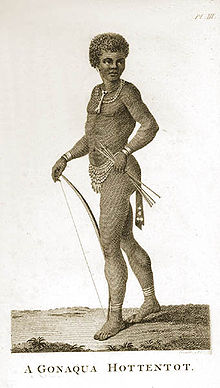

Anthropologically, the Hottentots belong together with the Bushmen to a special racial type - the capoid race .
Content
Title
The name comes from the niderl. hottentot , which means "stutter" (meaning the pronunciation of clicking sounds ). In the XIX - XX centuries. the term ‛Hottentots' has acquired a negative connotation and is now considered offensive in Namibia and South Africa, where it is replaced by the term Khoekhoen (koi-koin), derived from the self-nama. In Russian, while both terms are used.
Languages
The Hottentots spoke the languages of the Khoikhoi of the Central Kinsman family : Nama and Kap Khoi Khoi. At the last one nobody speaks now. In the Nama language, besides the Hottentots themselves, they also speak Damara and Heil , culturally and anthropologically different from Nama. In terms of dialect, the individual nama groups are very close to each other and speak the same dialect — the central nama, with the exception of topnar-nama. The remaining surviving groups of Hottentots now speak only Afrikaans : rehoboter , grikva (descendants of mixed marriages with white) and Koran .
History
Toward the arrival of Europeans, the Hottentots occupied the southwest coast of Africa, from the Fish River in the east to the central highlands of Namibia in the north. How long the Hottentots lived in these places is not known for sure. With confidence we can only say that the Bantu tribes several centuries earlier found them already in the same places. According to lexicostatistics , the Khoikkhi branch separated from other Central Khossan languages ( Chu-Khwe branch ) at the end of 2 thousand BC. er However, the place of initial settlement of their common ancestors (the Kalahari desert region or the Cape region) and the paths of further migrations are still unknown. The Khoikkhi branch itself broke up presumably in the 3rd century AD. er
Unlike the Bushmen, the Hottentots were engaged in nomadic herding .
Traditionally, Hottentots were divided into two large groups: Nama and Kapa Hottentots, who in turn were divided into smaller groups, and those into tribes (! Haoti).
Folklore
Hottentot folklore was recorded by scholars V. Blick and I. Cronlane. Their works give an idea of the characteristic features of the Hottentot legends, which V. Blik not without reason called the animal epos of the Hottentots. In them we get acquainted with the habits of a mighty but stupid lion, a cunning jackal, a greedy hyena, etc. [1]
The ironic attitude to the brute force of a lion and an elephant and the admiration of the hare and tortoise with the wit and wit with the wit and wit show themselves in all these tales.
Their main characters are animals, but sometimes the story is about people, but people - heroes of fairy tales - are still very close to animals: women marry elephants and go to their villages, people and animals live, think, talk and act together.
Nama
Self - namaqua. Before the arrival of the Europeans were divided into two groups:
- nama itself (big nama; Great Nama) - for the arrival of the Europeans lived north of the r. Orange (south of modern Namibia, Great Namakvalend ). Divided into the following tribes (listed from north to south, in parentheses are given: variants of the Russian name; name for Afrikaans ; self-name):
- Swartboi (Lhauzoan; swartbooi; || khau- | gõan)
- Kopers (Kharakhoi, Frasmanna; kopers, fransmanne, Simon Kopper hottentot;! kharkoen).
- roynasi (gai-lhaua, "red people"; rooinasie; gai- || xauan)
- hrotdoden-nama (lo-kai; grootdoden; ||-gain)
- feldshundrahera (Labobe, Haboben; veldschoendragers; || haboben).
- Zaybshi (Kharo; tsaibsche, keetmanshopers; kharo-! oan).
- Bondelswarts (Kamichnun; bondelswarts;! gamiǂnûn).
- topnaars (chaonin; topnaars; ǂaonîn).
- eagles (small nama; orlams, little nama; self-name :! gû-! gôun) - to the arrival of the Europeans lived to the south. Orange to the basin of the river. Ulifants (West of modern South Africa, Small Namakvalend). There are five tribes known to the eagles-nama:
- the tribe of Afrikaner (tsoa tzaran; afrikaanery; orlam afrikaners; | hfaa | aran) should not be confused with the afrikaners (boers).
- lamberts (gai-chauan; lamberts, amraals; kai | khauan).
- Vitboi (Tchobesin; witboois (‛white guys'); | khobesin).
- Betanian (Kaman; bethaniërs;! aman).
- berseba (tsai-chauan; bersabaers; | hai- | khauan).
In 1798 - 1850s , these 5 tribes, cramped by white settlers, moved to the north, subjugating the 8 tribes of the great nama who lived there. Together with the latter, they formed an early feudal association of tribes, headed by a leader named Jonker Afrikaner . Controlling all of southern and central Namibia, they fought constant wars between themselves and with Herero .
Soon they had a new common rival - Germany . In 1884, the territory north of the river. Orange was declared a German colony of South-West Africa . Following this, the lands of the Hottentots and other indigenous people were taken away, which was accompanied by many clashes and violence. In 1904-08, the Herero and the Hottentots raised several uprisings, which were crushed with unprecedented cruelty by the German troops and went down in history as the genocide of the Herero and Nama tribes . 80% of the herero and 50% of the hottentots (nama) were destroyed.
After the suppression of the uprisings, the nama were settled in special reserves (home-lands): Berseba, Bondels, Gibeon, Krantzplatz, Sesfontein, Soromas, Warmbad, Neuhol (ne) ), Ces (Tses), Hoachanas (Hoachanas), Okombahe / Damaraland (Okombahe / Damaraland), Fransfontein (Fransfontein). The reserve system was also supported by the South African administration, which controlled the territory of Namibia from 1915 to 1990 . Inside them, they still make up the majority of the population, but they also live outside of them: in cities and on farms, mixed with Bantu and whites. The division into tribal groups, which are now strongly mixed, remains.
Cape Hottentots
(kapskoy koykoin; kaphottentotten) - as a separate ethnic group now does not exist. Inhabited the coastal land from the Cape of Good Hope in the south-west to the basin of the river. Ulifants in the north (where they bordered on Nama) and to the river. Fish (Vis) in the east (modern Western Cape and west of the Eastern Cape Province ). As of 1652, their number is estimated at 100 thousand [Elphick 1985: 23] or 200 thousand [Wilson 1969: 68]. At the beginning of the XVII century, they were divided into 2-3 groups, represented by at least 13 tribes.
- Einikwa (riviervolk; ãi- || 'ae, einiqua). Perhaps they were closer to the Nama than to the Cape Hottentots.
- West Capotta
- Karos-heber (kaross-heber; ǂnam- || 'ae)
- cohokwa (tsoho; smaal-wange, saldanhamans; | 'oo-xoo, cochoqua)
- hyrikva (guriqua)
- horingaykva (goringhaiqua,! uri- || 'ae)
- Khorahaukva (kora-lhau; gorachouqua ('peninsulae');! ora- || xau)
- ubiqua
- Hainokwa (chainoqua; Snyer's volk;! kaon)
- hessequa
- attaqua
- authenikva (lo-tani; houteniqua, zakkedragers; || hoo-tani)
- East Cape Hottentots
- inqua
- Damakva (damaqua), not to be confused with Damara
- hunheikva (tsoang; hoengeiqua; katte; | hõãn)
- harihurikva (hrihri; chariguriqua, grigriqua).
Most of the tribes were exterminated or assimilated by the Europeans during the 18th and early 19th centuries, but by the beginning of the 18th century three new groups of mixed origin were formed: gonakva, korakva, and prairie, mostly outside the original Hottentot territory, to the east among the Bantus and among the Bushmen Orange River.
- Gonakva (Chona; gonaqua; ǂgona) - formed at the beginning of the XVIII century east of the r. Kei (center of the Eastern Cape Province) based on East Cape Hottentots influenced by the spit . Part moved to Betelsdorp (near Port Elizabeth ). Gone to the middle. XIX century.
- Koran (! Ora, korakva; koraqua;! Ora) - formed as a result of contacts with the Dutch and the significant movements and reorganizations of the local Hottentot tribes caused by them in the late 17th - early 18th centuries. Lived on the river. Orange from the border with Namibia to the vicinity of Kimberley ( North Cape Province ; west of Free State Province), among the Bushmen. By the end of the 20th century, more than 10,000 Coran lived in the environs of Douglas , Prischi , Campbell, and Grikwatuna ( South Africa , north of the middle reaches of the Orange River). They speak Afrikaans .
- Grikva (Khrikva, Khiri; griqua;! Xiri) is a mixed group formed around the city of Kokstad (East Grikvaland), southeast of Lesotho (south of the modern province of Kwazulu-Natal ). At the beginning of the 19th century, part of them moved to Grikwastad (modern Northern Cape Province) and to the south-east of Namibia (near Karasburg ), where small groups remain to this day. They speak Afrikaans.
See also
- Steatotopygia
- Hottentot morality
- Bushmen
Notes
- Г Hottentot Folklore Archived copy from September 5, 2015 on Wayback Machine
Literature
- Elphick . Khoikhoi and the founding of White South Africa. Second edition. Ravan Press. Johannesburg, 1985
- Wilson MH The hunters and herders. // Wilson MH & Thompson LM (eds.) The Oxford history of South Africa, vol. 1: to 1870. Oxford, 1969.