Red-browed Astrild [1] ( lat. Neochmia temporalis ) is an Australian bird of the finch weaver family. This is a very adapted species, often found even in the suburbs of large cities. It has three subspecies.
| Red-browed Astrild | ||||||||||||||
|---|---|---|---|---|---|---|---|---|---|---|---|---|---|---|
 | ||||||||||||||
| Scientific classification | ||||||||||||||
| ||||||||||||||
| Latin name | ||||||||||||||
| Neochmia temporalis ( Latham , 1801) | ||||||||||||||
| Area | ||||||||||||||
 |
Security status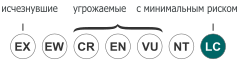 IUCN 3.1 Least Concern : 149391 |
Description
The red-browed astrild reaches a length of 12 cm. There is no sexual dimorphism . Male and female have wide bright red stripes of eyebrows. The tail and tail coverts are red, the top of the head to the back of the head is gray. The back and wings, in contrast, are olive green. The wings are dark with greenish outer edges. The tail is black-brown. The cheeks, throat, and the rest of the underside of the body are light gray to bluish gray. The middle of the abdomen has a yellowish tint. The plumage of young birds on the upper side of the body has a dull, greenish-gray color, only the tail is reddish.
Distribution
The area of distribution of the red-browed astrilda extends in eastern Australia from Cape York to Queensland and from New South Wales to Victoria and southeast Australia. They are also found on the island of Kangaroo . The subspecies Neochmia temporalis temporalis inhabits the territory from the Cape York Peninsula to Cairns . The subspecies Neochmia temporalis temporalis is found from the center of eastern Queensland to Victoria, and the third subspecies, Neochmia temporalis loftyi , lives on Kangaroo Island and Mount Loft Ranges in southeast Australia.
Habitat
Like the Australian Zebra Amadins, the red-browed Astrida are very adaptive birds. They inhabit, respectively, a wide variety of biotopes, among others, found in clearings in the humid jungle, on the edges of the forest, in light forests, pine plantations, park landscapes, as well as in forests and shrubs along rivers and lakes. They cope with the tropical climate in northern Queensland as well as the temperate climate in southern Australia with its relatively harsh winters. The red-browed astrild can be considered as a hemerophile , belonging, for example, in Sydney to the most frequent species in the suburbs [2] .
Nutrition
Nutrition consists of semi-mature and mature seeds of a wide range of herbs. Birds also feed on the seeds of plant species imported into Australia. They collect them directly on the ground or from ears, climbing on the stems of plants.
Reproduction
Outside the nesting period, birds live in schools of 200 to 300 individuals, combining with other species of finch weavers. During the nesting period, they live in pairs or in small groups, however they are very sociable even at this time. They often nest in small colonies with closely located nests. The observed minimum removal of nests is only 80 cm [3] .
The nesting period varies depending on the area of distribution. In tropical Australia, it falls in the second half of the rainy season. In the suburbs of Sydney, birds, due to the constantly rich assortment of feed, nest almost all year round, with the exception of the two coldest months, July and August [3] .
During mating, the male holds a straw in his beak or as a substitute for a feather and dances in front of the female. The female during this currenting repeatedly throws its head up, so that the beak points for a short time almost vertically upwards. In this case, it is likely that we are talking about the rudiments of the female dance, known from the African astrid.
If possible, the nest is built inside dense bushes and is located, as a rule, at a height of 1.5 to 2 m above the ground. In clutch from 4 to 6 white eggs. Chicks leave the nest after about 21 days. They are still incapable of flying, awkwardly moving in the crown of plants.
The natural enemies of the red-browed astrid are cats brought to Australia and the Australian brown hawk . This species of hawk pours from insignificant heights on birds looking for food on the ground.
Captivity
The red-browed Astrild was first imported into Germany in 1870, however, earlier it had been repeatedly traded in England. After that, he never went on sale again and for many years was almost completely absent. For general content with other finch weavers, the red-browed astilda is not suitable, since it chooses, as a rule, the highest-calorie food and fats in a short time [4] .
Gallery
Notes
- ↑ Boehme R. L. , Flint V. E. The Bilingual Dictionary of Animal Names. Birds. Latin, Russian, English, German, French / Ed. ed. Acad. V. E. Sokolova . - M .: Rus. lang., "RUSSO", 1994. - S. 440. - 2030 copies. - ISBN 5-200-00643-0 .
- ↑ Nicolai et al., P. 17
- ↑ 1 2 Nicolai et al., P. 18
- ↑ Nicolai et al., P. 20
Literature
- Jürgen Nicolai (Hrsg), Joachim Steinbacher (Hrsg), Renate van den Elzen, Gerhard Hofmann: Prachtfinken - Australien, Ozeanien, Südostasien . Eugen Ulmer Verlag, Stuttgart 2001, ISBN 978-3-8001-3249-4
- Peter Clement, Alan Harris, John Davis: Finches and Sparrows - An Identification Guide , Christopher Helm, London 1993, ISBN 0-7136-8017-2