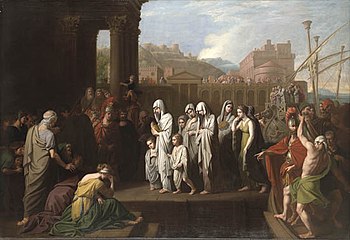

“Agrippina in Brundisia” (Brindisia) is a pictorial plot of the New Time painting, illustrating an episode of ancient Roman history ( Tacitus , “Annals”, 3: 1).
Story
Depicts the arrival in the Italian port of Brindisia Agrippina the Elder with the ashes of her husband Germanicus , poisoned in Syria (19 C.E.), and with two sons. Germanicus popular among the people was probably killed by order of his stepfather Emperor Tiberius, and his widow upon arrival was met by huge grieving crowds of people.
According to the Annals [1] :
Without ever interrupting sailing on a stormy winter sea, Agrippina arrives on the island of Korkira, which lies against the coast of Calabria. Embraced by grief and unable to control it, she spends several days there to restore mental strength.
Meanwhile, having heard of her imminent arrival, the closest of friends and many soldiers who served under the command of Germanicus, as well as many who have never seen him before inhabitants of nearby municipalities, others - believing that by doing this they fulfill their duty to the Princeps, others - following their example, they rush to the city of Brundisy, since Agrippina, who was sailing to Italy, was closest and most convenient to land on land.
As soon as the fleet appeared on the open sea, not only the harbor and embankments filled with crowds: people stuck around the fortifications and roofs of houses, they looked everywhere from where they could see a long distance, and, plunged in sorrow, they asked each other how it was more decent to meet Agrippina coming down from the ship - silence or some kind of exclamation. And still it remained unresolved, which is more appropriate here, when the fleet began to slowly approach the berth place; the rowers paddled the oars without fun and sweeping, as is customary in such cases, but everything was imbued with deep sadness.
When, having gone ashore with two children and a funeral urn in her hands, Agrippina turned her gaze to the ground, there was a general moan, and it was impossible to distinguish whether these moans came from relatives or from outsiders, from men or women; but those who met surpassed Agrippina's companions, exhausted by the long sorrow, in the expression of their still fresh grief.
Robert Graves uses the description of Tacitus to create the same episode in his historical novel "I, Claudius."
Iconography
Agrippina is portrayed in the widow's dressing with a veil covered, a person standing on the bow of the ship or entering the shore, holding an urn with the ashes of her husband. There are also images of the mourning Agrippina, sitting seizing an urn, sometimes in the company of children.
Her image symbolizes marital fidelity [2] .
G. Hamilton, approx. 1765
A. Ransaimon, approx. 1773
B. West, 1773
Turner, 1839
Notes
- ↑ Tacitus, Annals
- ↑ Hall, James. Dictionary of Plots and Characters in Art = James Hall; introduction by Kenneth Clark . Dictionary of Subjects and Symbols in Art / Transl. from English and introductory article by A. Maikapar . - M .: Kron-Press, 1996. - 656 p. - 15,000 copies. - ISBN 5-323-01078-6 . S. 51