Daniela Francois Malan [1] ( African. Daniël François Malan , May 22, 1874 , Riebeck West , Cape Colony - February 7, 1959 , Stellenbosch , South Africa ) - South African Calvinist preacher, politician and statesman of Afriarist nationalism . The leader of the National Party , the Prime Minister of the Union of South Africa in 1948-1954 . Ideologically formulated and enforced the policy of apartheid as a state system.
| Daniel Francois Malan | |||||||
|---|---|---|---|---|---|---|---|
| africa Daniël François Malan | |||||||
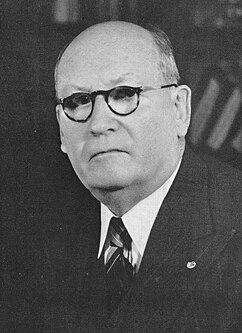 | |||||||
| Monarch | George VI Elizabeth II | ||||||
| Predecessor | Ian smuts | ||||||
| Successor | Johannes Straud | ||||||
| Birth | May 22, 1874 Ribek West , Cape Colony | ||||||
| Death | February 7, 1959 (84 years) Stellenbosch , South Africa | ||||||
| The consignment | National Party | ||||||
| Education | |||||||
| Academic degree | |||||||
| Religion | |||||||

Content
Origin
Occurred from a kind of French Huguenots , who at the end of the XVII century, moved to South Africa due to religious persecution. Clan Malanov was known and influential in the Afrikaner community. The ancestors of Daniel Francois Malan participated in wars with the Zulus , uprisings against the British and the Great Track . Daniel Francois Malan Sr. [2] , father of Daniel Francois Malan, was a farmer and Calvinist preacher.
Patriarchal clan education Malanov was based on the Boer traditions and ideas of Afrikaner nationalism . The parents of Daniel Francois, in his recollection, were the epitome of Protestant piety. At the same time, Daniel Francois from his childhood observed a discrepancy between the principles proclaimed and real behavior - facts of domestic promiscuity, extramarital relations of white men with colored and black women. Subsequently, these children's experiences contributed to his conviction of the need for racial segregation .
Daniel Francois had eight brothers and sisters. Four of them died in childhood. The head of the family hoped that Daniel Francois would inherit the family farm. However, a physically weak, short-sighted and shy-tempered son was not disposed towards this, which led to conflicts. Daniel Francois wanted to be a lawyer; Malan Sr. despised lawyers as "professional liars."
Daniel Francois Malan graduated from Stellenbosch Seminary of the Dutch Reformed Church and Victoria College in Mathematics and Natural Sciences [3] . Despite the natural insularity and lack of communication, Malan actively participated in student discussions. He spoke from the position of Afrikaner nationalism and Calvinist ethics; sharply criticized the policies of the British colonial authorities and the company De Beers , as well as socialist ideas. He was fond of German philosophy, especially Fichte and Kant . Politically fully supported the Boer republics , admired Transvaal president Paul Kruger .
Stay in Europe
Daniel Francois Malan did not participate in the Boer War . In 1900 he went to the University of Utrecht for theological studies. At the same time, he took into account that the Netherlands supported the Boers to the greatest extent. This gave him the opportunity to conduct pro-voor propaganda in Europe. In December 1900, Malan participated in the triumphal meeting of President Kruger in The Hague .
Malan also visited the homeland of his ancestors in France , in Calvinist Switzerland , as well as in Germany , Norway and the United Kingdom. In August 1902 represented South Africa at the World Conference of Christian Students in Denmark . October 10, 1902 Daniel Francois Malan met in Utrecht with Paul Kruger, who went into exile after the defeat of the Boers. I also met with Luis Botha , Christian de Vet , Coos de la Rey .
Traveling around Europe approved Malan in anti-British views: he regarded the British Empire as a force imposing a universal Anglo-Saxon capitalist model on the world, suppressing the cultural uniqueness of races and nations. For similar reasons, Malan categorically rejected Marxism and socialism. In addition, he concluded that the European states would not support the struggle of the Afrikaners, and the preservation of the Boer culture is their own national task.
In January 1905, Malan defended his doctoral dissertation on George Berkeley 's idealistic philosophy at Utrecht University [4] . Received a doctorate degree in theology. Soon after, he left Europe.
Boer Nationalist Activist
Returning to South Africa, the 31-year-old Dr. Malan became a preacher of the Reformed church [5] in Heidelberge , then in Montague . He actively defended the interests of the Afrikaner community, demanded state status for Afrikaans . He was involved in raising funds to help the veterans of the Anglo-Boer War and the families of the dead Boers. At the end of 1907 headed the Afrikaans Language Society, in 1909 participated in the founding of the South African Academy of Literature and Art.
In 1912, Malan made a trip to Southern and Northern Rhodesia and to the Belgian Congo , held meetings with local Afrikaner diasporas there. It is characteristic that in Congo Malan was filled with hostility towards the nomadic way of life and considered the jungle an unacceptable place to live.
Since 1906, Daniel Francois Malan was perceived as the ideological and political leader of the Afrikaner nationalists. In his political speeches, he rejected compromises with the British authorities, promoted the idea of Afrikaner independence. He insisted on the theocratic Calvinistic character of the future state. Often used in political agitation biblical images and stories. At the same time, his theological and philosophical views were not dogmatic — for example, Malan recognized Darwin’s theory .
Malan’s public views were largely based on social Darwinism . For him, the hierarchy of civilizations was immutable, he considered racial differences created by Providence. The Afrikaner nation was determined by the common white race , European descent, Afrikaans, Calvinistic religion and adherence to the Boer traditions. He considered the white civilization to be Christian and advanced, the Negro to be pagan and primitive. Accordingly, the civilizing mission in Africa was considered as the duty of whites, especially Afrikaner-Calvinists.
It should be borne in mind that in everyday life Malan almost never had to communicate with black people. His ideas about blacks were abstract and abstract-theoretical. The issues of race relations in South Africa in the first half of the 20th century were not considered paramount. They were pushed into the background by the contradictions between the Afrikaners and the British.
National Party Leader
In 1914, the Union of South Africa joined the First World War on the side of Great Britain and the Entente . South African troops were sent to Europe and fought with German contingents in South West Africa .
Participation in the war for Britain was unpopular in the Afrikaner community. Radical Afrikaner nationalists raised an armed uprising , suppressed by the government of Louis Bota. Daniel Francois Malan did not directly participate in the uprising, but in every way he expressed support for him and sought from a friend of his youth, Jan Smuts, pardon for the captured rebels.
In 1915, Afrikaner nationalists, led by James Barry Herzog, founded the National Party . One of the first to enter Daniel Francois Malan [6] . In July, he was tasked with editing the party’s print organ, Die Burger newspaper (the publication exists in South Africa to this day). In September, he headed the Cape Provincial Party organization. Malan paid special attention to the problem of “white poverty”, calling to overcome it at the expense of charity and the creation of new jobs in industry. At the same time, Malan insisted on the strictest racial segregation in production. It was from this time that he began to systematically address issues of race relations. In 1918, Malan was elected to the Parliament of South Africa. Entered into the Afrikaner secret society Broderbond .
The national party expressed support for 14 points of Wilson , especially in terms of self-determination of the population of the colonies. The South African delegation, in which Dr. Malan was a member, participated in the Versailles Peace Conference . However, the demands of the Afrikaner nationalists were rejected, since they themselves were viewed as pro-German politicians. David Lloyd George made it clear that he did not consider the Duke and Malan the legal representatives of South Africa (referring to the absence of representatives of the Negro majority in the delegation). Dr. Malan was once again convinced by Europe of the rejection of Boer aspirations and values.
In the government and in the opposition
In the party leadership, Malan tried to create an alliance of Afrikaner nationalists with color political activists on an anti-British basis. In addition, he established an alliance with Labor on the basis of anti - capitalism . In 1924, a coalition of nationalists and Labor won the election. The government formed the James Herzog. Dr. Malan received the post of Minister of the Interior, Education and Health in the office of the Duke. He remained in this position for nine years.
At the ministerial post, Malan achieved the approval of Afrikaans, along with English , as the second official language (instead of Dutch ). He introduced a system of immigration quotas, restricting entry into the AUA from English-speaking countries. In 1928, under the influence of Malan, the new flag of South Africa was approved - in which the British Union Jack occupied a more modest place than in the previous symbolism.
In 1930, on the initiative of Malan, white rights were granted to white women. The overall situation in the country was complicated by the drought and the Great Depression . Dr. Malan supported the Herzog in confrontation with Jan Smuts and Telman Rus, whom he considered anglophiles.
After the elections of 1933 , it was decided to merge the National Party of the Duke with the South African Party Smuts. Dr. Malan and his radical supporters, especially in Cape Town, were strongly opposed. 19 deputies of parliament led by Malan established the Reunited National Party , which stands for the proclamation of the Afrikaner republic. In the elections of 1938 the party received almost 250 thousand votes. Dr. Malan and his supporters actively participated in the celebration of the 100th anniversary of the Great Track and the Battle of the Bloody River .
The outbreak of World War II exacerbated the political situation in South Africa. Radical Afrikaner nationalists were grouped into the pro-Nazi militant organization Ossevabrandvag Johannes van Rensburg . The activists of the organization campaigned in support of the Third Reich , the militants of the organization committed sabotage, explosions on railways and power lines, attacked military personnel. The government of Jan Smuts pursued Ossevabrandvag under martial law.
Dr. Malan advocated the neutrality of South Africa. He considered Hitler Germany as an anti-British force. However, he was not a supporter of Nazism , because he considered his ideology anti-Christian.
In 1942, Dr. Malan published his draft constitution of South Africa, which spoke about racial segregation, white dominance and "Christian paternalism ." Thus, the basic principles of the future apartheid system were generally formulated.
At the elections of 1948, the Malan party went under the slogans of Afrikaner nationalism, the separate development of races, anti-communism , the advocacy of the economic interests of South Africa, social support for veterans of Afrikaners. In the new post-war conditions, this was met with the support of the majority of white voters. The party won and formed its own government. In 1951, she again adopted the name of the National Party .
Head of the Apartheid Government
On June 4, 1948, the 74-year-old Daniel Francois Malan became the Prime Minister of South Africa and the Minister of Foreign Affairs. All ministerial posts received activists Brudebond. Radical Afrikaner nationalist Hendrik Verwurd became Minister for Indigenous Affairs. Government decisions were taken in consultation with the leadership of Brudebond [7] .
During the premiership of Malan, the foundations of apartheid as a state system were laid. In 1950 , the fundamental act of apartheid, introduced by the Office of Vervourd, was introduced - the Population Registration Act , according to which every resident of South Africa was registered in a special Bureau of racial classification as a representative of one of the three (later four) racial groups - white , black, colored also indians ). Political rights, social statuses, economic opportunities directly depended on the position in the racial hierarchy, the top of which was occupied by whites, the intermediate position - color and Indians, the lower classes - the black majority.
The Bantu Power Act secured the privileges and prerogatives of traditional African tribal leaders, but placed them under tight political control of the government. The Pass Law , which severely restricted blacks in freedom of movement and the Separate Services Act, constituted the racial segregation of public premises, services, and transport, also came into force. Earlier, interracial marriages extramarital affairs were prohibited, interracial everyday communication was restricted. Since 1950, the Suppression of Communism Act has been in effect, banning all communist organizations in South Africa. At the same time, the concept of “communism” was interpreted very broadly - practically any oppositionist could be declared “communist” by law. In addition, non-traditional accents were made in the definition of communism: the essence of this ideology was called “incitement of hostility of non-European races to European ones” [8] . It is characteristic that it was this law that pushed the African National Congress and the Pan-African Congress towards an alliance with the South African Communist Party .
Racial inequality in colonial South Africa existed before. The main method of maintaining it was economic discrimination. The year 1948 was a turning point in the sense that the Malan government extended discrimination to all spheres of life, enshrined in law and justified ideologically.
At the same time, the Malan government tried to improve relations with part of the “color” community, to attract it to support the National Party. Social projects for bantustans were also initiated in order to ensure the loyalty of the black population, above all the elite.
An important role was played by ceremonial events aimed at rallying the Afrikaner community, the state cultivation of the Boer traditions. They were declared holidays on April 6 (the date of arrival of Jan van Ribeck in South Africa in 1652 ) and October 10 (the birthday of Paul Kruger).
The foreign policy of the government of Malan faced serious difficulties. The process of decolonization that had begun, the appearance of independent African-Asian states in the UN seemed to him a violation of the foundations of world order. Malan tried to integrate South Africa into the Western world system in the context of the Cold War . Thus, the South African troops participated in the Korean War on the side of the anti - communist coalition. The crews of the South African Air Force participated in the supply of West Berlin during the Berlin crisis . Malan attempted to maintain South African Union membership in the British Commonwealth . Malan paid special attention to relations with the USA , Great Britain and Israel , visited the coronation of Elizabeth II , met with Ben-Gurion . At the same time, Malan insisted on non-interference in the internal affairs of South Africa.
Initially, the apartheid regime maintained its position in the international community. But already under the Malan government, signs of isolation began to appear, which later turned into an international boycott and UN sanctions against South Africa.
Resignation, Death, Memory
On October 11, 1954, 80-year-old Daniel Francois Malan participated in the opening ceremony of the monument to Paul Krueger in Pretoria . After the ceremony, he announced his intention to move away from public affairs. He explained this decision by his old age, his wife's state of health and the desire to spend the rest of his life in peace and quiet. Malan considered his historical mission fulfilled.
His successor, Malan, called Finance Minister Nicholas Havengu . On October 19, 1954, Havenga assumed the duties of the head of government (Malan formally held the position). However, radical Afrikaner nationalists, including Hendrik Verwurd, promoted the candidacy of the Minister of Agriculture Johannes Straud . The radicals considered the policy of Malan too liberal and moderate. They sought to oust the "patriarchs" - the generation of the XIX century, led to a decisive break with Britain and the proclamation of an independent Afrikaner republic [9] .
After a month and a half of intense internal struggle on November 30, 1954, Daniel Francois Malan resigned from his post as prime minister. The South African government was headed not by Havenga, but by Straud. Four years later, Vervurd became Prime Minister. The policy of the National Party established a radical radical course.
The last years of his life Daniel Francois Malan spent at his home in Stellenbosch. He wrote an autobiography, but did not have time to finish. He died of a heart attack at the age of 84.
Under the apartheid regime, Daniel Francois Malan was considered an Afrikaner national hero. A museum and a memorial center of Malan were established in Stellenbosch, busts and memorial signs were installed. The streets in many cities are named after Malan, the airport in Cape Town (until 1995 ). After the dismantling of apartheid and the coming to power of the ANC, many of these objects were renamed, but a number of streets in Pretoria, Cape Town, and Germistone retained the name of Malan. Since 1961 , the Malan Medal has been awarded for achievements in the development of Afrikaans. The cult of Malan is preserved in the Afrikaner town of Oran . According to a 2004 poll, Daniel Francois Malan ranked 81st in the list of “100 Great South Africans”.
Family
Daniel Magdalena Malan’s mother, Daniel Francois Malan, died when he was 19 years old. Daniel Francois Malan Sr. again married Esther Fury. Malan Jr. maintained a warm relationship with his stepmother and three step-sisters.
Daniel Francois Malan's younger brother, Stefanus Francois Malan, inherited the family farm and was engaged in agriculture. He was a political supporter of his brother, a prominent figure in the National Party, a senator of South Africa. Another younger brother, Jacobus Malan, worked as a doctor.
Dr. Malan's older sister, Francine Susanna, was distinguished by deep religiosity, worked in charitable organizations, and was a Sunday school teacher for children of white workers. The younger sister Maria was married to a Transvaal teacher.
Daniel Francois Malan was married twice. The first marriage he concluded in 1926 with Martha Margaret Sandberg. The couple had two sons - Daniel Francois Malan Jr. and Johannes Lawrence Malan. The first became a Calvinist preacher, the second became a journalist, photographer, and a public ecologist.
In 1930, Martha Malan died suddenly. In 1937, Daniel Francois Malan married an activist of the National Party of Maria Sofia Anne Lou (30 years younger than her husband). This marriage has complicated relations in the clan Malanov. In 1948, the couple Malan adopted a German orphan girl.
Daniel’s grandnephew’s nephew Rian Malan , an investigative journalist, writer and musician, is known as a social activist and anti-apartheid.
A distant relative of Daniel Francois Malan was a prominent military leader Magnus Malan , commander of the South African armed forces and Minister of Defense in the government of Peter Bots .
Interesting Facts
In the name of Daniel Francois Malan was named one of the species of fish. In 1952, a well-known ichthyologist, James Smith, discovered in Fishermen on the island of Anjouan a rare specimen of the fish of the order of the whole breed . He appealed to Malan for assistance in the delivery of fish to South Africa. Malan singled out military aircraft for this purpose (the invasion of Comoros airspace triggered a diplomatic conflict between South Africa and South Africa). Smith named the fish in honor of the prime minister, who assisted in the delivery - Malania anjouanae ( Malanya anjouan ) [10] . It was subsequently determined that the fish belong to the species Latimeria chalumnae .
Literature
- Les Français Qui Ont Fait L'Afrique Du Sud ("The French People Who Made South Africa"). Bernard Lugan . January 1996. ISBN 2-84100-086-9
Notes
- ↑ Malan // Lomonosov - Manizer. - M .: Great Russian Encyclopedia, 2011. - p. 629-630. - (The Great Russian Encyclopedia : [in 35 t.] / Ch. Ed. Yu. S. Osipov ; 2004–2017, Vol. 18). - ISBN 978-5-85270-351-4 .
- ↑ Daniel Francois Malan (1874–1959)
- ↑ Dr DF Malan
- ↑ Lindie Koorts. DF Malan and the Rise of Afrikaner Nationalism.
- ↑ Malan, Daniel François (Not available link) . The appeal date is September 18, 2017. Archived July 8, 2017.
- ↑ Daniel Francois Malan
- ↑ Arkady Butlitsky. Braidbond stamp M., Publishing house of political literature, 1967.
- ↑ Legislative Implementation of Apartheid
- Age An aging anachronism: DF Malan as prime minister, 1948-1954
- ↑ Daniel François Malan - Malania Anjouanae