Soyuz 7K-L1 , other names Zond , L1 (11f91), also Zond-M , L1S (L1A) (11f92) - a series of Soviet manned spacecraft (KK) designed for flights to the Moon with return to Earth and made only unmanned unmanned flying. The work was carried out according to the program of the flyby of the moon during the so-called. "Moon race" . With the fulfillment of the training flights, the ships received the open names "Cosmos" and "Probe" .
| Union 7K-L1 | |
|---|---|
 | |
| General information | |
| Manufacturer | OKB-1 |
| A country |  the USSR the USSR |
| Application | astronauts fly by the moon without entering a circumlunar orbit and return to Earth |
| Specifications | |
| Production | |
| Status | canceled |
| Manufactured by | 15 |
| Launched | 14 |
| First start | March 10, 1967 |


General Information
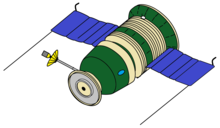
The ship L1 weighing about 5 tons was a double, consisted of a descent module and instrument-aggregate compartment of the Soyuz spacecraft (the household compartment was not used) and was additionally equipped with a star orientation and navigation system, as well as a long-distance communications system for which a parabolic, directional antenna was used . The thermal protection of the descent vehicle was enhanced due to its entry into the atmosphere at the second space velocity.
An interesting feature of the project was the way to enter the atmosphere when returning to Earth. The entrance to the atmosphere was carried out over the southern hemisphere of the Earth, at the same time due to the lifting force the descent vehicle "bounced off" from the dense layers of the atmosphere and again rose into space, and its speed decreased from the second cosmic to suborbital. Re-entry into the atmosphere took place over the territory of the Soviet Union. Such a “two-track” scheme made it possible to land at high latitudes, on the territory of the USSR.
To launch the ship, a three-stage Proton carrier rocket was used, which was created earlier and, despite a significant number of unsuccessful launches at the beginning of operation, was certified as the second USSR carrier for manned flights after the Vostok / Soyuz launch vehicle.
It was made 15 copies of the KK 7K-L1, of which only 5 made successful or partially successful flights under the names "Cosmos-146", "Cosmos-154", "Zond-4" - "Zond-8". At the same time, the spacecraft Cosmos-146, Cosmos-154 (variant L1P-L1E) made developmental high-elliptical flights without flying around the moon, and Zond-5 - Zond-8 circled the moon and returned to Earth. 5 more ships L1 (as well as 2 ships of modification L1S) could not be put into space due to rocket crashes during the launch phase.
The first manned flight of a similar spacecraft with the flyby of the moon, to advance the flight of the American Apollo-8 spacecraft (started on 12/21/1968), was planned for 12/12/1968, but was canceled due to the high risk due to the inadequacy of the ship and the launch vehicle despite the fact that the crews wrote a statement to the Politburo of the Central Committee of the CPSU with a request to allow them to fly to the Moon immediately to be ahead of the United States. When attempting to launch this ship in unmanned mode on 01/20/1969, the Proton launch vehicle exploded, although the descent vehicle was rescued by an emergency rescue system (CAC) .
In three flights of the probe of five, there were serious malfunctions that could theoretically be repaired with the crew on board, but if they could not be overcome, they could lead to the death of crew members or their injury. During the flights of the Zond-4 and Zond-5 ships, due to the failure of the stellar sensor and the impossibility of building the orientation, the entrance to the atmosphere passed along a ballistic trajectory with twentyfold overloads, and during the Zond-6 flight there was a depressurization of the cockpit due to for frostbite of the rubber hatch seal and failure of the gamma ray altimeter, which led to the premature shooting of the parachute system at an altitude of 1500 m [1] (according to other data, 5300 m), which caused the descent vehicle to crash.
It should be noted, however, that 20-fold overloads do not necessarily lead to serious injuries of astronauts, for example, cosmonauts Vasily Lazarev , Oleg Makarov , Vladimir Titov and Gennady Strekalov experienced similar overloads during accidents of their spacecraft, and three out of four later flew in space.
Ships 7K-L1 made only automatic unmanned flights until 1970, and the program of manned flights to them was curtailed for political reasons - in connection with the obvious victory of the United States in the "lunar race".
On the ship "Zond-5" were two turtles . They became the first living creatures in history, returning to Earth after the flight of the Moon - three months before the first manned flight to the Moon "Apollo 8" [2] . The turtles were aboard the Zond-6, Zond-7 and Zonda-8 [3] . The choice of turtles was due to the fact that they do not need equipment for feeding in weightlessness - they can not eat or drink for one and a half weeks [4] . In addition, onboard the four ships that had flown around the Moon and returned to Earth were Drosophila , Khrushka , Tradescantia with buds, Hela’s human cells in culture, seeds of higher plants - wheat , pine , barley , chlorella algae on various nutrient media, various species lysogenic bacteria, etc. [4] One of the tasks of these missions was to measure the radiation dose that a person would receive in a ship on the lunar route, particularly when crossing radiation belts. The measured integral dose was about 3.5 rad , which corresponded to preliminary calculations. Analysis of the data showed that “the radiation conditions on the studied Earth-Moon-Earth route with a quiet state of solar activity are not dangerous for humans” [5] .
During the flight of the Zond-6 spacecraft in November 1968, the Earth was transmitted - the ship - the Earth of voice messages from astronauts, which initially caused a stir in the West when NASA intercepted the messages [6] .
A version of the Zond-M L1S (L1A) ship weighing about 7 tons was also created [7] , which has an additional front service compartment smaller than the Soyuz household compartment and equipped with powerful photo equipment, a booster control system and other modified systems . According to one data, the variant was intended for organizing the lunar expedition according to the “replanting” scheme, when Zond-M is launched by unmanned aerial vehicles, and the astronauts are switching to it after a separate subsequent launch of the Soyuz, according to others, for testing systems and launching of an extra heavy rocket H-1 and the lunar orbital module Soyuz 7K-LOC of the L-3 expeditionary complex.
Among conspiracy theories about the "moon race", there are allegations of a "Soviet moon plot" that Yuri Gagarin died not in a plane crash, but several days earlier on the Zond-4 ship, as well as on an attempt by the Soviet to stage the moon landing using the ship " Zond-M ”in the second launch of the N-1 carrier rocket, which ended in failure.
Flying spaceships L1
| Title | Modification | Launch date | Carrier rocket | Main tasks | Flight progress | NSSDC ID SCN |
|---|---|---|---|---|---|---|
| Cosmos-146 | 7K-L1P (L1E) | 03/10/1967 | " Proton " | Testing of airborne units in high-elliptical near-earth orbit | Launched into a highly elliptical orbit | 1967-021A 02705 |
| Cosmos-154 | 7K-L1P (L1E) | 04/08/1967 | "Proton" | Testing of onboard units with lunar flyby | The second start of the upper stage has not passed, the spacecraft remained in low earth orbit | 1967-032A 02745 |
| Probe-4A | 7K-L1 | 09/28/1967 | "Proton" | Testing of onboard units with lunar flyby | RN explosion at launch, SA was returned to Earth by an emergency rescue system (CAC) | - |
| Probe-4b | 7K-L1 | 11/22/1967 | "Proton" | Testing of onboard units with lunar flyby | RN explosion at launch, SA returned to Earth | - |
| Probe-4 | 7K-L1 | 03/02/1968 | "Proton" | Test of airborne units in high-elliptical near-earth orbit, return of SA to Earth | The ship with the help of the D-block was launched into a highly elliptical orbit with an apogee of about 300 thousand kilometers, but, due to the failure of the orientation system [8] , away from the moon. The circled moon was not carried out. On March 9, when approaching Earth due to failures in the stellar sensor, the necessary maneuver for entering the atmosphere was not performed. The descent vehicle launched a ballistic descent into an unplanned area and was undermined by a system of self-destruction over the Gulf of Guinea. | 1968-013A 03134 |
| Probe-5A | 7K-L1 | 04/23/1968 | "Proton" | Testing of airborne units with the flyby of the moon, the return of the SA to Earth | PH crash at launch, SA returned to Earth | - |
| Probe-5B | 7K-L1 | 07.21.1968 | "Proton" | Testing of airborne units with the flyby of the moon, the return of the SA to Earth | PH blast before launch | - |
| Probe-5 | 7K-L1 | 09/15/1968 | "Proton" | Circling the moon, photographing the earth, returning sa to the earth | Moon circled 09/18/1968, SA's return to Earth 09/21/1968, due to failures on board, descent along a ballistic trajectory with large overloads and splashdown in the Indian Ocean | 1968-076A 03394 |
| Probe-6 | 7K-L1 | 11/10/1968 | "Proton" | Surfacing and photographing the moon , returning SA to Earth with a landing in a given area | Flight of the moon 11/14/1968 , when returning to Earth on 11/17/1968 on the territory of the USSR, the SA crashed due to premature parachute shooting | 1968-101A 03535 |
| Probe-7A | 7K-L1 | 01.20.1969 | "Proton" | The circled moon, the return of SA to Earth | Planned [ when? ] the world's first manned flyby of the Moon with 2 astronauts, the return of the SA to Earth. Piloted flight 08/12/1968 (and subsequent) canceled. RN explosion at launch for automatic flight, SA returned to Earth | - |
| Probe-7b | 7K-L1S (L1A) | 02/21/1969 | " H-1 " | The circled moon, the return of SA to Earth | RN explosion at launch, SA returned to Earth | - |
| Probe-7B | 7K-L1S (L1A) | 07/03/1969 | "H-1" | The circled moon, the return of SA to Earth | RN explosion at launch, SA returned to Earth | - |
| Probe-7 | 7K-L1 | 08.08.1969 | "Proton" | Fly around the moon, taking pictures of the moon and the earth, testing the control of the vehicle from an onboard computer | Flight of the Moon 08/11/1969, the return of the SA to Earth 08/14/1969 | 1969-067A 04062 |
| Probe-8 | 7K-L1 | 10/20/1970 | "Proton" | Circling the moon, photographing the moon and the earth, working out a variant of landing from the northern hemisphere | The circled moon of 10/24/1970, the return of the SA to Earth 10/27/1970 | 1970-088A 04591 |
See also
- Probe (space program)
- Soyuz (spaceship)
- Soviet lunar program
- Cosmos (KA)
Notes
- ↑ KA 7K-L1 ("Probe")
- ↑ Vitaly Rozhdaev. "34 years ago we were one step away from the moon" . URA-Inform. The appeal date is September 14, 2009. Archived April 28, 2012.
- ↑ Brian Harvey, Olga Zakutnyaya. Space Biology's space flight to the tortoises // Russian Space Probes: Scientific Discoveries and Future Missions . - Springer Science & Business Media, 2011. - p. 315-318. - 514 s. - ISBN 9781441981509 .
- ↑ 1 2 Rogozin D. Flying animals into space // Universe, space, time. - 2007. - Vol. 9 (40) . - pp . 26-29 .
- ↑ Gazenko O. G. , Antipov V. V., Parfenov G. P. The results of biological studies performed at the Zond-5, Zond-6 and Zond-7 stations (Rus.) // Space Research . - 1971. - V. 9 , no. 4 - p . 601-608 .
- ↑ "Flights that were not"
- ↑ 7K-L1A
- ↑ V.P. Mishin, Why did we not fly to the moon? “Astronautics, Astronomy” № 12, 1990 - ISBN 5-07-001569-9
Literature
- Astronautics, encyclopedia. M., 1985.
- Journal "Aviation and Cosmonautics" 1993 № 3-5. Flights that were not
- Soviet manned missions to the moon