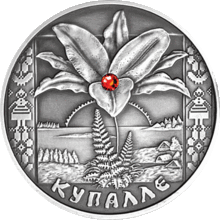
The fern flower is a mythical flower that reveals its owner treasures and secrets of the world, giving clairvoyance and power over an unclean spirit. According to Slavic beliefs, fern blooms only for a moment, on the night before Ivan Kupala (on June 24 [July 7] ); it is very difficult to pick a flower , all the more so because unclean power in every way prevents and intimidates a person, in some cases depriving reason, speech, memory.
Content
Belief
Tearing off the color of the fern and keeping it with it acquires unusual capabilities. He becomes perspicacious, can understand the language of animals , see all the treasures , no matter how deep they are in the ground, enter freely into treasures, put a flower on locks and castles - they will crumble in front of him, possess unclean spirits, command the earth and water, become invisible and take any form [1] [2] .
According to legend, at midnight from a fern bush, a flower bud is shown. It either moves forward and backward, then sways like a river wave, then jumps like a living bird. All this comes from the fact that the evil spirits are trying to hide an expensive color from the human eye. Then, every minute increasing and growing up, it blooms like hot coal. Finally, at exactly 12 o’clock, the color unfolds with a bang, like a lightning-bulb, and with its flame illuminates near itself and in the distance ” [1] .
To pluck a fern, on the night of Ivan Kupala, spread a sacred tablecloth (used in Bright Week ) near the plant, draw a circle around it with a consecrated knife, read the plot and wait until midnight. Wickedness tries to distract the hunter for the fern flower: it makes noise, calls in the voice of a loved one, calls out. If you respond to a voice or turn to a ghost, you can lose your life. An evil spirit tears its head instead of a fern and sends the soul to hell for torment because it dared to steal the flower that makes up the ornament of hell. Having plucked a flower, you need to hide it in your bosom and run without looking back (according to another belief, you need to carefully put it on your open palm and carry it home without looking back) [1] [2] .
Belorussian traditions
According to Belarussian belief, on a Kupala night it was necessary to go out into the forest alone, without a torch, without a flashlight (according to some legends, even barefoot or even without clothes). It was necessary to go into such forest jungle, from which even roosters or dogs from his native village were not heard. Fern flower is said to sparkle in the dark. It was necessary to injure a palm, squeeze a flower in this palm and go home. Unclean power will make noise, roar, frighten, but do not look back. Having received a fern flower, a person will acquire the ability to see that which is invisible to others, will become wise.
It happened that a cross was drawn over a flower, which denoted a secret treasure, and below - a rooster, which symbolized the north.
Carpathian counterpart
In the Carpathians, there was a similar legend about the red flower of the rue , which usually blooms in yellow. This legend is sung in the song Chervona Ruta . According to one version of the red root, the rue is an ordinary plant of fragrant rue , the yellow flowers of which miraculously turned red [3] . As if this happens once a year [* 1] - on the night of Ivan Kupala , and for a very short time. That girl who has time to pluck the red color of the rue before it turns yellow again will be able to “bewitch” any guy for life.
Fern flowering
From a botanical point of view, a fern never blooms - it reproduces by spores .
A. B. Strakhov compared the beliefs about the fern flower with European folk legends about the flowering and fruiting of trees on Christmas night . He came to the conclusion that all such representations have no “pagan” background and represent a popular rethinking of the biblical comparison of the Virgin (conceived and given birth, remaining a virgin) with the blossomed rod of Aaron [5] .
Stamp of Ukraine with the legendary fern flower. 1997 year.
Blossomed Aaron's Wand. German miniature, XV century.
A “fertile leaf” similar to a fern flower, but is not.
In the literature
Fern flower is found in folk tales, legends and songs.
A number of writers and poets turned to the legend: Nikolai Vasilievich Gogol (the novel “ An Evening Before Ivan Kupala ”), Jozef Krashevsky (“Fern Flower”), Vincent Dunin-Martsinkevich , Yanka Kupala (“On the Kupala Night”, “Kurgan”), Yakub Kolas (“The Night When the Fern Blossoms”), Mikhas Charot (“On the Kupala”), Frantisek Alekhnovich (children's play “Flower of the Fern”, 1916), Constance Builo (“Flower of the Fern”), Vladimir Korotkevich (“That Night” , the play “The Cradle of Four Sorceresses”).
See also
- Ivanovo herbs
- Loafer
- Ivan da Maria
- Grass key
- Sleep grass (Backache open)
- Plakun-grass (Loosestrife loosestrife)
- Mermaid Flower (Water Lily)
- The Virgin's Dream (Forest Anemone)
- Tirlich grass (gentian cross-shaped)
- Svetoyansk Potion (Hypericum perforatum)
- Blue Rose
- Pteridophyllum
Notes
Comments
- ↑ According to other sources - once every 10 years [4] .
Footnotes
- ↑ 1 2 3 Sakharov I.P. Tales of the Russian people. People's diary. Holidays and customs . - SPb. : Publishing House of Moscow State University, 1885. - S. 90-92. - 245 s.
- ↑ 1 2 Tereshchenko A.V. Life of the Russian people: fun, games, round dances . - ed. 1847-1848. - M .: Russian book, 1999 .-- 336 p. - ISBN 5-268-01383-1 .
- ↑ F. I. Razzakov Sofia Rotaru ..., 2012 : “... In Transcarpathia there is such a legend: a yellow flower of the root grows in the mountains, which only once a year, on a holiday, on the night of Ivan Kupala ... [and on to the end of the paragraph] ".
- ↑ Holonist user magazine, 2016 : "... But the red root ... is considered ... a mysterious flower that blooms only once every ten years, and not once a year, like a fern."
- ↑ A. Strakhov. The Night Before Christmas: Popular Christianity and Christmas Rituals in the West and among the Slavs. Cambridge-Mass., 2003.S. 5 et seq.
Literature
- Sakharov I.P. Tales of the Russian people. People's diary. Holidays and customs . - SPb. : Publishing House of Moscow State University, 1885. - 245 p.
- Tereshchenko A.V. Genesis of the Russian people: fun, games, round dances . - M .: Russian book, 1999 .-- 336 p. - ISBN 5-268-01383-1 . (according to the ed. 1847-1848).
- Razzakov, Fedor Ibatovich. The legend of the red root : passage // Sophia Rotaru and its millions [Text]: biogr. / F.I. Razzakov. - M .: Algorithm, 2012. - 379, [4] p., [8] p. silt : portr. - (Legends of the author's song). - ISBN 978-5-4438-0159-9 .
- Miracle Plants: Some Slavic Parallels , 2014
- Chervona Ruta [Electronic resource]: [ arch. November 28, 2017 ]: p. blog // Holonist user log : blog. - Holon, Israel: LiveJournal, 2016 .-- September 5.