Arkady Nikolaevich Yermakov ( September 22, 1899 - October 25, 1957 ) - Soviet military leader, lieutenant-general ( 1944 ). Member of the civil war , the Polish campaign of the Red Army , the Soviet-Finnish and World War II.
| Arkady Nikolaevich Ermakov | ||||||||||||||
|---|---|---|---|---|---|---|---|---|---|---|---|---|---|---|
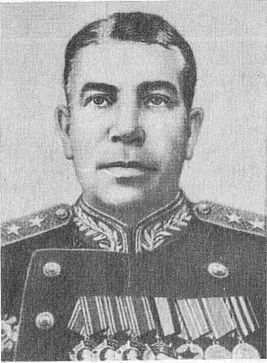 | ||||||||||||||
| Date of Birth | ||||||||||||||
| Place of Birth | ||||||||||||||
| Date of death | ||||||||||||||
| Place of death | ||||||||||||||
| Affiliation |  the USSR the USSR | |||||||||||||
| Type of army | infantry | |||||||||||||
| Years of service | 1918 - 1957 | |||||||||||||
| Rank |  | |||||||||||||
| Commanded | 100th Infantry Division , 2nd Rifle Corps , 50th Army 60th infantry corps 23rd Guards Rifle Corps , 36th Guards Rifle Corps , 2nd Guards Rifle Corps | |||||||||||||
| Battles / Wars | Russian Civil War , Polish campaign of the Red Army , Soviet-Finnish War (1939-1940) , The Great Patriotic War | |||||||||||||
| Awards and prizes |
Foreign awards:
| |||||||||||||


Content
Biography
Born on September 22 (according to other sources [1] - September 10) in 1899 in Mtsensk, Oryol Province [2] .
Civil war and interwar period
In the Red Army since August 1918 . During the Civil War, A. N. Yermakov was a Red Army 2nd Orlovsky regiment [1] , a Red Army retinue of the Warsaw consolidated regiment, a Red Army reserve battalion in the Oryol Military District, from January 1919 - a separate battalion in the 2nd 2nd Infantry Division , from August 1919 1919 - machine gunner of the 49th Orenburg rifle division, from December 1919 - commander of the 4th rifle division . He fought on the Eastern and Southern fronts, participated in the suppression of the rebels in the Voronezh province , the Soviet-Georgian war of 1921 . In 1920 he graduated from the 2nd Volya machine-gun command courses [2] .
In the interwar period, A. N. Yermakov continued to serve in the army. From 1920 - commander of a rifle platoon of the 277th rifle regiment of the 31st rifle division, from 1921 - assistant commander of a machine-gun company of the 192nd rifle regiment of the 22nd rifle division, from the same year - commander of a machine-gun company of the 39th rifle regiment 13 Infantry Division. In 1924 he graduated from the Kiev Infantry School .
From September 1924, he served in the 135th rifle regiment of the 45th rifle division: the commander of a training platoon, from October 1925 - the commander of a machine-gun company, from October 1929 - the commander of a training company. In 1931, he graduated from the Shooting and Tactical courses for improving the commanders of the Red Army "The Shot" named after the Comintern , in 1932 - for armored courses for improving the command staff, in 1937 - for improving the senior commanders at the Military Academy of Mechanization and Motorization of the Red Army [2] .
From October 1931 - commander of a rifle battalion of the 135th rifle regiment, from September 1932 - commander of a separate motorized rifle battalion of the 135th rifle brigade, from March 1933 - commander of a training battalion there.
Participation in the hostilities of 1939-1940
From November 1936 - Commander of the 299th Infantry Regiment as part of the 100th Infantry Division . Since June 1938 - the commander of this division. In September 1939, the division took part in the hostilities in Western Belarus as part of the 16th Infantry Corps of the 11th Army of the Belarusian Front 100th Infantry Division . Club "Memory" of Voronezh State University. The appeal date is September 23, 2014 ..
From December 16, 1939, the 100th Infantry Division participated in the Soviet-Finnish war . During the December operation to break through the Mannerheim Line, the division was in reserve of the 7th Army . In February 1940 - acted on the direction of the main attack as part of the 50th Rifle Corps in the area of the Summa-Khotynen fortified area , located between Lake Summajärvi (Lake Zhelannoe) and the Summayoki River ( Kamyshovka River) [3] . In March 1940, as part of the troops of the 34th rifle corps, advancing north-east of the city of Vyborg in the direction of Koivikkhovi, Tammysuo , Sementtivalimo, the Häyryu manor.
He commanded the 100th Infantry Division during the accession of Bessarabia and Northern Bukovina to the USSR . From July 29, 1940 - commander of the 2nd rifle corps as part of the Baltic Special Military District , then the Western Special Military District [2] .
Initial period of World War II
From the beginning of World War II, the corps was in the reserve of the Western Front , then it became part of the 13th Army of this front. At the end of June 1941, corps units under the command of A. N. Yermakov together with the 44th rifle corps of the army were advanced to the line of the Minsk fortified area , where they fought hard with the 3rd tank group of German troops during the Belostok-Minsk battle . Under the blows of superior enemy forces, part of the corps first moved to the Berezina River in the area of the city of Borisov and to the south, then to the Dnieper River and entrenched at the Kopyev and New Bykhov [2] .
From July 10, A. N. Yermakov commanded the actions of the 2nd Rifle Corps in the Battle of Smolensk . From July 24, as part of the 13th Army, it was included in the Central , and from August 15 - the Bryansk Front, which included defensive battles on the Sozh , Sudost and Desna rivers [2] . On August 20, 1941, the 2nd Rifle Corps was disbanded.
Oryol-Bryansk and Tula defensive operations
On August 16, 1941, the Bryansk Front was formed and at the same time Major General A. N. Ermakov was appointed Deputy Commander of the Bryansk Front and at the same time Commander of the Mobile Front Group ( 108th Panzer Division , 141st Panzer Brigade , 4th Cavalry Division ). At the beginning of the Roslavl-Novozybkov operation, this group of troops inflicted a counterattack on tank units of the 2nd tank army (G. Guderian), preventing the defeat and unorganized withdrawal of the 13th army , which allowed it to group forces and again take part in battles [1] [ 2] .
In September-October, A. N. Yermakov commanded the operational group of troops of the Bryansk Front ( 21st and 52nd cavalry divisions, the 121st and 150th tank brigades, and the 283rd infantry division ; later the 127th (from September 18 - the 2nd Guards) and the 160th rifle divisions). The group of General Yermakov reflected the strikes of the superior forces of the 2nd Tank Army of the enemy in the Lgov-Glukhov direction [1] [2] . According to the memoirs of the former commander of the Bryansk front of Marshal of the Soviet Union A. I. Eremenko : “In extremely difficult conditions, showing a lot of initiative and perseverance, General Yermakov proved himself a gifted commander and a man of great personal courage” [4] .
On October 13, 1941, Major General A. N. Yermakov was appointed commander of the 50th Army of the Western Front, the remnants of which left the encirclement during the unsuccessful Oryol-Bryansk operation for the Soviet troops. He commanded the actions of the army in the Tula defensive operation . The 2nd Panzer Army of the German troops, which was delayed in the region of Mtsensk for one week in early October, resumed the offensive in order to capture the city of Tula and bypass Moscow from the southeast [2] .
The 50th Army was entrusted with the defense of the approaches to Tula. Under the pressure of superior enemy forces, its small forces were forced to retreat in the northeast direction to Tula. October 29, 1941 A.N. Ermakov created the Southern combat section of the city of Tula, headed by Major I.Ya. Kravchenko [5] . On October 30, the advance units of the German 2nd Tank Army approached Tula, but they could not break into the city immediately. New attempts by the enemy in early November to seize Tula with a frontal blow, as well as bypass it from the north, were repelled by Soviet troops with the active participation of parts of the Tula garrison and the Tula working regiment [1] .
By the end of November 18, German troops, with the support of aviation, broke through the defense of the army in the Dedilov direction and began to develop an offensive against the cities of Stalinogorsk and Venev . In order to delay the advancement of the enemy, A.N. Yermakov strengthened anti-tank defenses in this direction with the help of anti-tank artillery and tank ambushes . However, the enemy’s tank formations managed to break through on November 22 to the city of Stalinogorsk , which created a threat of Moscow’s coverage from the southeast. On the same day, by the order of the commander of the Western Front, G. K. Zhukov, A. N. Yermakov was dismissed from his post, and on December 19, he was arrested and put on trial by a military tribunal. For “unauthorized retreat from orders given to him to fight contrary to military orders,” for not accepting orders from the command to suspend the enemy’s offensive, as a result of which, on November 22, 1941, the fascist German troops occupied Stalinogorsk [6] , was convicted on January 29, 1942 by the verdict of the Military Collegium of the Supreme Court of the USSR for five years of imprisonment in forced labor camps , he was deprived of his general rank and awards [1] [2] .
Further Battle Path
However, on the same day, on January 29, 1942, the Presidium of the Supreme Soviet of the USSR , by way of pardon, freed him from serving his sentence, restored the title and awards [1] . From February 1942 - at the disposal of the General Directorate of Personnel of NGOs, from March - at the disposal of the Commander-in-Chief by the troops of the Western strategic direction [2] .
In June 1942, he was appointed deputy commander of the 20th Army of the Western Front, who took part in the defense of the Rzhev-Vyazma bridgehead and in the Rzhev-Vyazma offensive operation . From March 20 to August 20 and from September 9 to September 15, 1943 - Commander of the 20th Army, which was withdrawn into the 2nd echelon of the Western Front and defended the line south-west of the city of Vyazma .
From September 18, 1943 - commander of the 60th rifle corps as part of the 4th Shock Army of the Kalininsky (from October 20, 1943 - 1st Baltic ) front. The corps under the command of A. N. Yermakov participated in the Nevelsk and Gorodok offensive operations. In the course of the latter, the corps attacked the direction of the main attack of the army and played an important role in breaking through the enemy’s main line of defense, surrounded and defeating his grouping of troops in the town projection.
From April 7, 1944 - Commander of the 23rd Guards Rifle Corps , which was part of the 6th Guards , 51st , 22nd , 42nd , 1st shock , 67th armies of the 1st, 2nd Baltic, Leningrad fronts. Corps units under the command of A. N. Yermakov took part in the Belarusian , Vitebsk-Orsha , Polotsk , Siauliai , Baltic , Riga , Memel offensive operations, the liberation of the city of Polotsk and other settlements. Subsequently, the corps carried out the tasks of dismembering and destroying the Courland grouping of the German fascist troops.
For valor, courage and heroism shown in offensive battles to break through the enemy defense and force the Zapadnaya Dvina river, Commissar Yermakov, on July 3, 1944, was presented to the rank of Hero of the Soviet Union by the commander of the 6th Guards Army [7] [8 ] , however, the upper management lowered the status of the award to the Order of Lenin which Yermakov was awarded by the Decree of the Presidium of the Supreme Soviet of the USSR of July 22, 1944.
Post-war years
After the war, A. N. Yermakov continued to command the 23rd Guards Rifle Corps, and from May 1948, he commanded the 36th Guards Rifle Corps of the Leningrad and Baltic Military Districts. In 1950 he graduated from the Higher Academic Courses at the Higher Military Academy named after KE Voroshilov , from June 1950 he commanded the 2nd Guards Rifle Corps ( 1950-1953 ). From July 1953 he was the senior military adviser to the commander of the East China Military District of the People’s Liberation Army of China ( 1953-1957 ). From April 1957 - at the disposal of the Commander-in-Chief of the Land Forces of the USSR.
He died on October 25, 1957 in Moscow , and was buried in the Novodevichy cemetery of the city [1] .
Rehabilitation
In 2007, after examining archive documents, the head of the cycle of the Tula training center of the Internal Affairs Directorate, police lieutenant colonel Yu. V. Aparin, showed that Stalinogorsk defended until November 25, 1941, and succeeded in terminating the criminal case for lack of corpus delicti and posthumous rehabilitation A. N. Ermakova [9] [10] .
Military ranks
- major (1935)
- Colonel (08/16/1938)
- brigade commander (02/10/1939)
- Major General (04/04/1940)
- lieutenant general (02.22.1944)
Awards
- Three Orders of Lenin (21.03.1940, 07.22.1944, 02.21.1945 [11] )
- Two Orders of the Red Banner (11/03/1944 [11] , 06/20/1949 [11] )
- Order of Kutuzov II degree (06/18/1944)
- medals [12] .
Notes
- ↑ 1 2 3 4 5 6 7 8 Bot V.I. Ermakov Arkady Nikolaevich . Tula Regional Universal Scientific Library. Date of appeal is September 23, 2014. (unavailable link)
- ↑ 1 2 3 4 5 6 7 8 9 10 11 Commanders, 2005 .
- ↑ List of Fortified Mannerheim Line. Archived copy of August 5, 2010 on Wayback Machine
- ↑ Eremenko A. I. At the beginning of the war. - M. , 1965. - p. 320.
- А. A.N. Lepyokhin. Unknown Tula defense hero. Site "Tula of the past century." 04/22/2011.
- ↑ Shaboltanov, I. A. The rehabilitation of victims of political repression continues. // "Russian Military Review." 2017. № 11 (203). - p.64.
- ↑ OBD “People's feat” - Award list1.1 by A. N. Ermakova
- ↑ OBD “People's feat” - Award sheet 1.2 for A. N. Ermakova
- ↑ GTRK "Tula" / Tula defense participant, Major General Yermakov, has been rehabilitated
- В. Zvyagintsev V. The war on the scales of Themis. The war of 1941-1945. in the materials of investigative cases. Book 1. - 2018. https://books.google.ru/books?id=XhvJDgAAQBAJ&pg=PT261&lpg=PT261&dq=ermakov+aparin&source=bl&ots=vVjMHrSlWr&sig=aY98DwZt2K6qAiyfoLLPfXMRHU8&hl=ru&sa=X&ved=2ahUKEwj_7bTDzMraAhWoDpoKHcUKAnwQ6AEwEXoECAcQAQ#v=onepage&q=ermakov%20aparin&f= false
- ↑ 1 2 3 Awarded in accordance with the Decree of the Presidium of the Supreme Soviet of the USSR of 04.06.1944 “On awarding orders and medals for long service in the Red Army”
- ↑ Award sheet . Feat of the people . The appeal date is January 9, 2014.


Literature
- The team of authors . The Great Patriotic War. Commanders. Military biographical dictionary / Under the general ed. M. G. Vozhakina . - M. Zhukovsky: Kuchkovo Pole, 2005. — pp. 70-72. - ISBN 5-86090-113-5 .
- Yermakov Arkady Nikolaevich (1899-1957) // Great Patriotic War 1941-1945: Encyclopedia - M. , 1985. - P. 260.
- Arkady Nikolayevich Ermakov // Who was Who in the Great Patriotic War of 1941-1945: A quick reference. - M. , 1995. - p. 93.
- I am writing solely from memory ... The commanders of the Red Army about the catastrophe of the first days of the Great Patriotic War: 2 tons. Volume 1. / Comp., Ed. Preface., Comments. and biogr. essays S. L. Chekunov. - M .: Russian Foundation for the Promotion of Education and Science, 2017. - 560 pp., Ill. - ISBN 978-5-91244-208-7 , 978-5-91244-209-4 (t. 1). - С.370-375 (the edition contains an excerpt from his track record and a brief description of the effect of his corps in the first days of the Great Patriotic War).
- Ermakov Arkady Nikolayevich // Tula Biographical Dictionary. - Tula, 1996. - V. 1. - p. 201-202.
- Makashov A.I. In the center of Russia. - Orel: OGTK Publishing House, 1994. - 456 p. - p. 352-353.
- Mikheenkov S. E. Stop Guderian. The 50th Army in the battles for Tula and Kaluga. 1941-1942. - M .: Tsentrpoligraf, 2013. ISBN 978-5-227-04417-4
- Hams Alexander. Secret War of the USSR. The most complete encyclopedia. - Moscow: Yauza, Eksmo, 2015. - ISBN 978-5-699-67679-8 . - P.711.
- Polozov E.M., Nemova S.N. General A.N. Ermakov. - Tula: Grif and K, 2013. - 64 p.
- Plotnikov A.P. Commander of the 50th Arkady Nikolayevich Ermakov. Materials of local history readings: To the 75th anniversary of the Tula region. local history museum. - Tula, 1995. - p. 65-68.
- Danilov M. General Yermakov // Communard. - 1991. - 21 December.
- Plotnikov A. For what the commander was arrested // Tula news. - 1994. - July 12th.
- Bot I.I. The General was brave and persistent: On the 100th anniversary of A. N. Ermakov // Tula news. - 1999. - September 11 Commander of the 50th Army in the days of the defense of Tula in 1941
Links
- Ermakov Arkady Nikolaevich . The Memory Club of the Voronezh State University (June 4, 2008). The appeal date is September 23, 2014.
- Ermakov Arkady Nikolayevich on the website of the Ministry of Defense of the Russian Federation