The Icelandic crown ( Isl. Íslensk króna ) is the monetary unit of Iceland . Introduced in 1885 .
| Icelandic Krona (Russian) | |||||
|---|---|---|---|---|---|
Íslensk króna (Iceland) | |||||
| |||||
| Codes and Symbols | |||||
| ISO 4217 Codes | ISK (352) | ||||
| Abbreviations | kr | ||||
| Territory of circulation | |||||
| Issuing country |  Iceland Iceland | ||||
| Derivative and parallel units | |||||
| Fractional | air (until 2003) ( 1 ⁄ 100 ) | ||||
| Coins and banknotes in circulation | |||||
| Coins | 1, 5, 10, 50 and 100 kroons | ||||
| Banknotes | 500, 1000, 2000, 5000 and 10 000 kroons | ||||
| Currency history | |||||
| Introduced | 1874 year | ||||
| Chronicle | Krona (old) (ISJ [a 1] ) Icelandic Krona (ISK) | ||||
| Issue and production of coins and banknotes | |||||
| Emission Center (Regulator) | Central Bank of Iceland | ||||
| www.sedlabanki.is | |||||
| Courses on October 15, 2019 | |||||
| 1 RUB | = 1,955 ISK | ||||
| 1 USD | = 125.6 ISK | ||||
| 1 EUR | = 138.3 ISK | ||||
| 1 GBP | = 158.9 ISK | ||||
| 1 JPY | = 1.16 ISK | ||||
| 2019 inflation | |||||
| Inflation | 3% (September) | ||||
| |||||
 Wikimedia Commons Media Files Wikimedia Commons Media Files | |||||

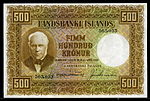
Initially, the krone consisted of 100 Eyre ( Isl. Eyrir , plural Isl. Aurar ), but since January 1, 1995, Eyre has not been used in cash. From January 1, 1999, in accordance with Law No. 36 of April 27, 1998, when calculating the amount should be rounded to 50 air [1] . In September 2002, a law was passed on the abolition of the division of kroons into exchange units from October 1, 2003. There is currently no official currency unit in Iceland.
Content
- 1 Coins
- 2 Banknotes
- 3 The crisis of 2008 and the planned transition to the euro
- 4 Exchange Rate Mode
- 5 notes
- 6 References
Coins
Coin minting in crowns started in 1925. Initially, the monogram of King Christian X was placed on all coins. In 1944, Iceland was proclaimed a republic; in 1946, coinage began without royal symbols.
On January 1, 1981, the Icelandic krona was denominated 100: 1 and coins of a new type were issued. Coins of the 1981 model in Eyre were made of brass , in crowns - of a copper-nickel alloy.
Icelandic coins were minted by the Royal Danish Mint , the Royal Mint of Great Britain and a private mint in Birmingham .
| Coins in circulation | ||||||||
|---|---|---|---|---|---|---|---|---|
| Picture | Face value (crowns) | Diameter (mm) | Thickness (mm) | Weight (g) | Material | Description | ||
| [one] | one | 21.50 | 1.66 | 4,50 | copper + nickel | Reverse : face value, Atlantic cod . Years of production : 1981 1984 1987 | ||
| [2] | 4.00 | steel , plaque . nickel | Years of production : 1989 1991 1992 1994 1996 1999 2000 2003 2005 2006 2007 2011 | |||||
| [3] | 5 | 24.50 | n / a | 6.50 | copper + nickel | Reverse : face value, dolphins-white-barrels . Years of production : 1981 1984 1987 1992 | ||
| [four] | steel, plaque. nickel | Years of production : 1996 1999 2000 2005 2006 2007 2008 | ||||||
| [5] | 10 | 27,50 | 1.78 | 8.00 | copper + nickel | Reverse : face value, capelin . Years of production : 1984 1987 1994 | ||
| [6] | 7.00 | steel, plaque. nickel | Years of production : 1996 2000 2004 2005 2006 2008 | |||||
| [7] | fifty | 23.00 | 2.60 | 8.25 | bronze | Reverse : face value, Carcinus maenas . Years of production : 1987 1992 2000 2001 2005 | ||
| [8] | one hundred | 25,50 | 2.25 | 8.50 | Reverse : face value, pinagor . Years of production : 1995 2000 2001 2004 2006 2007 2007 | |||
Banknotes
Issue of Icelandic banknotes started on the basis of the law of September 18, 1885. The first issue of banknotes consisted of three denominations - 5, 10 and 50 kroons of the National Treasury of the sample of 1886. In 1904, the private Bank of Iceland began issuing banknotes, and in 1907, the state National Bank of Iceland. In 1927, the National Bank of Iceland received the exclusive right to issue banknotes.
In 1947, banknotes of a new type were issued, which in the period from December 31, 1947 to January 9, 1948 were exchanged banknotes of previous issues 1: 1.
In 1961, the Central Bank of Iceland was established. In 1963, the bank began issuing banknotes, which gradually replaced the circulation of banknotes of the National Bank.
On January 1, 1981, a denomination of 100: 1 was carried out, the exchange was made until June 30 of the same year. Banknotes of 1981 were issued in 10, 50, 100 and 500 kroons. In 1984, a banknote of 1,000 kroons was issued, in 1986 - 5,000 kroons, in 1995 - 2,000 kroons, in 2013 - 10,000 kroons.
Banknotes in denominations of 10, 50 and 100 kroons are withdrawn from circulation.
| Picture | Face value (crowns) | Dimensions (mm) | The main colors | Description | Year indicated on banknotes |
|---|---|---|---|---|---|
| Obverse : Arngrimur Jounsson Reverse : old everyday scenes in Iceland based on a painting by August Meyer | |||||
| Obverse : Goodbrandur Thorlaxsson Reverse : printing the Bible in a printing house | |||||
| Obverse : Arnie Magnusson Reverse : scientist at work | |||||
| Obverse : Yone Sigurdsson Reverse : Joun Sigurdsson and the Icelandic tapestry - Reykjavik gymnasium | 2001 | ||||
Orange | Obverse : Brignolfour Sveinsson Reverse : Skalholt Church | 2001 | |||
brown | Obverse : Johannes Kjarval Reverse : “Longing for Flights” and “Women and Flowers” - paintings by Johannes Cjarval | ||||
green | Obverse : Ragnheidur Jonesdottir Reverse : Ragnheidur Jonesdottir and two students make an Icelandic tapestry | ||||
blue | Obverse : Jonas Hallgrimsson Reverse : a golden plover with a chick, lines from the poet's poem |
The crisis of 2008 and the planned transition to the euro
The crisis in the fall of 2008 led to the depreciation of the Icelandic krona by 53% against the US dollar [2] . In January 2009, a representative of the Icelandic Government stated:
Crohn is dead. We need a new currency. The only serious alternative is the euro . [3]
In March 2009, the report of the Minister of Foreign Affairs of Iceland, Ossur Skarfedinsson, indicated three possibilities: leave the crown, introduce the euro without joining the EU and introduce the euro by joining the EU. The third option was recommended in the report [4] . Iceland began EU accession negotiations [5] . Negotiations began in 2010, but already in 2013 they were suspended. In February 2014, the Icelandic parliament supported the initiative of the Minister of Foreign Affairs for the final refusal to join the European Union. On March 12, 2015, the Ministry of Foreign Affairs of Iceland announced the withdrawal of the application for accession to the European Union [6] .
Exchange Rate Mode
| Market rate | ||||||||
|---|---|---|---|---|---|---|---|---|
| ||||||||
Notes
- ↑ See http://www.althingi.is/altext/stjt/1998.036.html
- ↑ “The global crisis knocked out the economy of Iceland”
- ↑ Iceland to be fast-tracked into the EU , the Guardian
- ↑ “Could EU Application Save Billions for Iceland?” , Iceland Review Online , March 27, 2009
- ↑ “The EU is waiting for replenishment”
- ↑ Iceland officially refused to join the EU . Date of treatment July 11, 2016.