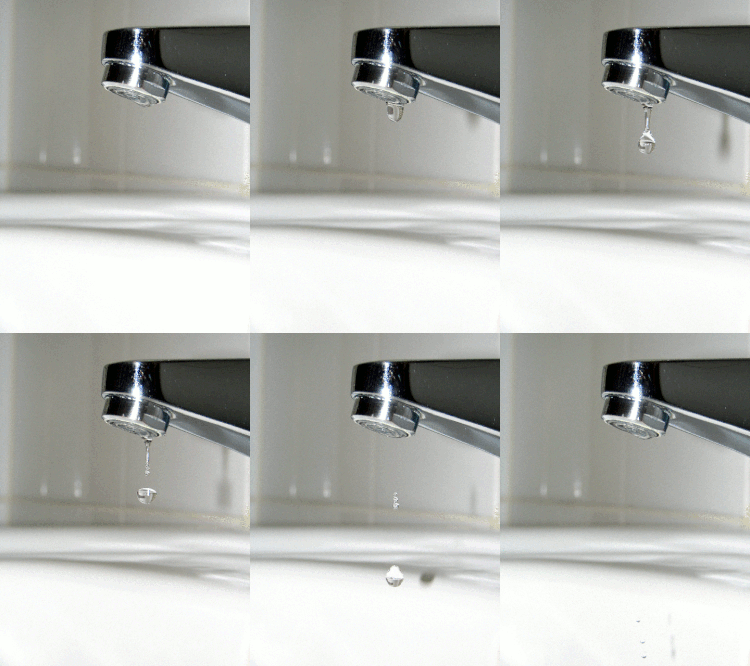

Drop - a relatively small volume of liquid , limited by the surface, determined mainly by the action of surface tension forces , and not external forces.
Drops are formed:
- when liquid drains from the edge of the surface or from small holes
- during condensation of ( water ) steam :
- on a solid non-wettable surface: for example, dew - when condensing on surfaces
- at condensation centers: for example, fogs and clouds - during condensation on dust particles of air
- when spraying liquid (see Aerosol )
- upon emulsification

The shape of the drop is determined by the combined effect of surface tension and external forces of gravity and aerodynamic forces . Under natural conditions, for droplets of a small size (1 mm or less), the surface tension force is predominant, which makes such a drop all the more close to spherical, the smaller the drop. With an increase in droplet size, the influence of surface tension weakens for obvious geometric reasons, and gravity grows cubically, which increases the steady-state fall rate and the acting aerodynamic forces. At the lower side of the falling raindrop 2-3 mm in size, an area of increased air pressure is formed, at the upper side, a less pronounced area of reduced pressure. Such a drop takes the form flattened from below. Drops 3-4 mm in size in the lower part are flat or concave, larger droplets are destroyed.
The shape and size of the droplet coming off from the end of the capillary tube depends on the diameter of the tube, surface tension and fluid density. This dependence underlies the methods for determining the surface tension of liquids by the mass of droplets detaching from a vertical cylindrical tube and by the shape of the droplet hanging at the end of the tube.
Volume Unit
It is used as a unit of measurement for the volume of medicines in the form of drops. For example, nose drops
The average drop size is:
- water or aqueous solution: 0.03 - 0.05 ml
- alcohol or alcohol solution: 0.02 ml
The pharmaceutical measure of a drop is considered to be:
- for aqueous solutions - 0.05 ml, so 20 drops have 1 ml.
- for alcohol solutions - 0.025 ml, so 20 drops have 0.5 ml.
Physics
We consider a vapor-gas medium in which a first- order phase transition occurs: vapor-liquid. Here, the drop is the irreversibly growing nuclei of the liquid phase, consisting of a number of molecules where runs through values from 1 to . Liquid droplets are macroscopic particles of a new stable phase in the initial metastable phase. When the germ is a single vapor molecule, if the germ is a drop of liquid.
It is often assumed that changes in the number of new phase nucleus molecules (liquid) occur by absorption or emission of a single vapor molecule. Drop is characterized chemical potential of molecules - chemical potential of condensate molecules in a macroscopic liquid phase (in a drop) radius.
See also
- Wetting
- Nucleation
- Drop Formation Work
Literature
- The many faces of the planet: Water. Beech house. 2005, 296 pp., ISBN 5-98641-008-4 .