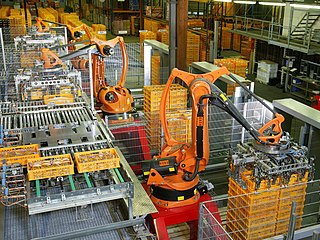
Automation of production is a process in the development of machine production, in which management and control functions, previously performed by man, are transferred to instruments and automatic devices [1] . The introduction of automation in production can significantly increase labor productivity, ensure a stable quality of products, and reduce the proportion of workers employed in various areas of production.
Before the introduction of automation tools, the substitution of manual labor occurred through the mechanization of basic and auxiliary operations of the production process. Intellectual work for a long time remained not mechanized (manual). At present, the operations of physical and intellectual labor that can be formalized become the object of mechanization and automation. The concept of level (degree) of automation can be used as a characteristic of measurement.
Content
The history of the development of industrial automation
Self-acting devices — prototypes of modern automata — appeared in ancient times. However, in conditions of small-scale handicraft and semi-handicraft production up to the XVIII century. they did not receive practical application and, remaining entertaining "toys", testified only to the high art of the ancient masters. The improvement of tools and labor methods, the adaptation of machines and mechanisms for replacing people in production processes, was called up at the end of the 18th century. - early XIX century. a sharp jump in the level and scale of production, known as the industrial revolution of the XVIII — XIX centuries.
The industrial revolution created the necessary conditions for the mechanization of production, first of all, spinning, weaving, metal and woodworking. Marx saw in this process a fundamentally new direction of technical progress and suggested a transition from the use of individual machines to an “automatic machine system” in which conscious functions of management remain with a person: a person becomes next to the production process as his supervisor and regulator. The most important inventions of this period were the inventions of the Russian mechanic I. I. Polzunov of the automatic regulator of the steam boiler (1765) and the English inventor J. Watt of the centrifugal speed controller of the steam engine (1784), which later became the main source of mechanical energy for driving machines, machines and mechanisms .
Since the 60s of the XIX century, due to the rapid development of railways, the need to automate railway transport and, above all, the creation of automatic speed control devices to ensure the safety of trains has become obvious. In Russia, one of the first inventions in this direction was the automatic indicator of the speed of mechanical engineer S. Praus (1868) and a device for automatically recording the speed of a train, its arrival time, stopping time, departure time and location of a train, created by engineer V. Salman and mechanic O. Graftio (1878). The degree of distribution of automatic devices in the practice of railway transport is evidenced by the fact that on the Moscow-Brest railway already in 1892 there was a department of "mechanical control of trains".
The doctrine of automatic devices to the XIX century. closed in the framework of classical applied mechanics, which considered them as separate mechanisms. The fundamentals of the science of automatic control were essentially set forth for the first time in the article by the English physicist J. K. Maxwell “On regulation” (1868) and the work of the Russian scientist I. A. Vyshnegradsky “On direct-action regulators” (1877), in which the regulator and The machine was considered as a single system. A. Stodola , Ya. I. Grdin and N. E. Zhukovsky , developing these works, gave a systematic presentation of the theory of automatic control.
With the advent of mechanical sources of electrical energy — electric machine generators of direct and alternating current (dynamos, alternators) —and electric motors , centralized power generation, its transmission over considerable distances and differentiated use at the places of consumption were possible. At the same time, the need arose for automatic voltage stabilization of generators, without which their industrial application was limited.
Only after the invention of voltage regulators since the beginning of the 20th century did electricity begin to be used to drive production equipment. Along with steam engines, the energy of which was distributed by transmission shafts and belt drives , the electric drive gradually spread, first replacing the steam engines for rotating transmissions , and then began to equip with individual electric motors.
The transition from a central transmission drive to an individual one in the 20s of the 20th century greatly expanded the possibilities of improving the machining technology and increasing the economic effect. The simplicity and reliability of the individual electric drive made it possible to mechanize not only the energy of the machines, but also their control. On this basis, various automatic machines, multi-position aggregate machines and automatic lines arose and developed. The widespread use of an automated electric drive in the 30s of the XX century not only contributed to the mechanization of many industries, but essentially marked the beginning of modern automation of production. At the same time, the term "Production Automation" appeared.
In the USSR, the development of automated controls and regulation of production processes began simultaneously with the creation of heavy industry and mechanical engineering and was carried out in accordance with the decisions of the Communist Party and the Soviet Government on industrialization and mechanization of production. In 1930, on the initiative of G. M. Krzhizhanovskiy , the Automation Committee was organized at the Head Center of the Supreme Economic Council of the USSR for the management of automation in the energy sector. In the board of the All-Union Electrotechnical Association (VEO) in 1932 was created the Bureau of automation and mechanization of electrical plants. The use of automated equipment in the heavy, light and food industries began, transport automation was improved. In a special machine building along with individual machines, conveyors with forced rhythm of movement were put into operation. The All-Union Association of the Precise Industry (WATI) for the production and installation of control and regulation devices was organized.
Research laboratories of power engineering, metallurgy, chemistry, mechanical engineering, and public utilities created automation laboratories. Industry and All-Union meetings and conferences on the prospects for its use were held. A feasibility study began on the importance of industrial automation for the development of industry in various social conditions. In 1935, the Telemechanics and Automation Commission began to work in the Academy of Sciences of the USSR to summarize and coordinate research in this area. The publication of the journal "Automation and Remote Control" began.
In 1936, D.S. Harder (USA) defined automation as “automatic manipulation of parts between separate stages of the production process”. Apparently, at first, this term meant the binding of machines with automatic equipment for the transfer and preparation of materials. Later, Harder extended the meaning of this term to each operation of the production process.
High economic efficiency, technological feasibility and often operational necessity contributed to the wide spread of automation in industry, transport, communication technology, trade and various service industries. Its main prerequisites are: more efficient use of economic resources - energy, raw materials, equipment, labor, and capital investments. At the same time, the quality is improved, and the uniformity of products is ensured, the reliability of operation of installations and structures is increased.
The socialist state, considering the automation of production as one of the most powerful factors in the development of the national economy, implements it according to a single integrated plan, linked to the corresponding allocations and material and technical support.
In the course of the implementation of the first three five-year plans for the development of the national economy (1928–1941), the first factories were created that produced instruments and equipment for automation and telemechanics for the automation of production. During World War II, the automation of production was of paramount importance in the material and technical support of the front and in meeting the needs of the defense industry of the USSR. The first post-war plan for the restoration and development of the national economy (1946-1950) provided for further automation in the energy, chemical, petroleum and petrochemical industries, and the widespread introduction of an automated electric drive into production. The program for the further development of production automation in the period 1953-1958, adopted at the XIX Congress of the CPSU , provided, in particular, for the mechanization of work and the automation of production at the enterprises of the ferrous metallurgy, mining, mechanical engineering, as well as the full automation of hydropower plants.
Practically the 1950s were the period when the automation of production began to be introduced into all branches of the national economy of the USSR that have a significant share. In mechanical engineering — the production of tractors, automobiles, and agricultural machinery — automatic lines were commissioned; An automated factory for the production of pistons for automobile engines began operating. The transfer to the automatic control of the HPP units was completed, many of them were fully automated. Boiler shops were automated at a number of the largest thermal power plants.
In the metallurgical industry, about 95% of pig iron and 90% of steel were smelted in automated furnaces; The first automated rolling mills were commissioned. Automatic installations at oil refineries are launched. Implemented telemechanical control of gas pipelines. Automated many water systems. Automatic concrete plants began to operate. The light and food industry has become widely equipped with automatic and semi-automatic machines for packaging, metering and packaging of products and automatic lines for the production of products.
The park of automated equipment in 1953 increased 10 times (compared to 1940). In the metalworking industry appeared software-controlled machines. For the production of mass products were used rotary automatic lines. In explosive chemical production, telemechanical process control has become widespread.
Accepted Abbreviations
- AL - Automated line.
- ASIO - Automated tool providing system.
- AWP - Automated workplace.
- ASC - Automated control system.
- ASNI - Automated research system.
- ASTPP - Automated system of technological preparation of production.
- ACS - Automated control system.
- ASUP - Automated production management system.
- PCS - Automated process control system.
- ACC - Automated warehouse system.
- ATNS - Automated transport and storage system.
- ATSS - Automated transport and storage system.
- AESP - Automated energy production system.
- GAP - Flexible automated production.
- GAU - Flexible automated area.
- GAC - Flexible automated workshop.
- GPC - Flexible Pallet Container (FPS - Flexible Pallet Сontainer).
- PMG - Flexible Pallet Store (FPM - Flexible Pallet Magazin).
- FPS - Flexible Manufacturing System ( FMS - Flexible Manufacturing System ) (English) .
- GPNA - Flexible manufacturing cell.
- MUS - Multi-level System (MLS).
- PR - Industrial robot.
- RPM - Robotic Production Module (RPC - Robotic Production Cell).
- RTC - Robotic Technological Complex (RoboFMS - Robotic Flexible Manufacturing System).
- RTL - Robotic process line.
- MOUTH - Robotic technology site.
- RTYA - Robotic technology cell.
- RL - Rotary line.
- SAC - Automated control system.
- CAD - Computer Aided Design.
- SORO - System maintenance and repair of equipment.
- SPO - System software.
- TM - Technological machine.
- TR - Transport robot.
Production automation elements
Modern production systems that provide flexibility in automated production include [2] :
- CNC machines , first appeared on the market in 1955. Mass distribution began only with the use of microprocessors .
- Industrial robots , which first appeared in 1962. Mass distribution is associated with the development of microelectronics.
- The robotic technological complex (RTC) , first appeared on the market in 1970-80. Mass distribution began with the use of programmable control systems .
- Flexible production systems characterized by a combination of technological units and robots , computer-controlled , with equipment for moving workpieces and tool changes.
- Automated storage systems ( English Automated Storage and Retrieval Systems, AS / RS ). Provide for the use of computer-controlled lifting and transport devices, which put the product into the warehouse and retrieve them from there on command.
- Quality control systems based on computers (computer -aided quality control, CAQ ) are a technical application of computers and computer-controlled machines for testing the quality of products.
- Computer-aided design ( eng. Computer-aided Design, CAD ) is used by designers in the development of new products and technical and economic documentation.
- Planning and linking of individual elements of the plan using a computer ( English Computer-aided Planning, CAP ). САР — разделяется по различным характеристикам и назначениям , по состоянию примерно одинаковых элементов. Соединенная между собой отдельных элементов происходит по следующим правилам:
- Физическая однородность измеряемых величин
- Однотипные каналы связей между этими элементами
- Совместимость соединений элементов.
Принципы организации автоматизации
В основе организации производственного процесса на каждом предприятии и в любом его цехе лежит рациональное сочетание в пространстве и во времени всех основных, вспомогательных и обслуживающих процессов. Особенности и методы этих сочетаний различны в разных производственных условиях, однако есть и общие принципы [3] :
- специализации
- пропорциональности
- параллельности
- прямоточности
- минимума перерывов
- ритмичности
- замена в первую очередь неквалифицированного монотонного труда
- упрощение сложных производственных процессов заменой на множество простейших
Положение автоматизации производства в современной России
Несмотря на глобальную автоматизацию, в России главную работу продолжают выполнять люди, в тот момент, когда в других странах ее уже выполняют роботы. [four]
Сегодня России необходимы 350 тыс. промышленных роботов, чтобы суметь приблизиться к развитым странам по уровню автоматизации производственных процессов.
Положение автоматизации производства в мире
На сегодняшний день в Китае на 10000 рабочих, приходится 36 промышленных роботов. Это в 8 раз меньше, чем в Германии, в 9 — чем в Японии и в 13 раз меньше чем Южной Кореи. Но в нашей стране количество роботов на 10 000 человек в 20 раз меньше, чем в даже Китае. По этому показателю Россия сегодня находится ниже Таиланда, Индонезии, Мексики и Филиппин. К году своего столетнего юбилея, который случится в 2049 году, КНДР планирует догнать и перегнать в производственном плане Германию, США и Японию. А без роботов это невозможно. Автоматизация производства позволяет увеличить производительность более чем в три раза. Автоматизация, пожалуй, единственное и наилучшее решение в улучшении качества и решении вопроса о низкой производительности труда. [five]
Criticism
Многие люди сегодня негативно относятся к автоматизации производства и повышению производительности труда, поскольку в рамках денежной системы это приводит к « технологической безработице », потере покупательной способности и средств к существованию для множества людей, в то время как рабочий день оставшихся работников не сокращается, а ответственность повышается.
Ответ на критику
Комплексные решения социальных последствий автоматизации производства, проблем технологической безработицы и разумного применения достижений науки и технике на благо всего человечества с минимизацией нагрузки на окружающую среду и претворением в жизнь остальных принципов устойчивого развития , а также максимальной созидательной самореализации каждого человека на планете, были разработаны и в настоящее время активно распространяются международной образовательной организацией « Проект Венера ».
Notes
- ↑ Большая советская энциклопедия
- ↑ Хауштайн Х.-Д. Гибкая автоматизация — М.: Прогресс, 1990.
- ↑ Хлытчиев М. С. Основы автоматики и автоматизации производственных процессов. — М.: Радио и связь, 1985.
- ↑ Lyudmila Vitalevna Khlebenskikh, Marina Andreevna Zubkova, Tatyana Yurievna Saukova. Automation of production in the modern world // Young scientist. - 2017. - Vol. 150 . - p . 308–311 . - ISSN 2072-0297 .
- ↑ Lyudmila Vitalevna Khlebenskikh, Marina Andreevna Zubkova, Tatyana Yurievna Saukova. Automation of production in the modern world // Young scientist. - 2017. - Vol. 150 . - p . 308–311 . - ISSN 2072-0297 .
Links
- Industrial robots in modern manufacturing [1]