Pogona vitticeps (lat.) - Agamidae lizard. It got its name because of the characteristic neck bag, which at the moment of danger or marriage flirting inflates, acquiring a dark color. The color is dominated by yellowish, gray or brown tones. Color may vary depending on the temperature and condition of the animal. In adults, the pattern is practically absent, in young spots and stripes on the back and sides form the correct geometric patterns.
| Pogona vitticeps | |||||||||||||||||||||||||||||||||||||||||
 | |||||||||||||||||||||||||||||||||||||||||
| Scientific classification | |||||||||||||||||||||||||||||||||||||||||
|---|---|---|---|---|---|---|---|---|---|---|---|---|---|---|---|---|---|---|---|---|---|---|---|---|---|---|---|---|---|---|---|---|---|---|---|---|---|---|---|---|---|
| |||||||||||||||||||||||||||||||||||||||||
| International scientific name | |||||||||||||||||||||||||||||||||||||||||
Pogona vitticeps Ahl , 1926 | |||||||||||||||||||||||||||||||||||||||||
| Area | |||||||||||||||||||||||||||||||||||||||||
| |||||||||||||||||||||||||||||||||||||||||
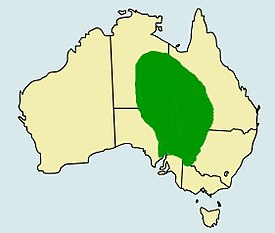
Distributed in Australia.
Content
Habitat
Australian semi-deserts, rare forests and rocky terrain . Inland: Queensland, New South Wales, northwestern Victoria, eastern half of South Australia, and southeast of Northern Territory, nowhere on the coast.
Appearance
The size of an adult can reach 50-60 centimeters. The body has a flattened ellipsoidal shape, the tail is one and a half times the length of the body. Due to the unusual structure of the scales, the bearded agama has an exotic and predatory appearance. Scales in the form of prickly spikes are located along the body of the lizard in rows, mainly on the sides, thereby increasing the visible size of the body. The head has a triangular shape and is framed by thorns, auditory holes are located on the sides. At the time of the threat, the lizard flattenes its body, inflates the "beard" and opens its mouth - this behavior visually increases the size of the agama and scares off enemies.
Biotope and lifestyle in nature
Arid desert and semi-desert biotopes, dry forests, rocky semi-deserts, arid scrubs (shrubbery). Leads a land and semi-wood lifestyle. Daily activity. Digs holes for shelters, uses holes of other animals, piles of stones, crevices at the roots of trees and bushes. In hot weather, it either hides in shelters, or can climb small trees and shrubs, where it hides in the relative ventilation zone. Agamas stick to their territorial plots.
Gender Differences
In males, the tail is noticeably thickened at the base. The throat (beard) of adult males in the "mating" period is dark blue or black, in females - orange or beige.
Nutrition
The bearded agama predominantly leads a predatory lifestyle. It feeds on insects. While the lizard is young, its diet includes 20% of plant foods and 80% of animals. When the agama becomes an adult, the diet gradually changes to the opposite ratio - 20% of the animal and 80% of the vegetable. Since agamas of this species live mainly in arid places, they get moisture through food and during dew. Also, during rain, a bearded agama tilts the body forward and drinks flowing water.
Breeding
Agamas become sexually mature at 2 years of age. Oviparous view.
After withdrawal from wintering, the agam is irradiated and fed, adding to the feed preparations containing vitamin E for 2-3 weeks. Males acquire a bright, “mating” color. Then the males and females are planted together if they were sitting separately. Males show a bright color of the throat, rising on their front legs and nodding their heads.
Females ready for mating demonstrate to males their agreement with various head movements and tail manipulations. After that, the males chase the females, overtaking, grab them with their teeth, hold and enter hemipenis. Copulations do not last long, up to 5 minutes. After mating, after 45-65 days, the females lay their eggs. To do this, they need to dig a hole at least 40 cm deep, so pregnant females should be placed in a special terrarium, in which they either create a layer of sand of a similar depth, moisturizing it from below, or attach a box to the bottom of the terrarium with a height of 40 cm and a length of about 30 cm wide, into which the entrance leads through a hole in the bottom of the terrarium, the box is filled with sand, a coconut substrate with vermiculite or a mixture of sand and vermiculite, also with lower moisture. The masonry is removed and placed in an incubator at a temperature of 27-29 ° С. The number of eggs in the clutch is from 9 to 25 pieces. After 65–90 days, and at a temperature in the incubator of 30–31 ° C, after 55–60 days, babies hatch from the eggs, which begin to feed after assimilation of the yolk reserve. The female lays for season 2, approximately equal, masonry.
It was known that the sex of these lizards is determined by chromosomes: ZW in females and ZZ in males, but the agama has a temperature dependence during the incubation period.
Temperature dependence:
22–32 ° C - both sexes.
32 ° C - all females.
Terrarium Content
Bearded agamies are kept in spacious horizontal terrariums with stones and strong branches, on which it is convenient for animals to climb. The minimum size of the terrarium for 1-2 individuals is 90 × 60 × 40 cm (excluding the height of the lamp). The temperature is maintained by means of a local downward heating (incandescent lamp, mirror lamp). It is advisable to place the terrarium at a considerable height from the floor, so that the animals feel relatively safe. Fine sand is used as soil (gravel, coconut, bark, and so on cannot be used, since the substrate can enter the lizard’s stomach with food, clogging it).
Agama water is obtained either from spraying the body once a day, or during short baths (at a temperature of 36-38 degrees Celsius) once or twice a week, or with succulent food. When molting is recommended to bathe more often.
Temperature during the day 25-30 ° C, under the heater (incandescent lamps) up to 42 °. Agam digestion begins at a temperature of 37 degrees. At night, the temperature is not higher than 27 degrees. Be sure to ultraviolet irradiation and calcium supplements. Humidity is low, as in nature agamas live in arid areas. Good ventilation is needed, but draft protection is required.
A lamp for spot heating and a UV lamp (ReptiGlo at least 10.0) are installed in the terrarium, which should be no further than 30 cm from the lizard. A snag, stones, branches, a shelf, a shelf are placed under the heating point so that the agamas can warm up well, choosing the temperature they need. Branches and snags are placed in a cold corner. You can not warm the agamas with thermal mats or thermal cords. Shelters are undesirable, since the agamas can get less UV. The walls of the terrarium are decorated with a backdrop made of figured material resembling rocks and allowing the agamas to climb along its surface (it is advisable not to use various types of polystyrene, since the agama can tear it off or bite it off). Plants or any ornaments that the agama may bite off cannot be placed in the terrarium (this threatens an intestinal obstruction). Young agam up to 6 months of age is recommended to be kept on napkins or plastic rugs.
Adult agamas can be kept in a group, but either only females, or a male and 2 females.
Seasonal and daily rhythm
The duration of daylight hours and daytime heating during the period of animal activity is 10-12 hours.
In the winter months, you can ensure a period of rest, under strict observance of the following conditions. Over the course of two weeks, daylight hours and the duration of the heating are gradually reduced, at 6 hours a day, lizards stop feeding and turn off the heating. Then, after a week, they are placed in a lightproof, ventilated cage filled with sawdust or well-pressed sphagnum. The temperature during wintering should be at the level of 15-18 ° С. Maintaining humidity: by spraying the soil in the corner of the cage once a week. From time to time they put a drinking bowl in a cage. Wintering duration up to 2 months, in the normal condition of the animal. Agamas are taken out of wintering in the same rhythm in which they were laid, gradually increasing light and heat day. At 6 hours a day, include heating and offer food. For immature young animals, wintering is not necessary, but desirable. Some terrarium practitioners change the seasonal rhythm of animals in the southern hemisphere to the seasonal rhythms of the northern hemisphere, but it should be remembered that such a replacement is possible only for animals that have undergone a long adaptation, have lived in captivity for several years or were born and raised (especially, having replaced more than one generation) in terrarium conditions.
Feeding
In nature, they feed on various invertebrates and small vertebrates, leaves and juicy shoots of plants, flowers and soft fruits. In terrarium conditions, agamus are fed with crickets (brownies, bananas, etc.), cockroaches, as well as flour worms, zofobas, and other insects. In adults, agam is fed twice a week with animal food, and the plant is placed in the terrarium every day. Young agamas are fed 2-3 times a day, it is desirable to select insects no larger than the distance between the eyes of the agama. It is not recommended to leave animal food in the terrarium at night, as some types of insects can bite the agama. Also, you can not feed the agama in the sand, this can cause blockage of the intestine.
It is necessary to give various mineral supplements along with feed, for example: crushed eggshells, calcium (sepia, in the form of a mineral stone rubbed through a fine grater, ReptiCal). Calcium at each feeding, multivitamins for reptiles once a week, according to the instructions. As you grow older, you need to increase the amount of vegetable feed. Already in a year, the diet should be up to 80% of vegetable feed.
Literature
- Magazine "In the world of animals" No. 10-2004 (p. 37) article "Lizards with a beard" by Alexander Gurzhiy (Member of the A. M. Nikolsky Herpetology Society at the RAS)
- Yudina N. A. "BEATED AGAMA." Publisher: Aquarium ISBN 978-5-904880-58-3 Year of publication: 2010
Notes
Links
- The Reptile Database: Pogona vitticeps
- Bearded agamas at home. Yudina N. A.
- http://bio.fizteh.ru/student/biotech/2007/gender_choise.html
- http://animaldiversity.ummz.umich.edu/site/accounts/information/Pogona_vitticeps.html
- http://eublepharis.ru/article/ bearded_agama.html
- https://web.archive.org/web/20110809055024/http://vitawater.ru/terra/sauria/agamidae/pog-vi1.shtml
- http://agama.su/pogona-vitticeps/