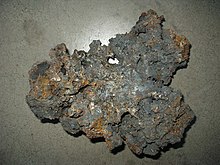
Tamahagane ( 玉 鋼 , "diamond steel") - Japanese steel, hookworm, known since antiquity, is an ingot of sponge iron. It is the main steel for the manufacture of sword blades and knives. Most gunsmiths in modern Japan use this traditional type of steel. This steel is made almost exclusively in Japanese-style melting furnaces called Tatars, under the control of NBTHK [1] in Yokot, a small town in Shiman Prefecture in western Honshu , supplying raw materials to modern gunsmiths. These furnaces were not originally a Japanese invention. It is believed that they came to Japan from Manchuria through the Korean Peninsula in the VI-VII centuries. To IX century. Tatars spread throughout Japan. The last such furnace was extinguished only in 1925 , but soon one of them again started working in the town of Yokota . The highest temperature in the Tatars can reach 1200-1500 ° C.
Tatara, like other smelters, uses the ability of red-hot iron to combine with carbon , resulting in steel . Iron ore in Shiman is found in the form of black sand, more precisely black sandy magnetite (Fe 3 O 4 ) - satetsu ( Japanese 砂 鉄 Sa: tetsu ) . The erosion product of the natural Satetsu iron ore deposits is often found in or near river beds mixed with silt and other sediments. The iron in this sand mixture is only about 1 percent.
In the Edo period, to separate iron, the sand mixture was injected into the water channels with wavy obstacles at the bottom. Heavier iron sand accumulated behind obstacles, while water carried away lighter sand. This old method is economical and makes it possible to obtain very pure ore, but the threat of environmental pollution forced to abandon it.
Today, sand is mined by a bulldozer, then iron ore is extracted by a magnet and delivered to the Tatars by truck. Charcoal made from special types of wood is burned in the Tatars to produce carbon to burn harmful sulfur and phosphorus impurities in iron and to saturate it with carbon. The resulting coals are covered with iron sand and immediately covered with a layer of charcoal. This operation is repeated every thirty minutes for seventy-two hours. One working cycle of the Tatars takes five days. During the full cycle of the Tatars, it consumes 13 tons of charcoal and 8 tons of satetsu.
When the temperature reaches 1400 degrees, oxygen enters the furnace using bellows. This oxygen reacts with carbon from charcoal to produce carbon monoxide. The reaction is simplified:
Fe 2 O 3 + CO → 2Fe + CO 2 + O 2
At the end of the smelting process, a steel block is formed at the bottom of the Tatars, which is about two tons in weight. The walls of the Tatars collapse, and a huge piece of metal is extracted outside, after which the workers break it into separate pieces.
The result is 2 tons of heterogeneous steel with varying carbon concentrations, which have yet to be sorted. The ingots of iron were flattened into thin plates, sharply cooled in water, and then broken into pieces the size of a coin. After that, pieces were selected, pieces with large inclusions of slag were discarded, and the rest were sorted by color and granular structure of the fault [2] . This method allowed the blacksmith to select steel with a predictable carbon content in the range from 0.6 to 1.5%. Although the Japanese Tatara is very effective, the tamahagane produced in it will go to the blacksmith rather “immature” and requires additional forging to reduce the carbon content in steel and make it suitable for making swords.
It is in the heterogeneous structure, due to the uneven carbon content, that there is the uniqueness and advantage of tamahagane for manufacturing a blade over factory steel with the same carbon content. A different degree of hardness (due to a different carbon content) allows the blade to better absorb impact, and also causes interesting visual effects on its surface, which is a criterion for its assessment by experts.
Tamahagane costs about $ 20 per pound (about 450 grams). Since a blacksmith needs 5 or 6 pounds of tamahagane to make one pound of steel, the cost of tamahagane to make one blade can reach $ 200.
Notes
- ↑ Society for the Preservation of Artistic Japanese Swords ( Jap. 術 美 刀 刀 剣 保存 協会 Nippon Bijutsu Tōken Hozon Kyōkai, NBTHK , Nippon Bijutsu then: ken hodzon kyo: kai)
- ↑ The brilliant clear color of the fault indicates a carbon content above 1% (high carbon steel).