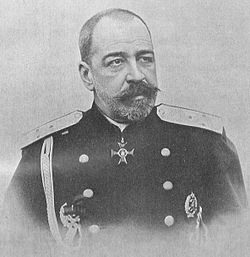
Prince (1861 [1] ) Peter Dmytrievich Svyatopolk-Mirsky ( 1857 , Vladikavkaz - 1914 , St. Petersburg ) - Russian statesman from the Svyatopolk-Mirsky clan, general from the cavalry (April 14, 1913), adjutant general . He served as Minister of the Interior of the Russian Empire (August 26, 1904 - January 18, 1905), with whom he was dismissed shortly after the riots in January 1905. Father of literary critic Dmitry Mirsky .
| Peter Dmitrievich Svyatopolk-Mirsky | ||||||||||
|---|---|---|---|---|---|---|---|---|---|---|
 | ||||||||||
| Predecessor | Vyacheslav Konstantinovich Pleve | |||||||||
| Successor | Alexander Grigoryevich Bulygin | |||||||||
| ||||||||||
| Predecessor | job vacancy | |||||||||
| Successor | Alexander Alexandrovich Frese | |||||||||
| ||||||||||
| Predecessor | Alexander Alexandrovich Batorsky | |||||||||
| Successor | Count Fedor Eduardovich Keller | |||||||||
| ||||||||||
| Predecessor | Alexey Alekseevich Goryainov | |||||||||
| Successor | Count Alexander Vasilievich Adlerberg | |||||||||
| Birth | August 18 (30), 1857 Vladikavkaz | |||||||||
| Death | May 16 (29), 1914 (56 years old) St. Petersburg | |||||||||
| Burial place | ||||||||||
| Kind | ||||||||||
| Father | Svyatopolk-Mirsky, Dmitry Ivanovich (1825-1899) | |||||||||
| Mother | Sofia Yakovlevna Orbeliani (1831-1879). | |||||||||
| Spouse | Countess Ekaterina Alekseevna Bobrinskaya | |||||||||
| Children | Sophia (1887), Dmitry (1890), Olga (1899) | |||||||||
| Education | ||||||||||
| Religion | Orthodox | |||||||||
| Awards |
| |||||||||
| Military service | ||||||||||
| Years of service | 1874-1914 | |||||||||
| Affiliation |  Russian empire Russian empire | |||||||||
| Rank | lieutenant general | |||||||||
| Battles | Russian-Turkish war (1877-1878) | |||||||||


Content
- 1 Biography
- 1.1 Starting a career
- 1.2 As Minister of the Interior
- 1.3 Svyatopolk-Mirsky and the events of January 9, 1905
- 2 Svyatopolk-Mirsky in the assessments of contemporaries
- 3 Military ranks
- 4 Awards
- 5 notes
- 6 Literature
- 7 Sources
Biography
Start of career
He was born on August 18, 1857 [2] in the family of General Prince Dmitry Ivanovich Svyatopolk-Mirsky (1825-1899) and Princess Sofia Yakovlevna Orbeliani (1831-1879). Parents owned in the Kharkov province Giyovka estate, the arrangement of which was subsequently much dealt by Pyotr Dmitrievich. He studied at the Page Corps ; began service in the Life Guards of the Hussars of His Majesty the regiment . In 1876 he was sent to the command of the commander of the Caucasian Army . Prince Mikhail Nikolaevich .
He participated in the Russian-Turkish war of 1877–78 , distinguished himself in the battle of Kars , and had several military awards. In 1877 he was appointed the adjutant wing of Emperor Alexander II . In 1881 he graduated from the course at the Nikolaev Academy of the General Staff , then commanded various military units, was the chief of staff of the 3rd Grenadier Division. On January 19, 1886, he married Countess E.A. Bobrinskaya, retired and settled on his estate Gievka in the Kharkov province . Marriage gave him great money. In 1894 he was elected Kharkov district leader of the nobility . In 1895 he was appointed Penza Governor, in 1897 - the Governor of Yekaterinoslav .
In 1900 , under the Minister of the Interior, D. S. Sipyagin , he was appointed April 20 as commander of the Separate Gendarme Corps and May 8 as a comrade of the Minister of the Interior. Already under Sipyagin, Mirsky wanted to resign, blaming him for unnecessary measures that were in vain irritating public opinion. In 1902 , after the new minister V.K. Pleve came to power, Mirsky had a frank conversation with him, in which he stated that he knew his views and did not share them, and therefore asked for his resignation [3] . Pleve asked him not to rush his resignation, and then appointed him Vilensky , Kovensky and Grodno governor-general . At this post, Mirsky was distinguished by a soft, benevolent attitude towards the local population, which earned him general respect and sympathy. Among other things, he was an honorary foreman of the Vilno Nobility Club [4] .
After the Pleve murder in August 1904 , Mirsky was summoned to St. Petersburg and appointed Minister of the Interior.
As Minister of the Interior
Empress Maria Fyodorovna played a decisive role in appointing Mirsky to the post of minister, who did not sympathize with Pleve's repressive policy and opposed her with Mirsky’s soft policy in the Vilnius region [5] . Being adopted by Emperor Nicholas II , Mirsky openly declared that he did not share Pleve’s views at all and therefore asked not to appoint him Minister. Despite this, the emperor insisted on accepting his post, and on August 26 Mirsky was appointed to the post of Minister of the Interior. The first action of the new minister was the dismissal of Pleve's closest assistants — the comrades-in-arms of the minister A. S. Stishinsky and N. A. Zinoviev , the commander of the Gendarme Corps V. V. von Val and the director of the Department of General Affairs B. V. Stürmer [5] .
On September 16, upon assuming the post of Minister, Mirsky delivered a speech in which, in particular, he stated:
“Administrative experience has led me to the deep conviction that the fruitfulness of government work is based on a sincerely benevolent and truly trusting attitude towards public and estate institutions and the population in general. Only under these working conditions can mutual trust be gained, without which it is impossible to expect lasting success in the matter of building a state ” [6] .
This speech gave an occasion to call the time of the reign of Svyatopolk-Mirsky “the era of trust”, as well as “the spring of Russian life”.
Mirsky’s speech was sympathetically received by the public, who saw in the words of the new minister a harbinger of widespread liberal reforms. Addresses and congratulations from private individuals and institutions rained down on the Minister; Zemstvos and city councils expressed the hope that the minister’s words of trust would be embodied in concrete transformations. Immediately after taking office, Mirsky ordered to weaken the supervision of the press and return from exile unreliable persons who were subjected to repression in the Pleven era [7] . To emphasize his lack of sympathy with repressive measures, by a special decree of September 22, he separated from himself all purely police work and entrusted it to the comrade of the minister, commander of the Separate Gendarmes Corps K. N. Rydzevsky [5] .
The actions of the new minister caused revival in the circles of the liberal public. Zemstvos decided to hold a large Zemstvo congress in November, at which Zemstvo leaders from all over Russia were to gather. After the new minister spoke about trust, the organizational bureau of the congress included in his agenda the question of the necessary reforms of the political system [6] . Learning about the upcoming congress, Mirsky tried to ask him for the highest permission, but did not receive the consent of the emperor. Despite this, the Zemsky Congress was held on November 6–9, 1904 as a "private meeting of Zemstvo leaders." The activity of the congress was monitored by all of Russia. The congress adopted a resolution proclaiming the need for fundamental reforms of the state system. It, among other things, contained the requirements of freedom of speech, unions, assemblies and faiths, the equality of all before the law and the convening of national representation [7] . The congress delegates acquainted with the resolution of Svyatopolk-Mirsky, who expressed full agreement with her and promised to submit it to the emperor [6] .
The resolution of the Zemsky Congress was published in many newspapers and caused a great public outcry. On the initiative of the illegal organization “ Union of Liberation ”, immediately after the congress, public meetings or “banquets” began throughout the country, which passed resolutions that clarified and supplemented the decision of the Zemsky Congress. In these resolutions, the demands of the public were expressed in a more vivid and decisive manner; they already explicitly spoke of the need for a constitution and the convening of a Constituent Assembly [6] . At banquets heated speeches were made with criticism of the autocracy and the demand for radical reforms of the political system [7] . The police did not take any measures against these meetings. Representatives of the revolutionary intelligentsia penetrated some banquets and turned them into rallies. All these events caused a great social upsurge and aroused hopes for near changes in the general public.
Meanwhile, on December 2, Svyatopolk-Mirsky asked Emperor Nicholas II to convene a government meeting under his chairmanship to discuss his reform program [6] . This program was set out in a special note drawn up on behalf of Mirsky S. Ye. Kryzhanovsky and in the draft Supreme Decree, the key point of which was the introduction of “elected representatives from public institutions” to the State Council . This paragraph meant the participation of elected representatives in legislative activity, and Mirsky saw in it the first step to the constitutional system [6] .
However, not being an experienced politician, Mirsky made the mistake of not setting the stage for his proposals and not having previously secured the consent of other ministers. In a conversation with the emperor, he asked not to invite KP Pobedonostsev to the meeting, known for his negative attitude to all sorts of reforms. This led to the exact opposite result: Nicholas II not only invited Pobedonostsev, but called him in a special note in which he wrote: “We are confused. Help us figure out our chaos ” [5] .
At a meeting held on December 4, Pobedonostsev made an outrageous criticism of Mirsky’s proposals, pointing out that inviting elected representatives meant restricting autocracy. At the same time, he stated that the autocracy is not only political, but also religious in nature, and therefore the emperor has no right to limit his power vested in him from above [6] . Pobedonostsev was supported by Minister of Finance V.N. Kokovtsov , who pointed out that public representatives should not be allowed to dispose of state resources. Strong support for Mirsky's proposals was made only by D. M. Solsky and E. V. Frisch . Chairman of the Committee of Ministers S. Yu. Witte , on whom Mirsky counted, spoke evasively. At the next meeting, on December 7, in addition to the ministers, the Grand Dukes Vladimir , Aleksey and Sergey Alexandrovich were present [6] . This time, Mirsky’s proposals were criticized by Governor-General of Moscow Sergey Aleksandrovich and Minister of Justice N. V. Muravyov . The latter, in particular, stated that, on the basis of existing laws, the emperor is not entitled to change the existing state system . After the meeting, Mirsky returned to the ministry upset and gloomily told his employees: “Everything failed! We will build prisons ” [5] .
As a result, Mirsky’s proposed decree on reforms was signed by the emperor, but a key point on elected representatives was thrown out of him. This decree, entitled "On Measures to Improve Public Order," was promulgated on December 12, 1904 and caused deep disappointment in society. At the same time as the decree, a government report was published condemning the recent public gatherings and said that henceforth such meetings and “anti-government gatherings” would be dispersed by police measures [7] . Zemsky assemblies were forbidden to discuss issues of a political nature. In society, all this was regarded as the onset of a new era of reaction. Immediately after the publication of the decree on December 12, Svyatopolk-Mirsky resigned, but his resignation was not accepted [6] .
Svyatopolk-Mirsky and the events of January 9, 1905
On January 3, 1905, a strike began at the Putilov factory , which spread to other plants and factories in St. Petersburg and turned into a general one. The strike was led by the legal working organization “ Meeting of Russian factory workers in St. Petersburg, ” led by priest Georgy Gapon . The authorities were alarmed that the strike was led by a legal society, whose charter was approved by the Ministry of the Interior [8] . On January 7, it became known that the priest Gapon composed in the name of the emperor Petition about work needs , which, in addition to economic ones, contained “daring demands of a political nature” [9] . At thousands of meetings, Gapon and his assistants read out a petition and invited all the workers, with their wives and children, to appear on Sunday at the Winter Palace Square to present it to the king. To ensure the success of his enterprise, priest Gapon on January 7 tried to meet with government officials. At a meeting with the Minister of Justice N.V. Muravyov, he asked him to turn to the tsar and convince him to go out to the people and accept the petition. But Muravyov met him coldly and did not promise anything [10] . Then Gapon turned to Svyatopolk-Mirsky, whom he contacted by phone from the reception of the Minister of Justice. However, Mirsky refused to speak with him. Gapon had no choice but to hang up. “The devil knows what it is!” Said Gapon, leaving the reception room [11] . Mirsky subsequently explained his refusal to speak with Gapon by the fact that he did not know him personally [12] . And in private conversations he admitted that he did not do this because he does not know how to talk “with them” [13] .
On January 8, Mirsky held a meeting at which the question of the Sunday procession was discussed. According to some reports, Mirsky expressed himself in the sense that the authorities could accept a deputation from the workers [14] . However, Minister of Justice Muravyov and Minister of Finance V.N. Kokovtsov strongly opposed this. Muravyov, on the basis of his meeting with Gapon, characterized him as an “ardent revolutionary” and offered to arrest him [15] . The mayor I. A. Fullon expressed the opinion that it is impossible to allow workers to the square, since the crowding of a 150,000-strong crowd in the city center can lead to unpredictable consequences. At the same time, he recalled the Khodynka disaster [16] . As a result of the meeting, it was decided: to arrest Gapon, and not to allow workers to the square. For this, it was decided to place outposts of troops on the outskirts of the city, which should stop the crowds of workers on their way to the center [13] . On the same day, priest Gapon sent a letter to Svyatopolk-Mirsky, in which he informed that a march to the palace was inevitable, that workers go to the tsar peacefully and guarantee the inviolability of his person. Gapon persuaded the minister to bring this to the attention of the king and familiarize him with the petition. At the end of the letter, the priest warned that if the tsar did not accept the petition, “then the end of the moral connection that still existed between the Russian tsar and the Russian people could happen” [17] . The Minister read the letter [18] .
In the evening, Mirsky went to Tsarskoye Selo and acquainted the tsar with the letter of Gapon and a working petition [18] . The minister described Gapon as a “socialist priest” and informed the emperor of the measures taken. The king wrote about this in his diary [19] . Judging by the records of the king, the minister’s messages were reassuring. [16] On the same evening, a deputation of public figures led by Maxim Gorky appeared at the Ministry of Internal Affairs. Целью депутатов было встретиться со Святополк-Мирским и объяснить ему опасность сложившегося положения. Ни у кого не было сомнений, что столкновение рабочих с войсками неизбежно приведёт к кровопролитию [20] . Когда депутаты прибыли в министерство, Мирский был в Царском Селе, и их принял его заместитель К. Н. Рыдзевский . Последний сообщил, что властям всё известно и в их посредничестве нет необходимости [20] . Тогда депутация отправилась к председателю Комитета министров С. Ю. Витте . Но тот только развёл руками и сказал, что ничем не может помочь. Витте связался по телефону с Мирским и спросил, не хочет ли он принять депутацию. Последний ответил, что ему уже всё сообщили и в приёме депутатов нет необходимости. Депутаты ушли ни с чем. Как свидетельствуют воспоминания чиновника министерства внутренних дел Д. Н. Любимова, Мирский не понимал серьёзности сложившегося положения. Ночью он вместе с военными разрабатывал диспозицию войск, а уходя спать, выразил уверенность, что завтра «всё обойдётся» [16] .
Утром 9 января многотысячные колонны рабочих во главе со священником Гапоном двинулись из разных концов города к Зимнему дворцу. На пути к центру их встречали воинские заставы, но рабочие, не обращая внимания на предупреждения, продолжали упорно идти вперёд [9] . Чтобы остановить шествие, войска были вынуждены в разных частях города произвести ружейные залпы. В результате столкновений с войсками было убито до 200 и ранено до 800 человек [21] . Общество было шокировано произошедшим кровопролитием, сообщения о котором, многократно преувеличивавшие количество жертв, распространялись по всей России. События 9 января подорвали престиж царской власти и положили начало Первой русской революции . Оппозиция возложила ответственность за кровопролитие на царя и Святополк-Мирского. Максим Горький в составленном от имени депутации общественных деятелей воззвании писал:
«Мы, нижеподписавшиеся, перед лицом всех русских граждан и перед лицом европейского общественного мнения обвиняем министра внутренних дел Святополк-Мирского в предумышленном, не вызванном положением дел и бессмысленном убийстве множества русских граждан» [22] .
Впоследствии Святополк-Мирский часто задавался вопросом, не совершил ли он ошибки. По данным дневника Е. А. Святополк-Мирской, он оправдывал себя тем, что вожаки шествия «шли с угрозой» и допустить 150-тысячную толпу в центр города было невозможно [18] .
На следующий день после событий, 10 января, князь Святополк-Мирский подал в отставку [16] . 18 января [23] 1905 года он был уволен от должности министра внутренних дел, с оставлением в звании генерал-адъютанта, и больше не возвращался к политической деятельности.
Скончался 16 мая 1914 года; отпевание совершено в церкви Спаса-на-Водах ; похоронен в селе Гиевка Харьковской губернии [24]
Святополк-Мирский в оценках современников
По общему мнению, Святополк-Мирский был честным и порядочным человеком, обладал добрым и мягким характером и пользовался общей любовью. С. Ю. Витте писал, что Святополк-Мирский «представляет человека выдающегося по своей нравственной чистоте. Это человек совершенно кристально чистый, безукоризненно честный, человек высоких принципов, редкой души человек и очень культурный генерал генерального штаба… Везде, где Мирский служил, его всюду любили и уважали» [3] . По словам Д. Н. Шипова , «князь П. Д. был человек всегда прямой и безусловно честный деятель; он обладал добрым сердцем и чуткой душой и всегда подходил к людям с доверием и любовью» [6] . Подобные характеристики давали ему и другие современники. В то же время, как государственному деятелю, ему недоставало твёрдости и решительности при проведении своей линии. По словам В. И. Гурко , «едва ли не отличительной его чертой было желание жить со всеми в мире и чувствовать себя окруженным благожелательной атмосферой» [5] . Вследствие такой мягкости характера он не обладал способностью настойчиво проводить свою политику и был склонен ко всяческим компромиссам. Святополк-Мирский был умён и имел определённые политические убеждения, но не обладал широким политическим кругозором и не имел необходимых для управления государством знаний. Он не умел импонировать собеседнику и аргументировать свои мнения убедительными доводами и соображениями [6] . В силу таких качеств характера благие намерения Мирского не получили практического воплощения, а его правление, начавшееся с заявлений о доверии обществу, закончилось кровью, пролитой на улицах Петербурга 9 января [5] .
Стремление снять с него вину за события 9 января 1905 года характерно для либеральной публицистики конца 1900-х — 1910-х; так, один из членов депутации, которая пыталась получить у него в тот день аудиенцию, писатель К. К. Арсеньев писал о нём вскоре по его кончине, в 1914 году:
Как ни коротка была его государственная деятельность, она оставила глубокий след в русской жизни. В правящих сферах покойный князь явился первой ласточкой, знаменующей приближение весны — и самая весна оказалась бы, быть может, более прочной, если бы наступление её застало его ещё у власти. 9-го января 1905 г. князь Святополк-Мирский был ещё министром, но уход его был предрешён и не на него падает ответственность за ужасные события этого дня.
— [25]
Военные чины
- В службу вступил (10.08.1874) [26]
- Корнет гвардии (04.08.1875)
- Поручик (04.08.1876)
- Флигель-адъютант (1877)
- Штабс-ротмистр (16.04.1878)
- Ротмистр (30.08.1881)
- Подполковник (27.11.1881)
- Полковник (30.08.1884)
- Генерал-майор (11.06.1895)
- Генерал-лейтенант (11.06.1901)
- Генерал от кавалерии (14.04.1913)
Rewards
- Орден Святой Анны 4-й степени с надписью «За храбрость» (1877) [26]
- Орден Святой Анны 3-й степени с мечами и бантом (1877);
- Орден Святого Владимира 4-й степени с бантом (1878);
- Орден Святого Станислава 2-й степени (1882);
- Орден Святой Анны 2-й степени (1888);
- Орден Святого Владимира 3-й степени (1892);
- Орден Святого Станислава 1-й степени (1896);
- Орден Святой Анны 1-й степени (1899);
- Орден Святого Владимира 2-й степени (1910);
- Кавалерский крест французского ордена Почетного Легиона (1879).
Notes
- ↑ Его отцу 8 апреля 1861 было Высочайше разрешено носить княжеский титул без представления соответствующих документов, которые повелено считать утерянными во время Польской войны 1831 года.
- ↑ Д. Н. Шилов. Государственные деятели Российской империи. СПб., 2002, стр. 661.
- ↑ 1 2 С. Ю. Витте. Memories. Царствование Николая II . — Берлин: «Слово», 1922. — Т. 1. — 571 с.
- ↑ Памятная книга Виленской губернии на 1904 год. - Вильна: Типография А.Г. Сыркина, 1904. - С.172.
- ↑ 1 2 3 4 5 6 7 В. И. Гурко. Черты и силуэты прошлого . — М. : «Новое литературное обозрение», 2000. — 810 с.
- ↑ 1 2 3 4 5 6 7 8 9 10 11 Д. Н. Шипов. Воспоминания и думы о пережитом. — М. : РОССПЭН, 2007. — 680 с.
- ↑ 1 2 3 4 И. П. Белоконский. Земское движение. — М. : «Задруга», 1914. — 397 с.
- ↑ Начало первой русской революции. Январь-март 1905 года. Документы и материалы / Под ред. Н. С. Трусовой. — М. : Изд-во АН СССР, 1955. — 960 с.
- ↑ 1 2 Доклад директора Департамента полиции Лопухина министру внутренних дел о событиях 9-го января // Красная летопись. — Л. , 1922. — № 1 . — С. 330—338 .
- ↑ Г. А. Гапон. История моей жизни . — М. : «Книга», 1990. — 64 с.
- ↑ А. В. Богданович. Три последних самодержца. — М. : Новости, 1990. — 680 с.
- ↑ 9-е января. Кн. П. Д. Святополк-Мирский о Гапоне // Русское слово. — М. , 1909. — № 269 (24 ноября) . — С. 4 .
- ↑ 1 2 А. И. Спиридович. Записки жандарма . — Харьков: «Пролетарий», 1928. — 205 с.
- ↑ Аннин. Из воспоминаний о 9 января // Речь. - SPb. , 1908. — № 7 (9 января) . — С. 1—2 .
- ↑ С. Н. Валк. Петербургское градоначальство и 9 января // Красная летопись. — Л. , 1925. — № 1 . — С. 37—46 .
- ↑ 1 2 3 4 Д. Н. Любимов. Гапон и 9 января // Вопросы истории. — М. , 1965. — № 8—9 .
- ↑ Г. А. Гапон. Письмо к министру внутренних дел П. Д. Святополк-Мирскому // Священника Георгия Гапона ко всему крестьянскому люду воззвание. — 1905. — С. 13—14 .
- ↑ 1 2 3 Е. А. Святополк-Мирская. Дневник кн. Е. А. Святополк-Мирской за 1904—1905 гг. // Исторические записки. — М. , 1965. — № 77 . — С. 273—277 .
- ↑ Дневники императора Николая II. 1905 г.
- ↑ 1 2 Л. Я. Гуревич. Народное движение в Петербурге 9-го января 1905 г. // Былое. - SPb. , 1906. — № 1 . — С. 195—223 .
- ↑ В. И. Невский. Январские дни в Петербурге в 1905 году // Красная летопись. — Л. , 1922. — № 1 .
- ↑ А. М. Горький и события 9 января 1905 г. в Петербурге // Исторический архив. — М. , 1955. — № 1 . — С. 91—116 .
- ↑ Дата согласно: Д. Н. Шилов. Государственные деятели Российской империи. СПб., 2002, стр. 663.
- ↑ « Правительственный Вѣстникъ ». 20 мая ( 2 июня ) 1914, № 108, стр. 2.
- ↑ « Вѣстникъ Европы ». 1914, № 6, стр. 419.
- ↑ 1 2 List of generals by seniority . СПб 1906г.
Literature
- Энциклопедия секретных служб России / Автор-составитель А.И.Колпакиди. — М. : АСТ, Астрель, Транзиткнига, 2004. — С. 151-152. — 800 с. — ISBN 5-17018975-3 .
Sources
- Князь Святополк-Мирский Пётр Дмитриевич
- Святополк-Мирский Пётр Дмитриевич
- Святополк-Мирский, Петр Дмитриевич // Энциклопедический словарь Брокгауза и Ефрона : в 86 т. (82 т. и 4 доп.). - SPb. , 1890-1907.
- Svyatopolk‐Mirsky's report to the tsar on the Jewish question in 1902-3 // Soviet Jewish Affairs, 2, 1972, № 2, 86-95.