Su-25T (T-8M product, according to NATO codification : Frogfoot - “Frog leg” ) - modification of the Su-25 attack aircraft . The aircraft was designed to destroy armored vehicles, firearms, ships (up to and including the destroyer), helicopters, transport planes, bridges, shelters, air defense systems and enemy manpower day and night, on the battlefield and at a depth of up to 450 km behind the front line, in the range heights from 30 to 5000 m.
| Su-25T | |
|---|---|
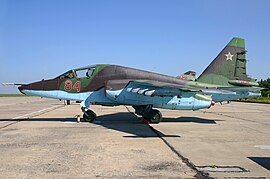 Su-25T in the Lipetsk Aviation Center | |
| Type of | attack aircraft |
| Developer |  OKB Sukhoi OKB Sukhoi |
| Manufacturer |
 Ulan-Ude Aviation Plant Ulan-Ude Aviation Plant |
| Chief Designer | V.P. Babak |
| First flight | August 17, 1984 |
| Status | the project is closed |
| Years of production | 1989 - 1991 |
| Units produced | ~ 20 |
| Base model | Su-25 |
| Options | Su-39 |

Content
Creation History
The first flight took place on August 17, 1984. Serial production began in 1990 at the Tbilisi Aircraft Plant.
In November 1991, the Su-25T (prototype T-8M3) was first demonstrated to the public at the air show in Dubai ( UAE ).
Design
The design of the aircraft is similar to the Su-25UB ( unification of 85%). The difference is in a single-seat cabin (while maintaining the Su-25UB armored unit), a precabin cabin compartment of increased length, which houses the equipment of the Shkval sighting system, and an extended keel.
The power plant consists of 2 turbojet engines R-195 (engine nacelles respectively modified). In the cockpit compartment and the rear of the fuselage, 2 additional fuel tanks are installed.
The VPU-17A cannon mount was replaced by NNPU-8M with the unit itself transferred from the pod compartment under the middle part of the fuselage (the barrel part of the gun was removed from the fuselage contours). Under the wing can be suspended 2 removable mobile installations SPPU-687 with guns GSh-301 (200 rounds of ammunition). Air-surface missiles with a laser and television guidance system, anti-radar missiles , anti-tank guided missiles "Whirlwind" (up to 16 pcs.) Were added to the armament. In the rear part of the fuselage the EW “Irtysh” equipment was installed with the “Dry cargo” infrared jamming station.
In total, TAGO managed to release an experimental batch of Su-25T aircraft in the amount of 12 aircraft before the collapse of the USSR . According to a number of sources, only 8 out of 12 aircraft were received by Russia .
After the collapse of the USSR, production was transferred to Ulan-Ude (by 2003, 4 modernized Su-25TM aircraft had been manufactured from the Su-25UB production reserve, 4 more were unfinished). Modernization of previously issued Su-25s is also carried out there. Serially, the Su-25T and Su-25TM were not produced.
The number of such aircraft in the Russian Air Force is extremely limited: there are about 6 Su-25Ts on the balance of the Russian Air Force (in early 2000, 2 aircraft after export sales were exported). Currently, all Su-25T are in the eternal parking lot of the Lipetsk air center .
Modifications
| Model name | Brief characteristics, differences. |
|---|---|
| T8-M1 | The first instance of the Su-25T was created by reworking the unfinished T-8UB (assembly completed in Tbilisi in 1984 , the first flight was made on August 17, 1984, the pilot was A.N. Isakov), 3 flight prototypes and 1 for testing were built ( 1985-1986). |
| Su-25T | Serial. In total, about 20 such cars were produced. |
| Su-25TK | Export . It differs in the composition of on-board equipment. |
| Su-25TM (T-8TM) | Upgraded. It features an improved Shkval-M sighting system, the presence of the Spear-25 fire control radar (in a hanging container), a long-range navigation radio system, and the A-735 satellite navigation system. Installation of a container with thermal imaging equipment is provided. Designed in 1986 - 1995 . The first flight took place on August 15, 1995 , piloted by a test pilot of the Sukhoi Design Bureau O. G. Tsoi. Pre-production cars released in Ulan-Ude . Serially not built. |
Combat use
In 1999, during a counter-terrorist operation in Chechnya, 4 Su-25T attack aircraft launched precision strikes. Then the attack aircraft made more than 20 sorties . Both guided missiles and KAB were used with high efficiency. Deciphering the results and video recordings made it possible to record the accuracy of hit of laser-guided SDs - 0.5 meters, of corrected air bombs with television-guided ones - 1 meter.
Ethiopia, fighting with Eritrea, became the first and possibly last buyer of the Su-25T. A supply contract was signed at the end of 1999, and the aircraft were delivered to the supplier in the early 2000s. This speed is due to the fact that they took ready-made attack aircraft from the Lipetsk center (pilots were also trained there) and promptly finalized the Su-25TK standard at the 121st aircraft repair plant in Kubinka (slightly changed the equipment). Aircraft very successfully "made" in the war, often using along with conventional ammunition guided missiles X-25MP and X-29T.
The Super Rook also showed excellent survival, so on May 20, 2000, during a successful attack on the position of the Kvadrat air defense system, one of the attack aircraft sustained a close missile explosion, but safely reached the base. In 2002, Ethiopia still operated two of its Su-25TKs.
Flight performance
Specifications
The following characteristics [1] correspond to the modification of the Su-25T:
- Crew : 1 person
- Length : 15.33 m (with LDPE )
- Wing span: 14.52 m
- Height : 5.2 m
- Wing Area: 30.1 m²
- Empty weight: 9 500 kg
- Normal take-off weight: 16,600 kg
- Maximum take-off weight: 19,500 kg
- Fuel weight: 3,840 kg
- Engines: 2x turbojet engine R-195
- Thrust: 2x 40 kN (4,500 kgf )
Flight performance
- Maximum speed : 950 km / h
- Cruising speed : 750 km / h
- Landing speed: 230 km / h
- Maximum flight range (with PTB): 2250 km
- Practical flight range: 1850 km
- Range with a combat load of 2000 kg:
- by the ground : 400 km
- at altitude : 700 km
- Practical ceiling : 10,000 m
- Rate of climb: 60 m / s
- The length of the run / mileage: 600-700 m
- Maximum operational overload : 6.5 G
Armament
- Rifle-cannon: double-barrel 30-mm gun GSh-30 with 200 rounds of ammunition (built-in)
- Guided missiles:
- air-to-air missiles: 2 x R-60M ; 2 x P-73
- air-to-surface missiles: 16 x Whirlwind ATGM ; 6 x X-25ML (MT, MR, MP, MPU); 8 x S-25L ; 2 x X-29L (T, ML, TE, TM, TD); 2 x X-58E (U).
- Unguided missiles :
- NAR blocks - 8 x B-5 blocks with S-5 NAR (256 NAR );
- 8 x NAR B-8 blocks; x NAR S-8 (160 NAR );
- 8 x NAR B-13L blocks; x NAR S-13 (40 NAR );
- 8 x NAR S-24 B; x NAR S-24 OFM;
- 8 x NAR S-25 ; x NAR S-25 OFM.
- Bombs : freely falling and adjustable for various purposes, bomb cassettes
- 2 x KAB-500Kp ;
- 10 x AB-100; 32 x AB-100 together with MBD-2-67U
- 10 x AB-250;
- 8 x AB-500;
- 8 x RBC-250 ;
- 8 x RBC-500;
- 8 x KMGU-2;
- 8 x ST -500;
- Gun containers: 4 SPPU-22-1 with a double-barreled 23-mm gun GSh-23 with 260 rounds
The use of anti-radar missiles (PRR) is only possible with the L-081 Fantasmagoria target designation aircraft.
Equipment
- Arms Management System:
- Optical-electronic aiming system "Flurry" - is used in the daytime;
- The low-level survey and sighting system "Mercury" - is used at night.
- Target designation system for X-58 and X-25MPU anti-radar missiles:
- Suspended target designation station "Phantasmagoria" ;
- Suspended target designation station "Blizzard" ;
- Navigation complex:
- Air signal system ;
- Dual inertial directional vertical ;
- Radio engineering system of near navigation and landing (RSBN) ;
- Doppler meter of ground speed and drift angle (DISS) ;
- Radio altimeter ;
- Equipment for long-range navigation radio technical system (RSDN) ;
- Satellite navigation system "Hurricane" .
- EW system "Irtysh":
- L-150 "Pastel" radiation warning station
- Gardenia-1FU - is installed in containers suspended on the external underwing points of the suspension;
- The device of the release of the LTC UV-26 (192 jamming cartridges) - protection against SD with TGS ;
- Station of optoelectronic interference type "Dry cargo";
See also
- Su-39
- A-10
Notes
- ↑ Dry Su-25T . www.airwar.ru. Date of treatment December 10, 2015.