The electric voltage between points A and B of an electric circuit or an electric field is a physical quantity whose value is equal to the work of an effective electric field (including external fields), which is carried out when a unit test electric charge is transferred from point A to point B [1] [2] .
| Voltage | |
|---|---|
| U, V | |
| Dimension | L 2 MT -3 I -1 |
| Units | |
| SI | volt |

Amperage
Electric power
Electrical resistance
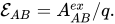
It is believed that the transfer of the test charge does not change the distribution of charges at the field sources (by definition of the test charge ). The voltage in the general case is formed from the contributions of two works: the work of electric forces and work of outside forces . If no external forces act on the chain section (i.e. ), the work of moving includes only the work of a potential electric field (which does not depend on the path along which the charge moves), and the voltage between points A and B coincides with the potential difference between these points (since ) In general, the voltage between points A and B differs from the potential difference between these points [3] for the operation of external forces to move a unit positive charge. This work is called electromotive force. on this section of the chain:





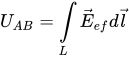
The definition of electrical voltage can be written in another form. To do this, submit work as an integral along the trajectory L laid from point A to point B.

- integral of the projection of the effective field strength (including external fields) to the tangent to the trajectory L , the direction of which at each point of the trajectory coincides with the direction of the vector at a given point. In an electrostatic field, when there are no external forces, the value of this integral does not depend on the integration path and coincides with the potential difference.


The dimension of electrical voltage in the International System of Quantities (ISQ ), on which the International System of Units (SI) is based , is L 2 MT -3 I -1 . The unit of measurement of voltage in SI is volt (Russian designation: V ; international: V ).
The concept of voltage was introduced by Georg Ohm in his work in 1827, in which a hydrodynamic model of electric current was proposed to explain Ohm's empirical law discovered in 1826: .

DC Voltage
The voltage in the DC circuit between points A and B is the work that an electric field does when transferring a test positive charge from point A to point B.
AC Voltage
The following voltages are used to describe AC circuits :
- instantaneous voltage;
- the amplitude value of the voltage;
- average voltage value;
- rms voltage value;
- average rectified voltage value.
Instantaneous voltage is the potential difference between two points, measured at a given moment in time. Depends on time (is a function of time):
The amplitude value of the voltage is the maximum absolute value of the instantaneous voltage for the entire period of oscillation:
For harmonic (sinusoidal) voltage fluctuations, the instantaneous voltage value is expressed as:
For an AC sine wave network with a RMS value of 220 V, the amplitude voltage is approximately 311.127 V.
Amplitude voltage can be measured using an oscilloscope .
The average value of the voltage (constant component of the voltage) is the voltage determined over the entire period of oscillation, as:
For a sinusoid, the average voltage value is zero.
The root-mean-square value of the voltage (outdated names: effective , effective ) is the voltage determined over the entire period of oscillation, as:
The rms voltage value is most convenient for practical calculations, since it does the same job on a linear active load (for example, an incandescent lamp has the same brightness, the heating element emits as much heat) as the constant voltage equal to it.
For sinusoidal voltage, the equality
In engineering and everyday life when using alternating current, the term “voltage” refers to the rms value of the voltage, and all voltmeters are calibrated based on its definition. However, constructively, most devices actually measure not the RMS value, but the mean-rectified (see below) voltage value; therefore, for a non-sinusoidal signal their readings may differ from the true value.
The average rectified voltage value is the average value of the voltage module:
For sinusoidal voltage, the equality
In practice, it is rarely used, however, most AC voltmeters (those in which the current is rectified before measurement) actually measure this value, although their scale is graduated by rms values.
Three-phase current voltage
In three-phase current circuits , phase and linear voltages are distinguished. Under the phase voltage is understood the rms value of the voltage at each of the phases of the load relative to the neutral, and under the linear - the voltage between the input phase wires. When a load is connected to a triangle, the phase voltage is linear, and when connected to a star (with a symmetrical load or with a grounded neutral), the linear voltage is times more than phase.
In practice, the voltage of a three-phase network is denoted by a fraction, the numerator of which is phase when connected to a star (or, which is the same, the potential of each of the lines relative to the earth), and in the denominator is the linear voltage. So, in Russia, the most common networks with a voltage of 220/380 V ; 127/220 V and 380/660 V networks are also sometimes used.
Characteristic Values and Standards
| An object | Voltage type | Value (at customer input) | Value (at source output) |
|---|---|---|---|
| Electrocardiogram | Impulse | 1-2 mV | - |
| Television antenna | High frequency variable | 1-100 mV | - |
| AA type galvanic cell (finger-type) | Constant | 1.5 V | - |
| Lithium cell | Constant | 3–3.5 V (in the performance of a finger element, for example, Varta Professional Lithium, AA) | - |
| Logic signals of computer components | Impulse | 3.3 V; 5 v | - |
| Battery Type 6F22 (Krona) | Constant | 9 V | - |
| Power supply of computer components | Constant | 5 V, 12 V | - |
| Electric equipment of cars | Constant | 12/24 V | - |
| Laptop power supply and LCD monitors | Constant | 19 V | - |
| Network "safe" low voltage for hazardous conditions | Variable | 36-42 V | - |
| The voltage of the most stable burning candles Yablochkova | Constant | 55 V | - |
| Telephone line voltage (off-hook) | Constant | 60 v | - |
| Voltage in Japan | Three phase variable | 100/172 V | - |
| US Home Voltage | Three phase variable | 120 V / 240 V ( split phase ) | - |
| Voltage in household electrical networks in Russia | Three phase variable | 220/380 V | 230/400 V |
| Stingray discharge | Constant | up to 200-250 V | - |
| Tram and trolleybus contact network | Constant | 550 V | 600 V |
| Electric eel discharge | Constant | up to 650 V | - |
| Metro Contact Network | Constant | 750 V | 825 V |
| Electrified Railway Contact Network (Russia, DC) | Constant | 3 kV | 3.3 kV |
| Low power overhead power distribution line | Three phase variable | 6-20 kV | 6.6-22 kV |
| Power plant generators, powerful electric motors | Three phase variable | 10–35 kV | - |
| At the anode of the tube | Constant | 7-30 kV | - |
| Static electricity | Constant | 1-100 kV | - |
| On a car spark plug | Impulse | 10-25 kV | - |
| Contact network of an electrified railway (Russia, alternating current) | Variable | 25 kV | 27.5 kV |
| Breakdown of air at a distance of 1 cm | 10-20 kV | - | |
| Rumkorf Coil | Impulse | up to 50 kV | - |
| Breakdown of a layer of transformer oil 1 cm thick | 100-200 kV | - | |
| High Power Overhead Power Line | Three phase variable | 35 kV, 110 kV, 220 kV, 330 kV | 38 kV, 120 kV, 240 kV, 360 kV |
| Electrophore car | Constant | 50-500 kV | - |
| Ultra-high voltage overhead power line (intersystem) | Three phase variable | 500 kV, 750 kV, 1150 kV | 545 kV, 800 kV, 1250 kV |
| Tesla Transformer | Pulse high frequency | up to several MV | - |
| Generator Van de Graaff | Constant | up to 7 MV | - |
| Thundercloud | Constant | 2 to 10 GW | - |
See also
- Voltage source
- List of voltage and electric current parameters
- Paschen's Law
Notes
- ↑ Miller M.A., Permitin G.V. Electric voltage // Physical Encyclopedia / Ch. ed. A.M. Prokhorov . - M .: Great Russian Encyclopedia , 1992. - T. 3. - S. 244-245. - 672 p. - 48,000 copies. - ISBN 5-85270-019-3 .
- ↑ Electric voltage / Yuryev Yu.V. // Great Russian Encyclopedia : [in 35 t.] / Ch. ed. Yu.S. Osipov . - M .: Great Russian Encyclopedia, 2004—2017.
- ↑ Detlaf A.A., Yavorsky B.M., Milkovskaya L.B. Physics course. - 1977.- T. 2.
Literature
- Miller M.A., Permitin G.V. Electric voltage // Physical Encyclopedia / Ch. ed. A.M. Prokhorov . - M .: Great Russian Encyclopedia , 1992. - T. 3. - S. 244-245. - 672 p. - 48,000 copies. - ISBN 5-85270-019-3 .
- Detlaf A.A., Yavorsky B.M., Milkovskaya L.B. Physics course. Electricity and magnetism. - M .: "HIGHER SCHOOL", 1977. - T. 2.
Links
- Electrical voltage // Brockhaus and Efron Encyclopedic Dictionary : 86 tons (82 tons and 4 additional). - SPb. , 1890-1907.
- About potential difference, electromotive force and voltage
- Glossary.ru: Dictionary of Natural Sciences.