Portia (lat.) - a genus of spiders from the family of horse spiders . More than 17 species that feed on other spiders (that is, they are araneophages, or arachnophages). They are distinguished by their intelligent hunting behavior, which suggests that they are capable of learning and solving problems and that are usually attributed to much larger animals.
| Portia | |||||||||||||||||||||||||||||||||||||
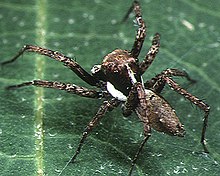
Female Portia fimbriata | |||||||||||||||||||||||||||||||||||||
| Scientific classification | |||||||||||||||||||||||||||||||||||||
|---|---|---|---|---|---|---|---|---|---|---|---|---|---|---|---|---|---|---|---|---|---|---|---|---|---|---|---|---|---|---|---|---|---|---|---|---|---|
| |||||||||||||||||||||||||||||||||||||
| International scientific name | |||||||||||||||||||||||||||||||||||||
Portia Karsch , 1878 | |||||||||||||||||||||||||||||||||||||
| Synonyms | |||||||||||||||||||||||||||||||||||||
According to the World Spider Catalog [1]
| |||||||||||||||||||||||||||||||||||||
| Type view | |||||||||||||||||||||||||||||||||||||
Salticus fimbriatus | |||||||||||||||||||||||||||||||||||||
| Area | |||||||||||||||||||||||||||||||||||||
| |||||||||||||||||||||||||||||||||||||

Content
Description
Small horse spiders . The length of females is from 5 to 10 mm, males from 5 to 7 mm. The main coloration is dark brown with light and dark marks [2] . These spiders feed mainly on other spiders. Touching the web, they can simulate the movement of a wind blow to go unnoticed. Thanks to good vision, they can approach the victim, go unnoticed, and quickly attack [3] .
Distribution
Africa , Madagascar , Australia , South and Southeast Asia (China, Malaysia, Myanmar, India, Nepal, Sri Lanka, Philippines, Vietnam) [1] .
Hunting Methods
Apparently their favorite prey are Orbiting Spiders, which are 10-200% larger than their own size. Spiders of the genus Portia are similar to leaf detritus stuck in a web, such a disguise is enough to deceive orbiting spiders that have poor eyesight [3] .
Hunting orbiting spiders, Portia creates various types of web vibrations that imitate insect attempts to get out or courtship signals, repeating any actions that prompt the intended victim to move to a spider of the genus Portia [4] . It was observed how Portia fimbriata performed vibrational signals for three days, until the victim decided to approach her [5] . Often they begin their invasion of someone else's web with the approach of a light breeze to hide the vibration that gives out their presence; they retreat if the intended victim begins to respond aggressively. The remaining horse spiders make short walks around the victim without interrupting eye contact, but Portia makes long walks with no eye contact [4] .
Laboratory studies have shown that the spiders of the genus Portia are very quickly trained in hunting techniques for orbiting spiders, which neither she nor her ancestors met in the wild. Accurate visual recognition of potential prey is an important part of her hunting tactics. For example, in the Philippines, spiders of this genus attack from the rear hunting very dangerous spider-spiders , who themselves prey on horse-spiders. This is instinctive behavior. On the other hand, they will attack spithead spiders that carry eggs in the forehead. However, as a result of experiments in which spiders of the genus Portia were poisoned by “living” spiders with different but consistent patterns of natural behavior, it was shown that instinctive tactics are only the starting point of the trial and error method, thanks to which these spiders learn very quickly [4] .
Compared to other horse spiders, which also have excellent eyesight, Portia can mimic leaf detritus. When Portia is close to its attack range, it begins to use different hunting tactics for various spiders. On the other hand, attacking simple prey, such as flies, they simply chase and rush at it [6] , and they also capture prey with a sticky web [4] .
Like its mimicry hunting method, Portia also relies heavily on traffic signals to find prey. In this particular strategy, non-directional jumps take place in the immediate vicinity of their victim to send visual signals. As a result of such actions, the victim will respond to this visual signal, give a reverse visual signal to the predator and after that Portia will quickly attack its victim [7] .
Portia can also eat the corpses of arthropods that they found [8] , as well as consume nectar [9] .
Social Behavior
Some representatives of the species Portia africana were observed living together, and at the same time they shared the prey [10] .
If a mature male meets an immature female, he will try to coexist with her [8] : 467 .
Females of Portia labiata can recognize a web of familiar and unfamiliar individuals of their species [11] , as well as distinguish their own web from someone else’s [12] .
Vision
Portia spiders have 8 eyes that support exceptional space sharpness [13] [14] . Three pairs of eyes located on the sides of the cephalothorax (the so-called secondary eyes) have a common field of view of almost 360 ° and serve mainly as motion detectors. A pair of forward middle eyes (called the primary eyes) is adapted for color vision and high spatial sharpness [15] .
The main eyes precisely focus on the subject at a distance of about 2 centimeters to infinity [16] [17] , and in practice can see up to 75 centimeters. [16] : 53 . Like all horse spiders, Portia can perceive only a small field of view at the same time [18] , since the sharpest part of the main eye can see the whole circle up to 12 millimeters wide at a distance of 20 centimeters or up to 18 millimeters wide at a distance of 30 centimeters [19] . The main eyes of jumping spiders can see from the red to the ultraviolet parts of the spectrum [20] .
Portia eye receptor angles can be as little as 2.4 minutes in an arc, which is only six times worse than humans, but six times better than the sharpest insect eye [21] . It is also better in daylight than a cat’s vision [3] .
In determining the prey types, spiders of the P. africana species rely on visual features of the general morphology and color (or relative brightness) [22] . The hunting of P. schultzi is stimulated only by sight, and if the victim is nearby, but hidden, then it does not cause a spider reaction [16] . P. fimbriata uses visual cues to distinguish members of its species from other members of the Salticidae family [23] .
Some authors, such as Cross and Jackson (Cross and Jackson, 2014) suggest that spiders of the P. africana species are able to mentally rotate visual objects held in his memory [22] .
Nevertheless, Portia spiders spend a relatively long time to see objects, perhaps because obtaining a good image from such small eyes is a complex process and requires more thorough scanning. This makes Portia vulnerable to much larger predators such as birds , frogs, and mantises , which Portia often cannot identify due to the large size of the predator [3] .
Movement
When Portia spiders do not hunt for prey or mate, they take a special pose called the "secretive rest pose", stretching their legs close to the body, and curling their tentacles back around the chelicera ("jaws"), which makes the contours of these appendages unclear. When walking, most Portia species have a slow, “intermittent” gait, which preserves their secrecy: they often stop at irregular intervals; continuously waving legs, and their tentacles jerk up and down; moving each appendage independently of the other [24] [25] ; and constantly changing speed [26] .
It is known that if they are disturbed, then some species of Portia spiders jump upwards by about 100-150 mm often from their secretive resting position and often along a wide trajectory. Usually, then the spider either freezes or runs about 100 millimeters, and then freezes [8] .
Classification
The genus was first identified in 1878 by the German arachnologist Ferdinand Karsch . Type species Portia fimbriata (Doleschall, 1859) [1] . Using molecular genetic methods and DNA sequence analysis, it was shown that the genus Portia is a basal member of the clade (that is, it is related to the common ancestor of all other horse spiders), in which Spartaeus , Phaeacius and Holcolaetis can be their closest related taxa [27 ] .
The genus Portia is divided into two species groups: the schultzi group, in which the males have fixed tibial apophysises; and the kenti group, in which the apophysises of the palps are connected through a joint separated by a membrane [2] . The schultzi group includes species P. schultzi , P. africana , P. fimbriata, and P. labiata [2] .
At least some Portia species are in a state of reproductive isolation: in the laboratory, the male P. africana mated with the female P. labiata , but the eggs were not laid after this; in all cases, the female P. labiata resisted and lunged in an attempt to bite her partner [8] : 435-466
More than 17 species are distinguished [2] [28] .
- Portia africana (Simon, 1886)
- Portia albimana (Simon, 1900)
- Portia assamensis Wanless, 1978
- Portia crassipalpis (Peckham & Peckham, 1907) - Singapore, Borneo
- Portia fimbriata (Doleschall, 1859)
- Portia heteroidea Xie & Yin, 1991 - China [29]
- Portia hoggi Zabka, 1985 - Vietnam [30]
- Portia jianfeng Song & Zhu, 1998 - China [31]
- Portia labiata (Thorell, 1887)
- Portia orientalis Murphy & Murphy, 1983 - China [32]
- Portia quei Zabka, 1985 - Vietnam, China [30]
- Portia schultzi Karsch, 1878 [33]
- Portia songi Tang & Yang, 1997 - China [34]
- Portia strandi Caporiacco, 1941 - Ethiopia
- Portia taiwanica Zhang & Li, 2005 - Taiwan [35]
- Portia wui Peng & Li, 2002 - China [36]
- Portia zhaoi Peng, Li & Chen, 2003 - China [37]
Health
The life span of these spiders is about 1.5 years [38] .
Portia fimbriata can recover a lost limb within a week after molting [39] .
Portia spiders can very easily lose their limbs, this is due to the presence of a protective mechanism. Therefore, spiders of this genus are often found without one or more limbs [8] .
Notes
- ↑ 1 2 3 Gen. Portia Karsch, 1878 . World Spider Catalog . Natural History Museum Bern. Date of treatment June 1, 2019.
- ↑ 1 2 3 4 Wanless FR A revision of the spider genus Portia (Araneae: Salticidae). Bulletin of the British Museum of Natural History (Zoology) (English) // Bulletin of the British Museum (Natural History) Zoology: Journal. - London: British Museum (Natural History, 1978. - Vol. 34, no. 3. - P. 83-124. Archived August 12, 2011. pdf
- ↑ 1 2 3 4 Harland DP, Jackson RR "Eight-legged cats" and how they see - a review of recent research on jumping spiders (Araneae: Salticidae ) // Cimbebasia: Journal. - 2000. - Vol. 16. - P. 231–240. Archived March 18, 2009. pdf
- ↑ 1 2 3 4 Jumping Spider Tricksters // The Cognitive Animal: Empirical and Theoretical Perspectives on Animal Cognition / Bekoff M., Allen C., Burghardt GM. - MIT Press, 2002. - P. 27–34. - ISBN 978-0-262-52322-6 .
- ↑ Australian Museum: Fringed Jumping Spider, Portia fimbriata
- ↑ Harland DP, Jackson RR A knife in the back: use of prey-specific attack tactics by araneophagic jumping spiders (Araneae: Salticidae) ( Journal ) // Journal of Zoology : Journal. - Wiley-Blackwell 2006. - April ( vol. 269 , no. 3 ). - P. 285-290 . - DOI : 10.1111 / j.1469-7998.2006.00112.x .
- ↑ Clark RJ, Harland DP, Jackson RR Speculative hunting by an araneophagic salticid Spider (Eng.) // Behavior: Journal. - 2000. - Vol. 137 . - P. 1601-1612 .
- ↑ 1 2 3 4 5 Jackson RR, Hallas SEA Comparative biology of Portia africana , P. albimana , P. fimbriata , P. labiata , and P. shultzi , araneophagic, web-building jumping spiders (Araneae: Salticidae): Utilisation of webs , predatory versatility, and intraspecific interactions (English) // New Zealand Journal of Zoology: Journal. - 1986. - Vol. 13, no. 4 . - P. 423-490. - ISSN 1175-8821 . - DOI : 10.1080 / 03014223.1986.10422978 . archive
- ↑ http://galliform.bhs.mq.edu.au/~ximena/Jackson%20et%20al%202001.pdf (link not available)
- ↑ Jackson RR, Pollard SD, Salm K. Observations of Portia Africana , an araneophagic jumping spider, living together and sharing prey (Eng.) // New Zealand Journal of Zoology: Journal. - 2008 .-- Vol. 35 , no. 3 . - P. 237-242 . - DOI : 10.1080 / 03014220809510119 .
- ↑ Clark RJ, Jackson RR Araneophagic jumping spiders discriminate between the draglines of familiar and unfamiliar conspecifics (Eng.) // Ethology Ecology & Evolution : magazine. - 1995. - Vol. 7 , no. 2 . - P. 185-190 . - DOI : 10.1080 / 08927014.1995.9522964 .
- ↑ Clark RJ, Jackson RR Self recognition in a jumping spider: Portia labiata females discriminate between their own draglines and those of conspecifics (Eng.) // Ethology Ecology: Journal. - 1994. - Vol. 6 , no. 3 . - P. 371-375 . - DOI : 10.1080 / 08927014.1994.9522987 .
- ↑ Blest AD, O'Carroll DC, Carter M. Comparative ultrastructure of Layer I receptor mosaics in principal eyes of jumping spiders: The evolution of regular arrays of light guides (Eng.) // Cell and Tissue Research : magazine. - 1990. - Vol. 262 , no. 3 . - P. 445-460 . - DOI : 10.1007 / BF00305241 .
- ↑ Harland, DP How animals see the world: comparative behavior, biology, and evolution of vision / DP Harland, D. Li, RR Jackson. - New York: Oxford University Press, 2012.
- ↑ Harland DP, Jackson RR Cues by which Portia fimbriata , an araneophagic jumping spider, distinguishes jumping-spider prey from other prey (Eng.) // The Journal of Experimental Biology : Journal. - The Company of Biologists , 2000. - Vol. 203. - P. 3485-3494.
- ↑ 1 2 3 Forster LM A qualitative analysis of hunting behavior in jumping spiders (Araneae: Salticidae) (Eng.) // New Zealand Journal of Zoology: Journal. - 1977. - Vol. 4 . - P. 51-62 . - DOI : 10.1080 / 03014223.1977.9517936 .
- ↑ Forster LM, Frances M. Murphy. Ecology and behavior in Portia schultzii , with notes on related species (Araneae, Salticidae) (Eng.) // The Journal of Arachnology: Journal. - 1986. - Vol. 14 . - P. 29-42 .
- ↑ Piper R. The Quest for Food: Portia spider // Extraordinary Animals: An Encyclopedia of Curious and Unusual Animals. - Westport, CT 06881: Greenwood Press, 2007. - P. 98-100. - ISBN 978-0-313-33922-6 .
- ↑ Jackson RR, Blest AD The distances at which a primitive jumping spider, Portia fimbriata , makes visual discriminations (Eng.) // The Journal of Experimental Biology : Journal. - The Company of Biologists , 1982. - Vol. 97 . - P. 441-445 .
- ↑ Richman DB, Jackson RR A review of the ethology of jumping spiders (Araneae, Salticidae) (English) // Bulletin of the British Arachnology Society: journal. - 1992. - Vol. 9 , no. 2 . - P. 33-37 .
- ↑ Land MF The Morphology and Optics of Spider Eyes. - 1985. - P. 53–78. - ISBN 978-3-642-70350-8 . - DOI : 10.1007 / 978-3-642-70348-5_4 .
- ↑ 1 2 Cross FR, Jackson RR Specialized use of working memory by Portia africana, a spider-eating salticid (English) // Anim Cogn : magazine. - 2014 .-- Vol. 17 , no. 2 . - P. 435-444 . - DOI : 10.1007 / s10071-013-0675-2 . - PMID 23982622 .
- ↑ Jackson RR, Harland DP Cues by which Portia fimbriata, an araneophagic jumping spider, distinguishes jumping-spider prey from other prey (Eng.) // The Journal of Experimental Biology : Journal. - The Company of Biologists 2000 .-- 15 November ( vol. 203 , no. 22 ). - P. 3485-3494 .
- ↑ Harland DP, Jackson RR Cues by which Portia fimbriata , an araneophagic jumping spider, distinguishes jumping-spider prey from other prey (Eng.) // The Journal of Experimental Biology : Journal. - The Company of Biologists , 2000. - November ( vol. 203 , no. Pt 22 ). - P. 3485-3494 . - PMID 11044386 .
- ↑ Harland DP Portia Perceptions: The Umwelt of an Aranephagic Jumping Spider // Complex worlds from simpler nervous systems / Frederick R. Prete. - MIT Press, 2004. - P. 5–40. - ISBN 978-0-262-66174-4 .
- ↑ Wilcox, R. Stimson. Cognitive Abilities of Araneophagic Jumping Spiders // Animal cognition in nature: the convergence of psychology and biology in laboratory and field / Russell P. Balda. - Academic Press, 1998. - ISBN 978-0-12-077030-4 .
- ↑ Maddison WP, Bodner MR, Needham KM Salticid spider phylogeny revisited, with the discovery of a large Australasian clade (Araneae: Salticidae ) // Zootaxa : Journal. - 2008 .-- Vol. 1893. - P. 49–64. - ISSN 1175-5334 .
- ↑ BioLib - Portia
- ↑ Xie LP & Yin CM Two new species of Salticidae from China (Arachnida: Araneae) (Eng.) // Acta Zootaxonomica Sinica: Journal. - 1991. - Vol. 16. - P. 30—34.
- ↑ 1 2 Żabka M. Systematic and zoogeographic study on the family Salticidae (Araneae) from Viet-Nam (Eng.) // Annales Zoologici, Warszawa: Journal. - 1985. - Vol. 39. - P. 197-485.
- ↑ Song DX & Zhu MS Two new species of the family Salticidae (Araneae) from China (Eng.) // Acta Arachnologica Sinica: Journal. - 1998. - Vol. 7. - P. 26-29.
- ↑ Murphy J. & Murphy F. More about Portia (Araneae: Salticidae ) // Bulletin of the British Arachnological Society: Journal. - 1983. - Vol. 6. - P. 37-45.
- ↑ Karsch F. Exotisch-araneologisches (Eng.) // Zeitschrift für die gesammten Naturwissenschaften: Journal. - 1878. - Vol. 51. - P. 332–333, 771–826 [774].
- ↑ Tang YQ & Yang YT A new species of the genus Portia from China (Araneae: Salticidae) (Eng.) // Acta Zootaxonomica Sinica: Journal. - 1997. - Vol. 22. - P. 353-355.
- ↑ Zhang JX & Li DQ Four new and one newly recorded species of the jumping spiders (Araneae: Salticidae: Lyssomaninae & Spartaeinae) from (sub) tropical China (English) // The Raffles Bulletin of Zoology : Magazine. - Lee Kong Chian Natural History Museum 2005. - Vol. 53. - P. 221-229.
- ↑ Peng XJ & Li SQ Chinese species of the jumping spider genus Portia Karsch (Araneae: Salticidae) (Eng.) // Pan-Pacific Entomologist: Journal. - 2002. - Vol. 78. - P. 255-264.
- ↑ Peng XJ, Li SQ & Chen J. Description of Portia zhaoi sp. nov. from Guangxi, China (Araneae, Salticidae) (Eng.) // Acta Zootaxonomica Sinica: Journal. - 2003. - Vol. 28. - P. 50-52.
- ↑ Hallas SEA The life cycle of three species of Portia (Salticidae, Spartaeinae ) . - Doctor thesis. - University of of Canterbury, 1987. - P. 69. - 90 p.
- ↑ Robinson M. Raising Portia fimbriata (English) // Invertebrate Rearing: Journal. - 2003. - Vol. 1 (1). - P. 5-9. - ISSN 2042-633X .
Literature
- Harland DP, Jackson RR "Eight-legged cats" and how they see - a review of recent research on jumping spiders (Araneae: Salticidae ) // Cimbebasia: Journal. - 2000. - Vol. 16. - P. 231-240. Archived March 18, 2009. pdf
- Harland DP, Jackson RR A knife in the back: use of prey-specific attack tactics by araneophagic jumping spiders (Araneae: Salticidae) (English) // Journal of Zoology : Journal. - Wiley-Blackwell 2006. - April ( vol. 269 , no. 3 ). - P. 285-290 . - DOI : 10.1111 / j.1469-7998.2006.00112.x .
Links
- Portia Date of treatment July 7, 2019.
- Portia Karsch, 1878 World Spider Catalog version 20.0. . Natural History Museum Bern (2019). Date of treatment July 7, 2019.
- Portia Tree of Life Web Project . tolweb.org. Date of treatment July 7, 2019.