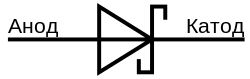

A Schottky diode is a semiconductor diode with a small voltage drop when directly connected. Named after the German physicist Walter Schottky . In the specialized literature, a more complete name is often used - the Schottky barrier diode .
In Schottky diodes, the metal-semiconductor transition is used as a Schottky barrier , in contrast to conventional diodes, where the pn junction is used . The metal-semiconductor transition has a number of special properties (different from the properties of the semiconductor pn junction). These include: reduced voltage drop during direct connection, high leakage current, very small reverse recovery charge. The latter is explained by the fact that, compared with the usual pn junction, such diodes do not have diffusion associated with the injection of minority carriers, i.e. they work only on the main media, and their performance is determined only by the barrier capacity.
Schottky diodes are usually made on the basis of silicon (Si) or gallium arsenide (GaAs) , less often - on the basis of germanium (Ge) . The choice of metal for contact with the semiconductor determines many parameters of the Schottky diode. First of all, it is the value of the contact potential difference formed at the metal-semiconductor interface. When using a Schottky diode as a detector, it determines its sensitivity, and when used in mixers, it determines the required local oscillator power. Therefore, the most commonly used metals are Ag , Au , Pt , Pd , W , which are deposited on a semiconductor and give a potential barrier of 0.2 ... 0.9 eV.
The permissible reverse voltage of the produced Schottky diodes is limited to 1200 volts (CSD05120 and analogues), in practice, most Schottky diodes are used in low-voltage circuits with a reverse voltage of the order of several tens of volts.
Content
- 1 Properties of Schottky diodes
- 2 Nomenclature of Schottky diodes
- 3 notes
- 4 References
Schottky Diode Properties
- Advantages
- The voltage drop across the Schottky diode when it is turned on directly is 0.2-0.4 volts, while for ordinary, for example, silicon diodes, this value is of the order of 0.6-0.7 volts. However, such a small voltage drop at the Schottky diode when it is switched on directly is inherent only in series with a minimum reverse voltage of the order of tens of volts, while for series with a higher maximum reverse voltage, the forward voltage drop becomes comparable to a silicon diode, which may limit the use of Schottky diodes.
- Theoretically, a Schottky diode may have a low Schottky barrier capacitance. The absence of a pn junction allows an increase in the operating frequency. This property is used in logic integrated circuits , where the base-collector transistor junctions are shunted by Schottky diodes . In power electronics, a short recovery time allows you to build rectifiers at frequencies of hundreds of kHz and higher. For example, the MBR4015 diode (15 V, 40 A ), designed to rectify high-frequency voltage, has a recovery time of 10 kV / μs [1] .
- Due to the above advantages, rectifiers on Schottky diodes differ from rectifiers on conventional diodes in a lower noise level, therefore they are preferred in analog secondary power supplies .
- disadvantages
- Even if the maximum permissible value of the reverse voltage is exceeded for a short time, the Schottky diode irreversibly fails, in contrast to ordinary silicon pn diodes, which switch to the reversible breakdown mode [2] , provided that the power dissipated by the diode crystal does not exceed the permissible values after falling The voltage diode completely restores its properties.
- Schottky diodes are characterized by increased (relative to conventional silicon pn diodes) reverse currents that increase with increasing crystal temperature. For the 30CPQ150, the reverse current at maximum reverse voltage changes from 0.12 mA at +25 ° C to 6.0 mA at +125 ° C. For low-voltage diodes in TO220 cases , the reverse current can exceed hundreds of milliamps (MBR4015 - up to 600 mA at +125 ° C). Poor heat dissipation conditions during the operation of the Schottky diode with high currents lead to its thermal breakdown.
Schottky Diode Nomenclature
Schottky diodes are components of modern discrete semiconductor devices:
- MOSFETs with a built-in Schottky reverse diode (first released by International Rectifier under the FETKY trademark in 1996 ) are the main component of synchronous rectifiers . Unlike a conventional MOS transistor, the reverse diode of which has a high forward voltage drop and mediocre time characteristics (since it is a normal diode at the pn junction formed by the drain regions and the substrate combined with the source), the use of the Schottky reverse diode allows one to construct synchronous power rectifiers with a conversion frequency of hundreds of kHz and higher. There are devices of this class with built-in gate drivers and synchronous rectification control devices.
- The so-called ORing [3] diodes and ORing assemblies are power diodes and diode assemblies used to combine parallel power supplies of a common load in high-reliability devices (logical OR power supply). They are distinguished by a particularly low, normalized direct voltage drop. For example, the specialized miniature diode MBR140 (30 V, 1 A) at a current of 100 mA has a direct voltage drop of no more than 360 mV at +25 ° C and 300 mV at +85 ° C. ORing diodes are characterized by a relatively large pn junction area and low specific current densities.
Notes
- ↑ alldatasheet.com. MBR4015 pdf, MBR4015 description, MBR4015 datasheets, MBR4015 view ::: ALLDATASHEET ::: unspecified . pdf1.alldatasheet.com. Date of treatment February 14, 2018.
- ↑ Semiconductor diode . TSB .
- ↑ Performing operation OR
Links
Schottky Diode - article from the Great Soviet Encyclopedia .