Nevada Test Site ( Eng. Nevada Test Site ) - one of the largest nuclear test sites in the United States , existing since 1951. Previously called Nevada Proving Ground . The landfill area is about 3500 km², 928 nuclear explosions were carried out on it. The very first 1 kiloton explosion was carried out on January 27, 1951.
| Nevada Test Site | |
|---|---|
| English Nevada Test Site | |
 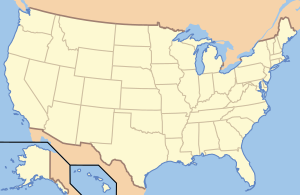 The location of the polygon. | |
| Type of | Nuclear Test Site |
| Location | near Las Vegas USA USA |
| Area | ~ 3,500 km² (~ 1350 miles²) |
| In management | US Department of Energy |
| condition | Operated by |
| In operation | 1951 - n. at. |
| Test | |
| Nuclear tests | 928 |
The location of the polygon. | |


Content
- 1 Geographical data
- 2 History of the landfill
- 2.1 1951-1992
- 2.2 1992—2007
- 3 Current status
- 4 Survival Studies
- 5 Test series of nuclear explosions at a nuclear test site in Nevada
- 6 See also
- 7 Notes
- 8 References
Geographic data
The landfill is located in the US in southern Nevada in Nye County, 105 km northwest of Las Vegas .
The landfill covers 3500 km². Its territory is divided into 28 parts, on which 1000 buildings, 2 runways, 10 helipads are located.
Landfill History
The first nuclear explosion at this training ground was carried out on January 27, 1951 . The power of the bomb was 1 kiloton . The creation of the landfill was part of the nuclear project and the choice was made, as it turned out later, very successfully - the terrain allowed for underground nuclear explosions in adits and in wells.
1951-1992
From 1951 to 1992, 928 charges were tested at the test site, 828 of which were underground [2] . Elsewhere, the United States detonated a total of 126 nuclear charges.
May 25, 1953 at the Nevada nuclear test site in the framework of the operation "Upshot-Knothole" the first ever shot was fired by an artillery nuclear shell Grable . The radioactive cloud from the shot (" nuclear mushroom ") was visible even in Los Angeles .
In the 1960s, mushroom clouds from explosions were visible over 160 km in any direction, including Las Vegas , where people came as tourists to look at them. Nuclear precipitation fell mainly on the city of St. George in Utah , and there were many more cancer patients in this city than the national average [3] [4] .
July 17, 1962, the explosion of "Little Feller I" of the Sunbeam operation was the last explosion in the atmosphere at a nuclear test site in Nevada.
Underground tests continued until September 23, 1992; explosions that do not reach critical mass continue to this day.
1992—2007
The usual non-nuclear explosion of a very powerful 1,100-ton bomb was planned in 2006, but this project was officially canceled in 2007 [5] .
Current status
Currently, nuclear explosions at the test site are not carried out. The administration of the Nevada nuclear test site organizes monthly tours of the territory, the queue for which is scheduled for the months ahead. Visitors are not allowed to take cameras, binoculars , mobile phones and other equipment, and are also forbidden to take stones from the landfill for memory [6] .
Survival Studies
The range reproduces buildings typical of European and American cities, various equipment and vehicles, fortifications of both NATO and the Warsaw Pact are located . All these objects were at different distances and at different angles to the points of the explosion.
High-speed cameras located in protected places recorded all the effects of blast waves, radiation, temperature and other consequences of nuclear explosions.
Nevada Test Site Nuclear Explosion Series
|
|
See also
- Nevada - Semipalatinsk
- Semipalatinsk nuclear test site
- Nuclear testing ground in Novaya Zemlya
Notes
- ↑ United States Geologic Survey. Nevada Test Site. Geologic Surface Effects of Underground Nuclear Testing . Accessed on April 18, 2009.
- ↑ United States Nuclear Tests ; July 1945 through September 1992, DOE / NV - 209-REV 15 December 2000, p. xv. Archived copy . Date of treatment November 10, 2009. Archived October 12, 2006.
- ↑ Johnson, Carl. Cancer Incidence in an Area of Radioactive Fallout Downwind From the Nevada Test Site // Journal of the American Medical Association : journal. - 1984. - Vol. 251 , no. 2 . - P. 230 . - DOI : 10.1001 / jama.1984.03340260034023 .
- ↑ Falk, Jim (1982). Gobal Fission: The Battle Over Nuclear Power , p. 134.
- ↑ Pentagon to Test a Huge Conventional Bomb , The Washington Post (March 31, 2006). Date of treatment May 20, 2010.
- ↑ US DOE / NNSA - Nevada Site Office, Nevada Test Site Tours http://www.nv.doe.gov/nts/nts.aspx Archived May 27, 2010 on Wayback Machine
Links
- DOE Nevada Test Site
- The Nevada Test Site Oral History Project
- Origins of the Nevada Test Site
- Radiation Exposure Compensation Act
- Account of NTS fallout in 1955 (PDF)
- Study Estimating Thyroid Doses of I-131 Received by Americans From Nevada Atmospheric Nuclear Bomb Test , National Cancer Institute (1997)
- Images of the Nevada Test Site
- Cards:
- Annotated bibliography for the Nevada Test Site from the Alsos Digital Library for Nuclear Issues
- 'Exposed' spreads anti-nuke message
- Russian translation documentary