Astrophysical Institute named after VG Fesenkov ( AFIF ) is a scientific institution founded on October 10, 1941 as the Institute of Astronomy and Physics of the Kazakhstan branch of the USSR Academy of Sciences in Alma-Ata , the capital of the Kazakh SSR , as a result of the evacuation of a group of astronomers from the European part of the USSR. In 1950, astronomers separated and the Astrophysical Institute of the Academy of Sciences of the Kazakh SSR was formed. In 1989, the institute was named after VG Fesenkova . The Soviet Astrophysical Institute had 250–300 employees in 2008, about 100 in 2008, and 169 in 2009 [1] .
| Astrophysical Institute named after VG Fesenkova ( Afif ) | |
|---|---|
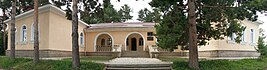 | |
| Former name | Astrophysical Institute of the Academy of Sciences of the Kazakh SSR |
| Based | 1941 |
| Director | R. R. Valiullin |
| Employees | 169 (2009) |
| Location | Kamen Plateau , Almaty , Kazakhstan |
| Legal address | 050020, Kazakhstan , Almaty , Observatory, 23 |
| Site | Official site |
Content
Institute Leaders
- 1941–1964 - V. G. Fesenkov - Founder and First Director of the Institute of Astronomy and Physics of the Kazakhstan Branch of the USSR Academy of Sciences (since 1950, head of the Astrophysical Institute of the Academy of Sciences of the Kazakh SSR)
- 1941–1943 - Vorontsov-Vel'yaminov, Boris Aleksandrovich - head of the Astrophysical Department of the Institute of Astronomy and Physics of the Kazakh Academy of Sciences.
- 1964-1972 - Idlis, Grigori Moiseevich
- 1974-1984 - Omarov, Tuken Bigalievich
- in 1987 - B.T. Tashenov
- 2005—2010 - Chechin, Leonid Mikhailovich
- 2010—2016 - Omarov, Chingis Tukenovich
- 2016—2017 - Valiullin, Rashit Ravilevich
- c 2017 - Bibosinov, Asylkhan Zhanibekovich
Institute History
On September 21, 1941, 7 expeditions were observed in Kazakhstan , which included astronomers, physicists and geophysicists from Moscow and Leningrad . In the light of the active offensive of the fascist troops in the western part of the country, they decided to stay in Kazakhstan and join the evacuated scientists in Almaty. This is how the team of the Research Institute of Astronomy and Physics was formed, which was created in a few weeks at the suggestion of V. G. Fesenkov. The building of the institute was built during the war by Japanese prisoners.
The Astrophysical Institute was one of the first organizations in which in the middle of the 20th century a new science, astrobiology, was born [2] [3] .
Observational bases
- Kamenskoe Plateau Observatory
- Assy-Turgen Observatory
- Tien Shan Astronomical Observatory
- Radio polygon "Orbit". Located at an altitude of 2740 meters above sea level, next to the Tien-Shan Astronomical Observatory, 40 km from Almaty. Established in 1978. Since 2009, unique devices purchased in Canada and the United States have been installed at the radio ground, which allow studying the atmosphere at an altitude of 90 kilometers using frequency spectra; a solar radio telescope with an antenna TNA-57 is working, on which radiometers are mounted on waves of 10.7 and 27.8 cm ; In May 2011, a radio spectrograph was launched for the range of 45 - 870 MHz . The landfill belongs to the Institute of Ionosphere of the Republic of Kazakhstan .
- The observatory of the astrobotany sector of the Academy of Sciences of the Kazakh SSR. It was founded by G. A. Tikhov , who in 1948 headed an independent institution — the sector of astrobotany of the Academy of Sciences of the Kazakh SSR. After the death of Tikhov in 1960, the sector of astrobotany was disbanded.
- Other observatories:
- Observatory in Petropavlovsk, which appeared thanks to the efforts of enthusiast Andrei Solodovnik and students.
- In Priozersk only created, its staff will monitor the artificial satellites of the Earth.
JSC "National Center for Space Research and Technology" (JSC "NC KIT")
JSC "National Center for Space Research and Technology" (JSC "NC KIT") - established by a decree of the Government of Kazakhstan in January 2008. The head of JSC "NC KIT" - Zhumabek Zhantaev. The field of research of NC KIT JSC: studies of galactic systems, stars and planets, physics of the formation and evolution of space weather, physics of the interaction of particles and nuclei accelerated in terrestrial conditions and outer space, the study of the radiation environment of near-Earth space. The center was established on the basis of the Republican state-owned enterprise “Center for Astrophysical Research” and its subsidiaries - the Institute for Space Research and formerly included in the Academy of Sciences of the Ionosphere Institute and the Astrophysical Institute named after them. V.G. Fesenkova.
Institute laboratories
- Artificial Earth Satellites and Information Systems.
- Physics of stars and nebulae.
- Cosmology, stellar dynamics and computational astrophysics.
- Physics of the moon and planets.
- Nuclear astrophysics.
- Active processes in space.
- Group of spectral observations of active galactic nuclei (AGN)
- Theoretical model development group.
- Solar Activity Group.
Research Directions
- Atmospheric optics
- Interstellar medium
- Light and dark nebulae
- Solar Activity
- Spectrophotometry of active galaxies
- Star astronomy
- Big Planets of the Solar System
- Comets
- Astrometry AES
- Giant planets
- complex research of AGN (experimental and theoretical)
- research in the physics of the early universe
- the problem of space debris and comet-meteor-asteroid danger
The main topics of scientific work
- Creating and maintaining a catalog of artificial space objects.
- The study of the dynamics of natural and artificial celestial bodies in cosmic force fields.
- The study of the physics of emerging space objects.
- Research of non-stationary processes on the Sun and in the atmospheres of the planets of the solar system
- The development of astrophysical research for high-precision determination of the orbits of space objects.
- The development of modern numerical methods in gas mechanics and plasma physics and their application in astrophysical research and astrodynamics.
- Development of qualitative, analytical and numerical methods for the study of non-stationary problems of the dynamics of artificial and natural celestial bodies.
- Development of methods for astrometric calculations for problems of space flight dynamics.
General Publications
- "News" of the Institute (1955-1962)
- thematic "Works" (since 1961)
See also
- National Academy of Sciences of Kazakhstan
- Kamenskoe Plateau Observatory
- Assy-Turgen Observatory
- Tien Shan Astronomical Observatory
- List of astronomical instruments
Notes
- ↑ Astrophysical Institute. V.G. Fesenkova - composition Archived October 26, 2009.
- ↑ Tejfel, V. Gavriil Adrianovich Tikhov (1875–1960), a pioneer in astrobiology ( Neopr .) // Highlights of Astronomy. - 2009. - August ( v. 15 ). - S.: 720-1. . - DOI : 10.1017 / S1743921310011166 .
- ↑ Briot, D. The Creator of Astrobotany, Gavriil Adrianovich Tikhov (eng.) // Astrobiology, History, and Society (edited by D. A. Vakoch): journal. - 2013. - P.: 175-185. . - DOI : 10.1007 / 978-3-642-35983-5_8 .
Links
- Astrophysical Institute. V.G. Fesenkova - on the website of the Center for Astrophysical Research
- Collection of news on astronomical topics in Kazakhstan
- "KIT goes to the stars" - an interview about the current state of affairs at the Institute
- Joint-stock company "National Center for Space Research and Technology" NCA RK
- Space Research Institute
- Description of institute tools
- Planetary Researches in Kazakhstan
- Observatory of the Astrophysical Institute
- Astrophysical Institute named after Fesenkov // Great Soviet Encyclopedia : [in 30 t.] / Ch. ed. A. M. Prokhorov . - 3rd ed. - M .: Soviet Encyclopedia, 1969-1978.