Brunia ( lat. Bruniales ) - the order of dicotyledonous plants. Consists of two families, uniting 80 species in 14 genera. The flowers of all representatives of the order are actinomorphic [2] .
| Brunia | |||||||||||||||
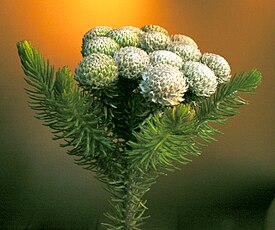 Brunia sp. The upper part of the shoot with coniferous leaves and cone-shaped inflorescences (about 1 cm in diameter), collected in a complex inflorescence. | |||||||||||||||
| Scientific classification | |||||||||||||||
|---|---|---|---|---|---|---|---|---|---|---|---|---|---|---|---|
| |||||||||||||||
| International Scientific Name | |||||||||||||||
Bruniales Dumort. (1829) | |||||||||||||||
| Families | |||||||||||||||
See text | |||||||||||||||
In the classification system, APG III is included in the campanulids group (euasterids II).
Content
Synonyms
The synonyms of order include the following names [2] :
- Columelliales Doweld (2001)
- Brunianae Doweld (2001)
The composition of the order
The order consists of two families:
- Bruniaceae Bercht. & J.Presl (1820) , nom. cons. - Brunia . The total number of genera of the family is 12, the total number of species is about 75 [3] .
- Columelliaceae D.Don (1828) , nom. cons. - Columellic . Two kinds, 5 species. The monotypic genus Desfontainia Ruíz & Pav. previously it was usually distinguished in the monotypic family Desfontainiaceae Endl. (1841) , nom. cons. [four]
Representatives of Brunia are common in southern Africa; these are shrubs and perennial herbaceous plants with needle leaves and inflorescences that look like small buds, which are combined into complex inflorescences [3] .
Representatives of columellia are plants from Central and South America . Columellia is a genus of shrubs and trees growing in the Andes ; the northern boundary of the range of the genus is in the south of Colombia , the southern boundary of the range - in Bolivia . Desfonainia is a genus of shrubs spread from Costa Rica in the north to Chile in the south [4] .
Earlier Systems
There was no order of Bruniales in the APG I (1998) and APG II (2003) classification systems. The Bruniaceae , Columelliaceae, and Desfontainiaceae families were included in the euasterids II group, but they did not belong to any order.
Some authors included the Bruniaceae and Columelliaceae families in the Dipsacales order. The proximity of the Bruniaceae family to representatives of the Asterales order was also indicated [2] .
Phylogeny
Below is a cladogram of the asterids group, showing the alleged kinship relations of the order Brunece according to the classification system APG III (2009) [5] :
| asterids |
| ||||||||||||||||||||||||||||||||||||||||||||||||||||||||||||||||||||||||
Notes
- ↑ About the conditionality of specifying the class of dicotyledons as a higher taxon for the group of plants described in this article, see the section “APG Systems” of the article “Dicotyledons” .
- ↑ 1 2 3 Brunece (English) : information on APWeb . (Verified May 25, 2010)
- ↑ 1 2 Bruniyevy (English) : information on the APWeb website (Verified on May 25, 2010) .
- ↑ 1 2 COLUMELLIA (eng.) : Information on the APWeb website (Verified on May 25, 2010) .
- ↑ Angiosperm Phylogeny Group (2009). An update of the Angiosperm Phylogeny Group: APG III // Botanical Journal of the Linnean Society: Journal. - London, 2009. - T. 161 , № 2 . - pp . 105-121 . - DOI : 10.1111 / j.1095-8339.2009.00996.x . (Verified May 25, 2010)
| |||||||||||||||||||||||||||||||||||||||||||||||||||||||||||||||
| •• Angiosperm Phylogeny Group (including Bremer B. , Bremer K. , Rivil D. , Chase M. ) • APG I • APG II (+ list ) • APG III (+ list ) •• |