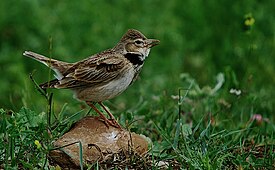
The steppe lark , or the common steppe lark , or dzhurbay , or calender [1] ( lat. Melanocorypha calandra ), is a species of passerine bird from the family of larks (Alaudidae) [2] .
| Steppe lark |
 |
| Scientific classification |
|---|
| No rank : | Bilateral symmetric |
|
| International Scientific Name |
|---|
Melanocorypha calandra ( Linnaeus , 1766 ) |
| Security status |
|---|
Least concernIUCN 3.1 Least Concern : 22717285 |
|
Content
These are large larks 17.5-20 cm long with a nondescript color. They are painted brown above and white below with two large black spots on the chest . There is a white stripe along the hind margin of the wing (noticeable only in flight), the outer tail feathers are also white.
Steppe larks live in countries such as Azerbaijan , Albania , Algeria , Armenia , Afghanistan , Bulgaria , Bosnia and Herzegovina , Greece , Georgia , Egypt , Israel , Jordan , Iraq , Iran , Spain , Italy , Kazakhstan , Cyprus , Kyrgyzstan , Lebanon , Libya , Macedonia , Morocco , Moldova , Palestine , Portugal , the Russian Federation , Romania , Saudi Arabia , Serbia , Syria , Slovenia , Tajikistan , Tunisia , Turkmenistan , Turkey , Uzbekistan , Ukraine , France , Croatia , Montenegro [3] .
For nesting, these birds prefer open spaces such as steppes . The nest of the steppe lark is on the ground, usually 4-5 eggs are found in the clutch. The main food of these birds is grain . During the mating season, their “menu” is also supplemented by insects . The song resembles a song of a field lark , but louder.