The square root of 2 is a positive real number , which when multiplied by itself gives the number 2 . Designation:

| Irrational numbers ζ (3) - ρ - √ 2 - √ 3 - √ 5 - ln 2 - φ, Φ - ψ - α, δ - e - and π | |
| Number system | Estimated number √ 2 |
| Decimal | 1.4142135623730950488 ... |
| Binary | 1.0110101000001001111 ... |
| Hexadecimal | 1.6A09E667F3BCC908B2F ... |
| Sixty | one; 24 51 10 07 46 06 04 44 50 ... |
| Rational approximations | 3/2 ; 7/5 ; 17/12 ; 41/29 ; 99/70 ; 239/169 ; 577/408 ; 1393/985 ; 3363/2378 ; 8119/5741 ; 19601/13860 (listed in order of increasing accuracy) |
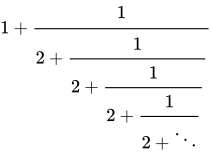
| Continued fraction | |

1.4142135623 7309504880 1688724209 6980785696 7187537694 8073176679 7379907324 7846210703 8850387534 3276415727 3501384623 0912297024 9248360558 5073721264 4121497099 9358314132 2266592750 5592755799 9505011527 8206057147 0109559971 6059702745 3459686201 4728517418 6408891986 0955232923 0484308714 3214508397 6260362799 5251407989 6872533965 4633180882 9640620615 2583523950 5474575028 7759961729 8355752203 3753185701 1354374603 4084988471 6038689997 0699004815 0305440277 9031645424 7823068492 9369186215 8057846311 1596668713 0130156185 6898723723 5288509264 8612494977 1542183342 0428568606 0146824720 7714358548 7415565706 9677653720 2264854470 1585880162 0758474922 6572260020 8558446652 1458398893 9443709265 9180031138 8246468157 0826301005 9485870400 3186480342 1948972782 9064104507 2636881313 7398552561 1732204024 5091227700 2269411275 7362728049 5738108967 5040183698 6836845072 5799364729 0607629969 4138047565 4823728997 1803268024 7442062926 9124859052 1810044598 4215059112 02494413 41 7285314781 0580360337 1077309182 8693147101 7111168391 6581726889 4197587165 8215212822 9518488472
The first 1000 characters of the value are √ 2 [1] .

Geometrically, the root of 2 can be represented as the length of the diagonal of a square with side 1 (this follows from the Pythagorean theorem ). This was probably the first irrational number known in the history of mathematics (that is, a number that cannot be accurately represented as a fraction ).

A good and frequently used approach to is a fraction . Despite the fact that the numerator and denominator of the fraction are only two-digit integers, it differs from the real value by less than 1/10000.


History
The Babylonian clay tablet (c. 1800–1600 BC) gives the most accurate approximate value when writing in four six-decimal digits, which after rounding is 6 exact decimal digits:
Another early approximation of this number in the ancient Indian mathematical text called the Shulba Sutras (c. 800-200 BC) is given as follows:
- {\ displaystyle 1 + {\ frac {1} {3}} + {\ frac {1} {3 \ cdot 4}} - {\ frac {1} {3 \ cdot 4 \ cdot 34}} = {\ frac {577} {408}} \ approx 1.414215686.}
The Pythagoreans found that the diagonal of a square is incommensurable with its side, or in modern language, that the square root of the two is irrational . Little is known with certainty about the time and circumstances of this outstanding discovery, but traditionally its authorship is attributed to Hippasus of Metapont , who, according to different versions of the legend, either killed or expelled the Pythagoreans for this discovery, blaming him for the destruction of the main Pythagorean doctrine of that "everything is a [natural] number." Therefore, the square root of 2 is sometimes called the Pythagorean constant, since it was the Pythagoreans who proved its irrationality, thereby discovering the existence of irrational numbers .
Computation Algorithms
There are many algorithms for calculating the square root of the two. The result of the algorithm is an approximate value in the form of an ordinary or decimal fraction . The most popular algorithm for this, which is used in many computers and calculators, is the Babylonian method of calculating square roots. It consists of the following:
The more repetitions in the algorithm (i.e., the more ), the better the approximation of the square root of two. Each repetition approximately doubles the number of correct digits. A few first approximations starting with :
In 1997, Yasumasa Canada calculated the value Up to 137 438 953 444 decimal places. In February 2007, the record was broken: Shigeru Kondo calculated 200 billion decimal places for the decimal point for 13 days and 14 hours using a processor with a frequency of 3.6 GHz and 16 GB of RAM .
Mnemonic rule
To memorize the value of the root of a deuce with eight decimal places (1.41421356), you can use the following text (the number of letters in each word corresponds to a decimal digit): “And I have fruit, but they have many roots.”
Square root properties of two
Half approximately equal to 0.70710 67811 86548; this value gives in geometry and trigonometry the coordinates of a unit vector forming an angle of 45 ° with the coordinate axes:
One of the interesting properties consists of the following:
- . Because
This is the result of a silver section property.
Another interesting property :
The square root of two can be expressed in imaginary units of i , using only square roots and arithmetic operations:
- and
The square root of 2 is the only number other than 1 whose infinite tetration is equal to its square.
The square root of two can also be used to approximate :
- at
In terms of higher algebra , is the root of the polynomial and therefore it is an integer algebraic number [2] . The set of numbers of the form where - rational numbers , forms an algebraic field . It is designated and is a subfield of the field of real numbers .
Proof of Irrationality
We apply the proof by contradiction : for example, rational , that is, it is represented as a fraction where Is an integer , and - natural .
Square the supposed equality:
- .
Since decomposition by prime factors contains to an even degree, and - in odd, equality impossible. So the initial assumption was wrong, and - irrational number.
Continuous Fraction
The square root of two can be represented as a continued fraction :
Suitable fractions of a given continued fraction give approximate values that quickly converge to the exact square root of two. The way to calculate them is simple: if we denote the previous suitable fraction then the subsequent one has the form . The convergence rate here is less than the Newton method, but the calculations are much simpler. We write down the first few approximations:
The square of the last fraction given is (rounded) 2.000000177.
Paper Size
The square root of two is used in the aspect ratio of a sheet of paper in ISO 216 format. Aspect ratio is equal . When cutting a sheet in half parallel to its short side, two sheets of the same proportion will be obtained. This allows you to number paper sizes in one number in descending order of the sheet area (number of cuts): A0, A1, A2, A3, A4 , ...
See also
- Irrational numbers
- Vieta Theorem
Notes
- ↑ The Square Root of Two, to 5 million digits
- ↑ Not to be confused with an integer .
Literature
- Claudi Alsina. Sect of numbers. Pythagorean theorem. - M .: De Agostini, 2014 .-- 152 p. - (World of Mathematics: in 45 volumes, volume 5). - ISBN 978-5-9774-0633-8 .