Locusts , acridas - several species of insects of the family Locust ( Acrididae ), capable of forming large flocks (numbering up to hundreds of millions of individuals), migrating over considerable distances. A specific feature of the locust biology is the presence of two phases - single and herd, differing in morphology and behavior [1] .
| Group of animals | |
|---|---|
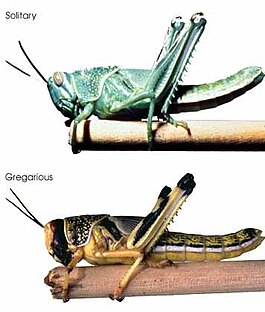 Nymphs of the solitary (above) and herd (below) phases of the desert locust Nymphs of the solitary (above) and herd (below) phases of the desert locust | |
| Title | |
| Locust | |
| Title Status | |
| not determined | |
| Parent taxon | |
| Real Locust family ( Acrididae ) | |
| Representatives | |
Content
Etymology
The word is borrowed from Turkic languages (according to Vasmer ’s etymological dictionary from Turk. Sarynča - the same, derived from sary (ɣ) “ yellow ” (cf. tur . Sarı ), saryǯa “yellowish”; cf. kipch . Sarynčqa - the same, saryǯqa (XIII century)).
Views
There are several species of locusts belonging to three subfamilies [2] :
- Cyrtacanthacridinae
- Anacridium melanorhodon - East Africa , southwest of the Arabian Peninsula .
- Anacridium wernerellum - East Africa.
- Nomadacris septemfasciata - South Africa.
- Nomadacris succincta - Southwest Asia .
- Schistocerca americana - South America .
- Schistocerca gregaria - Desert Locust - North Africa , Arabian Peninsula, Hindustan .
- Schistocerca piceifrons - Central America .
- Anacridium wernerellum - East Africa.
- Oedipodinae
- Chortoicetes terminifera - Australia .
- Locusta migratoria - Locust migratory - Southern Europe , Africa, South of Russia , China , Japan , Australia.
- Locustana pardalina - South Africa , Mozambique .
- Locusta migratoria - Locust migratory - Southern Europe , Africa, South of Russia , China , Japan , Australia.
- Homphocerinae
- Dociostaurus maroccanus - Moroccan locust - Mediterranean , Middle East , Central Asia .
Another species of Melanoplus spretus , which lived in the Rocky Mountains region in the USA, became extinct at the end of the 19th century [3] .
Locust phases
The herd and solitary (filly) locust phases have significant differences, both in appearance and physiology, and in the nature of behavior. These two phases differ so much that at one time the insects of the single phase of the genus Locusta were assigned to another genus ( Pachytylus ) [2] .
Locusts of a single phase usually have a protective coloration, pronounced sexual dimorphism and lead a low activity (at least at the larval stage) solitary lifestyle. The insects of the herd phase are colored more brightly and contrastly, morphologically the adults are more adapted to flight. Locusts in this phase behave much more actively, swarms of larvae or flocks of adults form. In the herd phase, sexual dimorphism is practically absent [2] .
In the single phase, locusts exist when there is enough food to preserve a population. When food begins to be scarce (most often this occurs in hot, dry years), locusts lay off “marching” offspring, which gather in large accumulations, they undergo significant metamorphoses - the size of their bodies and wings increases, and the mares turn into locusts. A signal factor for such a conversion is population density. It has been experimentally shown that in order for a sedentary locust to have such offspring, it is enough to place mirrors on its plot [4] . Seeing a lot of its reflections and conflicting with them, the locust lays eggs with an activated alternative “hiking” program.
According to recent studies, filly mites become locusts due to protein deficiency. At the same time, some of them become locusts, attacking protein-rich relatives, and others - fleeing from predatory relatives. Along the way, both reinforce their strength by consuming carbohydrate-containing feed (that is, all available vegetation) [5] .
Bible Locusts
- The locust attack is the eighth Egyptian execution , a sign for Pharaoh to allow Moses to lead the people out of Egypt ( Exodus 10:13 ).
- Locusts were food in the desert for John the Baptist ( Matthew 3: 4 ).
- Locusts emerge from the smoke to the ground in a vision of John the Theologian ( Rev. 9: 3 ).
Locust Invasion
The first annalistic mention of the locust invasion of Russia dates back to 1008, which resulted in famine. The invasion was repeated in 1094, 1095, 1103 and 1195. Similar misfortunes were repeated in the XVI-XVII centuries [6] .
In 1824, a locust invasion was observed in the south of modern Ukraine , in the Kherson , Yekaterinoslav and Tauride provinces, and A.S. Pushkin was seconded to fight it. He made a short report [7] :
May 23 - Flew, flew
May 24 - And sat down
May 25 - Sat, sat
May 26 - I ate everything
May 27 - Flew away again .
The largest invasion of locusts in human history occurred in the United States in 1875. A flock of locusts from the state of Texas spread to the west, but after a while, having made colossal devastations, it disappeared as unexpectedly as it appeared [8] .
Currently, vast areas of crops across the Earth suffer from locust invasions, especially in Africa.
Other facts
Locusts are found almost everywhere, with the exception of the coldest areas.
The body length of the locust ranges from 1 cm for meadow locusts to 6 cm for migratory locusts. The largest individuals can reach 20 cm in length.
Locusts are different from grasshoppers and crickets by the length of their antennae: they are shorter.
Every day, one locust eats the amount of plant food equal to its own weight.
There are swarms of locusts, numbering several billion individuals. They form “flying clouds” or “clouds”, the area of which can reach 1000 km 2 .
When the locust wings rub against each other, a characteristic creaky sound is heard. The noise produced in flight by a flock of several million insects can be mistaken for thunder.
Sound locust extraction is carried out by friction of the hind leg with special tubercles on the elytra [9] .
Locusts live from 8 months to 2 years.
Notes
- ↑ More on locusts . www.fao.org. Date of treatment January 13, 2019.
- ↑ 1 2 3 Resh VH (ed.), Carde RT (ed.) . Encyclopedia of Insects. Academic Press. 2003. p. 666–669
- ↑ Matthew Garcia. Melanoplus spretus (Rocky Mountain Locust) Animal Diversity Web. Date of treatment January 13, 2019.
- ↑ Dolnik V. R. Demographic explosion - through the eyes of a biologist // Knowledge - Power : Well .. - 1990. - Issue. 3 .
- ↑ Locusts: invasions and riddles . Date of treatment January 13, 2019.
- ↑ Outbreaks of mass propagation of phytophages in the forests of the European part of Russia from ancient times to the present . science-bsea.narod.ru. Date of treatment January 13, 2019.
- ↑ Secret of Pushkin’s trip to the locust. (inaccessible link) . Date of treatment July 4, 2015. Archived July 5, 2015.
- ↑ (inaccessible link - history , copy )
- ↑ Morozov V.P. Entertaining bioacoustics. Ed. 2nd, add., Rev. - M .: Knowledge, 1987 .-- 208 p. + 32 s. incl. - S. 38
Literature
- Soviet encyclopedic dictionary . - M., 1984
- Bei-Bienko G. Ya. , Mishchenko L. L. , 1951. Locust faunas of the USSR and neighboring countries // Def. According to the fauna of the USSR. Publishing house of the Institute of Zoo. USSR Academy of Sciences. M.-L. T. 38. Part 1. S. 1-380 .; T. 40. Part 2.P. 381-667.
- Berezhkov R.P. Locusts of Western Siberia. - Tomsk: Publishing House of Tomsk University, 1956. - 176 p.
- s: BEAN / Locust // Biblical Encyclopedia of Archimandrite Nicephorus . - M. , 1891-1892.
- Locust // Small Encyclopedic Dictionary of Brockhaus and Efron : in 4 volumes - St. Petersburg. 1907-1909.
- Locust // Brockhaus and Efron Encyclopedic Dictionary : in 86 volumes (82 volumes and 4 additional). - SPb. , 1890-1907.