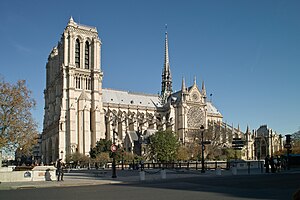
The Cathedral is the main temple of a city or monastery in which the service is led by a bishop ( archbishop , metropolitan , patriarch ).
In the synodal period in the history of the Russian Church, the cathedral could also designate the main church of the department in which protopresbyter of the military, sea or court clergy performed divine services, and regimental cathedrals were created in regiments with a long history. In large cities, each of the administrative units had its own cathedral [1] .
For example, in St. Petersburg , in addition to the main cathedral , there were cathedrals of the main parts of the city, as well as two court cathedrals, two naval cathedrals, four military cathedrals, a cathedral of all educational institutions, as well as two memorial cathedrals: Sampsonievsky and "Savior on Spilled Blood" . The tradition of the construction of memorial cathedrals (cathedrals-monuments) dates back to Ancient Russia . In particular, such a cathedral-monument was the famous Cathedral of the Intercession on the Moat (better known as St. Basil's Cathedral ) [1] , located in Moscow on Red Square .
The Russian term cathedral in Western European languages corresponds to the terms English. cathedral , fr. cathédrale , German Kathedrale , Ital. cattedrale , sp. catedral , derived from the word pulpit . Thus, they indicate that we are talking about a cathedral church, in Russian often referred to as a "cathedral". In Italian and German, another term is often used to refer to the cathedral, etymologically dating back to lat. domus - ital. duomo , dumb . Dom .
Content
Status Value
In Orthodoxy, the status of the cathedral is also assigned to the main temple of the city, the monastery , and churches of particular importance in the capitals [2] .
Both in Orthodoxy and in Catholicism , the status of the cathedral is assigned to the church once and for all. The ruling bishop can build or elect another temple for himself to find a pulpit. Then the status of the cathedral is assigned to the new church, the name of the cathedral also remains behind the former cathedral (although there is no episcopal department in it). In Moscow , for example, the cathedrals are called the former patriarchal cathedrals: the Assumption , Arkhangelsk and Blagoveshchensky in the Kremlin , Pokrovsky (St. Basil the Blessed) on Red Square , built by Ivan the Terrible to commemorate the capture of Kazan , Epiphany (Elokhovsky), etc. Moreover, the cathedrals are [3 ] Epiphany and the Cathedral of Christ the Savior .
The size of the cathedral may not differ from the usual parish church, but it is calculated that divine services (mainly festive) are performed by a clergy council , that is, there are several priests in the church’s staff (ideally, the abbot and 12 priests serving him, in the image of Christ and twelve apostles). In reality, the clergy are numerous only in the main churches of the diocese (for example, under the title "Metropolitan of Smolensk and Kaliningrad" the cathedrals should be in Smolensk and Kaliningrad), where the bishop's chair is located. In Catholic cathedrals, modern worship even on holidays is often performed by a single priest.
The cathedral of the second diocesan city can be quite small in size, rarely visited by the bishop (which together does not make it necessary to stay permanently in the center of the cathedral church) with a small staff of priests (two or three).
In a monastery (mainly in a man’s monastery , where monastic monks often have the holy dignity, especially those who occupy key positions - the deanery , ecclesiarch , sacristy , etc.), as a rule, there is always a cathedral church called a catholicon .
Features
Orthodoxy
Along with the building where the current department of the bishop is located, the cathedrals are the buildings where this department has ever been.
In addition, the cathedral is called the main church of the monastery ( catholicon in modern Greece). It should be noted that the monastery cathedral may be the main church of the diocese.
Catholicism
For Catholics, the cathedral is the building where the episcopal department is located or was. In addition to the cathedrals themselves, there are:
- Co-cathedral - the building in which the second department of the diocese is located, or the second cathedral of the diocese.
- Pro-cathedral (pro-cathedral, English Pro-cathedral ) - a building that temporarily performs the functions of a cathedral or a second cathedral.
- the small basilica is an honorary title given by the pope to some important cathedrals.
Protestantism
Among Protestants ( Anglicans , Lutherans ), the cathedral is always a temple where there is or was a bishop's chair. Recently, however, the name "cathedral" has sometimes been used metaphorically - for example, the Arctic Cathedral (the parish church in Tromsø ) or the Crystal Cathedral (the presbyterian mega church , which never had an institute of an episcopate).
The most famous cathedrals
In Orthodoxy
- Annunciation Cathedral (Voronezh)
- Annunciation Cathedral (Athens, Greece)
- Vladimir Cathedral (Kiev, Ukraine)
- Dmitrievsky Cathedral (Vladimir, Russia)
- St. Isaac's Cathedral (St. Petersburg, Russia)
- Kazan Cathedral (St. Petersburg, Russia)
- Peter and Paul Cathedral (St. Petersburg, Russia)
- St. Nicholas Cathedral ( Bialystok , Poland )
- Smolny Cathedral (St. Petersburg, Russia)
- Savior on the Blood (St. Petersburg, Russia)
- Cathedral of Saint Sava Belgrade, Serbia
- Saint Sophia Cathedral (Kiev, Ukraine)
- Saint Sophia Cathedral (Veliky Novgorod, Russia)
- Saint Sophia Cathedral (Vologda, Russia)
- Saint Sophia Cathedral (Polotsk, Belarus)
- Trinity Cathedral (Tbilisi, Georgia)
- Assumption Cathedral of the Moscow Kremlin (Moscow, Russia)
- Assumption Cathedral (Vladimir, Russia)
- Assumption Cathedral (Tbilisi, Georgia)
- Pokrovsky Cathedral (St. Basil's Cathedral) (Moscow, Russia)
- Cathedral of Christ the Savior (Moscow, Russia)
In Catholicism
- St. Peter's Basilica (Rome, Vatican City)
- Cathedral of Santa Maria del Fiore (Florence, Italy)
- St. Mark's Cathedral (Venice, Italy)
- Milan Cathedral (Milan, Italy)
- Cologne Cathedral (Cologne, Germany)
- Konigsberg Cathedral (Cathedral in Kaliningrad , Russia )
- Frankfurt Cathedral (Frankfurt, Germany)
- Speyer Cathedral (Speyer, Germany)
- Notre Dame Cathedral (Paris, France)
- Strasbourg Cathedral (Strasbourg, France)
- Rouen Cathedral (Rouen, France)
- Amiens Cathedral (Amiens, France)
- Reims Cathedral (Reims, France)
- St. Francis Xavier Cathedral (Grodno, Belarus)
- Cathedral of Our Lady of Antwerp (Antwerp, Belgium)
- Salisbury Cathedral (Salisbury, England)
- St. Vitus Cathedral (Prague, Czech Republic)
- Cathedral of St. Stanislava (Vilnius, Lithuania)
- Latin Cathedral (Lviv, Ukraine)
- Archcathedral of the Blessed Virgin Mary (Minsk, Belarus)
- Cathedral of the Immaculate Conception of the Blessed Virgin Mary (Moscow, Russia)
In Protestantism
- St. Nicholas Cathedral (Helsinki, Finland)
- Minster Cathedral (York, UK)
- Berlin Cathedral (Berlin, Germany)
- Dome Cathedral (Riga, Latvia)
- Ulm Cathedral (Ulm, Germany)
Pre-Separated Churches
- St. Peter's Basilica in Rome
- St. Sophia Cathedral in Constantinople
- St. Sophia Cathedral in Kiev
- Saint Sophia Cathedral in Veliky Novgorod
Orthodox cathedrals in painting
Cathedral Lists
- List of Russian Cathedrals
- List of cathedrals in France
- List of Cathedrals in the Novgorod Region
Notes
- ↑ 1 2 Cathedral Archival copy of April 11, 2015 on the Wayback Machine (unavailable link from 06/14/2016 [1161 days]) // Russian Humanitarian Encyclopedic Dictionary: In 3 vols. - M.: Humanit. ed. Center VLADOS: Filol. Fak. St. Petersburg state University, 2002.
- ↑ Complete Orthodox Theological Encyclopedic Dictionary, vol. 2. M .: Renaissance, 1992
- ↑ Moscow diocese (city) / Organizations / Patriarchy.ru . Patriarchy.ru. Date of appeal September 30, 2016.