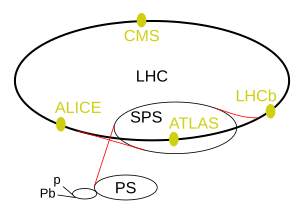
MoEDAL ( Monopole and Exotics Detector At the LHC ) is the seventh experimental setup at the Large Hadron Collider in CERN [1] . It is located at point 8 of the LHC in the same cavity as the LHCb , and is designed to search for the event of the birth of massive stable (or pseudo-stable) particles (such as magnetic monopoles or dyons ) that are generated during beam collisions in the LHC .
In November 2013, the first MoEDAL results from magnetic analysis of metal rods were published. When studying all samples, a signal from magnetic monopoles was not detected. The results make it possible to exclude the presence in the samples of captured monopoles with a magnetic charge of more than 0.4 from the Dirac charge, the standard unit of measurement of the magnetic charge of a monopole.
The new phase of the MoEDAL experiment will take place in 2014–2015 with a large volume of sensitive substance.
In 2015, the MoEDAL Large Hadron Collider detector searched for magnetic monopoles at a collision energy of 13 TeV. No traces of magnetic monopoles with a mass of up to 6 TeV and a magnetic charge of up to 5 Dirac units were found, the question of their existence remained open [2] .
Notes
- ↑ CERN Courier, “MoEDAL becomes the LHC's magnificent seventh” , 05/05/2010.
- ↑ Magnetic monopoles are not visible even at an energy of 13 TeV
Links
- http://moedal.web.cern.ch/
- MoEDAL experiment // “Elements”, 2010
- Aims of the moedal experiment
- K. Bendtz et al., Search in 8 TeV proton-proton collisions with the MoEDAL monopole-trapping test array // arXiv: 1311.6940, 11.27.2013
- The results of the MoEDAL experiment on the search for magnetic monopoles are presented // "Elements", 02/02/2013