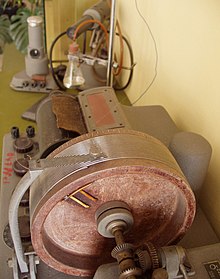

Polarography is one of the most important electrochemical methods for analyzing substances and studying the kinetics of chemical processes.
Content
Method Origin
It was proposed by J. Geyrovsky in 1922 when he studied the effect of the voltage applied to a mercury drop immersed in an aqueous solution on the surface tension (the so-called "electrocapillary effect"). He noted that the magnitude of the current through the drop depends on the composition of the solution. Refining this idea, he created a method that is based on measuring the dependence of current on voltage on a mercury-drop electrode. The resulting dependences, the so-called current-voltage curves or voltammograms, depend on the composition of the solution and allow both qualitative and quantitative analysis of trace elements contained in the solution. In 1959, Geyrovsky was awarded the Nobel Prize in Chemistry for the method of polarography.
In the USSR, the first researcher of the polarography method was Evgenia Varasova . She worked in Czechoslovakia as an assistant to Professor J. Geyrovsky, and, returning to Leningrad, translated his book Polarographic Method. Theory and practical application. " In 1938, Yevgeny Varasova was sentenced by Art. 58-6 of the Criminal Code of the RSFSR to capital punishment and shot [1] .
Principle of the method
The flow of electric current in an aqueous solution is associated with the movement of ions formed as a result of electrolytic dissociation. The flow of current through mercury, other metal and carbon materials - with the movement of electrons. Therefore, at the electrode / solution interface, there must be some process that ensures the transition of the ion flux into the electron flux, otherwise the current will not go. Such a process is an electrochemical reaction. The amount of reacted substance is determined by the Faraday law, that is, in proportion to the charge passing through the electrode:
- M = M equiv Q / ( z F ),
Where M is the mass of the reacted substance, M eq is the equivalent mass of the reacted substance, Q is the charge passed through the electrode, z is the number of electrons involved in the conversion of one molecule or one ion, F is the Faraday number that determines the proportionality coefficient. The Faraday number is 96,485 C / mol and represents the Avogadro number times the electron charge. If we attribute the equation above to a unit of time, then the mass will turn into the mass reaction rate (substance flow) J , and the charge will turn into current i , which are usually referred to the unit surface of the electrode (current density):
- J = M equiv i / ( z F ).
The method is based on the analysis of the curves of the dependence of the current strength on the voltage applied to the electrochemical cell - the so-called polarograms . Depending on the shape and rate of change of the polarizing voltage, direct current (classical), alternating current, high-frequency, pulsed, oscillographic polarography are distinguished, the variants of the method have different sensitivity (minimum detectable concentration of the substance) and resolution (allowable ratio of the concentrations of the determined component and the accompanying ones).
The polarography cell contains polarizable and non-polarizable electrodes , the area of the first should be much smaller than the area of the second - in this case, the electrode reaction going on it does not cause noticeable chemical changes in the solution or changes in the potential difference. As a polarizable electrode, a mercury-dropping electrode, a stationary mercury electrode, solid electrodes of graphite , noble metals , etc. can be used.
Why mercury?
The choice of a mercury electrode in the first versions of polarography is not accidental. On a mercury electrode in an aqueous solution containing electrochemically inactive salts, say sodium fluoride, no reactions associated with the flow of current through the electrode occur in a wide voltage range. Therefore, if some voltage is applied to the mercury-droplet electrode, the current remains zero, since there are no reactions to the electrode. Such an electrode is called polarizable, from the word "polarization", which in this case means the deviation of the potential (voltage) on the electrode from the equilibrium value. The ability to change the voltage allows you to measure the voltammogram.
As an opposite example, usually a platinum electrode in an aqueous solution. Due to the high catalytic properties of platinum, when negative voltages are applied, platinum generates hydrogen with the corresponding current flow (water recovery), and when positive potentials are applied, oxygen (water oxidation) with the corresponding current flow in one and the other direction is generated. Therefore, it is impossible to arbitrarily change the voltage at the platinum electrode in an aqueous solution without creating a significant current. Such an electrode is called “non-polarizable”. For him, you can not arbitrarily change the voltage and measure the analytical voltammogram. A dripping electrode allows you to constantly update the sensor surface. There are some other mercury electrode benefits associated with the chemical properties of mercury.
Unfortunately, all this is somewhat spoiled by the fact that mercury is toxic.
Application of the method
Polarography is widely used in metallurgy , geology , organic chemistry [2] , medicine , electrochemistry to determine a number of ions ( cadmium , zinc , lead , etc.), organic substances (amino acids, vitamins), their concentration, to study the mechanism of electrode and photochemical reactions flowing in photoelectrochemical cells (see Gretzel cell ).
Notes
- ↑ EVGENIA NIKOLAEVNA VARASOVA — the first researcher in the field of polarography in the USSR // Returned names.
- ↑ Polishchuk V. R. How to make out a molecule. - M., Chemistry, 1979. - Circulation of 70,000 copies. - S. 320—331.
Literature
- Geyrovsky I. Polarographic method. Theory and practical application: Per. from Czech (revised and supplemented by the author for the Russian edition). - L .: ONTI, 1937 .-- 223 p.
- Geyrovsky, Y., Kuta, Ya. Fundamentals of polarography: Per. Chesh / Ed. S. G. Mayranovsky. - M .: Mir, 1965 .-- 559 p.
- Kryukova T.A., Sinyakova S.I., Arefieva T.V. Polarographic analysis. - M .: Goskhimizdat, 1959.- 772 p.
- Tsfasman S. B. Electronic polarographs. - M .: Metallurgy, 1960 .-- 169 p.
- Vinogradova E.N., Gallay Z. A., Finogenova Z. I. Methods of polarographic and amperometric analysis. - M: Publishing house Mosk. University, 1960 .-- 280 s.
- Patz R. G., Vasilieva L. N. Methods of analysis using polarography of alternating current. - M .: Metallurgy, 1967 .-- 116 p.
- Brooke B.S. Polarographic Methods. - 2nd ed. - M .: Energy, 1972. - 160 p.
- Mairanovsky S. G. Catalytic and kinetic waves in polarography. - M .: Nauka, 1966 .-- 288 p.
- Mairanovsky S.G. Double layer and its effects in polarography. - M .: Nauka, 1971. - 88 p.
- Mairanovsky S.G., Stradyn Y. P., Bezugly V.D. Polarography in Organic Chemistry. - L .: Chemistry, 1975 .-- 351 p.
- Turyan Ya. I. Chemical reactions in polarography. - M .: Chemistry, 1980 .-- 336 p.
- Salikhjanova R.M.-F., Ginzburg G.I. Polarographs and their operation in practical analysis and research. - M .: Chemistry, 1988 .-- 160 p. - ISBN 5-7245-0082-5 .
- Bezugly VD Polarography in the chemistry and technology of polymers. - 3rd ed., Revised. and add. - M .: Chemistry, 1989 .-- 252 p.