Hepatitis B is an anthroponous viral disease caused by a pathogen with pronounced hepatotropic properties - hepatitis B virus (in the literature it may be referred to as the " hepatitis B virus", hepatitis B virus or HBV) from the hepatadavirus family.
| HepatitisB | |
|---|---|
 Electronic micrograph of hepatitis B virus | |
| ICD-11 | 1E50.1 , 1E51.0 , KA62.9 |
| ICD-10 | B 16. , B 18.0 - B 18.1 |
| ICD-9 | 070.2 - 070.3 |
| ICD-9-KM | |
| Diseasesdb | 5765 |
| Medlineplus | 000279 |
| eMedicine | med / 992 ped / 978 |
| Mesh | , and |
Hepatitis B surface antigen was discovered in 1964 by an American doctor and virologist Baruch Samuel Blumberg in the study of blood samples of an Australian aborigine, who subsequently received a Nobel Prize in Physiology or Medicine for hepatitis B studies in 1976 .
The virus is extremely resistant to various physical and chemical factors: low and high temperatures (including boiling), repeated freezing and thawing, prolonged exposure to an acidic environment. In the external environment at room temperature, hepatitis B virus can persist for up to several weeks: in blood stains, on a razor blade, at the end of a needle. In blood serum at a temperature of + 30 ° C, the infectivity of the virus persists for 6 months, at a temperature of −20 ° C for about 15 years; in dry plasma - 25 years. It is inactivated by autoclaving for 30 minutes, sterilizing with dry heat at a temperature of 160 ° C for 60 minutes, heating at 60 ° C for 10 hours.
Epidemiology
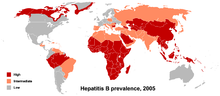
Infection with hepatitis B virus (HBV) remains a global public health problem, and it is estimated that about 2 billion people worldwide were infected with this virus, more than 350 million people are sick.
The transmission mechanism is parenteral. Infection occurs through the natural (sexual, vertical, domestic) and artificial (parenteral) routes. The virus is present in blood and various biological fluids - saliva, urine, semen, vaginal secretions, menstrual blood, etc. The contagiousness (infectivity) of the hepatitis B virus is 50-100 times higher than that of HIV [2] [3] : the infectious dose is 0.0000001 ml of serum containing HBV [4] .
Sexual Path
In recent years, sexual transmission of the virus has become increasingly important in developed countries, which is due, firstly, to a decrease in the value of the parenteral route (the appearance of one-time instruments, the use of effective disinfectants , the early detection of sick donors), and secondly, to the so-called “sexual revolution ”: the frequent change of sexual partners, the practice of anal intercourse, accompanied by greater trauma to the mucous membranes and, accordingly, an increased risk of the virus entering the bloodstream. In this case, infection with kisses, transmission of the infection through mother’s milk, as well as spread by airborne droplets is considered impossible [5] . Spreading drug addiction also plays a big role, since “intravenous” drug addicts are at high risk and, importantly, they are not an isolated group and easily engage in promiscuous, unprotected sex with other people. Approximately 16-40% of sexual partners with unprotected sexual contact become infected with the virus.
Vertical path
Of great importance in countries with intensive circulation of the virus (high morbidity) is the transplacental route of transmission when the child is infected by the mother, and the contact when the infection occurs during childbirth when passing through the birth canal. The activity of the infectious process in the mother's body is of great importance. So, with a positive HBe antigen , which indirectly indicates a high activity of the process, the risk of infection increases to 90%, while with a single positive HBs antigen , this risk is no more than 20%.
Domestic Way
In the household way of infection, infection occurs in the family, immediate environment and in organized groups. The danger is the use of general razors, blades, manicure and bath accessories, toothbrushes, towels, etc. Any microtraumas of the skin or mucous membranes are dangerous, as well as contact with them on a damaged surface ( abrasions , cuts, cracks, skin inflammation, punctures , burns, etc.), on which there is even a small amount of infected biological fluids (blood, sperm, saliva).
Parenteral Path
The parenteral route is through medical, laboratory instruments and medical devices contaminated with HBV. Infection with hepatitis B virus can also occur with transfusions of blood and / or its components in the presence of HBV.
Non-medical invasive procedures in public services organizations ( hairdressing , manicure , pedicure , cosmetology ), in tattoo , piercing and other invasive procedures [4] occupy a significant place in the transmission of viral hepatitis B.
Over time, in Russia, the age structure of patients with acute viral hepatitis B changes significantly. If in the 70-80s, 40-50-year-old people were more likely to suffer from serum hepatitis, in recent years, from 70 to 80% of patients with acute hepatitis B are young people aged 15-29.
Pathogenesis
The most significant pathogenetic factor in viral hepatitis B is the death of infected hepatocytes due to an attack by their own immune agents . Massive death of hepatocytes leads to impaired liver function, primarily detoxification, to a lesser extent - synthetic.
Current
The incubation period (the time from infection to the onset of symptoms) of hepatitis B averages 12 weeks, but can range from 2 to 6 months. The infectious process begins when the virus enters the bloodstream. After viruses enter the liver through the blood, there is a latent phase of the multiplication and accumulation of viral particles. When a certain concentration of the virus is reached in the liver, acute hepatitis B develops. Sometimes acute hepatitis passes almost imperceptibly for a person, and it is detected by accident, sometimes it proceeds in a mild anicteric form - it manifests itself only as malaise and decreased performance. Researchers believe that the asymptomatic course, anicteric form, and "icteric" hepatitis are equal in number of affected individuals to the group. That is, the diagnosed cases of acute hepatitis B identified are only one third of all cases of acute hepatitis. According to other researchers, one “icteric” case of acute hepatitis B accounts for 5 to 10 cases of diseases that, as a rule, do not fall into the field of view of doctors. Meanwhile, representatives of all three groups are potentially contagious to others.
Acute hepatitis either gradually disappears with the elimination of the virus and the persistence of immunity (liver function is restored in a few months, although residual effects can accompany a person for life), or becomes chronic.
Chronic hepatitis B occurs in waves, with periodic (sometimes seasonal) exacerbations. In the specialized literature, this process is usually described as a phase of integration and replication of the virus. Gradually (the intensity depends on both the virus and the human immune system), hepatocytes are replaced by stromal cells , fibrosis and cirrhosis of the liver develops. Sometimes chronic HBV infection results in primary cell carcinoma of the liver ( hepatocellular carcinoma ). The addition of hepatitis D virus to the infectious process dramatically changes the course of hepatitis and increases the risk of developing cirrhosis (as a rule, in such patients liver cancer does not have time to develop).
It is worth paying attention to the following pattern: the sooner a person becomes ill, the greater the likelihood of chronicity. For example, more than 95% of adults with acute hepatitis B recover. And of newborns with hepatitis B, only 5% will get rid of the virus. Of infected children aged 1-6 years, about 35% will become chronicles.
Clinic
All the symptoms of viral hepatitis B are due to intoxication due to a decrease in the detoxification function of the liver and cholestasis - a violation of the outflow of bile. Moreover, it is assumed [by whom? ] that in one group of patients exogenous intoxication prevails - from toxins coming from raw food or formed during digestion in the intestine , and in another group of patients endogenous intoxication prevails - from toxins formed as a result of metabolism in own cells and with hepatocyte necrosis .
Since nerve tissue , in particular brain neurocytes , is sensitive to any toxins, the cerebrotoxic effect is primarily observed, which leads to increased fatigue, sleep disturbance (with mild forms of acute and chronic hepatitis), and confusion up to the hepatic coma (with massive hepatocyte necrosis or the last stages of liver cirrhosis) Do not confuse the cause with the effect? Liver function is impaired - removal of toxins - toxins affect nerve cells .
In the late stages of chronic hepatitis, with extensive fibrosis and cirrhosis , portal hypertension syndrome aggravated by the fragility of blood vessels comes to the forefront due to a decrease in the synthetic function of the liver. Hemorrhagic syndrome is also characteristic of fulminant hepatitis.
Sometimes hepatitis B develops polyarthritis.
Diagnostics
In Russia, doctors of all specialties, paramedical workers of medical institutions, regardless of ownership and departmental affiliation, as well as children's, adolescent and recreational institutions identify patients with acute and chronic forms of hepatitis B, HBV carriers based on clinical, epidemiological and laboratory data when providing all types of medical care. Serological screening of groups of people with a high risk of infection is carried out [4] .
In the initial diagnosis based on clinical data, it is impossible to distinguish between hepatitis B and hepatitis caused by other viral agents, therefore laboratory confirmation of the diagnosis is extremely important. There are several types of blood tests for diagnosing and monitoring people with hepatitis B. These tests can be used to distinguish between acute and chronic infections [6] . The final diagnosis is made after laboratory tests (indicators of liver function, signs of cytolysis , serological markers , virus DNA isolation).
Diagnostic Markers for HBV Infection
For diagnosis, serological markers of hepatitis B virus infection (HBsAg, anti-HBcIgM, anti-HBc, anti-HBs, HBeAg, anti-HBe) and virus DNA (HBV-DNA) should be detected. In the body of people infected with HBV virus with different frequencies and at different stages, surface HBsAg, E-antigen- (HBeAg) and antibodies to these antigens, as well as virus-specific DNA (HBV-DNA) can be detected. [four]
Differential Diagnostics
Usually viral hepatitis B is not difficult to correctly diagnose. Difficulties arise only with super- and co-infections (when it is difficult to isolate the currently active agent), as well as in the presence of non-infectious diseases of the liver and bile ducts.
Treatment
Acute hepatitis B usually does not require treatment, as most adults cope with this infection spontaneously [7] [8] . Less than 1% of cases may require early antiviral treatment: for patients with aggressive infection (fulminant hepatitis) and those with weakened immune systems . On the other hand, treatment of a chronic infection may be useful to reduce the risk of cirrhosis and liver cancer. Chronically infected individuals with a constantly elevated level of alanine aminotransferase , a marker of liver damage, and large amounts of HBV DNA are preferred candidates for therapy [9] . Treatment lasts from six months to a year, depending on the drug and the genotype of the virus [10] .
Although none of the available drugs can completely cleanse the patient from the hepatitis B virus, they can stop the virus from multiplying, thereby minimizing liver damage. As of 2016, there are eight drugs licensed for the treatment of infectious hepatitis B in the United States . These include:
direct-acting antiviral drugs (DAAs) :
- nucleoside reverse transcriptase inhibitors
- lamivudine (Epivir), telbivudine (Tyzeka), entecavir (Baraclude)
- nucleotide reverse transcriptase inhibitors
- adefovir (Hepsera), tenofovir disoproxil fumarate (Viread), tenofovir alafenamide fumarate (Vemlidy)
immunomodulators :
- interferon alfa-2a , pegylated interferon alfa-2a (Pegasys)
The nucleosides lamivudine, telbivudine, and adefovir nucleotide are morally obsolete and are not recommended due to the low threshold of resistance and the possibility of the formation of cross-resistance of the virus to entecavir and tenofovir preparations, respectively. [11] The World Health Organization recommended entecavir or tenofovir as first-line therapy. [12] Entecavir is contraindicated in pregnancy; nephrotoxic and bone toxic for TDF, it is advisable, if possible, to replace it with TAF . Patients with cirrhosis are most in need of treatment. Treatment with direct-acting drugs has a moderate level of side effects, but symptomatic, is expressed in the suppression of the viral load - it almost never leads to seroconversion of the virus.
Unlike direct-acting therapy, interferon therapy has a high level of side effects, but compares favorably with DAA therapy in that it often leads to seroconversion of HB e Ag (a marker of virus replication). The response to treatment with interferons depends on several factors. Some patients are far more likely to respond to therapy than others. The reason may be in the genotype of the virus that the person is infected with, as well as in the genetic characteristics of the patient himself. Treatment reduces the replication of the virus in the liver, thereby reducing the viral load (the number of viral particles in the blood) [13] . Interferon therapy HBeAg seroconversion is observed in 37% of patients infected with HBV genotype A, but only 6% of patients infected with HBV virus genotype D. HBV B genotype has HBeAg seroconversion rates similar to Type A. In the case of HBV genotype C, seroconversion is observed only in 15% of cases. A steady decrease in the number of HBeAg after treatment is ~ 45% of patients for types A and B, 25-30% of patients for types C and D [14] . The use of interferon, which requires injections daily or three times a week, was replaced by pegylated interferon, a long-acting drug that is injected only once a week [15] .
Prevention
Vaccination
Hepatitis B vaccination is a universal way of protection for all routes of infection.
Hepatitis B vaccines in the United States have been widely recommended for infants since 1991 [16] . The first dose is usually recommended during the first days after birth [17] .
Most vaccines are administered in three doses over several months. A vaccine protective response is defined as an anti-HBs antibody concentration of at least 10 mIU / ml in blood serum. The vaccine is more effective in children: 95% of vaccinees have protective antibody levels. Their level decreases to about 90% at the age of 40, and to about 75% in people over 60. The protection provided by vaccination lasts even after antibody levels drop below 10 mIU / ml.
Все, кто подвержен воздействию жидкостей организма, таких как кровь, должны быть вакцинированы [16] . Рекомендуется проводить тестирование для проверки эффективной иммунизации, а дополнительные дозы вакцины предоставляются тем, кто недостаточно иммунизирован [16] .
В исследованиях, которые продолжались от 10 до 22 лет, не было случаев гепатита B среди вакцинированных лиц с нормальной иммунной системой. Зарегистрированы только редкие хронические инфекции [18] . Вакцинация особенно рекомендуется для групп высокого риска, включая работников здравоохранения, людей с хронической почечной недостаточностью и мужчин, имеющих половые контакты с мужчинами [19] [20] [21] .
Руководящие указания в Великобритании гласят, что первоначально ответившие на прививку лица (получившие иммунитет благодаря прививкам) нуждаются в дальнейшей защите (это касается людей, находящихся в зоне риска заражением гепатитом B). Им рекомендуется, для сохранения иммунитета к вирусу гепатита B, повторная ревакцинация — раз в пять лет [22] .
Половой путь
Безопасный секс , включая сведение к минимуму числа партнёров и использование барьерных методов ( презервативов ), защищают от передачи инфекции [6] .
Вертикальный путь
Профилактика вертикальной передачи вируса гепатита B от инфицированной матери к ребёнку непосредственно во время беременности рекомендована, по крайней мере, женщинам с высокой вирусной нагрузкой и/или высоким уровнем HBsAg, начиная с 24-28-ой недель беременности и до 12 недель после родов.
Для тех новорожденных, чьи матери инфицированы HBsAg: только одна вакцина против гепатита В, только иммуноглобулин гепатита В или комбинация вакцины плюс иммуноглобулин против гепатита В [23] . Эти меры предотвращают передачу HBV во время родов в 86 % −99 % случаев [24] .
Для профилактики используется исключительно тенофовир : если беременная женщина уже принимает препараты прямого противовирусного действия (ПППД), отличные от тенофовира, то ей следует перейти на приём тенофовира.
Наличие активного вирусного гепатита не является противопоказанием для кормления грудью независимо от того, находится кормящая грудью женщина на противовирусной терапии или нет, поскольку это не влияет на риск передачи гепатита B ребёнку [25] [26] .
Тенофовир, назначенный во втором или третьем триместре, может снизить риск передачи от матери к ребёнку на 77 % в сочетании с иммуноглобулином гепатита В и вакциной против гепатита В, особенно для беременных женщин с высоким уровнем ДНК вируса гепатита В [27] . Однако нет достаточных доказательств того, что введение одного лишь иммуноглобулина гепатита В во время беременности может снизить вероятность передачи вируса новорожденному [28] .
Бытовой путь
В семье или в организованном коллективе следует соблюдать обычные меры предосторожности [29] : не допускать пользование чужими средствами личной гигиены и с опаской относиться к чужой крови. Этим правилам нужно учить и детей. Опасность могут представлять кусачки и пилки для ногтей, зубные щётки, серьги, глюкометры и прочие. При уборке дома или автомобиля от загрязнения кровью необходимо пользоваться дезинфекционными средствами, а на руки надевать латексные перчатки или, в крайнем случае, полиэтиленовые пакеты. Любые повреждения кожи следует закрывать пластырем или повязкой.
Парентеральный путь
При инвазивных процедурах обязательно организовать [30] :
- использование перчаток;
- безопасное обращение и удаление острых предметов и отходов;
- безопасную очистку оборудования и инструментов;
- тестирование донорской крови;
- подготовку медицинского персонала;
- предотвращение повторного использования шприцев и прочих одноразовых предметов;
- принимать меры для уменьшения частоты травм от колющих и режущих инструментов у медицинских работников.
На государственном уровне ВОЗ рекомендует [30] работу с лицами, употребляющими внутривенные наркотики: программы выдачи игл и шприцев; опиоидную заместительную терапию; программы раздачи презервативов для людей, употребляющих инъекционные наркотики, и их сексуальных партнёров; вакцинацию, диагностику и лечение вирусного гепатита.
See also
- Вирусный гепатит
- Вирус гепатита B
- Гепатит D
Notes
- ↑ Monarch Disease Ontology release 2018-06-29sonu - 2018-06-29 - 2018.
- ↑ Hepatitis B & sexual health (англ.) (pdf). cdc.gov (2013). Date of treatment November 11, 2018.
- ↑ Viral hepatitis . Information for Gay and Bisexual Men (англ.) (pdf) . cdc.gov (2013) . Date of treatment November 11, 2018.
- ↑ 1 2 3 4 Санитарно-эпидемиологические правила СП 3.1.1.2341-08 . «Профилактика вирусного гепатита В» (28 февраля 2008) . Date of treatment November 11, 2018.
- ↑ Hepatitis B FAQs for the Public .
- ↑ 1 2 Гепатит B . Информационный бюллетень/ . who.int (18 июля 2018) . Date of treatment November 11, 2018.
- ↑ Hollinger FB , Lau DT Hepatitis B: the pathway to recovery through treatment. (англ.) // Gastroenterology clinics of North America. - 2006. - Vol. 35, no. 4 . — P. 895—931. — DOI : 10.1016/j.gtc.2006.10.002 . — PMID 17129820 .
- ↑ Hepatitis B FAQs for Health Professionals. . Transmission, Symptoms, and Treatment (англ.) . Centers for Disease Control and Prevention (CDC) . Дата обращения 13 мая 2016.
- ↑ Lai CL , Yuen MF The natural history and treatment of chronic hepatitis B: a critical evaluation of standard treatment criteria and end points. (англ.) // Annals of internal medicine. - 2007. - Vol. 147, no. 1 . — P. 58—61. — DOI : 10.7326/0003-4819-147-1-200707030-00010 . — PMID 17606962 .
- ↑ Alberti A. , Caporaso N. HBV therapy: guidelines and open issues. (англ.) // Digestive and liver disease : official journal of the Italian Society of Gastroenterology and the Italian Association for the Study of the Liver. - 2011. - Vol. 43 Suppl 1. — P. 57—63. — DOI : 10.1016/S1590-8658(10)60693-7 . — PMID 21195373 .
- ↑ Абдурахманов Д. Т. Резистентность вируса гепатита В к противовирусной терапии: диагностика, профилактика и лечение . www.hcv.ru. Date of treatment November 21, 2016.
- ↑ Guidelines for the prevention, care and treatment of persons with chronic hepatitis B infection. (англ.) (pdf). WHO (March 2015). Дата обращения 13 мая 2016.
- ↑ Pramoolsinsup C. Management of viral hepatitis B. (англ.) // Journal of gastroenterology and hepatology. - 2002. - Vol. 17 Suppl. — P. 125—145. — DOI : 10.1046/j.1440-1746.17.s1.3.x . — PMID 12000599 .
- ↑ Cao GW Clinical relevance and public health significance of hepatitis B virus genomic variations. (англ.) // World journal of gastroenterology. - 2009. - Vol. 15, no. 46 . — P. 5761—5769. — DOI : 10.3748/wjg.15.5761 . — PMID 19998495 .
- ↑ Dienstag JL Hepatitis B virus infection. (англ.) // The New England journal of medicine. - 2008. - Vol. 359, no. 14 . — P. 1486—1500. — DOI : 10.1056/NEJMra0801644 . — PMID 18832247 .
- ↑ 1 2 3 Schillie S. , Murphy TV , Sawyer M. , Ly K. , Hughes E. , Jiles R. , de Perio MA , Reilly M. , Byrd K. , Ward JW , Centers for Disease Control and Prevention (CDC). CDC guidance for evaluating health-care personnel for hepatitis B virus protection and for administering postexposure management. (англ.) // MMWR. Recommendations And Reports : Morbidity And Mortality Weekly Report. Recommendations And Reports. — 2013. — 20 December ( vol. 62 , no. RR-10 ). — P. 1—19 . — PMID 24352112 .
- ↑ COMMITTEE ON INFECTIOUS DISEASES , COMMITTEE ON FETUS AND NEWBORN. Elimination of Perinatal Hepatitis B: Providing the First Vaccine Dose Within 24 Hours of Birth (англ.) // Pediatrics. — 2017. — 28 August ( vol. 140 , no. 3 ). — P. e20171870 . — ISSN 0031-4005 . — DOI : 10.1542/peds.2017-1870 .
- ↑ Shepard CW , Simard EP , Finelli L. , Fiore AE , Bell BP Hepatitis B virus infection: epidemiology and vaccination. (англ.) // Epidemiologic Reviews. - 2006. - Vol. 28 . — P. 112—125 . — DOI : 10.1093/epirev/mxj009 . — PMID 16754644 .
- ↑ Chen W. , Gluud C. Vaccines for preventing hepatitis B in health-care workers. (англ.) // The Cochrane Database Of Systematic Reviews. — 2005. — 19 October ( no. 4 ). — P. 000100—000100 . — DOI : 10.1002/14651858.CD000100.pub3 . — PMID 16235273 .
- ↑ Schroth Robert J , Hitchon Carol A , Uhanova Julia , Noreddin Ayman M , Taback Shayne P , Moffatt Michael , Zacharias James M. Hepatitis B vaccination for patients with chronic renal failure (англ.) // Cochrane Database of Systematic Reviews. — 2004. — 19 July. — ISSN 1465-1858 . — DOI : 10.1002/14651858.CD003775.pub2 .
- ↑ Viral Hepatitis And Men Who Have Sex with Men (англ.) . cdc.gov. Date of treatment November 11, 2018.
- ↑ Joint Committee on Vaccination and Immunisation. Chapter 18 Hepatitis B // Immunisation Against Infectious Disease 2006 ("The Green Book"). — 3rd edition (Chapter 18 revised 10 October 2007). — Edinburgh : Stationery Office, 2006. — P. 468. — ISBN 0-11-322528-8 .
- ↑ Lee Chuanfang , Gong Yan , Brok Jesper , Boxall Elizabeth H , Gluud Christian. Hepatitis B immunisation for newborn infants of hepatitis B surface antigen-positive mothers (англ.) // Cochrane Database of Systematic Reviews. — 2006. — 19 April. — ISSN 1465-1858 . — DOI : 10.1002/14651858.CD004790.pub2 .
- ↑ Wong F. , Pai R. , Van Schalkwyk J. , Yoshida EM Hepatitis B in pregnancy: a concise review of neonatal vertical transmission and antiviral prophylaxis. (англ.) // Annals Of Hepatology. — 2014. — March ( vol. 13 , no. 2 ). — P. 187—195 . — PMID 24552860 .
- ↑ European Association for the Study of the Liver. EASL 2017 Clinical Practice Guidelines on the management of hepatitis B virus infection (англ.) // EASL. — 2017.
- ↑ Гепатит В: как я могу себя защитить? . who.int (2014). Date of treatment November 11, 2018.
- ↑ Hyun MH , Lee YS , Kim JH , Je JH , Yoo YJ , Yeon JE , Byun KS Systematic review with meta-analysis: the efficacy and safety of tenofovir to prevent mother-to-child transmission of hepatitis B virus. (англ.) // Alimentary Pharmacology & Therapeutics. — 2017. — June ( vol. 45 , no. 12 ). — P. 1493—1505 . — DOI : 10.1111/apt.14068 . — PMID 28436552 .
- ↑ Eke AC , Eleje GU , Eke UA , Xia Y. , Liu J. Hepatitis B immunoglobulin during pregnancy for prevention of mother-to-child transmission of hepatitis B virus. (англ.) // The Cochrane Database Of Systematic Reviews. — 2017. — 11 February ( vol. 2 ). — P. 008545—008545 . — DOI : 10.1002/14651858.CD008545.pub2 . — PMID 28188612 .
- ↑ Chistine M. Kukka. Preventing Hepatitis B . at Home and in Personal Care Settings (англ.) (pdf) . HCVadvocate.org (2015) . Date of treatment November 11, 2018.
- ↑ 1 2 Guidelines for the prevention, care and treatment of persons with chronic hepatitis b infection (англ.) . World Health Organization (2015). Date of treatment November 11, 2018.
Literature
- Санитарные правила СП — 3.1.1.2341-08 «Профилактика вирусного гепатита B».
- Санитарно-эпидемиологические правила СП 3.1.958-00 «Профилактика вирусных гепатитов. Общие требования к эпидемиологическому надзору за вирусными гепатитами» (утв. Главным государственным санитарным врачом РФ 1 февраля 2000 г.)
- Приказ Минздравсоцразвития РФ от 23.11.2004 № 260 «Об утверждении стандарта медицинской помощи больным хроническим гепатитом В, хроническим гепатитом С».
- Приказ Минздравсоцразвития РФ от 06.10.2005 № 621 «Об утверждении стандарта медицинской помощи больным с хроническим активным гепатитом в сочетании с первичным билиарным циррозом».
- Приказ Минздравсоцразвития РФ от 06.10.2005 № 618 «Об утверждении стандарта медицинской помощи больным с хроническим активным гепатитом в сочетании с первичным склерозирующим холангитом».
- Методические указания МУ 3.1.2792-10 Эпидемиологический надзор за гепатитом B.
- Информационный бюллетень ВОЗ (по вирусному гепатиту B) № 204 от июля 2013 года. http://www.who.int/mediacentre/factsheets/fs204/ru/
- Шахгильдян И. В., Михайлов М. И., Онищенко Г. Г. Парентеральные вирусные гепатиты (эпидемиология, диагностика, профилактика). Москва, ГОУ ВУНМЦ МЗ РФ, 2003. — 384 с. ISBN 5-89004-149-5
- Вирусные гепатиты и другие актуальные инфекции. Сборник научных статей разных авторов. Санкт-Петербург, «ССЗ», 1997. — 2 тома. ISBN 5-85077-033-5 (ошибоч.)
- Таточенко В. К., Озерецковский Н. А. и др., Иммунопрофилактика-2003. Справочник — 6-е изд. Москва, Серебряные нити, 2003. — 176 с.
- Рахманова А. Г. Пригожина В. К., Неверов В. А. Инфекционные болезни. Руководство для врачей общей практики. С-Пб. «ССЗ», 1995. ISBN 5-85077-001-1
- Семенов С. И., Кривошапкин В. Г., Саввин Р. Г., Индеева Л. Д., Павлов Н. Н., Хронические вирусные гепатиты B, C, D в условиях Крайнего Севера. Якутск, Триада, 2003. — 120 с.
- Материалы VII Российского съезда инфекционистов, Н.Новгород, 2006
- Материалы VI Всероссийской научно-практической конференции «Вирусные гепатиты — проблемы эпидемиологии, диагностики, лечения и профилактики», Москва, 2005
- Балаян М. С., Михайлов М. И. Вирусные гепатиты — Энциклопедический словарь. Москва, Новая Слобода, 1993, — 208 с., ISBN 5-86395-068-4
- Соринсон С. Н., Вирусные гепатиты A, B, C, D, E, ни AE в клинической практике. С-Пб., ТЕЗА, 1996, — 306 с. ISBN 5-88851-003-3
- Костинов М. П., Гурвич Э. Б. Вакцины нового поколения в профилактике инфекционных заболеваний. М., Медицина для всех, 2002. — 152 с. ISBN 5-93649-010-6
- Медуницын Н. В. Вакцинология. Ed. 2-е, М. Триада-Х. 2004. — 448 с. ISBN 5-8249-0008-6 , ISBN 5-8949-0008-6 (ошибоч.)
- Михайлов А. А. Справочник фельдшера. Ed. 2-е, стереотипное. М. Медицина, 1995.