


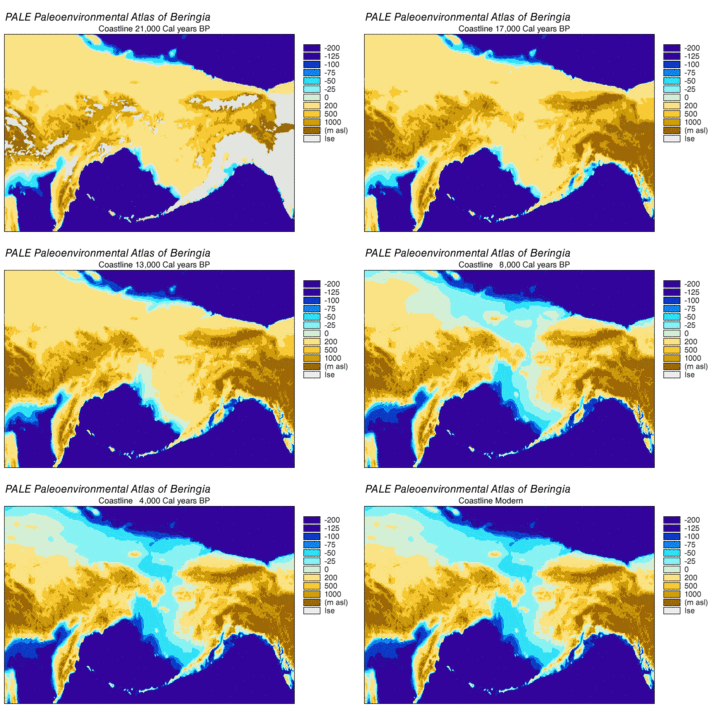
Paleoglaciology is a branch of glaciology that studies the natural ice of the past, and in a broad sense, the natural nival-glacial systems of the past, in which glaciers played a major role.
M.G. Groswald , one of the founders of the national and world glaciological school, wrote that as far back as the middle of the 20th century, paleoglaciology was identified with pale glaciation, however, research has already begun in the field of paleosnowing, on ancient sea ice, paleomerflooding and other directions. Paleoglaciology also studies the history of existing natural ice in order to identify current trends in their dynamics and create the basis for predicting future climate changes .
Paleoglaciology is close to paleogeography , glacial geology and geomorphology , Quaternary geology ( Quaternary geology) and paleohydrology. However, these and other similar disciplines study the physical and geographical situation in the past, the development of the earth's crust and the topography of the earth's surface under the influence of glaciation , while the subject of paleoglaciology is the natural ice of the past.
The main task of paleoglaciology is the reconstruction for various chronological sections of the physical parameters of ice formations, the size, shape and structure of ice bodies, their geographical distribution, mass balance and its components, temperature and heat balance , dynamics and geological activity, mechanisms of formation and degradation. A special place in paleoglaciology is given to the analysis of direct and feedback relationships of natural ice in the global system atmosphere – ocean – land – glaciation .
Content
Paleoglaciology methods
Paleoglaciology methods are based on the integrated use of two main groups of facts.
The first group covers data on traces of exacration (glacial erosion) and glacial accumulation, the material composition of glacial and glacial-caused deposits, their exact radioisotope , paleotemperature, paleontological , and paleomagnetic characteristics. These facts are also based on the analysis of the magnitude and distribution of glacioisostatic movements of the earth's crust , relict cryogenic textures and other signs of cold climates and ancient glaciations.
The second group of facts includes observational data on modern glaciers, including information on the dependence of the shape of their longitudinal and transverse profiles on the planned sizes, on the intensity and mechanisms of mass-energy exchange of ice with the atmosphere, ocean and earth's crust.
In modern paleoglaciology, several approaches are used:
- a joint study of the regime and short-period oscillations of existing glaciers, which are determined by the methods of absolute geochronology ( lichenometry , dendrochronology , radiocarbon method and others);
- reconstruction of ancient glaciers based on geological and geomorphological data (traditional methods of paleoglaciology that appeared back in the time of J. L. Agassis , see, for example, [4] );
- creation of empirical-actualistic models of ancient glaciers that use data on the mode of modern glaciation (for example, [5] );
- application of the theory of automatic regulation for the analysis of fluctuations in global natural systems, including glaciers, sea ice and snow cover;
- obtaining information necessary for the reconstruction of ancient climates, namely: data on paleotemperature fluctuations based on the isotopic composition of ice from deep wells of continental glaciers, on carbon dioxide content in ancient atmospheres, dustiness of air and precipitation [6] .
On the basis of paleoglaciological methods, the Pliocene (and some experts believe that even the Miocene ) age of the beginning of the Cenozoic glaciation of the polar regions of the Earth, as well as the synchronism of the growth stages of the ice sheets of the Northern and Southern hemispheres, was proved. Estimates were also obtained of the volumes of ancient glaciers and eustatic decreases in sea level. The achievements of paleoglaciology allowed a number of leading glaciologists of the world to put forward a concept according to which ancient glaciations extended not only to land, but also to a number of continental shelves and deep polar basins [7] .
Already in the 1990s, on the basis of the complex methods of paleoglaciology and the deductive method of cognition, a model of the Panarctic ice sheet was created and the foundations of a new scientific direction, marinoglaciology, were laid [8] . And already at the beginning of the new millennium, a model of the Arctic ice sheet was proposed [9] , which covered the Arctic land and the continental shelves of the Northern Hemisphere with powerful interconnected ice sheets, including the entire gigantic region of the Northern Polar Basin .
Notes
- ↑ John S. Schlee. OUR CHANGING CONTINENT.
- ↑ Beringia
- ↑ S. A. Vasiliev . Siberia and the First Americans // Priroda, 2001. - No. 8.
- ↑ Rudoi A. N. About the criticism of “traditional moraine geomorphology” ... // Vestnik TSPU. - 2004 .-- T. 6 (43) . - S. 164-169 . Archived on September 1, 2011.
- ↑ V.P. Galakhov. Simulation as a method of glaciological reconstruction of mountain glaciation. - Novosibirsk: Nauka, 2001 .-- 136 p.
- ↑ Avsyuk G.A. , Grosvald M.G. , Kotlyakov V.M. Paleoglaciology: subject and methods, tasks and successes // Materials of glaciological studies, 1972. - Issue. 19. - S. 92-98.
- ↑ Hughes TJ, Denton GH, Grosswald MG Was there a late Wuerm Arctic Ice Sheet? // Nature, 1977. - Vol. 266. - P. 596-602.
- Grosvald M. G. Covering glaciers of continental shelves. - M .: Nauka, 1983. 216 p.
- ↑ Groswald, Mikhail Grigorievich
- ↑ Grosvald M. G. Glaciation of the Russian North and North-East during the era of the last great cooling // Materials of glaciological studies, 2009. - Issue. 106. - 152 p.
Literature
- Avsyuk G.A. , Grosvald M.G. , Kotlyakov V.M. Paleoglaciology: subject and methods, tasks and successes // Materials of glaciological studies, 1972. - Vol. 19 .-- S. 92 - 98.
- Groswald M.G. Paleoglaciology. Glaciological Dictionary / Ed. V.M. Kotlyakov . - L .: Gidrometeoizdat, 1984. - p. 317-318.
- Kotlyakov V. M. About the causes of various development trends of existing glaciers // Materials of glaciological studies , 1964. - Issue. 10 .-- S. 121-127.
- Golubev V.N. Relation of fluctuations of mountain glaciers with climatic events // Materials of glaciological studies , 1997. - Vol. 82. - S. 3-12.
- Grosvald M. G. The Arctic “white hole” and its role in the Earth system of ice ages // Bulletin of the Russian Academy of Sciences. Geographical series, 2001. - No. 6. P. 32-41.
- Obruchev V.A. Signs of the Ice Age in North and Central Asia // Bull. Moscow Society test of nature, 1931. - No. 3. - S. 43-120.
- Kropotkin P.A. Research on the ice age. - St. Petersburg, 1876 .-- 170 s.
- Solomina O. N. Mountain glaciation of Northern Eurasia in the Holocene . - M.: Scientific World, 1999. - 272 p.
- Khodakov V.G. Water-ice balance of the regions of modern and ancient glaciation of the USSR. - M .: Nauka, 1978.- 194 p.
Links
- Glaciers and climate in the past.
- Eugene Podolsky . Icy worlds.
- M. G. Groswald. P. A. Kropotkin and the problem of the ancient glaciation of Siberia. - 2002.
- M. G. Groswald. The problem of the glacial history of the polar shelf remains unresolved. (inaccessible link)
- Keenan Lee. THE MISSOULA FLOOD.
- Keenan Lee. THE BONNEVILLE FLOOD.
- Keenan Lee. THREE GLACIERS FLOOD. Arkansas River, Colorado
- United States Geological Survey The Channeled Scablands of Eastern Washington .
- Russian glaciologists got the history of Eurasia from Elbrus (video and text)
- A.N. Rudoi. Paleoglaciology.
See also
Snow line depression