
“Keynesian Cross” - a macroeconomic model, a graphic representation of the positive relationship between the total costs of economic agents and the general price level in the economy [1] [2] .
Content
- 1 cumulative flow function
- 1.1 Main parameters [2]
- 2 Construction
- 2.1 Changing the position of the curve of the total flow
- 3 Keynesian Cross Analysis
- 4 Literature
- 5 notes
Aggregate Flow Function
Main parameters [2]
Consumer spending (ref. C ) - household spending on goods and services. Consumer spending consists of two parts:
- autonomous expenses independent of income level,
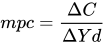
- the part that depends on earnings and the marginal consumption rate ( mpc ) (how much expenses increase for each additional unit of disposable income ( Yd )).
In this way,
- {\ displaystyle C = C (autonomous) + mpc * Yd}
where
Investments (ref. I ) —- firms buy capital in order to increase the production of goods and, therefore, maximize profits.
Government procurement of goods and services (ref. G ) —– state investments, salaries for government employees, etc.
Net export (design. Xn or NX ) —– a difference between export and import. The ratio of exports to imports shows the state of the trade balance. If exports exceed imports, then the country has a surplus in the trade balance, if imports - exports, then the trade deficit, respectively.
Net exports can also be either autonomous or dependent, this time, on the marginal rate of import ( mpm ) and the level of aggregate output. The marginal propensity to import explains how on average imports to the country increase with each additional unit of total income (or real GDP).
- where
Net taxes (ref. T ) —- difference between taxes and transfers
- The ratio of public procurement to net taxes shows the state budget. If public procurement exceeds net taxes, then the country has a state budget deficit, respectively, a budget surplus means that net taxes exceed public procurement.
Equilibrium output volume (designation Y ) - is equal to total consumption ( AE ).
- —- the formula of total output for an open economy, which determines the function of total expenditure [3] .
Build
Keynesian cross on the graph is represented as a combination of two curves:
- real aggregate flow rate curve,
- curve of the planned total flow .
The real aggregate flow curve is a graph of the function:
- ,
since in macroeconomic theory it is believed that real total consumption is always equal to total output.
The planned total consumption curve is a graph of the function, the form of which depends on the type of economy. If we consider only the private sector or an economy that is closed from foreign trade, then this curve is drawn at an angle equal to the marginal rate of consumption (aforementioned, mpc ) and at a height from the coordinate origin equal to either simply the autonomous consumption of households ( ), or the sum of autonomous consumption and investment in the economy ( ), or the sum of the first two, previously mentioned and state purchases of goods and services ( ) If we are considering an open economy, that is, supporting international trade, then the angle of the planned aggregate consumption curve is equal to the difference between the marginal rate of consumption and the marginal rate of import ( aforementioned , mpm ) ( mpc - mpm ), and the height of the curve relative to the origin is the sum of all parameters of the equilibrium output volume, but only autonomous ( ) [1] [2] .
Changing the position of the total flow curve
Only the planned total consumption curve can change. It can either shift in parallel or change its angle of inclination. A parallel shift of the curve can be observed in the event of a change in any autonomous parameters of the total flow. The angle of inclination, respectively, changes if either the marginal rate of consumption changes, or the marginal rate of import, or both of these parameters [1] [2] change simultaneously.
Keynesian Cross Analysis
The Keynesian Cross is one of the best-known methods for modeling aggregate demand. Using this model, you can determine such parameters as the equilibrium volume of output, the general price level in the economy, as well as in the AD-AS model. Since the intersection of the planned curve and the curve of real total consumption shows the full employment of resources in the economy, the phases of economic cycles can also be analyzed by the “Keynesian cross”. If the real total expenditure exceeds planned (that is, the level of output is greater than the level of full employment of resources), this means that firms were not able to sell as much as they planned, which entails a decrease in output, an increase in the level of cyclical unemployment , and therefore a recession is observed in the country . If the real aggregate expenditure is less than planned, when the output level is below the full employment level, then firms, on the contrary, have less production than is required on the market, which is why they increase their output, and thus we can observe an increase in the economy [ 1] .
Literature
- David Begg, Stanley Fisher , Rudiger Dornbusch . Economics . - 8. - The McGraw Hill Companies, 2005. - S. 353-358. - 674 s. - ISBN 978-007710775-8 .
- Matveeva T. Yu. Introduction to Macroeconomics . - “The publishing house of the HSE”, 2007. - S. 28-29. - 511 p.
Notes
- ↑ 1 2 3 4 David Begg, Stanley Fisher , Rudiger Dornbusch . Economics . - 8. - The McGraw Hill Companies, 2005. - 674 p. - ISBN 978-007710775-8 .
- ↑ 1 2 3 4 Matveeva T. Yu. Introduction to macroeconomics . - “The publishing house of the HSE”, 2007. - S. 28-29. - 511 p.
- ↑ It is also a calculation formula for GDP by expenditure, as well as a function of aggregate demand