Her coat on the upper body is reddish brown with a purple tint, her limbs are darker, as are her shoulders and head. Height at the withers is 120 cm, weight - 130 kg. Both sexes have curved horns . Both horns grow from a common base and give the impression of a lyre or crescent.
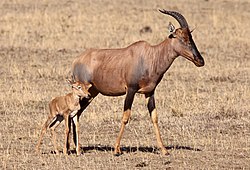
Marshes (Damaliscus korrigum - northern subspecies)
Being herbivores , swamps prefer open savannas . As a rule, these antelopes move slowly, however, escaping from a predator can reach speeds of up to 70 km / h. At the same time, they make characteristic, strongly nodding head movements.
Swamps live in small herds consisting of a dominant male and an average of eight females, as well as their cubs. Young males at the age of one year are driven out of the herd, while young females tend to remain. In the first years of life, young males form their own bachelor herds, which again decay when its members reach the age of four and are able to be leaders of a mixed herd. Dominant males defend their herd from strangers. As a rule, enough threatening gestures to solve the rivalry of two males. In some cases, however, it comes to serious fights, during which horns are also used. Males who are driven out of the herd after such fights survive their lives alone.
Southern subspecies - sassabi
The internal taxonomy of the swamp is still not fully established. In their large area, the following subspecies are traditionally distinguished:
- Marshlands ( D. l. Topi ) - the most famous subspecies inhabiting the savannas of East Africa ;
- Sassabi [1] ( D. l. Lunatus ) - nominative subspecies, South Africa ;
- Corrigum ( D. l. Korrigum ) - West Africa ;
- Tiang ( D. l. Tiang ) - Chad and Central African Republic ;
- Jimela ( D. l. Jimela ) is a region of large lakes.
Wilson & Reeder (2005) divide the swamps into the following three species:
- Damaliscus korrigum - northern subspecies (swamp, corrigum, dzhemela. Tiang is not recognized as a subspecies).
- Damaliscus lunatus is a southern subspecies of sassabi.
- Damaliscus superstes is a population in Zambia , recognized in 2003 as a separate subspecies.
Chirol , formerly sometimes considered a subspecies of the swamp, is today considered a separate species.