Enrico Fermi ( Italian: Enrico Fermi ; September 29, 1901 , Rome , Italy - November 28, 1954 , Chicago , USA ) is an Italian physicist , best known for creating the world's first nuclear reactor , who made a great contribution to the development of nuclear physics , elementary particle physics , quantum and statistical mechanics . It is considered one of the "fathers of the atomic bomb " [11] . During his life, he received several patents related to the use of atomic energy. Winner of the 1938 Nobel Prize in Physics "for proving the existence of new radioactive elements obtained by neutron irradiation, and the related discovery of nuclear reactions caused by slow neutrons " [12] . Fermi was one of the few physicists who excelled both in theoretical physics and in experimental physics .
| Enrico Fermi | |
|---|---|
| ital. Enrico fermi | |
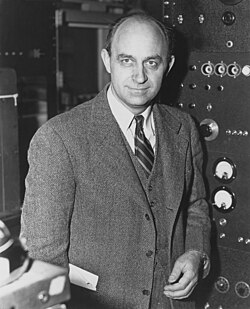 | |
| Date of Birth | |
| Place of Birth | Rome , Italy |
| Date of death | |
| Place of death | Chicago , Illinois , USA |
| A country | |
| Scientific field | physics |
| Place of work |
|
| Alma mater | Higher Normal School in Pisa , University of Pisa |
| supervisor | M. Bourne , P. Ehrenfest |
| Famous students | C. Lee C. Young E. Segre , O. Chamberlain , M. Gell-Mann |
| Known as | one of the founders of nuclear physics |
| Awards and prizes | Matteucci Medal (1926)  Nobel Prize in Physics ( 1938 ) Nobel Prize in Physics ( 1938 ) Hughes Medal (1942) Franklin Medal (1947) Sillimanov Lecture (1949) Barnard Medal (1950) Richtmyer Memorial Award (1952) Rumford Award (1953) Henry Norris Russell Award (1953) Max Planck Medal (1954) |
| Signature | |
Member of the National Academy of Dei Linchei (1935), National Academy of Sciences of the USA (1945) [13] Foreign Corresponding Member of the USSR Academy of Sciences (1929) [14] , Foreign Honorary Member of the Romanian Academy [15] , Foreign Member of the Royal Society of London (1950) [16] .
He created theories of beta decay , neutron moderation. In 1939 he introduced the concept of chain reaction and later took part in the atomic project .
The Fermi - Dirac distribution , the Thomas - Fermi model , the chemical element of Fermi , and others are named in his honor.
Content
Biography
Young years
Fermi was born in 1901 in Rome in an Italian family. His father is a railway employee Alberto Fermi, a descendant of peasants from Piacenza, his mother is a teacher Ida de Gattis, from a military family from Bari . In addition to Enrico, the family had an older sister and an older brother, Giulio, with whom Enrico was very friendly. The boys made electric motors together and conducted various physical experiments. In 1915, Giulio died during an operation to remove an abscess in the larynx, after which Enrico's character became more withdrawn. The boy devoted all his free time to reading books on physics and mathematics. The first physics book read by Enrico was the 900-page Latin textbook by Andrea Caraffo, Elementorum physicae mathematicae (1840), which he found in a bazaar in Campo dei Fiori . It examined the foundations of both mathematics and astronomy, classical mechanics, optics and acoustics. Adolfo Amidei, a colleague of Alberto Fermi, noted the young Fermi's deep interest in science began to help him in choosing literature for training. Together with his friend Enrico Persico, Fermi conducted a variety of physical experiments, in particular, tried to determine the exact density of drinking water [17] [18] .
In November 1918, Fermi entered the Higher Normal School in Pisa [17] [19] . Four years later, in 1922 , he successfully completed it and received a degree from the University of Pisa for his experiments with x-rays . In addition to experimental work, Fermi publishes a large number of works on the general theory of relativity . Due to the lack of regular places for a physicist in educational institutions in Italy, Fermi goes on an internship to Max Born at the University of Gottingen . Upon returning to Italy, Fermi takes part in competitions for the post of professor of physics at the universities of Pisa and Florence , in the last of which he wins. Before starting work in Florence, Fermi accepts Paul Ehrenfest’s invitation, given to him by Georg Uhlenbeck , to study at Leiden University [20] . Fermi's abilities were highly praised by Ehrenfest. This was a turning point in Fermi's career and made him believe in himself. In 1925, he began teaching at the Universities of Florence and Rome . And in December 1925, independently of Paul Dirac, he developed statistics on particles with a half-integer spin obeying the Pauli principle , which were later called fermions [17] [21] .
At the University of Rome
In 1926, Fermi was appointed professor at the University of Rome [17] . A very fruitful period began in his life. In 1928, he developed the method proposed by L. Thomas for determining the ground states of many-electron atoms ( Thomas-Fermi theory ). Also in 1929 - 1930 . Fermi made a fundamental contribution to the development of quantum electrodynamics by developing canonical rules for quantizing the electromagnetic field , which differed from the Heisenberg - Pauli approach. In 1928, the 27-year-old Fermi was elected a member of the Royal Academy of Sciences of Italy , and a year later - a corresponding member of the USSR Academy of Sciences .
In 1931, Fermi explained the phenomenon of resonance arising in the vibrational spectrum if the same or almost identical energies correspond to two vibrational states in the harmonic approximation. After 1932, Fermi concentrated on the problems of nuclear physics [17] . In 1934, he created the first quantitative theory of beta decay , also known as the four-fermion theory of weak interaction . Its essence is that in beta decay four fermions ( proton , neutron , electron and neutrino ) interact at one point [21] . The four-fermion theory became the prototype of the modern theory of weak interactions of elementary particles , although the very assumption of a direct interaction of four particles turned out to be erroneous. In view of the importance of Fermi's contribution to theoretical studies of weak interaction and beta decay, a number of concepts in this field of physics bear his name; so, the constant determining the intensity of weak interaction in the modern Standard Model of particle physics is called the Fermi constant ( G F ); there is a Fermi function (not to be confused with the Fermi – Dirac function ), which describes the effect of a nuclear charge on the motion of an electron resulting from beta decay; the Fermi selection rules are known (the relation between the spin and parity of the initial and final state of nuclei), which are fulfilled for beta decays, known as allowed Fermi transitions. In addition, the unit of length used in nuclear physics is called Fermi (10 −13 cm).
In 1934, Fermi performed the first major experimental work in the field of nuclear physics related to the irradiation of elements with neutrons [21] . Immediately after the discovery of artificial radioactivity by F. Joliot-Curie, Fermi came to the conclusion that neutrons , since they have no charge and will not be repelled by nuclei , should be the most effective tool for producing radioactive elements , including transuranic ones . This original solution turned out to be very fruitful - more than 60 new radioactive isotopes were obtained and neutron moderation ( the Fermi effect ) was discovered, and selective neutron absorption was discovered in 1936 .
Fermi, like many Italian scientists of that time, was a member of the fascist party . However, in 1928 he married Laura Kapon, who came from a well-known Jewish family, and by 1938 they had two children: Nella and Giulio [17] .
Nobel Prize and Emigration
The work of the Fermi group was highly appreciated in the scientific world, it was also the beginning of neutron physics . The Fermi effect (the phenomenon of neutron deceleration by substances consisting of light atoms) has proven to be in demand in atomic engineering. For a series of works on obtaining radioactive elements by neutron bombardment and for the discovery of nuclear reactions by slow neutrons in 1938, Enrico Fermi was awarded the Nobel Prize in Physics [17] . Having left in 1939 to get her to Stockholm with his family, Fermi did not return to Italy , since at that time the Italian authorities passed laws that significantly toughened the situation of Jews [17] . He moves to the United States , where five universities have offered him the position of professor of physics. Fermi chose Columbia University in New York , where he worked from 1939 to 1942 .
In 1939, he developed the theory of energy loss by charged particles on the ionization of matter, taking into account its polarization .
Work on atomic projects
In January 1939, Fermi suggested that in fission of a uranium nucleus one should expect the emission of fast neutrons and that if the number of emitted neutrons is greater than the number of absorbed ones, then the path to a chain reaction will be open (theoretically predicted before it, but could not get Leo Sylard ). The experiment confirmed the presence of fast neutrons , although their number per fission event remained not very well defined.
At the same time, Fermi began working on the theory of a chain reaction in a uranium - graphite system. By the spring of 1941, this theory was being developed, and in the summer a series of experiments began, the main task of which was to measure the neutron flux. Together with G. Anderson , about thirty experiments were performed, and in June 1942 a neutron multiplication coefficient of more than one was obtained. This meant the possibility of obtaining a chain reaction in a sufficiently large lattice of uranium and graphite and served as the beginning of the development of the reactor design. Fermi made an adjustment to the obtained value of the multiplication factor and took this into account in the size of the planned boiler, developed a method for determining the critical dimensions of the system. In addition, fearing that atmospheric nitrogen would absorb neutrons well, Fermi insisted that the entire huge device of the reactor should be placed in a giant tent made of matter for shells of balloons . Thus, it became possible to maintain an appropriate composition of the atmosphere surrounding the reactor. The construction of the reactor began in the Metallurgical Laboratory of the University of Chicago in October, and ended on December 2, 1942 . In an improvised laboratory under the Stagg Field Stadium , an experiment was conducted on this reactor that demonstrated the first self-sustaining chain reaction . The work of the metallurgical laboratory was initiated by the US government, which was going to use the results for military purposes [17] . The search for materials for the metallurgical laboratory was carried out by Arthur Compton , he also invited Fermi to the project, going for this to Columbia University [22] . For the next two years, Fermi continued to experiment with the reactor , and was also developing a new reactor for the Argonne National Laboratory located in the vicinity of Chicago [17] .
In 1944, Fermi and his wife Laura accepted American citizenship. For some time he worked on the development of plutonium with DuPont , and in August 1944 he began working at the Los Alamos National Laboratory in New Mexico . Fermi was one of the leaders of the Manhattan project . Fermi observed many of the project’s experiments, in particular the first bomb test in Alamogordo . He was one of President Truman 's scientific advisers on the use of bombs for military purposes [17] .
In 1946, he returned to Chicago and became a professor at the Institute for Nuclear Research , which now bears his name. He continued his research in the field of nuclear physics and elementary particle physics [17] . In addition, since 1950 he became one of the first members of the Committee of Advisers to the Atomic Energy Commission .
Recent years
Fermi was very obsessed and passionate about science. At the age of about 50, having a huge stock of knowledge in the field of nuclear energy, he changed the direction of his scientific activity and began to study high-energy particle physics and astrophysics . And here he made many discoveries: he created the theory of the origin of cosmic rays and discovered the mechanism of particle acceleration in them ( 1949 ), developed the statistical theory of multiple meson production ( 1950 ), discovered the isotopic quadruplet, which became the first hadron resonance ( 1952 ), studied the interaction of protons with pi -mesons [21] .
The main feature of Fermi's physical ideas is their longevity. A number of recent works of this scientist was evaluated only after his death. One of them is his joint work with C. Young on composite models of elementary particles , in which nucleons and antinucleons were considered as the main particles (it is also known as the Fermi - Young model ). When it appeared, then many, even many theoretical physicists were surprised by its “contentlessness”. But soon, based on the work of Fermi - Young, new model schemes appeared that played a large role in the development of elementary particle physics . One of the latest such models is the quark model.
In his late years, Fermi, according to E. Segre , was going to write a book devoted to those difficult questions of physics, seeming elementary, he even began to collect them. But he did not have time for this. In 1946, Fermi said that he had done only one third of all his work. He tried so hard to do two-thirds that he tightened his working day to the limit. According to Pontecorvo , “one-third,” which Fermi managed to make from his plan, deserves 6–8 Nobel Prizes, which will forever retain the name of this exceptionally gifted scientist in science.
Fermi spent the summer of 1954 in Europe, being at the last stage of stomach cancer . He attended lectures in France, Germany and Italy, met with old friends. Upon returning to Chicago, Fermi attended various medical procedures for two months. He died in his sleep on November 28, 1954 at the age of 53. [17]
Memory
Shortly before Fermi's death , the Atomic Energy Commission established a special award for the scientist [17] . In 1956, this award became known as the Enrico Fermi Prize and was awarded regularly. The prize is awarded to scientists who have made an outstanding contribution to the research, use and production of energy [23] . In his honor was named the 100th chemical element - fermium . His name is the Chicago Institute for Nuclear Research , the National Accelerator Laboratory (Fermilab) and the space telescope [24] , as well as the streets in many Italian cities.
On the website of the Argonne National Laboratory, he is called "the last universal scientist" ( English last universal scientist ) [22] .
In 1970, the International Astronomical Union named Enrico Fermi a crater on the far side of the moon .
Pupils
Fermi is the creator of a major scientific school. Among his students working at the University of Rome (late 1920s - 1930s ) - E. Amaldi , F. Rasetti , E. Segre , B. Pontecorvo , J. Bernardini , J. Vic , E. Majorana , B. Rossi , J. Cancer , J. Okkialini and others. In the 1940s - 1950s in Chicago, Fermi's students were G. Anderson , M. Gell-Mann , M. Goldberger , C. Lee , C. Jan , J. Chu , O. Chamberlain , M. Rosenblut , J. Steinberger and others.
Publications
Books
- Fermi E. Molecules and crystals. - M .: IL, 1946.
- Fermi E. Elementary particles. - M .: IL, 1953.
- Fermi E. Lectures on pi-mesons and nucleons. - M .: IL, 1956.
- Fermi E. Quantum Mechanics. - 2nd ed. - M .: Mir, 1968.
- Fermi E. Scientific works. - In 2 volumes - M .: Science , 1971-1972.
- Fermi E. Thermodynamics. - 2nd ed. - Kharkov: Publishing house Kharkiv . University , 1973.
- Fermi E. Lectures on quantum mechanics. - M. , 2000.
- Fermi E. Lectures in atomic physics. - M. , 2001.
Articles
- E. Fermi. On the possible finding of an element with an atomic number higher than 92 = Possible Production of Elements of Atomic Number Higher than 92 // Phys . - 1934 . - T. 14 , No. 7 . - S. 829-832 .
- Fermi E., Amaldi E. , d'Agostino O., Rasetti F. , Segre E. Artificial radioactivity created by neutron bombardment. // Usp . - 1934. - Issue. 8 .
- Amaldi E. , d'Agostino O., Fermi E., Pontecorvo B. , Rasetti F. , Segre E. Artificial radioactivity created by neutron bombing - II. // Usp . - 1935. - Issue. 7 .
- E. Fermi. Elementary theory of boilers with nuclear chain reactions = Elementary Theory of the Chain-reacting Pile // Usp . Fiz . - 1947 . - T. 32 , No. 1 . - S. 54-65 .
- Fermi E. Nuclear processes at high energies. // Usp . - 1952. - T. 46 , No. 1 .
Literature
- Fermi Laura Atoms in the Family. - Chicago .: University of Chicago Press , 1954.- P. 123.
- Fermi L. Atoms at our place. - 2nd ed. - M .: Foreign literature , 1959.
- Pontecorvo B. Enrico Fermi (1901-1954) (On the anniversary of death). // Usp . - 1955. - T. 57 , No. 11 .
- Lyatil P. Enrico Fermi. - M .: Atomizdat , 1965.
- Pontecorvo B. Enrico Fermi. - M.: Knowledge , 1971.
- Pontecorvo B. , Pokrovsky V.N. Enrico Fermi in the memoirs of students and friends. - M .: Science , 1972.
- Segre E. Enrico Fermi is a physicist. - M .: Mir , 1973.
- Gurevich I.I. , Smorodinsky Y.A. Scientific works of Enrico Fermi. // Usp . - 1974. - T. 114 , No. 10 .
- Temples Yu. A. Fermi Enrico (Fermi Enrico) // Physics: Biographical reference book / Ed. A.I. Akhiezer . - Ed. 2nd, rev. and add. - M .: Nauka , 1983 .-- S. 275—276. - 400 p. - 200,000 copies. (in per.)
See also
- Fermium
- Fermi (unit of length)
- Statistics Fermi - Dirac
- National Accelerator Laboratory Enrico Fermi
- Theory of Thomas - Fermi
- Fermi - Young Model
- Fermi Level
- Fermi surface
- Fermi paradox
- Fermi (metro station)
- Fermi Golden Rule
- Fermi gas
- Fermi liquid
Notes
- ↑ 1 2 Internet Movie Database - 1990.
- ↑ 1 2 BNF identifier : Open Data Platform 2011.
- ↑ Archive for the history of mathematics MacTyutor
- ↑ Pontecorvo B. M. Fermi Enrico // Great Soviet Encyclopedia : [in 30 vol.] / Ed. A. M. Prokhorov - 3rd ed. - M .: Soviet Encyclopedia , 1977. - T. 27: Ulyanovsk - Frankfort. - S. 306.
- ↑ http://www.tv.com/shows/the-adventures-of-jimmy-neutron-boy-genius/broadcast-blues-professor-calamitous-i-presume-236760/
- ↑ http://www.nytimes.com/1999/11/16/science/scientist-at-work-richard-l-garwin-physicist-and-rebel-is-bruised-not-beaten.html
- ↑ https://www.nytimes.com/learning/general/onthisday/bday/0929.html
- ↑ http://www.bbc.co.uk/2/hi/science/nature/7584915.stm
- ↑ http://www.bbc.co.uk/1/hi/sci/tech/7584915.stm
- ↑ https://www.biography.com/people/enrico-fermi-9293405
- ↑ Enrico Fermi Dead at 53; Architect of Atomic Bomb (November 29, 1954). Date of treatment January 21, 2013.
- ↑ The Nobel Prize in Physics 1938 . Nobel Foundation . Date of treatment June 17, 2012. Archived June 22, 2012.
- ↑ Enrico Fermi (English)
- ↑ Profile of Enrico Fermi on the official website of the RAS
- ↑ Academia Romana (membri din strainatate) . academiaromana.ro. Date of treatment April 30, 2019.
- ↑ Fermi; Enrico (1901 - 1954 )
- ↑ 1 2 3 4 5 6 7 8 9 10 11 12 13 14 About Enrico Fermi . University of Chicago Date of treatment January 7, 2012. Archived January 10, 2013.
- ↑ P. Lyatil. Enrico Fermi. - M .: Atomizdat, 1965.
- ↑ Segrè, Emilio , "Enrico Fermi" , Dizionario Biografico degli Italiani , Enciclopedia Italiana
- ↑ Samuel Gaudsmith . Discovery of the electron spin (from the history of physics). // Usp . - 1967. - T. 93 , No. 9 .
- ↑ 1 2 3 4 Fermi Enrico - article from the Great Soviet Encyclopedia . B. M. Pontecorvo .
- ↑ 1 2 The “Last Universal Scientist” Takes Charge . www.ne.anl.gov. Date of treatment November 8, 2014.
- ↑ The Enrico Fermi Award . science.energy.gov. Date of treatment November 8, 2014.
- ↑ Enrico Fermi and the First Self-Sustaining Nuclear Chain Reaction . www.osti.gov. Date of treatment November 8, 2014.
Links
- Fermi, Enrico . hirosima.scepsis.ru. Date of treatment November 8, 2014.
- Enrico Fermi . Nobel Foundation . Date of treatment June 17, 2012. Archived June 22, 2012.