Yellow-throated mouse [1] ( lat. Apodemus flavicollis ) is a species of rodents of the murine family ( Muridae ).
| Yellow-throated mouse |
 |
| Scientific classification |
|---|
| No rank : | Bilateral symmetrical |
| Squadron : | Euarchontoglires |
| Gender: | Forest and field mice |
| View: | Yellow-throated mouse |
|
| International scientific name |
|---|
Apodemus flavicollis ( Melchior , 1834 ) |
| Area |
|---|
|
| Security status |
|---|
Least ConcernedIUCN 3.1 Least Concern : 1892 |
|
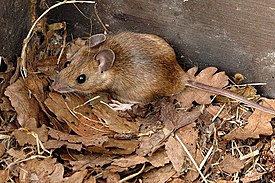
The yellow-throated mouse is similar to the European mouse ( Apodemus sylvaticus ), with which it has been confused for a long time. It was recognized as a separate species in 1894. She is distinguished by a strip of yellow fur around her neck, her ears are larger and she, as a rule, is a little larger. It reaches a length of 10 cm. It feeds like all rodents.
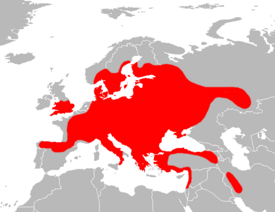
It can climb trees and sometimes winters in houses. It occurs mainly in the southern part of Europe, but sometimes it occurs in the north, in particular, it lives in Scandinavia and Great Britain.
The species is listed in the Red Book of the Moscow Region (2008) [2] . Excluded from the Red Book of the Moscow Region in 2018. http://mep.mosreg.ru/download/document/26500
The yellow-throated mouse is a carrier of various diseases. Among the most dangerous, tick-borne encephalitis can be distinguished [3] . In addition, in 1992 it was discovered that the mouse is a natural reservoir for the Dobrava-Belgrade virus hantavirus , which causes hemorrhagic fever with renal syndrome [4] .