William Longsword ( William Longspe , English; William Longespée ; 1176 - March 26, 1226 , Salisbury Castle, England ) - 3rd Earl of Salisbury since 1196 by the right of wife Elah , English warlord, illegitimate son of Henry II , king of England , from Countess Ida.
| William Long Sword | |||||||
|---|---|---|---|---|---|---|---|
| English William Longespée | |||||||
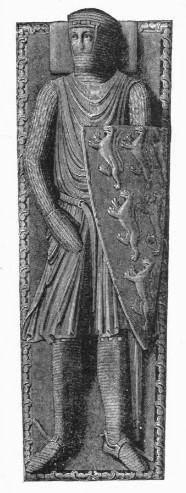 | |||||||
| Together with | Elah ( 1196 - 1226 ) | ||||||
| Predecessor | William Fitz Patrick | ||||||
| Successor | Humphrey | ||||||
| Birth | 1176 | ||||||
| Death | March 7, 1226 Salisbury Castle | ||||||
| Burial place | Salisbury Cathedral | ||||||
| Kind | Plantagenets | ||||||
| Father | Henry II | ||||||
| Mother | Ida de Tosni | ||||||
| Spouse | Ala | ||||||
| Children | sons: William , Richard, Stephen, Nicholas daughters: Ela, Isabella, Petronella, Ida | ||||||

Content
Biography
William was the illegitimate son of King Henry II . His mother's name was previously unknown. Thanks to a document found by William, it was determined that his mother, Countess Ida, came from the Tosni clan, and in 1181 married Roger Bigot , 2nd Earl of Norfolk [1] [2] [3] .
King Henry recognized his son and granted him the estate of Appleby in Lincolnshire in 1188 . Eight years later, in 1196 , his half- brother, King Richard I of Lionheart , married him to the heiress of the great lands, Ele , daughter of William Fitz-Patrick , 2nd Earl of Salisbury . William held the title of Earl of Salisbury by the right of his wife.
During the reign of King John , William was a member of the court on a number of important matters, and also held various posts: Sheriff Wiltshire , Lieutenant Gascony , Constable Dover and the Warden of the Five Ports , and then the head of the Welsh Mark prison. He was the commander of the Welsh and Irish expeditions of the king in 1210 - 1212 . The king awarded him the Ai estate in Suffolk .
In 1213, William was put at the head of a large fleet, on which he went to Flanders, where at the battle of Damm, he captured and destroyed most of the French fleet, anchored for further invasion of England. The threat of invasion was averted, but the conflict between England and France did not end.
In 1214, William was sent to help Emperor Otton IV , an ally of England, to invade France. Salisbury commanded the right wing of the army to a crushing defeat at the Battle of Bouvin , where he was captured.
By the time he returned to England, a riot among the barons was brewing. Salisbury was one of the few who remained faithful to King John. During the civil war, which took place a year after the signing of the Magna Carta , Salisbury was one of the leaders of the king’s army in the south of the country. However, after the French prince Louis landed as an ally of the rebels, William went over to his side. He probably believed that John lost.
After the death of John and the departure of Louis, William, along with many other barons, took advantage of the infancy of the son of John Henry III and took important positions in the government during the minority of the king. At the same time, William fought in Gascony to protect the rest of the continental English possessions.
The Salisbury ship crashed during a storm when he returned to England in 1225 , and he spent several months in refuge at a monastery on the French island of Ile de Re . He died shortly after his return to England at Salisbury Castle . Chronicler Roger from Wendover claimed that Salisbury was poisoned by Hubert de Burg , 1st Earl of Kent . He was buried in the Salisbury Cathedral in Wiltshire .
The tomb of Earl William was opened in 1791 . In it, among other things, a well-preserved rat corpse with traces of arsenic was found inside its skull. The rat is currently on display at Salisbury Cathedral and the Museum of South Wiltshire. [four]
Marriage and children
Wife: (since 1196 ) Ala (1187 or 1191 - August 24, 1261, buried at Lacock Abbey), Countess of Salisbury since 1196, daughter of William Fitz-Patrick , 2nd Earl of Salisbury. From this marriage they had eight children:
- William (until 1209 - killed at the Battle of El Mansour on February 7, 1250), titular Earl of Salisbury , crusader
- Richard (died before December 27, 1261, buried at Lacock Abbey), priest in Salisbury
- Stefan (died 1260, buried in Lacock Abbey), Seneschal Gascony
- Nicholas (died 1297, buried in Salisbury Cathedral ), Bishop of Salisbury
- Isabella (died before 1244, buried in Alnwick Abbey); husband from until May 16, 1226 - William de Vesy (died before October 7, 1253), Lord Alnwick
- Petronella (buried in the monastery of Bradenstock)
- Elah (died February 9, 1298, buried in Osni Abbey, Oxfordshire ); 1st husband - Thomas de Beaumont (died June 26, 1242), 6th Earl of Warwick ; 2nd husband from November 25, 1254/23 March 1254/1255 - Philip Bassett of Wycombe (died before October 29, 1271, buried in Stanley ( Wiltshire )), Justiciary of England
- Ida 1st husband - Ralph de Somery (died before 1220), Baron Dudley; 2nd husband from before 1220 - William de Beauchan (died before 1247), Lord Bedford ; 3rd husband from before 1247— Walter Fitz-Robert of Wodem Walter, Essex (died April 10, 1268, buried at Stanley (Wiltshire)), Justiciary of England
Image in Art
- William Long Sword appears in the novels by Elizabeth Chadwick “The Scarlet Lion”, “For the Grace of the King”, “Reject the King”.
- William Long Sword is one of the characters in Cornelia Funke ’s novel “Ghost Knight”.
Notes
- ↑ Reed, Paul C. Countess Ida, Mother of William Longespée, Illegitimate Son of Henry II. - Baltimore, Maryland, USA: The American Genealogist 77, 2002 .-- S. 137.
- ↑ Vera CM Cartulary of Bradenstoke Priory. - London: Wiltshire Record Society Publications, 1979.
- ↑ Phair, Raymond W. William Longespée, Ralph Bigod, and Countess Ida. - The American Genealogist 77, 2002. - S. 279—281.
- ↑ Unusual Facts & Figures . Salisbury Cathedral. Date of treatment May 14, 2010. Archived on April 25, 2012.
Literature
- Douglas Richardson, KG Everingham, D. Faris. Plantagenet Ancestry. - Genealogical Publishing Company, 2004. - S. 456.
- Reed, Paul C. Countess Ida, Mother of William Longespée, Illegitimate Son of Henry II. - Baltimore, Maryland, USA: The American Genealogist 77, 2002 .-- S. 137.
- Phair, Raymond W. William Longespée, Ralph Bigod, and Countess Ida. - The American Genealogist 77, 2002. - S. 279—281.
- Vera CM Cartulary of Bradenstoke Priory. - London: Wiltshire Record Society Publications, 1979.
- Weis, Frederick Lewis. Ancestral Roots of Certain American Colonists Who Came to America Before 1700. - S. 30-26, 31-26, 33A-27, 108-28, 122-28, 122A-28.
- Weir, Alison. Britain's Royal Family: A Complete Genealogy. - UK: The Bodley Head London, 2002 .-- S. 113. - ISBN 0-7126-4286-2 .
- Cokayne, GE Alan Sutton. The Complete Peerage of England, Scotland, Ireland, Great Britain and the United Kingdom, Extant, Extinct, or Dormant. - UK: The Bodley Head London, 2000 .-- C. Vol I. 368; Vol III. 258-259. - ISBN 0-7126-4286-2 .
- Dodsworth, William. An historical account of the episcopal see, and cathedral church, of Sarum, or Salisbury . - Salisbury: Brodie and Dowding, 1814. - P. 192-193.
- Bryant Arthur The era of chivalry in the history of England / Per. from English T.V. Kovaleva, M.G. Muravyova. - SPb. : Publishing group "Eurasia", 2001. - 576 p. - 3,000 copies. - ISBN 5-8071-0085-9 .
Links
- EARLS of SALISBURY 1196-1310 (LONGESPEE ) . Foundation for Medieval Genealogy. Date of treatment December 28, 2010.
- William Longespée, 1st Earl of Salisbury . thePeerage.com. Date of treatment December 28, 2010. Archived April 25, 2012.
- LONGESPEÉ (E. Salisbury) William LONGESPEÉ (E. Salisbury ) . The Tudorplace. Date of treatment December 28, 2010.
- Unusual Facts & Figures . Salisbury Cathedral. Date of treatment December 28, 2010. Archived April 25, 2012.
- William Longespee 3rd Earl of Salisbury . Genealogics. Date of treatment December 28, 2010. Archived April 25, 2012.