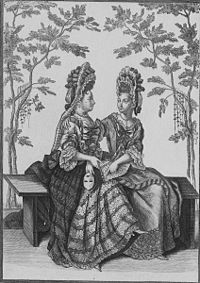
Mushka (from French mouche ) is a cosmetic product for skin correction, common in the XVII - XVIII centuries in an aristocratic and bourgeois environment.
It was a piece of black plaster, taffeta or velvet , which was glued to the face, chest or shoulders in the form of a "mole". In the XVIII century, the front sight became not only a means of makeup , but also a tool of flirting (the so-called “tongue of flies”).
Content
- 1 The appearance of flies
- 2 Accessory of an entire era
- 3 Tongue Flies
- 4 notes
- 5 Links
- 6 Literature
Flies Appear
It is believed that the fly owes its appearance to the British Duchess of Newcastle , whose skin left much to be desired. The Duchess inventively defeated her shortcomings with the help of round pieces of black taffeta, which on her face began to play the role of “artificial moles” [1] .
With their help, it was possible not only to “defeat” the roughness of the skin, but also to tone down the whiteness of the face. In England, this black circle was called the “beauty spot” ( beauty spot ), and also - patch ( patch ) or speckle ( speckle ).
In France , where the fashion for flies penetrated very quickly, they began to call them moucheron or mouche ( fly ). It was the tracing-paper of this gallicism that took root later in Russia .
In those days, the female beauty could be destroyed overnight by the insidious enemy - smallpox : the most beautiful faces were plagued with terrible scars that did not disappear even after many years. Flies came in very handy.
Accessory of an entire era
Always, speaking about the times of “red heels and stately wigs ”, we recall this little accessory . Without flies, the lady of the "gallant era" felt naked.
In addition to a purely corrective function, the front sight was of great importance for the court beauty: with the help of this insignificant piece of material, you could even change the expression on your face ! Pasted near the corner of the mouth , the fly made his face seem to be smiling.
Focusing on the relatively weak candlelight, men and women applied whole layers of whitewash, powder and blush to their faces, let their eyes down, and used bright lipsticks . The front sight added liveliness to these masked faces.
There was a real fly business : an 18th- century advertising publication, “A Useful Book of Paris Addresses,” reported that the “Pearly Pearls” workshop was working on Saint-Denis Street. In it you can not only purchase finished goods , but also stencils for independent creativity in this area. The recommendations of professionals stated that for the manufacture of a high-quality front sight, a new taffeta (or velvet) and special glue are required.
The shape of the flies varied depending on the vagaries of fashion . It could be crescents, triangles , stars, and even silhouettes of various objects. So, flies- carriages and flies- ships are known.
It was believed, however, to blindfold a person to a state of unrecognizability - this was considered decent only for courtesans.
Fly language
Paris, Louvre Museum
XVII , and in particular, the XVIII century, can also be called the "era of flirting ." Love , reduced to continuous and sometimes dangerous coquetry, was the basis of the relationship of idle aristocrats. A well-educated lady should have been able to flirt with several gentlemen at once, without going beyond the bounds of decency.
When the authors write about the “gallant age”, as about the era of debauchery and sexual licentiousness, they are wrong - it was in fashion just flirting , omissions, half-tones and coquetry that did not lead to any “terrible consequences”.
"The language of flies" is a clear confirmation of this. Often, a lady could not directly express her affection to the gentleman or, on the contrary, refuse to reciprocate. To do this, she resorted to allegories. Flies, glued on the face in a special way, could tell more about their owner than she herself could afford.
Different sources contain different interpretations of the position of the flies (probably, the values changed over time). The historian M.N. Mertsalova writes that the crescent fly invited to a night date, the cupid meant love, and the carriage - consent to a joint escape.
A round fly, located between the temple and the eye, was called a "killer" or "passionate person." If there were two or three flies on the face, then the interpretation depended on the age , position in society and the reputation of the woman.
Men also sometimes used flies, but, of course, less often than their wives, daughters, and "ladies of the heart."
After the French Revolution, the fashion for flies came to naught. Currently, this accessory is used in cinema , in the theater and on the catwalk - at exclusive fashion shows.
Notes
- ↑ James Fitzmaurice. Margaret Cavendish: Sociable Letters . - Routledge, 2013-01-11. - 254 p. - ISBN 9781135814151 .
Links
Literature
- Mertsalova M.N. History of costume. - M. , 1972.
- D. Pake. The story of beauty. - M. , 2001.
- Gislene Pillivet in Per. A. Tolstoy. “Secrets of seduction” // “Pinakothek”. - M. , 1998. - No. 6-7 .