Content
Schools of Princes Vladimir and Yaroslav
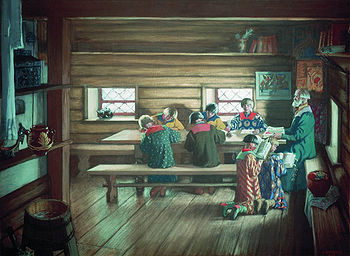
The period of development of national education under princes Vladimir and Yaroslav the Wise is often recognized as the initial in the entire history of this formation, which is largely associated with Christian churches [1] .
Under the year 988 in the Tale of Bygone Years : “And (Vladimir) set up a church in the name of St. Basil on a hill where the idol of Perun and others stood and where the prince and the people created them. And in other cities they began to put churches and determine priests in them, and bring people to baptism in all cities and villages. He sent to collect children from the best people and give them to book training. The mothers of these children cried for them; for they had not yet established themselves in the faith, and wept for them, as for the dead ”(the pagans were against Christian innovation).
Russian scribes who worked in advanced schools used their version of the structure of subjects, which to some extent took into account the experience of the Byzantine and Bulgarian schools, which provided higher education.
Sophia's first chronicle about a school in Novgorod: 1030. “In the summer of 6538. Ida Yaroslav on Chyud, and I defeat, and put the city of Yuryev. "Come to Novugorod, and having taken 300 children from the elders and from the priests, teach us with a book."
The school in Novgorod, created in 1030 by Yaroslav the Wise, was the second institution of higher education in Russia, in which only children of elders and clergy studied. There is a version that in the annals we are talking about children of church elders who were elected from the lower classes, but until the end of the 16th century. only the elders administrative and military are known. The term "churchwarden" appeared in the XVII century. The contingent of students of the Novgorod school consisted of children of the clergy and the city administration. The social composition of students reflected the class nature of education of that time.
The main task of the school was to prepare a competent and united by the new faith management apparatus and priests, whose activities took place in a difficult struggle with the strong traditions of the pagan religion among the Novgorodians and the Ugro-Finnish tribes that surrounded Novgorod.
The activities of the school of Yaroslav relied on an extensive network of elementary schools, as evidenced by the large number of birch bark letters discovered by archaeologists, he wrote, waxed tablets. On the basis of widespread literacy, Novgorodian book-writing flourished. In Novgorod, the famous Ostromir Gospel was written, a description | Dobrynya Yadreikovich Tsargrad, a mathematical treatise of Kirik. For the descendants of “ Izbornik 1073 ”, the initial annalistic vault, a brief edition of the “Russian Truth” have been preserved. The Novgorod book depositories served as one of the main sources of the Great Fourth Mineas - a collection of "all books read in Russia," consisting of 12 huge volumes with a total volume of over 27 thousand pages.
1037. In the year 6545. Yaroslav laid the big city, which now has the Golden Gate, laid the church of St. Sophia, the metropolis, and then the Church of the Holy Virgin of the Annunciation at the Golden Gate, then the monastery of St. George and St. Irina ... Yaroslav loved church charters, priests very much He complained, especially of the Chernozorists, and showed zeal for books, often reading them night and day. And he gathered many bookwriters who translated from Greek into Slavic. And they wrote many books on which believers learn and enjoy divine teaching. As it happens that one plows land, the other sows, and still others reap and eat non-scaling food, and here. After all, his father, Vladimir, plowed and softened the earth, that is, he enlightened with baptism, and we are reaping, receiving book teaching.
Great is the use of book teaching; books instruct and teach us the ways of repentance, for we gain wisdom and abstinence in book words. These are the rivers that fill the universe, these are the sources of wisdom, because the books have immeasurable depth ... ... Yaroslav ... he loved books and, after rewriting a lot of them, put them in the church of St. Sophia, which he himself created " [2]
The educational reform of Vladimir and Yaroslav strengthened Christianization on the lands of the future of Russia and its neighbors, however centuries-old pagan traditions had deep roots in the peoples of the country.
Graffiti of the 11th century from St. Sophia of Kiev : “On the 10th (day) of the month of June, we removed (disturbed the relics) a grammar, and in the 15th gave it to Lazor” [3] .
“Grammars” called themselves as professional scribes of South Slavonic manuscripts, so the teachers - teachers of the full course of grammar were also called the Greeks. Emperor Justinian in 534 established a reward for prominent grammars in the amount of 70 solidity and determined a number of other privileges for these teachers. Grammarians also taught at the Kiev Palace School, after death by status they were buried in the cathedral. The relics of the Grammar were transferred to the monastery, where Lazarus was the hegumen (mentioned under 1088).
Monastic education under Prince Vsevolod
Vsevolod Yaroslavich (1030-1093) - the son of Yaroslav the Wise, could also be in his father's Novgorod school. From 1054 to 1076 Vsevolod reigned in the Pereyaslavl and Suzdal lands. After the death of his brother, Svyatoslav became the Grand Duke of Kiev, but he gave the throne to his brother Izyaslav and began to reign in Chernigov. After the death of Izyaslav in 1078, he again became the Grand Duke of Kiev. He was an educated person, he knew five foreign languages, together with his brothers he approved the so-called “Truth of Yaroslavichi”.
Education, including the monastery, was supported by Theodosius of the Caves (c. 1008 - May 3, 1074). “The Life of Theodosius of the Caves” reported on a school in Kursk: “It happened to the blessed parents to move to another city called Kursk ... Let us turn to the story about this holy youth. He grew up with his body, and with his soul he was drawn to the love of God and went to the church of God every day, with all his attention listening to the reading of divine books. He didn’t come close to playing children, as is common with minors ... In addition, he asked his teacher to learn from the divine books, which they did. Soon he comprehended all the letters, so that everyone was amazed at his mind and abilities and how quickly he learned everything. ”
Schools in other regions of Russia
Medieval education in Russia is often reduced to examples of Novgorod and Kiev. But there is a lot of evidence of the development of education in other cities of the medieval state. Around 1096. Murom "After the adoption of the Christian faith, the Muromites sent" their children to the teaching of literacy "" [4] .
It is known in 1143 that the women's monastery school founded by Euphrosyne of Polotsk in Polotsk (now Vitebsk Region, Belarus), which was then part of Russia.
Abraham Smolensky studied here. “... Blessed Abraham was born from faithful parents. His father was revered by all and loved, in the honor of the prince, and truly everyone knew him, and he was adorned with truth, and helped many in troubles, was merciful and calm with everyone, had diligence for prayers and church services. His mother was also adorned with all piety. ” “... When the boy reached a reasonable age, his parents gave him to study from books. He was not discouraged, like other children, but, thanks to great diligence, he quickly learned; besides, he didn’t play with other children, but he hastened ahead of others for divine and church singing and reading, so his parents rejoiced at this, while others were surprised at such a reason of the child. ” “... Of all the books he most often liked to read the teachings of the Monk Ephraim, and the great teacher of the universe John Chrysostom, and Theodosius of the Caves ...” [5] .
Schools developed in Vladimir on Klyazma . “The great prince Konstantin Vsevolodovich the Wise, the grandson of Yuri Vladimirovich Monomash ... he was a great hunter to read books and was taught many sciences, for the sake of which he had people of scientists with him, many ancient Greek books were bought at a high price and ordered to be translated into Russian. "Many of the affairs of the ancient princes were collected and written by himself, and others worked with him as well." “... 6735 (1227). Maya 11, a great fire broke out in Vladimir and 27 churches burned and the courtyard of Blessed Grand Duke Konstantin Vsevolodich and the church built in it, Archangel Michael with all the rich utensils. In it, monks Russian and Greeks worked, a part of infants, and many books, collected by this Constantine the Wise, were burnt ” [6] .
School at the Church of Michael could be one of several in the district of Vladimir.
The school operated in Nizhny Novgorod . So blessed Euthymius was born and was raised in Nizhny Novgorod. Here he studied literacy and studied approximately - he did not like to engage in childish pranks, was meek and obedient to his parents ... [7] . Euthymius was born at the beginning of the XIV century. He graduated from school, which, apparently, existed in the city already in the XIII century. He was tonsured a monk, and later appointed archimandrite of a monastery in Suzdal. In "Life" Euthymius preserved the earliest mention of the school in Nizhny Novgorod.
Most likely, the existence of primary schools in many churches and passages of Russia, but their total number is still difficult to determine.
The results of medieval education in Russia according to Stoglav
Tsar Ivan the Terrible, in order to strengthen centralized power in 1551, gathered a cathedral - representatives of the church hierarchy with the participation of the boyar duma to draw up a special code. The collection of solutions consisted of 100 chapters.
Chapter 26 of the Stoglava sets forth the decree on literacy schools. The authors of the document argued their proposal by the need to combat the illiteracy of deacons and priests (chap. 25) and a reference to schools in the past. Researchers believe that the compilers of the mentioned historical reference had in mind only Russia before the Mongol-Tatar invasion, but at least Novgorod birch bark letters in the XIII-XV centuries. talk about maintaining a high level of education. This is confirmed by the example of Moscow. The lead seal of the 11th century was found in it. Metropolitan of Kiev, attached at that time to some letter of the church hierarch. V.L. Yanin dated the seal of 1091-1096.
Literacy discovered by archaeologists testifies to the spread in Moscow, she wrote: bone, two bronze in the layers of the XII-XIII centuries. In the XIII-XIV centuries. Moscow becomes a new center for book writing in Russia. The chronicle, describing the approach to the city of Tokhtamysh near 1382, reports that the city was "... many books were demolished from the whole city, in cathedral churches I’m blinking to a sling, conservation is justified for the sake of it" [8] .
Many handwritten books could only accumulate over the centuries. The Stoglava compilers knew this, mentioning the schools “before” not only in Novgorod.
Stoglava about schools (according to some versions - only in pre-Mongol times, although "before this" - it was earlier than the XVI century). (chapter 25)
“... And before that, schools were in the Russian Empire in Moscow and in Veliky Novugrad, and in other cities many schools were taught to read, write, write, and pete and honor. Therefore, then there were many letters of honor, and scribes, and singers, and readers were glorious in the whole earth ... ” [9] .
The general achievements of the culture of medieval Russia are largely confirmed by the estimates of the authors of Stoglava [10] [11] [12] [13] [14] [15] [16] [17] [18] [19] [20] [21] [ 22] .
Notes
- ↑ Testimonies of sources about schools in Russia in the XI-XIII centuries. Given in the publication: Anthology of the pedagogical thought of Ancient Russia and the Russian state of the XIV-XVII centuries. M .: Pedagogy. 1985.P. 90-102, 106-129, 145-148. http://ricolor.org/history/hr/culture/school/ Russian education in the 10th-17th centuries Kirillin V. M. The state of education in Russia during the pre-school period (11th-17th centuries) http: //www.roman. by / r-90984.html In the era of Vladimir, there were already Christian churches and, accordingly, there were people who could teach “books”.
- ↑ See: Essays on the history of the school and pedagogical thought of the peoples of the USSR from ancient times to the end of the 17th century. / [E. D. Dneprov, Oh. E. Kosheleva, G. B. Kornetov et al.]; Repl. ed. E. D. Dneprov; [APN USSR, Research Institute pedagogy]. - M.: Pedagogy, 1989 .-- 479 p. http://www.booksite.ru/ancient/reader/spirit_2_05_01.htm do not take into account antique and earlier periods of national education
- ↑ Vysotsky S.A. Medieval inscriptions of Sophia of Kiev: Based on graffiti materials of the 11th – 17th centuries. Kiev, 1976; Zhurakovsky G. E. Essays on the history of ancient pedagogy. M., 1963
- ↑ The Tale of the Placement of Christianity in Murom.— In the book: Monuments of ancient Russian literature published by Count Grigory Kushelev-Bezborodko. Vol. 1 / Ed. N. Kostomarova. SPb., 1860.30, p. 235
- ↑ The Life of Abraham Smolensky.— In the book: Monuments of the Literature of Ancient Rus: XIII Century. M., 1981, p. 73
- ↑ Tatishchev V.N. Russian History, vol. III. M .; L., 1964. p. 221
- ↑ The repose of St. Euthymius of Suzdal. - In the book: Lives of saints honored by the Orthodox Church, compiled by Filaret (Gumilevsky) with additions from other books. SPb., 1885, apr. 37, p. 11 - 12
- ↑ Complete collection of Russian chronicles, vol. IV. SPb., 1848. p. 334
- ↑ Stoglav. Ed. D.E. Kozhanchikova. St. Petersburg, 1863, Ch. 25
- ↑ Culture and art of Ancient Russia
- ↑ Sarabyanov V., Smirnova E. The history of ancient Russian painting
- ↑ Dictionary of scribes and books of Ancient Russia : [in 4 issue] / Ros. Acad. Sciences , Inst. lit. ( Pushkin House ); open ed. D. S. Likhachev [et al.]. - L.: Science , 1987-2017. An electronic version of the first and 1-2 parts of the second issue on the website of the Institute of Russian Literature.
- ↑ Lukashevskaya I. The concept of “artistic image” and the problems of its study in primitive art
- ↑ Ilyina T. Art History. Domestic art
- ↑ Rabinovich M. Old Russian banners (X — XV centuries) from miniature images
- ↑ Gurevich A. Categories of medieval culture
- ↑ Eliade M. History of faith and religious ideas. Volume One: From the Stone Age to the Eleusinian Mysteries
- ↑ Eliade M. History of faith and religious ideas. Volume Two: From Gautama Buddha to the Triumph of Christianity
- ↑ Eliade M. History of faith and religious ideas. Volume Three: From Mohammed to the Reformation
- ↑ Ermolin E. Russian culture. The personalistic paradigm of the educational process
- ↑ B. A. Rybakov - Craft of Ancient Russia
- ↑ B.A. Rybakov - Craft of Ancient Russia :: NoNaMe