The Chamber of drafters (n. Lakenhalle ) is one of the largest secular Gothic structures in Europe, built in the 13th century in the city of Ypres . Construction work was completed in 1304.
| Chamber of Cloth and Beffroix | |
| Chamber of Cloth and Beffroix Ypres | |
|---|---|
| Lakenhalle van ieper | |
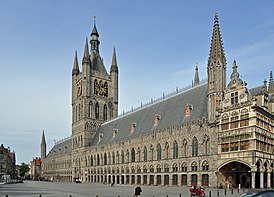 Chamber of Cloth and Beffroix Ypres | |
| A country |  Belgium Belgium |
| City | Ypres |
| Architectural style | gothic (restored) |
| Building | 1200 - 1304 years |
| condition | Burned in 1914 , restored in 1967 |
| Site | |
The seventy- meter beffroy was completed in 1230. Together with other Belgian and French beffroys, it is inscribed on the UNESCO World Heritage List under the number ID 943-010 [1] .
The Cloth Chamber was completely destroyed during the First World War and was recreated only in 1967. At the base of the building today are visible the stones of the old chamber of cloth makers.
Today, the In Flanders Fields Museum, dedicated to the events of the First World War, is located in the house of draggers. The name of the museum is a reference to the eponymous poem of the Canadian military doctor and poet John McCray (1872-1918) who fought against Ypres. Translated by A. Yaro, the first stanza sounds:
- Everywhere poppies candles burn sorrows
- In the war of the seared flanders fields
- Between the gloomy crosses that stand in rows
- In places where our ashes have recently been buried
- In the war of the seared flanders fields
These verses inspired American professor Moyna Michael to use poppies as a sign of memory of those killed in the First World War , and more broadly, a sign of memory of the dead soldiers in general. Today this tradition exists in the UK, USA [2] , and Belgium.
There is a carillon with 49 bells with a total weight of 11,892 kilograms in the beffroix of the house of drafters. Every quarter hour, Carillon performs “Het Iepers Tuindaglied,” a seventeenth-century song describing the siege of Ypres in 1383 [3] .
Feline Parade
The culmination of the traditional "cat parade" ( Dutch: Kattenstoet ) in Ypres is the dropping of cats from the upper tier of beffra. From the 12th century until 1817, real animals were used for these purposes. In 1955, the tradition was renewed, but instead of live cats, plush toys began to be used.