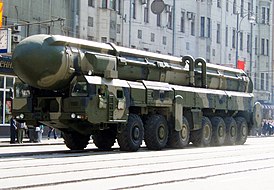
RT-2PM Topol ( GRAU index of the complex / missile - 15P158 / 15ZH58 , under the START treaty - RS-12M , according to NATO classification - SS-25 Sickle , translated - Sickle ) - a Soviet / Russian strategic mobile ground missile system with 15Zh58 three - stage solid propellant intercontinental ballistic missile .
| RT-2PM "Poplar" | |
|---|---|
 | |
| General information | |
| A country |  the USSR the USSR |
| Index | 15ZH58 |
| START Code | RS-12M |
| NATO classification | SS-25 Sickle |
| Appointment | ICBMs |
| Developer | MIT |
| Main characteristics | |
| Number of steps | 3 |
| Length (with GP) | 22.3 m [1] |
| Length (without MS) | 17.5 m |
| Diameter | 1.80 m |
| Starting weight | 45 100 kg [1] |
| Cast weight | 1 200 kg [1] |
| Type of fuel | solid blended |
| Maximum range | 11,000 km [1] |
| Accuracy, quo | 150 meters [1] |
| Type of head | monoblock |
| Number of War Blocks | one |
| Charge power | according to various sources 550 ct [2] or about 800 ct [3] [4] |
| Control system | autonomous, inertial based on BTsVK |
| Basing method | PGRK |
| Launch history | |
| condition | in service |
| Adopted | 1988 year |
Content
- 1 Development History
- 2 Production
- 3 Deployment
- 4 Construction
- 5 Comparative characteristic
- 6 Operation and Prospects
- 7 Where can I see
- 8 See also
- 9 notes
- 10 Sources
- 11 Literature
- 12 Links
Development History
- Timeline
The development of a new strategic missile system based on the RT-2P solid-propellant ICBM with the deployment of a new missile on a self-propelled automobile chassis was launched at the Moscow Institute of Heat Engineering in 1975 under the leadership of the chief designer A.D. Nadiradze (B.N. Lagutin after his death).
Decree of the Central Committee of the CPSU and the Council of Ministers of the USSR No. 668-212 on the development of the Topol missile system was issued on July 19, 1977 [5] .
The first flight test of the rocket took place on October 27, 1982 at the Kapustin Yar training ground and ended unsuccessfully [5] .
The second (according to other sources, the first [6] ) launch was carried out on February 8, 1983 at the Plesetsk training ground on the 6thNRU was successful. The first three test launches were carried out from a RT-2P missile silo launcher [5] specially adapted for these operations [6] .
On August 10, 1983, the fourth launch of the RS-12M rocket was carried out, it was the first one carried out with a self-propelled launcher [5] 15U128 [6] .
In total, at the stage of joint flight tests of the complex from February 1983 to December 23, 1987, 16 missile launches were carried out [5] .
The missile system was adopted on December 1, 1988 [7] .
- Involved Structures
The following structures were involved in the development and production of military and training weapons of the Topol complexes:
- Rocket - Moscow Institute of Heat Engineering , Moscow (development); [8] Production Association Votkinsk Plant , Votkinsk , Udmurt Autonomous Soviet Socialist Republic (production); [9]
- Missile Aiming System - TsKB Arsenal (development) and PA Arsenal Plant , Kiev , Ukrainian SSR (production); [10]
- Control system - Leningrad Optical and Mechanical Association , Leningrad (development / production); [eleven]
- Drives - All - Russian Research Institute "Signal" , Kovrov , Vladimir Region (development); Lyubertsy agricultural engineering plant them. A. V. Ukhtomsky , Lyubertsy , Moscow Region (production); [12]
- Launcher and support machine - Central Design Bureau “Titan” (development) [13] and PO “Barricades” , Volgograd , Volgograd region. (production); [fourteen]
- Basic load-bearing structures (BNK) for missiles - NPO Soyuz , Dzerzhinsky , Moscow Region (development); [fifteen]
- Testing grounds - Sofrinsky artillery range . [16]
Production
From November 1984 to September 1994, during the period of serial production of the elements of the complex and the deployment of missile regiments on combat alert, 32 serial control launches were conducted (in defense of the party). During the period of operation of the PGRK in the Strategic Missile Forces from April 1988 to November 2005, 33 combat training launches of the RT-2PM rocket were completed [5] .
| List of starts for which data is available | ||||||
|---|---|---|---|---|---|---|
| Start number | date and time | Launch site | goal | Subdivision | Result | Note |
| one | April 22, 1985 [17] | Plesetsk | 1st rdn 79 rp 8 rd | successful | after retraining of the 79th RP (military unit 19970) on the Republic of Kazakhstan 15P158.1 "Poplar 1". On July 30, 1985, military unit 19970 entered the database. [eighteen] | |
| 2 | June 14, 1985 [17] | Plesetsk | 1st rdn 107th rp 8 rd | successful | after retraining of the 107th RP at the Topol 1 RK. On 10/19/1985, the 107th RP entered the database. [19] | |
| 3 | August 14, 1985 [17] | Plesetsk | 2nd rdn? Th rp 8 rd | successful | ||
| four | August 25, 1985 [17] | Plesetsk | 1 rdn 304th rp (military unit 21649) 8 rd | successful | after retraining of the 304th RP in RK "Topol. 1". On 10.12.1985, military unit 21649 entered the database. [twenty] | |
| 5 | October 4, 1985 [21] | Plesetsk | 1st rdn of the 308th rp ( pl. 21) 42 rd | successful | military unit 29438 12/30/1985 entered the database with RK “Topol 1” in readiness “Permanent”. [22] | |
| 6 | October 24, 1985 [17] | Plesetsk | 1st rdn? Th rp 8 rd | successful | ||
| 7 | November 1986 [21] | Plesetsk | 2nd rdn? Th rp ( pl. 11) 42 rd | successful | ||
| 8 | April 26, 1987 | Plesetsk (spaceport) | in / h? 54 Guards rd | successful | ||
| 9 | June 1987 [21] | Plesetsk | 2nd rdn? Th rp (military unit 12830, pl. 12) 42 rd | successful | military unit 12830 in August 1987 entered the database. [22] | |
| 10 | July 1987 [21] | Plesetsk | 2nd rdn? -Th RP (military unit 19972, pl. 1) 42 rd | successful | military unit 19972 from October 6, 1987 entered the database. [22] | |
| eleven | 1987 [21] | Plesetsk | ? th rdn? th rp (military unit 93401, pl. 11) 42 rd | successful | military unit 93401 in 1985 retrained at the Topol RK. On 04/27/1987, military unit 93401 entered the database. [22] | |
| 12 | July 5, 1988 9:50 p.m. | Plesetsk | in / h? 54 Guards rd | successful | ||
| 13 | October 1988 | Plesetsk | 235th RP (military unit 12456) 54 Guards rd | successful | military unit 12456 in 1988 retrained on the Topol RK. On December 13, 1988, military unit 12456 entered the database. | |
| fourteen | May 22, 1990 [23] | Plesetsk | Kura | 1st rdn 235th rp (military unit 12465) 54 Guards. rd | successful | Combat training launch (UBP) |
| fifteen | November 28, 1990 | Plesetsk | in / h? 54 Guards rd | successful | UBP | |
| 16 | June 25, 1991 | Plesetsk | 189 Guards rp (military unit 11466) 23 Guards. rd | ?successful? | UBP | |
| 17 | August 20, 1991 [24] | Plesetsk | Kura | 2nd rdn 479 rp 35 rd | successful | after retraining of the 479th RP at the Topol RK. On December 30, 1991, 479 RP entered the database. |
| eighteen | October 2, 1991 [25] | Plesetsk | Kura | ? -th rdn 346 rp 32 rd | successful | after retraining of the 346th RP at the Topol RK. On December 30, 1991, 346 rp entered the database. |
| 19 | July 23, 1993 12:24 | Plesetsk | Kura | in / h? 54 Guards rd | successful | Command Post Exercise (KShU) |
| twenty | October 10, 1995 [21] | Plesetsk | in / h? 14 rd | successful | UBP | |
| 21 | October 4, 1996 | Plesetsk | Kura | military unit 14264 7 Guards rd | successful | |
| 22 | November 9, 1996 | Plesetsk | Kura | military unit 52642 7 Guards rd | successful | |
| 23 | October 3, 1997 10:17 | Plesetsk | Kura | military unit 21663 54 Guards rd | successful | KShU |
| 58 | September 16, 1998 [26] | Plesetsk | Kura | ? | successful | The rocket has been on combat duty for 10 years |
| October 1, 1999 11:42 | Plesetsk | Kura | 235th RP (military unit 12465) 54 Guards rd | successful | KShU, rocket for more than 15 years | |
| February 16, 2001 1:43 p.m. MSK [27] | Plesetsk | Kura | ? | successful | UBP as part of a command post training (KShT) [28] | |
| October 3, 2001 1:00 p.m. MSK [29] | Plesetsk | Kura | ? | successful | UBP, the rocket carried a DB in the troops for 15 years Launch goal : confirmation of the performance characteristics and reliability of the missile system in extended service life [29] | |
| November 1, 2001 19:20 MSK [30] | Plesetsk | Kura | ? | successful | ||
| October 12, 2002 1:52 p.m. MSK [31] | Plesetsk | Kura | ? | successful | UBP, the rocket carried a DB in the troops for 12 years Launch goal : confirmation of the performance characteristics and reliability of the missile system [31] | |
| March 27, 2003 12:27 MSK [32] | Plesetsk | Kura | 235th RP (military unit 12465) 54 Guards rd | successful | UBP in the framework of the KShU, the missile carried combat duty in the troops for 18 years [32] | |
| February 18, 2004 [33] [34] | Plesetsk "Anniversary" [35] | Kura | ? rdn 307 rp (military unit 29532) 35 rd | successful | UBP during strategic KShT | |
| November 2, 2004 12:52 MSK [31] | Plesetsk | Kura | ? | successful | UBP Launch goal : confirmation of the performance characteristics of ICBMs and extension of the service life to 20 years [31] | |
| 78 | November 1, 2005 20:10 MSK [36] | Kapustin Yar | Sary Shagan | ? | successful | Test run Launch goal : flight test of a new single (for marine and ground-based) combat unit and tests to extend the life of the complex [37] |
| 79 [26] | November 29, 2005 10:44 MSK [38] | Plesetsk | Kura | ? | successful | UBP Launch goal : reliability check after 20 years of combat duty [38] |
| 80 | August 3, 2006 13:38 MSK [39] | Plesetsk | Kura | ? | successful | UBP Launch goal : confirmation of the main LTH for extension of terms complex operation up to 23 years [39] |
| 81 | October 18, 2007 09:10 MSK [39] | Plesetsk | Kura | ? | successful | UBP Launch goal : confirmation of LTH stability in extended terms operation [39] , extension of the service life to 21 years [40] |
| 82 | August 28, 2008 2:36 p.m. MSK [41] | Plesetsk | Kura | ? | successful | Test launch, rocket manufactured in 1987, Launch goal : testing promising military equipment for the BRNB (experimental BB with special JV PRO and ability hit point highly protected objects), as well as confirmation LTH stability in extended to 21 years of operation [41] |
| 83 | October 12, 2008 11:24 AM MSK [42] | Plesetsk | Kura | ? | successful | UBP during KShU with 33 RA in the framework of the exercises "Stability-2008", rocket manufactured in 1987, Launch Goal : Confirm the stability of performance in extended up to 21 years of operation [42] |
| 84 | April 10, 2009 [43] | Plesetsk | Kura | ? | successful | UBP, the rocket was manufactured in 1987, until August 2007 on a database of 54 Guards. rd Launch goal : confirmation of the stability of the main LTH in extended service life, extension of service life up to 22 years. [43] |
| 85 | December 10, 2009 3:53 p.m. MSK [44] | Kapustin Yar | Sary Shagan | ? | successful | Test run Launch target : test of the ICBM combat equipment, confirmation stability of the main characteristics in the long term of operation [44] |
| 86 | October 28, 2010 [45] | Plesetsk | Kura | ? | successful | UBP, the rocket was manufactured in 1987, until March 2007 on a database of 54 Guards. rd Launch goal : extending the life of the complex to 23 years [45] |
| 87 | December 5, 2010 [46] | Kapustin Yar | Sary Shagan | ? | successful | Test launch, rocket manufactured in 1987, Launch goal : testing a new type of combat equipment of the BR, with parallel, individual breeding of warheads in return, the so-called " bus " that implements a consistent breeding scheme [47] , Confirmation of the stability of LTH in the extended terms of operation, testing of measuring instruments [48] |
| 88 | September 3, 2011 13:46 MSK [49] | Plesetsk | Kura | ? | successful | the rocket was made in 1988, until March 2011 on a 39 Guards database . rd (Novosibirsk), Launch Purpose : Testing an Experimental Warhead with high accuracy, assessment of the possibility of further extension complex service life [49] |
| 89 | November 3, 2011 10:45 MSK [50] | Plesetsk | Kura | unit 14 rd | successful | UBP, the rocket was manufactured in 1987, until July 2007 on a database in 42 rd, Launch goal : confirmation of the stability of the main performance characteristics of missiles of this class in the period extended to 24 years of service life and assessment the possibility of extending the life of up to 25 years [50] |
| 90 | June 7, 2012 9:39 p.m. MSK | Kapustin Yar | Sary Shagan | successful | The purpose of the launch : confirmation of the stability of the LTH in the extended terms of operation, tests of combat equipment. | |
| 91 | October 19, 2012 1:12 p.m. MSK | Plesetsk | Kura | successful | The purpose of the launch : confirmation of the stability of the LTH in the extended up to 24 years of operation, The price of the possibility of extending the life of up to 25 years. | |
| 92 | October 10, 2013 17:39 MSK | Kapustin Yar | Sary Shagan | successful | The purpose of the launch : testing of military equipment, evaluating the effectiveness of anti-missile defense countermeasures, confirming the stability of LTH in the long term of operation. The missile was placed in the army 25 years ago [51] [52] . | |
| 93 | October 30, 2013 14: ?? Msk | Plesetsk | Kura | successful | Launch goal : strategic exercises of nuclear deterrence forces [53] . | |
| 94 | October 27, 2013 21:30 MSK | Kapustin Yar | Sary Shagan | successful | The purpose of the launch : testing promising military equipment [54] . | |
| 95 | March 4, 2014 10:10 p.m. MSK | Kapustin Yar | Sary Shagan | successful | The purpose of the launch : testing promising military equipment [55] . | |
| 96 | May 8, 2014 ??: ?? Msk | Plesetsk | Kura | successful | Launch target : KShT | |
| 97 | May 20, 2014 9:08 p.m. MSK | Kapustin Yar | Sary Shagan | successful | The purpose of the launch : testing promising military equipment [56] . | |
| 98 | August 22, 2015 18:13 MSK | Kapustin Yar | Sary Shagan | successful | Launch goal : testing promising military equipment [57] . | |
| 99 | September 26, 2017 ??: ?? Msk | Kapustin Yar | Sary Shagan | successful | The purpose of the launch : testing promising military equipment [58] . | |
Deployment
The first missile regiment with the Topol RK was put on combat duty on July 23, 1985 (according to other sources - July 20), even before the completion of joint flight tests in the 14th missile division ( Yoshkar-Ola ) (commander - Colonel V. Dremov B.), and until the end of 1985 - another missile regiment [7] [59] .
On May 27, 1988, the first regiment entered the database, the divisions of which included an advanced mobile command post (PKP) equipped with a new automated control system [7] .
| The development of the RT-2PM group. The number of PU on combat duty [60] | ||||||||||||||||||||||||||||||||
|---|---|---|---|---|---|---|---|---|---|---|---|---|---|---|---|---|---|---|---|---|---|---|---|---|---|---|---|---|---|---|---|---|
| 1984 | 1985 | 1986 | 1987 | 1988 | 1989 | 1990 | 1991 [sn. one] | 1992 | 1993 | 1994 | 1995 | 1996 | 1997 | 1998 | 1999 | 2000 | 2001 | 2002 | 2003 | 2004 | 2005 | 2006 | 2007 | 2008 | 2009 | 2010 | 2011 | 2012 | 2013 | 2014 | 2015 | |
| RT-2PM | eighteen | 72 | 81 | 99 | 162 | 234 | 306 | 333 | 351 | 369 | 360 | 360 | 360 | 360 | 360 | 360 | 360 | 360 | 345 | 333 | 315 | 291 | 254 | 243 | 213 | 180 | 171 | |||||
| Total ICBMs | 1398 | 1398 | 1398 | 1390 | 1398 | 1398 | 1398 | 1333 | 1305 | 1129 | 975 | 870 | 832 | 748 | 756 | |||||||||||||||||
| % of RKSN (including RSD) | 0.94 | 3.76 | 4.23 | 5.37 | 9.34 | 14.63 | 21.21 | 24.98 | 26.89 | 32.68 | 36.92 | 41.38 | 43.27 | 48.13 | 47.62 | |||||||||||||||||
Design
RT-2PM is made according to the scheme with three marching steps, each of which is equipped with solid propellant rocket propeller with one fixed nozzle. The total mass of the rocket is 45 tons.
- The first stage of the rocket has a mass of 27.8 tons, a length of 8.1 m and a diameter of 1.8 m. The tail compartment has a cylindrical shape, aerodynamic rudders ( grilles ) and stabilizers are placed on its outer surface. Flight control during the operation of the first stage is carried out due to the rotary gas-dynamic and aerodynamic rudders (grilles).
- The second stage has a diameter of 1.55 m.
- The third stage has a diameter of 1.34 m.
The head of the rocket consists of one combat unit and a compartment with a propulsion system and control system. An inertial type control system was used on the missile, which provides missile flight control, routine maintenance on the missile and launcher, prelaunch preparation and missile launch.
For the entire period of operation, the rocket is placed in a sealed transport and launch container (TPK) 22.3 m long and 2 m in diameter, in which constant temperature and humidity are maintained.
The launcher is mounted on the basis of the MAZ-7912 semi-axle chassis (later modifications are based on the MAZ-7917 , which was increased by approximately 1 m in length and modified crew cabs), it is equipped with aggregates and systems that provide transportation, maintain a certain degree of combat readiness, and prepare and launching a rocket.
To launch a rocket launcher is hung on the jacks and level. The rocket is launched after lifting the container into a vertical position using a powder pressure accumulator placed in the transport-launch container - “ mortar launch ”.
The engine housings of all three stages are made of composite materials.
Type of warhead: detachable monoblock (high power class) thermonuclear with a high-speed uncontrolled warhead with a capacity of 1 MT. The head part includes a propulsion system and a control system that provides the extremely small deviation from the aiming point required for hitting targets.
During the operation of the Republic of Kazakhstan, the missile is located in a transport and launch container placed on a mobile launcher, which is based on the MAZ-7917 7-axle wheel tractor. The installation is equipped with an onboard inertial navigation system, which provides the ability to autonomously launch a missile from any suitable point on the route of combat patrol. Start-up can also be carried out from a shelter (special facilities with a sliding roof) in the area of permanent deployment.
In addition to the mobile launcher, the complex includes a command post and other auxiliary units located on 4-axle wheeled off-road chassis (MAZ-543A, MAZ-543M).
Part of the Topol PGRK was deployed in the newly created positional areas (PR), and part in the converted PRs from the dismantled Pioneer medium-range PGRK in accordance with the 1987 INF Treaty.
The mass deployment of the Topol PGRK as part of the RK Strategic Missile Forces group helped solve the problem of its survivability in the face of a possible nuclear strike. Due to the survival of the Topol PGRK, they accounted for the preservation of more than 60 percent of the required retaliatory strike potential, taking into account the presence of railway complexes with RS-22 missiles in the group.
The use of solid propellant rockets gave certain advantages: significantly reduced the time for their preparation for launch compared to liquid ones, for which fueling at the start was provided with liquid fuel; simplified the operation of the Republic of Kazakhstan; It excluded the possibility of spillage of liquid fuel during refueling, poisoning of personnel and environmental pollution by the aggressive components of this fuel, and as a result of this increased the environmental safety of the Strategic Missile Forces.
In addition, according to American experts, solid-fuel rockets are more economical to operate. The information materials reported that the system based on the solid-fuel rocket "Minuteman" ("Minuteman") had operating costs 10 times less than the system based on the liquid rocket "Titan-2". At the same time, the service life of solid fuel rockets, from experience in the United States, ranges from 10 to 15 years and can be brought up to 20 years, as evidenced by the MX ICBM, which was on combat duty from 1986 to 2005 . For Topol missiles, the service life is increased from 10 years to 21 years, according to reliability forecasts, service life can be extended to 23 years. [61] On 03/03/2011, the 1988 Topol rocket was successfully launched. [62]
The Topol PGRK with the fourth-generation intercontinental-range ICBMs favorably differed from their predecessors the Temp-2C and Pioneer missiles . The main advantages of the Topol PGRK included: higher maneuverability, degree of camouflage, the ability to launch missiles from pre-prepared route points and, as a result, higher survivability. More advanced combat equipment of the Republic of Kazakhstan and higher accuracy of hitting the target made it possible to use it to solve the full range of strategic tasks.
Comparative characteristic
| The name of the rocket | RT-2PM | R-36M2 | RT-23 UTTH | RT-23 UTTH ( BZHRK ) |
|---|---|---|---|---|
| Design department | MIT | Design Bureau "South" | ||
| General Designer | A. D. Nadiradze , B. N. Lagutin | V. F. Utkin | ||
| Organization for the development of nuclear warheads and chief designer | All-Union Scientific Research Institute of Experimental Physics , S. G. Kocharyants | |||
| Charge Developer Organization and Chief Designer | VNIIEF , E. A. Negin | VNIIP , B.V. Litvinov | ||
| Development start | 07/19/1977 | 08/09/1983 | 08/09/1983 | 07/06/1979 |
| Test start | 02/08/1983 | 03/21/1986 | 07/31/1986 | 02/27/1985 |
| Date of adoption | 12/01/1988 | 08/11/1988 | 11/28/1989 | - |
| The year of putting on alert the first complex | 07/23/1985 | 07/30/1988 | 08/19/1988 | 10/20/1987 |
| Maximum number of missiles in service | 369 | 88 | 56 | 36 |
| Maximum range , km | 11000 | 11000 | 10450 | 10,000 |
| Starting weight , t | 45.1 | 211.1 | 104.5 | 104.5 |
| Payload mass , kg | 1000 | 8800 | 4050 | 4050 |
| Missile length , m | 21.5 | 34.3 | 22.4 | 22.6 |
| Max diameter m | 1.8 | 3.0 | 2,4 | 2,4 |
| Type of head | Monoblock | Separate warhead with individual guidance units | ||
| The number and power of warheads , MT | 1 × 0.8 | 10 × 0.8 | 10 × 0.55 | 10 × 0.55 |
| The cost of a serial shot , thousand rubles | 4990 | 11180 | 10570 | 11250 |
| Source : Nuclear Weapon Weapon / Ed. Yu.A. Yashin . - M.: Publishing House of MSTU named after N.E. Bauman , 2009. - P. 25 - 492 p. - Circulation of 1 thousand copies. - ISBN 978-5-7038-3250-9 . | ||||
Operation and Prospects
The maximum number of Topol missiles in service with the Strategic Missile Forces is 369 units.
In 2007, 36 Topol launchers were liquidated, having reached the established operating life [63] . As of January 2008, 213 Topol missiles were on alert.
Over the past few years, the number of RT-2PM Topol in service has been rapidly declining.So, if according to December 2010, there were 171 Topol PGRK units in the Strategic Missile Forces , as of the beginning of 2016, 72 Topol PGRKs were already in service with the Strategic Missile Forces , and by the beginning of 2018 their number had dropped to 36 missiles [64] . Currently, the Topol missile systems are gradually being replaced in the troops with more modern RS-24 Yars mobile missile systems .
According to information received from a representative of the Strategic Missile Forces after the launch of the Topol missile from Plesetsk on September 3, 2011 :
«Прогнозируемая оценка надёжности и технического состояния ракетного комплекса „Тополь“ указывает на принципиальную возможность дальнейшего продления сроков его эксплуатации, которые в настоящее время составляют 23 года (при первоначально установленном гарантийном — 10 лет)».
— Вадим Коваль [49]
Данные по срокам эксплуатации непосредственно ракет комплекса были сообщены после пуска 3 ноября 2011 с космодрома Плесецк (ракета 1987 года изготовления), целью которого было подтверждение стабильности лётно-технических характеристик ракет в продлённые до 24 лет сроки эксплуатации, а также оценка возможности продления их сроков эксплуатации до 25 лет. [50]
Где можно увидеть
ВДНХ Москва
- С 2008 года 3 машины из 6, входящих в комплекс, демонстрируются в Санкт-Петербургском Артиллерийском музее .
- На Красной площади. Впервые участвовал на параде 7 ноября 1990 года . Затем участвовал на парадах 9 мая 2008 года и 9 мая 2009 года . На парадах 2008 и 2009 годов участвовали по 4 машины.
- Один экспонат находится на открытой экспозиции Центрального музея Вооружённых Сил Российской Федерации .
- Комплекс представлен в филиале Центрального музея РВСН в Учебном центре Военной академии РВСН им. Петра Великого в Балабанове Калужской области [65] .
- В городе Одинцово Московской области на открытой площадке местного краеведческого музея.
Снимки следа пуска 10 октября 2013 с борта МКС :
See also
- MGM-134 Midgetman
- Старт — ракета-носитель, созданная на базе РТ-2ПМ.
- Тополь-М
- Циркон (гиперзвуковая ракета)
- Искандер-М
- Стратегические ядерные силы Российской Федерации — состав, количество.
Notes
- ↑ С 1991 года на вооружении РВСН СССР/России остались только ракетные комплексы с МБР
Sources
- ↑ 1 2 3 4 5 РС-12М Тополь, ракета РТ-2ПМ / 15Ж58 - SS-25 SICKLE . MilitaryRussia.Ru. Дата обращения 23 сентября 2017.
- ↑ Ракетный комплекс РС-12М, "Тополь" (SS-25, Sickle)
- ↑ Ракеты РВСН России . Коммерсант. Дата обращения 1 октября 2017.
- ↑ Николаев, Ю. М. Панин, С. Д. Соломонов, Ю. С. Основы проектирования твердотопливных управляемых баллистических ракет. Часть 2. — МГТУ имени Н. Э. Баумана, 1998.
- ↑ 1 2 3 4 5 6 Северный космодром России / Под общей ред. А. А. Башлакова. — Мирный: космодром «Плесецк», 2007. — Т. 1. — С. 501-513.
- ↑ 1 2 3 Бухштаб В. И. С "Тополями" все было непросто . Независимое военное обозрение (2 октября 2015). Дата обращения 4 октября 2015.
- ↑ 1 2 3 Стратегические ракетные комплексы наземного базирования, 2007 , с. 188.
- ↑ Тихонов, Т.1, 2010 , с. 41.
- ↑ Тихонов, Т.2, 2010 , с. 61.
- ↑ Тихонов, Т.2, 2010 , с. 491.
- ↑ Тихонов, Т.2, 2010 , с. 191.
- ↑ Тихонов, Т.2, 2010 , с. 448.
- ↑ Тихонов, Т.2, 2010 , с. 42.
- ↑ Тихонов, Т.2, 2010 , с. 43.
- ↑ Тихонов, Т.1, 2010 , с. 465.
- ↑ Тихонов, Т.1, 2010 , с. 359.
- ↑ 1 2 3 4 5 65 лет на страже Родины (Мелитопольская Краснознамённая РД). — Киров: ООО «Форекс», 2006. — С. 186. — 192 с. - 500 copies. — ISBN 5-85-271-180-2 .
- ↑ Севастопольский Гвардейский Краснознамённый полк, войсковая часть 19970 // 65 лет на страже Родины (Мелитопольская Краснознамённая РД). — Киров: ООО «Форекс», 2006. — С. 62-72. — ISBN 5-85-271-180-2 .
- ↑ Краснознамённый Свирско-Печенгский орденов Суворова и Александра Невского ракетный полк // 65 лет на страже Родины (Мелитопольская Краснознамённая РД). — Киров: ООО «Форекс», 2006. — С. 48-51. — ISBN 5-85-271-180-2 .
- ↑ Гвардейский Краснознамённый ракетный полк, войсковая часть 21649 // 65 лет на страже Родины (Мелитопольская Краснознамённая РД). — Киров: ООО «Форекс», 2006. — С. 52-61. — ISBN 5-85-271-180-2 .
- ↑ 1 2 3 4 5 6 Феоктистов Ю. Н. Оренбургская стратегическая. Хроника основных событий истории Оренбургской ракетной армии / Под общ. ed. А. С. Борзенкова. — Пермь: Пермское книжное издательство, 2001. — С. 289-293. — 328 с. — 7000 экз. — ISBN 5-93683-001-2 .
- ↑ 1 2 3 4 Рекламный буклет, посвящённый 45-летию 42-й ракетной дивизии
- ↑ Гвардейская ордена Кутузова II-ой степени ракетная дивизия / Гл. ред.: И. Р. Фазлетдинов. — Тейково: СТЭЛС-дизайн, 2008. — С. 22.
- ↑ Омская стратегическая 1959—2004 годы / Под общ. ed. Швайченко А. А.. — 2-е изд. — Омск: Омская типография, 2004. — С. 192-193.
- ↑ Лата Л. Ф. Новый этап исторического пути 32-й рд // 32-я Херсонская Краснознамённая ракетная дивизия (Они защищали Отечество). — М. , 2007. — 544 с.
- ↑ 1 2 На стратегическом направлении / Под общ. ed. Ю. С. Соломонова. — М. : Интервестник, 2006. — С. 127. — 174 с. — ISBN 5-9900745-1-4 .
- ↑ Ракетчики запустили самый старый «Тополь» . Lenta.ru (16 февраля 2001). Дата обращения 4 ноября 2011.
- ↑ Россия успешно запустила две баллистические ракеты одновременно . Новости России . NEWSru.com (16 февраля 2001). Дата обращения 4 ноября 2011. Архивировано 14 февраля 2012 года.
- ↑ 1 2 После 15 лет боевого дежурства ракета «Тополь» успешно поразила учебную цель . Lenta.ru (3 октября 2001). Дата обращения 4 ноября 2011.
- ↑ Российский «Тополь» не промахнулся . Lenta.ru (1 ноября 2001). Дата обращения 4 ноября 2011.
- ↑ 1 2 3 4 Россия осуществила учебно-боевой пуск двух баллистических ракет - с суши и из-под воды . Новости России . NEWSru.com (2 ноября 2004). Дата обращения 3 ноября 2011. Архивировано 14 февраля 2012 года.
- ↑ 1 2 С космодрома Плесецк успешно запущена баллистическая ракета «Тополь» . Lenta.ru (27 марта 2003). Дата обращения 4 ноября 2011.
- ↑ Ракета «Тополь» успешно поразила цель на Камчатке . Lenta.ru (18 февраля 2004). Дата обращения 4 ноября 2011.
- ↑ Омская стратегическая 1959—2004 годы / Под общ. ed. Швайченко А. А. — 2-е изд. — Омск: Омская типография, 2004. — С. 194-195.
- ↑ Российские стратегические силы приняли участие в крупномасштабных учениях . Сайт «Стратегическое ядерное вооружение России» (18 февраля 2004). Дата обращения 6 ноября 2011. Архивировано 14 февраля 2012 года.
- ↑ Ракетные войска успешно запустили «Тополь» . Новости России . NEWSru.com (1 ноября 2005). Дата обращения 3 ноября 2011. Архивировано 14 февраля 2012 года.
- ↑ Россия скрещивает боеголовки // стратегических ракет «Булава» и «Тополь-М» Коммерсантъ(Волгоград) № 73 (3404) от 25.04.2006
- ↑ 1 2 РВСН успешно поразили цели на Камчатке с помощью межконтинентальной баллистической ракеты «Тополь» . Новости России . NEWSru.com (29 ноября 2005). Дата обращения 3 ноября 2011. Архивировано 14 февраля 2012 года.
- ↑ 1 2 3 4 Учебная головная часть ракеты «Тополь» с заданной точностью поразила условную цель на Камчатке . Новости России . NEWSru.com (18 октября 2007). Дата обращения 3 ноября 2011. Архивировано 14 февраля 2012 года.
- ↑ C космодрома Плесецк запущен «Тополь» . Lenta.ru (18 октября 2007). Дата обращения 3 ноября 2011.
- ↑ 1 2 Россия успешно испытала ракету, способную преодолевать ПРО . Новости России . NEWSru.com (28 августа 2008). Дата обращения 3 ноября 2011. Архивировано 14 февраля 2012 года.
- ↑ 1 2 С Плесецка в присутствии Дмитрия Медведева произведён пуск баллистической ракеты РС-12М «Тополь» . Новости России . NEWSru.com (12 октября 2008). Дата обращения 3 ноября 2011. Архивировано 14 февраля 2012 года.
- ↑ 1 2 На космодроме Плесецк успешно прошёл учебно-боевой пуск баллистической ракеты «Тополь» . Новости России . NEWSru.com (10 апреля 2009). Дата обращения 3 ноября 2011. Архивировано 14 февраля 2012 года.
- ↑ 1 2 После 13-й неудачи с «Булавой» военные успешно запустили старенький «Тополь» . Новости России . NEWSru.com (10 декабря 2009). Дата обращения 3 ноября 2011. Архивировано 14 февраля 2012 года.
- ↑ 1 2 Военные провели учебные пуски сразу трёх межконтинентальных ракет . Новости России . NEWSru.com (28 октября 2010). Дата обращения 3 ноября 2011. Архивировано 14 февраля 2012 года.
- ↑ Ракета «Тополь» поразила цель в Казахстане . Lenta.ru (5 декабря 2010). Дата обращения 3 ноября 2011.
- ↑ В России созданы ядерные боеголовки, неуязвимые для любой ПРО . Вести (27 января 2011). — Сообщение о комментариях Генконструктора МИТ Ю. С. Соломонова по результатам пуска МБР «Тополь-Э» 5 декабря 2010 года.. Дата обращения 10 ноября 2011. Архивировано 14 февраля 2012 года.
- ↑ РВСН успешно испытали боевое оснащение межконтинентальных баллистических ракет . Новости России . NEWSru.com (6 декабря 2010). Дата обращения 3 ноября 2011. Архивировано 14 февраля 2012 года.
- ↑ 1 2 3 «Тополь» с экспериментальной боеголовкой успешно поразил условную цель . Новости России . NEWSru.com (3 сентября 2011). Дата обращения 3 ноября 2011. Архивировано 14 февраля 2012 года.
- ↑ 1 2 3 Баллистическую ракету «Тополь» испытали на «надёжность»: она успешно поразила условную цель . Новости России . NEWSru.com (3 ноября 2011). Дата обращения 3 ноября 2011. Архивировано 14 февраля 2012 года.
- ↑ С полигона Капустин Яр проведён испытательный пуск межконтинентальной баллистической ракеты . Официальный сайт Минобороны России (10 октября 2013). Дата обращения 19 октября 2013.
- ↑ Russian Missile Launch Viewed October 10, 2013, from ISS Cupola . satobs.org. 21 сентября 2015.
- ↑ Боевые расчёты РВСН в ходе внезапной проверки боевой готовности выполнили два пуска межконтинентальных баллистических ракет . Официальный сайт Минобороны России (30 октября 2013). Дата обращения 31 октября 2013.
- ↑ С полигона Капустин Яр проведён испытательный пуск межконтинентальной баллистической ракеты . Официальный сайт Минобороны России (27 декабря 2013). Дата обращения 7 марта 2014.
- ↑ С полигона Капустин Яр проведён испытательный пуск межконтинентальной баллистической ракеты . Официальный сайт Минобороны России (4 марта 2014). Дата обращения 7 марта 2014.
- ↑ С полигона Капустин Яр проведён испытательный пуск межконтинентальной баллистической ракеты . Официальный сайт Минобороны России (21 мая 2014). Date of treatment May 22, 2014.
- ↑ С полигона «Капустин Яр» проведён испытательный пуск межконтинентальной баллистической ракеты . Официальный сайт Минобороны России (22 августа 2015). Дата обращения 23 августа 2015.
- ↑ С полигона «Капустин Яр» проведён испытательный пуск межконтинентальной баллистической ракеты . Официальный сайт Минобороны России (26 сентября 2017). Дата обращения 26 сентября 2017.
- ↑ Оренбургская стратегическая, 2001 , с. 158.
- ↑ Сухина, Ивкин, Дюрягин, 1999 , с. 80,85.
- ↑ В Удмуртии уничтожили 6 «Тополей», rosbaltvolga.ru, 28 марта 2008 (недоступная ссылка) . Дата обращения 5 апреля 2008. Архивировано 22 сентября 2008 года.
- ↑ Ракета «Тополь» поразила цель на камчатском полигоне // ria.ru, 03.09.2011
- ↑ Завершена очередная ликвидация пусковых установок РК «Тополь» Cnews.ru 2008-03-28
- ↑ Ракетные войска стратегического назначения
- ↑ Музей Ракетных войск стратегического назначения Архивная копия от 30 сентября 2015 на Wayback Machine Министерство обороны
Literature
- Сухина Г. А., Ивкин В. И., Дюрягин М. Г. Ракетный щит Отечества / Под общ. ed. В. Н. Яковлева . — М. : ЦИПК РВСН, 1999. — 254 с.
- Стратегические ракетные комплексы наземного базирования. — М. : «Военный Парад», 2007. — 248 с. - 2000 copies. — ISBN 5-902975-12-3 .
- Оренбургская стратегическая. Хроника основных событий истории Оренбургской ракетной армии / под общ.ред. А.С.Борзенкова. — Пермь: Пермское книжное издательство, 2001. — 328 с. - 7000 copies. — ISBN 5-93683-001-2 .
- Tikhonov S.G. Defense enterprises of the USSR and Russia: in 2 vols . - M .: TOM, 2010 .-- T. 1 .-- 608 p. - 1000 copies. - ISBN 978-5-903603-02-2 .
- Tikhonov S.G. Defense enterprises of the USSR and Russia: in 2 vols . - M .: TOM, 2010 .-- T. 2 .-- 608 p. - 1000 copies. - ISBN 978-5-903603-03-9 .
Links
- RS-12M "Poplar" Test by rocket - 09/03/2011
- RS-12M "Topol" 15ZH58 RT-2PM SS-25 "Sickle
- Intercontinental ballistic missile "Topol" (RS-12M)
- Video
- Model on a scale of 1:35, topol158.narod.ru
- Asymmetric start. Intercontinental ballistic missile "Topol" (RS-12M).
- Bukhstab V.I. With "Poplars" everything was not easy . Independent Military Review (October 2, 2015). Date of treatment October 4, 2015.