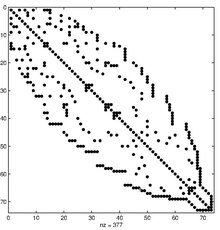
The Cuthill – McKee Algorithm is an algorithm for reducing the width of a tape sparse symmetric matrices . It is named after the developers - Elizabeth Cuthill and James Mackey.
The reverse Cuthill – McKee algorithm ( RCM , reverse Cuthill — McKee ) is the same algorithm with reverse index numbering.
Algorithm
The original symmetric matrix 

The algorithm builds an ordered set of vertices 
- select a peripheral vertex (or a pseudo-peripheral vertex )
for the initial value of the tuple
;
- for
while the condition is satisfied
, perform steps 3-5:
- build an adjacency set
for
where
component
;
- sort
ascending degrees of peaks ;
- add
In other words, the algorithm numbers the vertices during the breadth-first search , at which adjacent vertices are dispensed in the order of increasing their degrees .
For a disconnected graph, the algorithm can be applied separately to each connected component [1] .
The temporal computational complexity of the RCM algorithm, provided that sorting by inserts is used for ordering, 


Selecting the starting vertex
To get good results, you need to find the peripheral vertex of the graph. . This task is generally quite difficult, therefore, they usually look for a pseudo-peripheral vertex using one of the modifications of the Gibbs heuristic algorithm , etc.
To describe the algorithm, the concept of a root level structure is introduced. For a given vertex level structure with root in will be a split many vertices :
where are the subsets defined as follows:
and
Algorithm for finding a pseudo-peripheral vertex [3] :
- select arbitrary vertex of ;
- build a level structure for the root : ;
- pick the top with the least degree of ;
- build a level structure for the root : ;
- if a then assign and go to step 3;
- vertex is the desired pseudo-peripheral vertex.
Notes
- ↑ George, Liu, 1984 , pp. 65-66.
- ↑ George, Liu, 1984 , p. 68.
- ↑ George, Liu, 1984 , pp. 70-72.
Literature
- E. Cuthill and J. McKee. Reducing the bandwidth of sparse symmetric matrices In Proc. 24th Nat. Conf. ACM , pages 157-172, 1969.
- George A., Liu J. Numerical solution of large sparse systems of equations = Computer Solution of Large Sparse Positive Definite Systems. - M .: Mir, 1984. - 333 p.
Links
- Cuthill-Mackey documentation for Boost C ++ libraries .
- Detailed explanation of the Cuthill-Mackey algorithm .
- A detailed explanation of the Cathill-Mackey algorithm (Russian) (inaccessible link) .
- Python Cuthill-Mackey algorithm implementation (inaccessible link) .