France in World War II was directly involved from the very first days of September 1939. As a result of hostilities , the northern half of France and the Atlantic coast were occupied .
Content
The French in the war against the Hitler coalition
Joining the War
France declared war on Germany on September 3, 1939 , but did not engage in active hostilities (the so-called Strange War ). The only attempt to influence the course of the war was the Saarland offensive operation .
By May 10, 1940, 93 French divisions were deployed in northeastern France , 10 English divisions and 1 Polish division.
By May 10, 1940, French troops consisted of 86 divisions and totaled more than 2 million people and 3609 tanks, about 1,700 guns and 1,400 aircraft. [one]
Germany held 89 divisions on the border with the Netherlands, Belgium and France [ specify ] .
1940 French Campaign
On May 10, 1940, German troops crossed the border of the Netherlands and Belgium . On the same day, French troops entered Belgium . Directly on the German-French border, no hostilities were fought. The first clash of German and French troops occurred on May 13 in Belgium. On the same day, German troops crossed the Belgian-French border.
On May 25, Commander-in-Chief of the French Armed Forces, General Weygand announced at a government meeting that the Germans should be asked to accept surrender.
On June 8, German troops reached the Seine River. On June 10, the French government moved from Paris to the Orleans area. Paris was officially declared an open city . On the morning of June 14, German troops entered Paris. The French government fled to Bordeaux .
On June 17, the French government turned to Germany for a ceasefire. On June 22, 1940, France surrendered to Germany, and the Second Compiegne Armistice was concluded in the Compiegne Forest . The armistice resulted in the division of France into the occupation zone of German troops and a puppet state ruled by the Vichy regime.
Officially, hostilities ended on June 25. As a result of the war, the French army lost 84,000 people killed and more than a million prisoners. German troops lost 45,074 people killed, 110,043 wounded and 18,384 missing.
The Occupation of France
German occupation of France
During the occupation of France, the only magazine that did not stop publishing was Historia . All other magazines were closed [2] .
Italian occupation of France
Resistance
On the other hand, immediately after the German occupation, the “Resistance Movement” unfolded in France. Part of the French helped the Soviet Union and the Allies. At the end of 1942, the Normandy squadron (later the Normandy-Niemen air regiment) was formed on the territory of the USSR, consisting of French pilots and Soviet aircraft mechanics. French citizens served in the Royal Air Force , as well as in other units of the countries of the anti-Hitler coalition.
The French in the war against the anti-Hitler coalition
Vichy regime in southern France
The Vichy regime was created in the unoccupied zone of France and its colonies in July 1940. Even during its creation, the French government broke off diplomatic relations with Britain as a result of the British attack on the French fleet. The USSR and the USA initially established diplomatic relations with the Vichy regime and transferred ambassadors to London only in 1941, after the German attack on the Soviet Union. Formally, the Vichy regime pursued a policy of neutrality , but actually collaborated with Nazi Germany and Japan.
During the Vichy regime, the French government helped the Nazis deport 76,000 French Jews to death camps. [3] According to various sources, the number of Jews killed in the Holocaust of France is from 75 721 to 120 thousand people [4] .
War at Sea
After the surrender of France, the British government was preoccupied with the fate of the French fleet. Putting it in the hands of the Germans changed the balance of power, and maintaining its advantage at sea for Great Britain was vital. Therefore, on July 2, 1940, it was decided to launch an operation to capture or destroy the French Navy [5] [6] .
All warships of France, stationed in the British ports of Plymouth and Portsmouth, were captured. A compromise was reached in Alexandria ; the French ships were disarmed and deprived of fuel, but were not captured. At the French base of Mers-el-Kebir, the French refusal to fulfill the British ultimatum led to a naval battle . The obsolete French battleship "Brittany" was sunk and several other French ships were seriously damaged. The losses of the French exceeded 1,200 people. The British lost only a few aircraft. After several more clashes of a smaller scale, the parties stopped fighting on July 12.
The main goal of the British was not achieved. The main forces of the French fleet, including three modern battleships, were concentrated in the port of Toulon . This fleet was flooded by the French themselves only in November 1942, when there was a threat of capture by the Germans.
On the other hand, the “treacherous” from the point of view of the French British attack strengthened anti-British sentiment and led to the consolidation of the Vichy regime, which was forming at the same time, in France itself and its colonies. The positions of General De Gaulle were greatly weakened [7] .
War in Africa and the Middle East
In September 1940, the British and the “ Fighting France ” attempted to land in Dakar in order to capture the French colony of Senegal . However, contrary to De Gaulle's assumptions, the French fleet and army were loyal to the Vichy regime and gave a stiff rebuff to the attackers. After a two-day battle, the Anglo-Australian fleet, which was significantly superior in strength, could not achieve practically anything, the landing on the shore failed and the Senegalese operation ended in complete failure. This dealt another blow to De Gaulle's reputation.
In November 1940, De Gaulle, with the support of the British, launched a successful attack on the French colony in equatorial Africa, Gabon . As a result of the Gabon operation , Libreville was captured and all of equatorial French Africa was captured. However, due to the economic underdevelopment and strategic importance of the region, this success did not compensate for the failure in Senegal. Most French prisoners of war refused to join the “Fighting France” and preferred captivity until the end of the war in Brazzaville [8] .
On June 8, 1941, British, Australian troops and the “Fighting France” launched a ground operation to capture Syria and Lebanon , controlled by the Vichy government. At the first stage, the Vichy resisted stubbornly, carried out several successful counterattacks, and inflicted significant losses on the enemy in aviation. However, within a month, the Allies managed to break the enemy’s resistance and on July 14, an agreement on surrender was signed in Acre . Under its terms, the Anti-Hitler coalition gained control of Syria and Lebanon, and all soldiers and officers of the Vichy regime were offered the option of repatriating to France or joining the forces of Free France. As in Gabon, the vast majority of Vichy refused to join General De Gaulle. The French also retained their fleet and aircraft and managed to flood the captured British ships.
On May 5, 1942, Great Britain launched an operation to occupy Madagascar in order to prevent the creation of a Japanese naval base on this island. The insignificant forces of the French (8000 people) resisted for more than six months and surrendered only on November 8 [9] .
On November 8, 1942, Americans and British landed in Morocco and Algeria . For political reasons, the operation was conducted under the flag of the United States. The troops of the Vichy regime at this point were demoralized and did not show organized resistance. The Americans won a quick victory with minimal losses in a few days. French forces in North Africa sided with the Allies.
War on the Eastern Front
On the Eastern Front , at least two units were formed from French volunteers who fought as part of the Wehrmacht , but under the French flag and with the French command staff.
Since the fall of 1941, the French volunteer legion took part in the German war against the USSR in the Moscow direction and was the only non-German unit to take part in this operation. On November 5, 1941, Marshal Petain sent a message to the French volunteers: "Before you go into battle, I am glad to know that you are not forgetting - you own part of our military honor." The regiment suffered significant losses for the most part from frostbite and disease and was withdrawn to the rear. Subsequently, it was used for anti-partisan actions in Belarus.
On February 10, 1945, the 33rd Grenadier Division of the SS troops Charlemagne (1st French) was formed — from the previously existing French brigade of the SS of the same name that had fought against the USSR. The French SS division fought on the Eastern Front. In March 1945 it was defeated by the Red Army in Pomerania and its remnants were withdrawn to the rear. The battalion of this division (300 men) in the Berlin operation, together with the Nordland division , defended the Reichstag area. According to some French sources, the heroically defending French destroyed 60 “Russian” tanks, were the last defenders of Hitler’s bunker and prevented the “Soviets” from taking it for the May 1st holiday. [ten]
The number of French prisoners of war captured by the USSR in 1945 reached 23,136, which is three times the number of the Charlemagne division.
Exemption
Normandy Landing
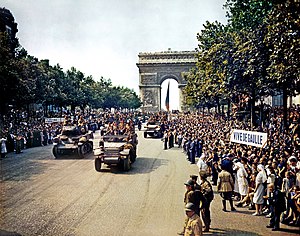
After landing in Normandy, American, British, Canadian and Polish troops captured Paris (August 25, 1944). This gave a serious impetus to the development of the Resistance Movement, Charles de Gaulle , who lived in London, was considered a national hero.
Summary
France was allocated a zone of occupation of Germany and given the place of permanent member of the UN Security Council.
Consequences
Punishment of war criminals and collaborators
In France, 39.9 thousand people were convicted of collaborationism, 2071 death sentences were imposed (1303 people received a death sentence with different terms of imprisonment, and 768 death sentences were carried out) [11] .
See also
- French prisoners of war in World War II
- List of French divisions in World War II
Notes
- ↑ Russian Bureau of Information
- ↑ New historical project “Amateur”
- ↑ French court acknowledges France’s participation in the Holocaust
- ↑ France. World war and disaster - an article from the Electronic Jewish Encyclopedia
- ↑ Robert Aron , Grands dossiers de l'histoire contemporaine , éd. Librairie académique Perrin, Paris, 1962-1964; rééd. CAL, Paris, “Le drame de Mers el-kébir”, P. 164
- ↑ Winston Churchill , The Second World War , Plon, 1948-1954; rééd. La Deuxième Guerre mondiale , Le Cercle du Bibliophile, 12 Template: Vol. , 1965-1966, tome troisième, L'Heure tragique - la chute de le France, 1940 , XI: L'amiral Darlan et la flotte française, Mers-el-Kébir ", p.249
- ↑ Gaulle, Charles, de. War Memoirs: Call 1940-1942. - M .: AST; Astrel, 2003.
- ↑ The Second World War in the French Overseas Empire . Date of treatment February 27, 2007. Archived February 11, 2007.
- ↑ World Battlefronts: Madagascar Surrenders (English) // Time : magazine. - 1942. - 16 November.
- ↑ Jean Mabir , Mourir à Berlin , Fayard, 1975.
- ↑ Volokitina T.V., Murashko G.P., Noskova A.F., Pokivailova T.A. Moscow and Eastern Europe. The formation of political regimes of the Soviet type: 1949-1953: Essays on history. - M .: ROSSPEN , 2002 .-- S. 79.
Links
- Insignia of the French Army during World War II // Russian Portal Information Bureau
- The Liberation of France, 1944-1945
- The US Army Campaigns of World War II: Southern France