Pykhta ( Latin Abies ) is a genus of evergreen forest-forming gymnosperms of the Pine family ( Pinaceae ). A characteristic feature of the fir - their cones , like those of real cedars , unlike most other coniferous families of pine, grow upwards and break up even in the trees, leaving behind only sticking rods, and the needles are flat.
| Fir | |||||||||||||||||
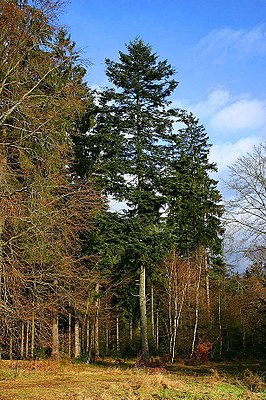 Fir white typus . General view of an adult tree. ( Thuringian Forest , Germany ) | |||||||||||||||||
| Scientific classification | |||||||||||||||||
|---|---|---|---|---|---|---|---|---|---|---|---|---|---|---|---|---|---|
| |||||||||||||||||
| International Scientific Name | |||||||||||||||||
Abies Mill. , 1754 [1] | |||||||||||||||||
| Synonyms | |||||||||||||||||
| |||||||||||||||||
| Typical view | |||||||||||||||||
Abies alba Mill. [2] - White Fir | |||||||||||||||||
| Subsidiary taxa | |||||||||||||||||
See text | |||||||||||||||||
Content
Name etymology
A. G. Preobrazhensky in his dictionary reports that “pihta is a tree of Abies sibirica ; fir; dial sib Fir - Fir forest . Borrowed from it. Fichte spruce, also pine, fir; borrowing folk " [3] . Earlier, the same idea was expressed by the Czech linguist “Fir - Russian. Pinus picea „spruce“, „pine“ from it. Fichte . M. Fasmer holds the same opinion, referring to A. Preobrazhensky and A. Mazenauer [4]
V. A. Merkulova proposed a different version of the origin of the word "fir". Her opinion boils down to the fact that the Russians could borrow the word pihk , pihku in the meaning of “big dense forest” or “pine forest”, “pine” from Western Finnish languages. In the Olonets and Arkhangelsk dialects, the lexeme of the fir is found in the meaning of “shrub of spruce” and “bor” and could be easily transferred to the name of a coniferous tree. Wed in Finnish languages, pihk is a large dense forest, pihku is pine, pihka is resin. In the last example, pihka (where -ka is perceived as a diminutive suffix, that is, a beer, “a small, frequent young forest”, “a thick, shallow forest”) from Fin. pihka [5] [6] .
Description
Pyramidal trees bearing ringed horizontal branches . Fir has straight tall trunks up to 60-80 meters high and up to 3.5 meters in diameter [7] . The leaves are needle-like ( needles ), flat, narrowed at the base into a short scape , entire, bottom with two white stripes, lasting for several years, on the branches usually spread out comb-like due to bending of the stalks on two sides. The needles are perennial, spirally located on the shoots [7] . The buds are almost spherical , dull or conical , stupidly-sharpened.
Fir wood is characterized by the absence of resin ducts and the construction of core rays only from uniformly thickened longitudinal parenchymal cells with simple pores. Pitch passages are concentrated in the cortex and form resin pitches in the places of their interweaving. The bark is smooth gray; old trees have fissured bark. Due to the deep core root system, fir is windproof [7] .
Male flowers in the form of earrings , made up of many cones , carrying two pollen sacs below, revealing a transverse slit. Female flowers in the form of upright standing cones, on the core of which the covering scales sit, narrower, but longer than the seed, or fruit, scales inside them; the latter bear two ovules . Pollination is made by wind.
By the time of seed ripening, which occurs already in the year of flowering, the scales become woody, and after ripening, they fall off, so that only a rod remains on the tree from the cone. The seeds are ovate or wedge-shaped, with a film-like asymmetric wing [7] , an embryo with several cotyledons . Unlike other conifers, the fir cone grows upwards.
Lives 150-200 years [7] . On the fir, the species of beetles Anthaxia helvetica is developing.
Spread
The total area of fir forests is about 18 million hectares [7] . Fir trees are common in temperate (taiga), subtropical and tropical regions of the Northern Hemisphere , including Mexico , Guatemala , Honduras and El Salvador [8] [9] [10] . In the north, they go beyond the Arctic Circle ( Siberian fir in the lower reaches of the Yenisei is the only polar location of the border of the Abies genus, the northernmost tip of which is located, according to earlier data, in the region of 67 ° N [11] , and later in 69 ° N [12] ), and to the south it extends below 14 ° C. sh. ( Guatemalan fir ) [10] . Depending on the geographical and climatic characteristics of the habitats, they grow almost from sea level (moderate latitudes, for example, balsam fir ) to 3,500–4,000 m above sea level, and sometimes slightly higher (subtropics and tropics, for example, wonderful fir and Guatemalan fir ) . The richest species in the area: the Pacific coast of Asia and North America . On the territory of the Russian Federation, 6 species are known: Siberian (Abies sibirica), Caucasian, or Nordman fir (Abies nordmanniana), Sakhalin (Abies sachalinensis), Mayra fir (Abies mayriana), kidney (Abies nephrolepis), whole-leaved (Abies holophylla) [7 ] . Unlike heat-undemanding larch and spruce , fir is a heat-loving tree, and most of their species are characterized by low frost resistance, while others are almost completely frost-resistant, such as Guatemalan fir and sacred fir . Firs are mostly frost-resistant, common in the taiga zone of the Northern Hemisphere, but they are also significantly inferior in frost resistance to larches and spruce. In addition, firs are demanding on soil fertility and moisture conditions of habitats. Exceptionally shade-tolerant at all ages and often quite shade-loving in the young.
Application
Fir wood is used in construction, pulp and paper industry, carpentry and furniture production. In Siberia, they are rich hunting grounds. From fir bark receive fir balsam, from the needles - essential fir oil. Used in gardening. Due to its sensitivity to atmospheric pollution, fir is unsuitable for breeding near factories and plants, along highways, etc. Fir forests have a climate-regulating, water-regulating, water-protective and soil-protective origin [7] .
Classification
The genus is about 60 species [7] [13] , distributed in a dozen sections.
Classification of the genus [14] [15] :
Abies Miller Section ( Central , Southern and Eastern Europe ; Asia Minor ):
- Abies alba Mill. typus [2] - White Fir
- Abies borisii-regis Mattf. - Macedonian fir
- Abies cephalonica Loudon - Kefalinian Fir , or Greek Fir
- Abies cilicica ( Antoine & Kotschy ) Carrière - Cilician Fir
- Abies nebrodensis ( Lojac. ) Mattei - Sicilian Fir
- Abies nordmanniana ( Steven ) Spach - Nordman Fir , or Caucasian Fir
Section Amabilis ( Matzenko ) Farjon et Rushforth ( Pacific coast of North America and Japan , high mountains with high rainfall):
- Abies amabilis ( Douglas ex Loudon ) J.Forbes typus - Comely Fir
- Abies mariesii Mast. - Fir Marisa
Section Balsamea Engelm. emend. Farjon et Rushforth (taiga, northern and highland areas of Asia and North America):
- subsection Laterales :
- Abies balsamea ( L. ) Mill. typus - Balsam Fir
- Abies lasiocarpa ( Hook. ) Nutt. - Fir shershavoplodnaya , or Subalpine Fir [ syn. Abies bifolia A.Murray [16] ]
- Abies sibirica Ledeb. - Siberian fir
- subsection Medianae :
- Abies gracilis ( Kom. ) - Graceful Fir , or Kamchatka Fir , or Elegant Fir , part of the taxonomists consider this species as a species of the Sakhalin Fir species: Abies sachalinensis Mast. var. gracilis ( Kom. ) Farjon , 1990
- Abies fraseri ( Pursh ) Poir. - Firara Fir
- Abies koreana EHWilson - Korean Fir
- Abies nephrolepis ( Trautv. ) Maxim. - White Fir , or Pickled Fir
- Abies sachalinensis ( F.Schmidt ) Mast. - Sakhalin fir
- Abies veitchii Lindl. - Fir Wicha
Section Bracteata Engelm. emend. Sarg. ( California Coast):
- Abies bracteata ( D.Don ) Poit. typus - Fir charming
Section Grandis Engelm. emend. Farjon et Rushforth (western North America up to Mexico , Guatemala , Honduras and El Salvador ; plain in the north, average heights in the south of the range ):
- Abies concolor ( Gordon & Glend. ) Lindl. ex Hildebr. - Fir monochrome
- Abies durangensis Martínez - Durango Fir
- Abies flinckii Rushforth [17]
- Abies grandis ( Douglas ex D.Don ) Lindl. typus - Great Fir
- Abies guatemalensis Rehder - Guatemalan Fir
- Abies jaliscana ( Martínez ) Mantilla [17]
Section Momi Franco ( East and Central Asia , the Himalayas ; mostly low and medium heights):
- Homolepides subsection:
- Abies homolepis Siebold & Zucc. - Fir equalischeyu
- Abies kawakamii ( Hayata ) Ito - Fir Kawakami
- Abies recurvata Mast. - Curved Fir , or Curved Fir
- Firmae subsection:
- Abies beshanzuensis MHWu
- Abies firma Siebold & Zucc. typus - The fir fir , or the Fir strong
- subsection Holophyllae :
- Abies chensiensis Tiegh. - Shenxi fir
- Abies holophylla maxim . - Solid fir
- Abies pindrow (Royle ex D.Don ) Royle - Himalayan fir , or West Himalayan fir
- Abies ziyuanensis LKFu & SLMo
Section Nobilis Engelm. ( US West, Highlands):
- Abies magnifica A.Murray - Great Fir , or Beautiful Fir
- Abies procera Rehder typus - Noble Fir = [ syn. Abies nobilis ( Douglas ex D.Don ) Lindl. ]
Section Oiamel Franco ( Mexico , Highlands):
- Religiosae subsection:
- Abies religiosa ( Kunth ) Schltdl. & Cham. typus - Sacred Fir , or Mexican Fir
- Abies vejarii Martínez
- subsection Hickelianae :
- Abies hickelii Flous & Gaussen - Fir Gikkeli
- Abies hidalgensis Debreczy
Piceaster Spach section emend. Farjon et Rushforth (Southern Spain , North-West Africa ):
- Abies pinsapo Boiss. typus - Spanish Fir
- Abies numidica de Lannoy ex Carrière - Algerian Fir , or Numidian Fir
Section Pseudopicea Hickel emend. Farjon et Rushforth ( Himalayas , Highlands):
- subsection Delavayianae :
- Abies chengii Rushforth - Fir Cheng , some taxonomists view this species as a type of Forrest Fir species: Abies forrestii var. forrestii Coltm.-Rog. [18]
- Abies delavayi Franch. - Delaway Fir
- Abies densa griff. - Fir thick
- Abies fabri ( Mast. ) Craib - Fir Fir
- Abies fanjingshanensis WLHuang , YLTu & SZFang
- Abies fargesii Franch. - Fir fir
- Abies forrestii Coltm.-Rog. - Forrest Fir
- Abies spectabilis ( D.Don ) Spach typus - Fir wonderful
- Abies yuanbaoshanensis YJLu & LKFu
- subsection Squamatae :
- Abies squamata Mast. - Scale fir
Notes
- ↑ Gard. Dict. Abr., Ed. 4., 1754 .
- ↑ 1 2 Information about the genus Abies (eng.) In the Index Nominum Genericorum database of the International Association of Plant Taxonomy (IAPT) .
- ↑ Preobrazhensky A. G. Etymological dictionary of the Russian language (P - C). - M: Type. G. Lissner and D. Sovco, 1910-1914. - T. 2. - p. 65.
- ↑ Etymological online dictionary of Max Fasmer. Fir . Etymological online dictionaries of the Russian language . The appeal date is December 24, 2017.
- ↑ Merkulova V.A. On the etymology of the word fir // Etymological research on the Russian language. - M: Ed. Mosk. University, 1960. - Vol. 1. - p. 46-51.
- ↑ Origin of the word fir . Etymological online dictionaries of the Russian language . Lexicographic online portal: online Russian language dictionaries. The appeal date is December 24, 2017.
- ↑ 1 2 3 4 5 6 7 8 9 Balandin, 2014 .
- Ø Sørensen, M., Kollmann, J. & Gardner, M. Abies guatemalensis . / IUCN 2013. IUCN Red List of Threatened Species. Version 2013.2.
- ↑ The Gymnosperm Database .
- ↑ 1 2 Abies Guatemalensis . The Gymnosperm Database (2006).
- ↑ Chinov, LS (ed.) Atlas of habitats and resources of medicinal plants of the USSR. - M .: Cartography, 1983. - 340 p.
- ↑ Siberian fir habitat (Abies sibirica). The project "Agroecological Atlas of Russia and neighboring countries: economically significant plants, their diseases, pests and weeds." Wild relatives of cultivated plants. (March 29, 2008). The appeal date is April 13, 2014. Archived February 2, 2013.
- ↑ The Plant List : Abies
- ↑ Compiled from materials of The Gymnosperm Database Archival copy of December 15, 2010 on the Wayback Machine and Catalog of Life: 2009 Annual Checklist
- ↑ Farjon A. A Handbook of the World's Conifers: [ eng ] : in 2 vol. - 2nd, revised and updated edition. - Leiden — Boston: Brill, 2017. - Vol. 1. - P. 58. - 1153 p. - ISBN 978-90-04-32442-8 .
- ↑ Abies bifolia (Eng.) : Information on the name of a taxon on The Plant List (version 1.1, 2013) .
- ↑ 1 2 Vazquez-García JA et al. Abies jaliscana (Pinaceae): A new combination in section Abies in western Mexico // Phytotaxa. - 2014. - Vol. 183, No. 1. P. 27-36. - ISSN 1179-3155 . - DOI : 10.11646 / phytotaxa.183.1.3 .
- ↑ Abies forrestii var. forrestii. Species details (English) . Conifer database . Catalog of Life: 2009 Annual Checklist. The date of circulation is December 17, 2009. Archived February 14, 2012.
Literature
- Philip Miller . The gardeners can be harvested of wine in england . - 4th ed., Corrected and enlarged. - London: Printed for the author and soldier by John and James Rivington, 1754.
- Fir // Encyclopedic dictionary of Brockhaus and Efron : in 86 tons (82 tons and 4 extra). - SPb. , 1890-1907.
- Fir in Collier's Encyclopedia
- Komarov VL Genus 38. Fir - Abies // Flora of the USSR : in 30 t. / Ch. ed. V.L. Komarov . - L .: Publishing House of the Academy of Sciences of the USSR , 1934. - T. 1 / ed. volume M. M. Ilyin . - p. 134-1142. - 302, XVI p. - 5000 copies
- Vasiliev Ya. Ya., Ukhanov V. V. The genus Abies - Fir // Trees and shrubs of the USSR. Wild, cultivated and promising for introduction. / Ed. Volumes S. Ya. Sokolov and B. K. Shishkin . - M. - L .: Publ . - pp. 53-103. - 464 s. - 3000 copies
- Fir // Great Soviet Encyclopedia : [in 30 t.] / Ch. ed. A. M. Prokhorov . - 3rd ed. - M .: Soviet Encyclopedia, 1969-1978.
- Fir Biological Encyclopedic Dictionary / Ch. ed. M. S. Gilyarov ; Edited .: A. A. Baev , G. G. Winberg, G. A. Zavarzin, and others. - M .: Sov. Encyclopedia , 1986. - p. 471. - 831 p. - 100 000 copies
- Krylov G.V., Maradudin I.I., Mikheev N.I., Kozakova N.F. Pikhta . - M .: Agropromizdat, 1986. - 239 p.
- Fir / Balandin S. А. // Peru - Semi-trailer. - M .: The Great Russian Encyclopedia, 2014. - P. 303. - (The Great Russian Encyclopedia : [in 35 tons.] / Ch. Ed. Yu. S. Osipov ; 2004–2017, Vol. 26). - ISBN 978-5-85270-363-7 .
Links
- Abies : A taxon on the Tropicos website.
- Abies (eng.) . World Checklist of Selected Plant Families (WCSP) . Royal Botanic Gardens, Kew .
- Abies (fir) description / Christopher J. Earle (ed.) // The Gymnosperm Database.
- Abies : information about the taxon in the Plantarium project (a determinant of plants and an illustrated atlas of the species).