Natalia Alekseevna Belevtseva at birth Hessing [1] (1895-1974) - Soviet theater and film actress. Actress of the Moscow Maly Theater . People's Artist of the RSFSR (1954).
| Natalia Alekseevna Belevtseva | |||
|---|---|---|---|
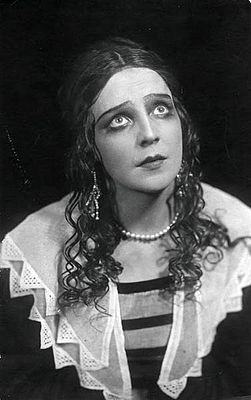 Natalia Alekseevna Belevtseva in the role of Judifi in the play "Uriel Acosta" by K. Gutskova (1924) | |||
| Date of Birth | January 20, 1895 | ||
| Place of Birth | Moscow Russian empire | ||
| Date of death | August 8, 1974 (aged 79) | ||
| A place of death | Moscow , USSR | ||
| Citizenship |  the USSR the USSR | ||
| Profession | actress | ||
| Years of activity | 1913-1972 | ||
| Theatre | Maly Theater | ||
| Awards |
 | ||
| IMDb | ID 0069788 | ||

Content
- 1 Biography
- 2 Awards and titles
- 3 Creativity
- 3.1 Theater roles
- 3.1.1 Roles in the Drama Theater (1916-1919)
- 3.1.2 State Exhibition Theater
- 3.1.3 Kursk City Theater named after M. S. Shchepkin
- 3.1.4 Maly Theater
- 3.2 Movie roles
- 3.1 Theater roles
- 4 notes
- 5 Links
Biography
Natalia Belevtseva came from a noble family of Russian intelligentsia of the XIX century . Then a lot of attention in education was given to literature, and the actress herself wrote poetry, she knew French well. According to the memoirs of her friend and partner on the stage of the Maly Theater, Irina Likso, she traveled a lot in her youth (visited even China , India ) and talked fascinatingly about her trips [2] . A graduate of the Alferov gymnasium , where she played a lot in the gymnasium theater under the direction of A. D. Alferov [1] .
Natalya Alekseevna told about her life herself in the memoir book “Through the Eyes of an Actress” (N. A. Belevtseva “Through the Eyes of an Actress.” M., WTO, 1974).
She was a late child in the family; when she was born, the elder sister Anna (ony's home) was 22 years old. She graduated from a theater school in the class of A.P. Lensky and entered the troupe of the Imperial Maly Theater, where she played under the stage name Matveeva ( Matveeva, Anna Alekseevna worked from the Maly Theater from 1898 to 1916). Among her roles: Agafya Tikhonovna in “The Marriage ” of Gogol , Cheboksarov in “ Mad Money ”, Khlestov in “ Woe from Wit ”, Kabanikh in “ Thunderstorm ”, Zvezdintsev in “ Fruits of Enlightenment ”. Natalia followed the path of her elder sister and after some time, together with her, played in the same performances. Since childhood, she was familiar with many actors of the Maly Theater troupe - co-workers of her older sister. Among them was N. M. Padarin , who, in fact, noticed the talent of young Natalia, who copied funny and accurate impressions of the people around her on vacation in Crimea . At his call, she entered the theater school of Fyodor Akimovich Ukhov in Merzlyakovsky Lane , where an older sister taught at that time.
And soon, in the same 1913, Natalia made her debut in the Sergievsky People’s House in the set of vaudeville "Checkers" set by her older sister. In the summer of the following 1914, the older sister, who organized a tour of the Maly Theater actors in the provincial cities of Russia, took the young actress with her younger sister. Despite the outbreak of war , artistic life in Moscow continued. In the autumn of the same year 1914, Onya opened her drama school. It was a spacious building of the former Adashevskaya school; it occupied the whole floor of a large Fabrizius house on Arbat Square. Both sisters settled here: one teacher of the school, the second student. Among the teachers of young Natalia of that time: N. M. Padarin , I. N. Khudoleev and I. N. Pevtsov .
“While still a student, she played Tanya in the play“ Sin and Misfortune on Whom Doesn't Live ”by A. N. Ostrovsky. After the performance, E. D. Turchaninova herself came to her backstage. “I am happy for you, dear. This is great, ”said the famous artist. And she gave Natasha a small keychain, which had previously belonged to her late daughter. So often in those days, the "old people" advised young talents " [3]
The official website of the Maly Theater gives such information about the actress: in 1916 she graduated from the drama courses of E. Musil in Moscow. In the same year, she made her debut at the Moscow Drama Theater E. Sukhodolskaya [4] .
The actress herself spoke of herself in a memoir: “According to Pevtsov’s class, I handed over a prologue from the Orleans Virgin. Illarion Nikolaevich arranged our exam on the stage of the Moscow Drama Theater, where he himself worked at that time. The auditorium was crowded, we were thrilled, played with enthusiasm and had success. The director of the Drama Theater, E. M. Sukhodolskaya, came to me backstage with an invitation to come to her in the coming days for negotiations.
A few days later with the words: “Here is Ophelia and Cordelia”, Pevtsov introduced me to the director's office of the Moscow Drama Theater. I signed my first contract for 75 rubles a month, on the role of an engineer. It was the spring of 1916. " [5]
Natalia Belevtseva played in the Moscow Drama Theater until 1919, having survived an impending revolution here, in which she understood nothing, busy with her artistic activities. True, one summer of 1917 she performed in the city of Lubny in the drama troupe of A. A. Matveeva.
I worked for a short time in Kursk.
From June 6, 1922 to June 14, 1972, Natalya Belevtseva was an actress of the Moscow Maly Theater , where she worked for 50 years and became one of the luminaries of the theater.
However, despite the outward success of her acting career and her leading roles, not everything in her fate developed as she would like herself. An intelligent, delicate and mentally vulnerable person, it was sometimes very difficult for her in the officially-official theater of the Soviet era. Irina Likso, who worked with her a lot, said quite clearly about this: “But her life in the theater did not always go smoothly. There were long “windows” when there were no roles. A delicate person, she did not know how to fend for herself and was very worried about forced downtime. Witty man, she wrote not only lyrical, but also satirical poems and epigrams, responded to various theatrical events. I remember how at one of the New Year’s meetings she read very accurate epigrams to the performers of the recent production of “Woe from Wit”. ... Actors who do not know how to stand up for themselves often lose not only roles. But, on the other hand, what would we and our theaters turn into if everyone suddenly learned to push each other? The indisputable merit of Natalia Alekseevna, in addition to everything, consisted precisely in the fact that she was a surprisingly delicate, intelligent, modest, subtle, noble man ” [2] .
She passed away on August 8, 1974. She was buried at Vagankovsky cemetery , plot number 35.
Awards and titles
- 2 orders of the Red Banner of Labor (09/23/1937; 10/26/1949)
- People's Artist of the RSFSR (1954)
Creativity
Theater Roles
Roles in the Drama Theater (1916-1919)
Season 1916/1917
- "Chameleon" by E.P. Karpov - Glasha
- “A Handful of Ash” by I. A. Novikov - Tatyana Strakhova
- “ Killer whale ” by A. N. Tolstoy - Raisa Glebovna
- The Strange Man by M. Yu. Lermontov - Princess Sophia
- The Wrong Side of Life X. Benavente - Sylvia
- "Psisha" by Yu. D. Belyaev - Psisha
- "Miss Hobbes" D.-K. Jerome - Miss Hobbes
- “Singer of His Sorrow” - Sheina
Season 1917/1918
- "The One Who Gets Slaps" L. N. Andreeva - Consuela
- Shadows of the Past A. Izmailov - Ira, Auchanin’s niece
- “The Lady with Camellias” by A. Dumas the Son - Nishetta
Season 1918/1919
- “ Sin and misfortune on whom does not live ” A. N. Ostrovsky - Tatyana Danilovna
- "The Noble Nest " by I. S. Turgenev - Lisa
- "Savva" L. N. Andreeva - Olympics
- "Paul I" D.S. Merezhkovsky - Elizabeth, wife of Alexander
- " The Last " by M. Gorky - Hope
- "Forest Secrets" E. N. Chirikova Dawn , Alyonushka
State Exhibition Theater
Season 1919/1920
- "Measure for Measure" by W. Shakespeare - Isabella
- "Wild Swans" by G.-H. Andersen - Princess Eliza
Kursk City Theater named after M. S. Shchepkin
Seasons 1920/1921 and 1921/1922
- Thunderstorm by A. N. Ostrovsky - Katerina
- "The novel" by E. Sheldon - Rita Kovalini
- “Dream of Love” by A. Kosorotov - Marie Charden
- " Three Sisters " by A.P. Chekhov - Masha
- "Sisters of the Kedrov" N. Grigoriev-Istomina - Tanya
- "The Noble Nest " by I. S. Turgenev - Lisa
- "The One Who Gets Slaps" L. N. Andreeva - Consuela
Maly Theater
- Season 1922/1923
- "The Snow Maiden " by A. N. Ostrovsky . Director: P. M. Sadovsky - Snow Maiden
- " Undergrowth " by D. I. Fonvizin . Director: N.O. Volkonsky - Sophia
- Shakespeare's “ Merchant of Venice ” - Portia
- “ For every sage is quite simple ” A. N. Ostrovsky. Director: I. S. Plato - Mashenka
Season 1923/1924
- The Iron Wall by B. K. Rynda-Alekseev. Director: I. S. Plato - Elena Libganten
- “Bear Wedding” by A. V. Lunacharsky - Maria
- “ Poverty is not a vice ” by A. N. Ostrovsky. Staged by I. S. Platon and L. M. Prozorovsky - Lyubov Gordeevna
- “ Woe from Wit ” by A. S. Griboedov. Director: A. A. Sanin - Sophia
Season 1924/1925
- " Uriel Acosta " K. Gutskova . Production by L. M. Prozorovsky - Judith
- "Sailor" T. Sauvage and E. Delurier. Staged by I.S. Plato - Jeanette
- Fiesco's conspiracy in Genoa by F. Schiller . Staged by N.O. Volkonsky - Leonor
Season 1925/1926
- The Promised Land by S. Maugham . Fast. N.O. Volkonsky - Nora Marsh
- "Zagmuk" by A. G. Glebov . Staged by N.O. Volkonsky - Iltani
- "Notre Dame Cathedral" by V. Hugo . Staged by I.S. Plato and N.F. Kostromsky - Esmeralda
Season 1926/1927
- “Profitable place” by A. N. Ostrovsky . Staged by N.O. Volkonsky - Vyshnevskaya
- “Sin and Misfortune for Whom Does Not Live” by A. N. Ostrovsky. Production by M.S. Narokova - Tatyana Danilovna
- "Dowry" by A. N. Ostrovsky - Larisa
- “Velvet and tattered clothes” by A. V. Lunacharsky and E. Shtukken . Staged by N.O. Volkonsky - Rachilda
Season 1929/1930
- "Rasteryaeva street" by G. Uspensky . Stage author and director: M. S. Narokov - Lipochka
- " Tradesman in the nobility " J.-B. Moliere . Staged by N. A. Popov - Lucille
Season 1930/1931
- “Change of Heroes” by B. S. Romashov . Production by M.S. Narokov - Belopolskaya
Season 1931/1932
- "Clear Log" by K. A. Trenev . Production by L. M. Prozorovsky - Natalia
Season 1932/1933
- "Glass of Water" E. Scriba - Queen Anne
Season 1933/1934
- " Enemies " by M. Gorky . Director: K.P. Khokhlov - Tatyana
- " Don Carlos " F. Schiller. Director K. A. Mardzhanov - Elizabeth Valois
Season 1934/1935
- " Wolves and sheep " by A. N. Ostrovsky. Production by K.P. Khokhlov - Kupavin
Season 1936/1937
- “Glory” by V. M. Gusev , production by K. P. Khokhlov - Elena
- " Forest " by A. N. Ostrovsky. Production by L. M. Prozorovsky - Aksyusha
1938/1939 season
- “ Woe from Wit ” by A. S. Griboedov. Production by P.M.Sadovsky . Directors I. Ya. Sudakov and S.P. Alekseev - Natalya Dmitrievna
- "Eugene Grande" by O. de Balzac . Director: K. A. Zubov - Eugene
Season 1940/1941
- " Barbarians " by M. Gorky. Directors: K. A. Zubov and I. Ya. Sudakov - Lydia
Season 1946/1947
- "Beyond the Kama River" by V. A. Tikhonov . Production by E.P. Velikhov . Director A.P. Gruzinsky - Matilda Ivanovna
Season 1948/1949
- " Dowry " by A. N. Ostrovsky. Staged by K. A. Zubov. Directed by L. M. Prozorovsky and B. I. Nikolsky - Ogudalova
- " Cunning and love ." F. Schiller . Performance resumed by V. I. Tsygankov - Mrs. Miller
- The Conspiracy of the Doomed by N. E. Wirth . Staged by K. A. Zubov . Directed by M.E. Turbina (Ger) and M.N. Gladkov - Mina
Season 1949/1950
- The Secret War by V. S. Mikhailov and L. S. Samoilov. Staged by E.I. Stradomskaya - Tumanova
1950/1951 season
- “ Woe from Wit ” by A. S. Griboedov - Countess-Granddaughter
1951/1952 season
- " Living Corpse " by L. N. Tolstoy . Staged by L. A. Volkova - Karenina
1952/1953 season
- "Glass of water" E. Scribe. Performance resumed by B. P. Brilliantov - Queen Anna
1953/1954 season
- "Jackals" by A. M. Jacobson. Staged by B.I. Ravensky . Director M.N. Gladkov - Doris
1954/1955 season
- The Pygmalion B. Shaw - Mrs. Higgins
Season 1955/1956
- " Pupil " A. N. Ostrovsky . Directors: V. I. Tsygankov and M. N. Gladkov - Ulanbekova
- "Doctor of Philosophy" B. Nusic . Production by K. A. Zubov - Mara
1956/1957 season
- "One Night" by B. L. Gorbatov . Production by V.I. Tsygankova - Larisa Danilovna
1958/1959 season
- “Why did the stars smile” by A. E. Korneychuk . Staged by B.I. Ravensky. Director M.E. Turbina - Zinaida Nikolaevna
- “ Fan Lady Windermere ” by O. Wilde . Director: V. G. Komissarzhevsky - Duchess of Berwick
1959/1960 season
- " Our people - count " A. N. Ostrovsky. Production by L. A. Volkova - Ustinya Naumovna
- "The village of Stepanchikovo and its inhabitants" according to F. M. Dostoevsky . Production by L. A. Volkova - Praskovya Ilyinichna
Season 1960/1961
- " Living Corpse " by L. N. Tolstoy . Director: L. A. Volkov (renewal). - Karenina
Season 1961/1962
- "Wings" A. Korneychuk . Directors: K. A. Zubov and V. I. Tsygankov - Campion
- “Vanity Fair” by W. Thackeray . Directors: I.V. Ilyinsky and V.I. Tsygankov - Miss Crowley
Season 1962/1963
- “ Woe from Wit ” by A. Griboedov . Director: E. R. Simonov - Countess Grandmother
- “They are waiting for us somewhere” by A. N. Arbuzov . Staged by E.R. Simonov. Director M.M. Novokhizhin - Aunt Pasha
Season 1963/1964
- "The main role" S. I. Aleshin . Staged by L.V. Varpakhovsky . - Vera Antonovna
1964/1965 season
- “ Truth is good, but happiness is better ” by A. N. Ostrovsky. Production by B. A. Babochkina - Mavra Tarasovna
1967/1968 season
- "John Reid" E.R.Simonova . The director is Donja Luis
Season 1970/1971
- “ Dostigayev and others ” by M. Gorky . Production by B. A. Babochkin - Ksenia
Movie Roles
- 1917 - Kira Zubova - Nina
- 1918 - Drama on the hunt - Olga
- 1918 - Living Corpse - Sasha
- 1954 - Anna on the neck - Princess
Notes
- ↑ 1 2 Reformed Mary . Alferov gymnasium // Our Plyushchikha. Notebook of memories. M .: Gemini. 2008.S. 410.
- ↑ 1 2 She helped not only with “A Glass of Water” (inaccessible link) // Irina Likso. " Evening Moscow " 5.1.1995 g.
- ↑ “And the voice sounded so marvelous” (inaccessible link) // Alexander SHEVLYAKOV. “Moscow Region News” February 2, 1995
- ↑ Natalia Alekseevna Belevtseva (inaccessible link)
- ↑ N. A. Belevtseva “Through the Eyes of an Actress” M., WTO, 1974 (inaccessible link) Part Two. Artistic youth