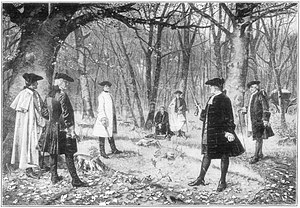
Duel ( fr. Duel < lat. Duellum - “duel”, “fight of two”) - an armed duel strictly regulated by the so-called duel code , the purpose of which is to satisfy the desire of one of the duelists (the caller to the duel) to respond to the insult inflicted by his honor pre-agreed and equal combat conditions. As a rule, duels occur only within certain social strata and are often associated with the aristocracy , although they are in fact not tied to any of them.
Currently prohibited by the laws of the vast majority of countries in the world.
Duel Organization
Duel Code
A duel code is usually referred to as a set of rules governing the causes and reasons for challenging a duel, types of duels, the order of challenge, its acceptance and rejection, the procedure for preparing and conducting the duel itself, determining which behavior of the participants in the duel is acceptable and which is not.
In France, the dueling code was first published by the comte de Châtiguillar in 1836. At the end of the 19th century, the dueling code of Count Verger, published in 1879, became generally recognized for Europe. [1] Both of these and other editions record the practice of duels of the corresponding time. The dueling code of Durasov, published in 1912, is known in Russia. All published versions of the duel code were not regulating official documents, but sets of recommendations formed by experts. The duel code has always been well known in the nobility and the officer environment (as well as within other communities where the duel was used).
Further in this section, the description of the duel is conducted in accordance with the Durasov Dueling Code, which is a generalization of the dueling experience of Russia and the later French dueling codes.
Weapon
The main type of dueling weapons was originally cold. Historians of the question notice that the nobility was originally supposed to fight a duel with the weapon that he had with him, so naturally bladed cold weapons that were constantly worn with him became a duel:
- One-handed or bastard sword ;
- Saber ;
- Sword , dagger or dagha ;
- Sword ;
- The rapier .
The weapons of legal duels (judicial duels) were appointed by the court and could depend on the class of rivals. So, rivals of a simple rank could fight on clubs, sticks or axes, for nobles such a weapon was considered not enough “noble”.
In duels of the nobles of Western Europe until the 17th century, the main weapon was a sword paired with dag, as it was the only weapon that a nobleman could carry with him outside the service. Instead of dagi in his left hand, the duelist could hold a special duel shield or a rolled-up cloak - with the help of these objects they parried the blows and also blocked themselves with them, hiding their actions from the enemy. In the 17th century, shields and dagas gradually fell out of use - the free hand in battle was removed behind its back. Only in Italy, the dueling dagger for the left hand continued to be used until the beginning of the 19th century. With the development of fencing techniques, more attention was paid to the speed of movements, which led first to the relief of swords, and then to a massive transition to rapiers, which are already purely piercing weapons.
In the 18th century, firearms became increasingly common in duels, mainly trigger pistols . The use of pistols removes the main problem of all duels with the use of physical strength or melee weapons - the effect on the result of the difference in age and the physical training of duelists. If during a duel with a cold weapon, one of the participants was significantly more skilled in fencing, then he was not in danger at all, as he defended himself much more effectively, and in a pistol duel even a bad shooter could, by shooting first, accidentally hit; Thus, both participants in the duel, regardless of their level of training, were in mortal danger. In some types of pistol duels artificially increased the influence of the factor of chance (see below). To equalize the chances of duelists, dueling pistols were made paired, absolutely identical and no different from each other, with the exception of the number 1 or 2 on the barrel. It is curious that at first pistol duels on horseback entered the practice, and only later the walking form, which is now widely known, appeared.
Much less often long-barreled firearms (a duel on rifles , rifles , carbines ) and multiply-charged pistols or revolvers were used for duels. There are also known cases of using duels of a completely “non-canonical” weapon or objects used in that capacity. Thus, for example, a duel between two English officers in India was described, which consisted of the following: the officers sat motionless for several hours in a dark room, where the Indian cobra was launched, until, finally, it bit one of them. In Russia in the XIX century there was a case of a duel between police officer Tsitovich and staff captain Zhegalov on copper candelabra - such a weapon, in accordance with his right to be offended, chose Tsitovich because he could not sufficiently shoot or fence .
Reason to duel
A challenge to a duel usually followed if one person (offended) believed that the actions or statements of another person (offender) were detrimental to his honor. The concept of honor itself could be interpreted very broadly and vary depending on the social community to which the offended and the offender belong, as well as geographical and historical circumstances. Usually, honor was understood as an innate personal dignity, requiring to observe certain rules of conduct with respect to a person, demonstrating respect for his origin and social status. Damage to honor was considered any deviation from such rules, degrading the face in his own eyes and the eyes of public opinion. Also, family or clan honor could be defended by means of a duel, and in certain circumstances - the honor of strangers, by virtue of accepted customs found themselves under the auspices of the offended.
No material damage could not, in itself, be the reason for the duel, such claims were resolved in court. Filing an official complaint against the offender to the authorities, the authorities or the court forever deprived the offended right to challenge the offender to a duel because of this insult.
Over the centuries, a variety of circumstances became almost a pretext for duels. There were duels for extremely serious reasons, such as revenge for a murdered relative or friend, but it happened that an unwary joke, taken by someone at his own expense, or an awkward gesture led to the duel. Since in all cases the fact of an insult was determined by the offended himself, there was no standard of insulting or non-insulting behavior. At the same time, even having received a call on an extremely dubious reason, the abuser most often was forced to accept it in order not to look like a coward in the eyes of society.
It was widely believed that only a person of equal status could damage his honor. An insult inflicted by a lower rank or social position, for example, a raznochintsy - a nobleman , was a violation of the right, but did not touch the honor of a nobleman, therefore could not become a reason for a duel - the call from the highest to the lowest was excluded, the violated right should be restored in court. A call from a lower rank to a higher one, under certain circumstances, was allowed, so sometimes a junior officer could challenge a superior to a duel, but the unequal position of the caller allowed the caller to reject such a call if he wanted to, without fear of his reputation.
Later dueling codes classified the reasons for the duel as follows:
- Normal, or slight insult (first degree insult).
- Insult with the word, directed mainly against the vanity of the offended and not affecting the good name and reputation. For example, such are offensive or stinging expressions affecting unimportant personality traits, appearance, manner of dress, unfamiliarity with any subject.
- Insulted received the right to choose weapons, other conditions of the duel were determined by the agreement worked out by the seconds.
- Heavy insult (second degree insult).
- Insult with a word or indecent gesture affecting the honor and reputation of the offended, including accusation of dishonest actions and accusation of lying, or combined with obscene language. The "spiritual infidelity" of the spouse was also considered an insult to the second degree.
- Insulted could choose the type of weapon and the type of duel (before the first blood, before injury, before the result).
- Insult action (third degree insult).
- The real aggressive action aimed at the offended. A blow, a slap in the face, an insulting touch, a throw of an object into an insulted person, as well as an attempt at any such action if it could be brought to a result under the given concrete conditions, but did not reach the goal due to circumstances beyond the control of the offender. By insulting the action was also equated physical infidelity spouse.
- In the event of an insult, the offended had the right to choose a weapon, kind of duel, barrier distance (if it was a duel with pistols), or a choice between a moving and stationary duel (with a duel with swords, sabers or rapiers), and also to use his own weapon ( in this case, the enemy could also use their own weapons).
Sometimes the difference between a grave insult and an insult was purely formal: if an attempt was made to strike or throw an object from a distance at which the strike or throw could reach the goal, it was considered an insult to the action, if the insult could not be touched (by hand or object) to the offended, then - an insult of the second degree. At the same time, a verbal announcement of insulting an action (for example, a statement: “I spit on you!”), Not even accompanied by any real actions, was considered an insult of the third degree.
The severity of insults of 2-3 degrees inflicted by a woman is reduced to 1 step. The severity of insults of 2-3 degrees inflicted by an incapacitated person was reduced by one degree. The severity of an insult inflicted on a woman, deceased relatives or the honor of a family increased by one degree.
If the offended responded to an insult with his insult of the same severity, then this did not deprive him of the rights of the offended. If the response to the insult was more severe, the more severe insult became the offending party and acquired the corresponding rights.
Call
It was recommended that the offended immediately, on the spot, in a calm and respectful tone, demand an apology or immediately declare to the abuser that seconds would be sent to him. Further, the offended could either send a written challenge (the cartel), or summon the offender to a duel through the seconds. The maximum period for a call under normal conditions (when the abuser was directly available and there were no objective difficulties for transferring the call) was considered a day. Delay with a call was considered a bad form.
In cases where one person simultaneously insulted several, the rule was: "One insult is one challenge." It meant that the offender was obliged to satisfy only one of the calls of several people who were simultaneously offended by him. If all the insults were inflicted with one degree of severity, then the offender was free to choose any of the incoming calls, but, having chosen, could no longer replace it with another. If the severity of the insult was different, then the advantage was given to those of the callers who were offended harder. In any case, after the duel about a particular insult took place, repeated calls from other offended people were not accepted. This rule excluded the possibility of a series of duels (with a high probability - fatal) for one person with a group of people about the same insult.
Duel Members
The duelists themselves, that is, the offending and offended, the seconds, the doctor, could take part in the duel. Friends and relatives of duelists could also attend, although it was not considered to be a good form to turn a duel into a performance, gathering spectators for it.
Duels with relatives and stakeholders
In later dueling codes, there was a direct prohibition against summoning close relatives to a duel, which included sons, fathers, grandfathers, grandchildren, uncles, nephews, and brothers. Cousin could already be called. Also duels between the creditor and the debtor were strictly forbidden.
Replacement for persons unable to duel
The direct participants of the duel could not be women, persons incapacitated, having a disease or injury, putting them in a clearly unequal position with the enemy, the elderly (usually from the age of 60, although if desired, an older man who maintained physical health could fight for duel myself) or too young (minors). If in reality the insult was inflicted or offended by such a person, a duel had to be replaced by one of his “natural patrons”; it was believed that such a substitute takes the brunt of the insult and takes on all the rights and obligations of the participant in the duel relying on the person being replaced. Someone from his closest blood relatives (up to and including his uncle and nephew) had to replace an elderly, minor, sick or injured man.
The woman had to replace either a man from the closest blood relatives, or a husband, or a companion (that is, who accompanied the woman at that time and in the place where the insult was inflicted), or, by expressing such a desire, any man who was present if you insult or later find out about him and who consider it necessary for him to intervene for this woman. At the same time, a prerequisite for recognizing the right of a woman to such intercession was her impeccable behavior, from the point of view of social norms adopted in society. A woman known to be too free to behave was deprived of her right to protection from insult.
In the event that the wife’s infidelity of the wife became the cause of the duel, the wife’s lover was considered an insult, and it was his duty to call him. In the event of a husband’s infidelity, for the honor of his wife, any of her immediate relatives or any man who considers this necessary for himself could intervene.
In all cases, when an offended person who was unable to take part in the duel independently, was expressed the desire to intercede by several people who are his (or her) “natural patrons”, only one of them had the right to be called. For a man, it was usually the closest blood relative, for a woman, her husband or her companion had the advantage. All other calls were automatically rejected.
Seconds
Ideally, the offended and the offender from the moment of the challenge and until the duel itself should no longer meet and, all the more, communicate with each other. To make preparations for the duel and agree on its terms, each of them invited one or two of their representatives - the seconds . The second played a dual role: he ensured the organization of the duel, while defending the interests of his ward, and was a witness to what was happening, which with his honor guaranteed that everything was done in accordance with the traditions and equality of the participants was not violated anywhere.
Dueling codes recommended to choose seconds from among equal by the position of people who are not interested in the outcome of the case and did not deface their honor. In accordance with these recommendations, the second could not choose a close relative, his or her opponent, as well as one of those who were directly affected by the insult. The duelist had to state in full detail to the invited seconds all the circumstances of the case, and the invited one, who considered that the circumstances were not sufficiently solid for the duel, had the right to refuse the role of the second without harming his honor. Seconds were instructed to negotiate a duel, and they were obliged to act within the authority given to them. Here, the duelist had every right to allow the seconds to act either fully according to their own understanding (including even allowing them to consent to reconciliation on their own behalf), or within certain limits, or clearly adhere to certain requirements. In the latter case, the seconds, in fact, turned into couriers, transmitting the demands of the principal and not having the right to depart from them.
In their talks, the seconds discussed the possibility of reconciliation and, if that turned out to be unattainable, the organization of the duel, first of all, those technical details that were not determined offended according to the severity of the insult: the type of duel (before the first blood, before serious injury, until the death of one of the participants and so on), in motion or without, barrier distance, shooting sequence, and so on. The main task of the seconds at this stage was considered to agree on a duel order in which none of the parties would have a clear advantage.
In the event that the seconds could not agree on the terms of the duel between themselves, they could jointly invite a respected person to perform the function of arbitrator, and in this case the decision of this invited was made by both parties without objection. For the duel, a manager was chosen from among the seconds, who owned the main role at the duel site. Usually, a doctor was also invited to a duel to certify the severity of the injuries, ascertain death and provide immediate help to the wounded.
General Duel Order
Traditionally, the duel was held early in the morning, in a secluded place. At the agreed time, the participants had to arrive at the place. A delay of more than 10-15 minutes was not allowed, if one of the opponents was delayed for a longer time, the arriving party received the right to leave the place, while the latecomer was considered to have evaded a duel, therefore, disgraced.
Upon arrival at the place of both sides, the seconds of the opponents confirmed their readiness for a duel. The steward announced the last offer to the duelists to resolve the matter with apologies and peace. If opponents refused, the manager announced aloud the conditions of the fight. Later, until the end of the duel, none of the opponents could return to the reconciliation proposal. Making an apology to the barrier was considered a sign of cowardice.
Under the supervision of the seconds, the opponents occupied initial positions, depending on the nature of the fight, and at the command of the manager a duel began. After the shots were fired (either after injuring or dying at least one of the opponents during a duel on cold weapons), the steward announced the end of the duel. If both opponents remained alive and conscious as a result, then they were supposed to shake hands, the offender to apologize (in this case, an apology did not hurt his honor, since it was considered a restored duel, but a tribute to ordinary politeness). Upon completion of the duel, the honor was considered restored, and any claims of opponents to each other about the former insult were invalid. Seconds compiled and signed a protocol on a duel, fixing as much as possible all the actions that took place. This protocol was preserved as evidence that everything happened in accordance with the traditions and the participants of the duel behaved as they should. It was believed that after a duel, opponents, if both were alive, should become friends, at least - to maintain normal relations . To call without any particular reason to whom he once fought was once considered to be a bad form.
Duel Types
In general, there were a huge number of different types of duels, but by the XIX century a certain “gentlemanly minimum” was established in the aristocratic environment, from which the choice was made when organizing a duel: two or three types of cold weapons and pistols. Everything else was considered exotic and was used extremely rarely. First of all, the type of duel was determined by the kind of weapons: cold or firearms.
Duels with edged weapons
As a cold weapon, duels were used mainly as a sword , saber and rapier . Usually used a pair of identical blades of the same type. With the urgent need to fight in the absence of identical blades, it was allowed, with the consent of opponents and seconds, to use a pair of similar blades of the same possible length. The choice of weapons was made in this case by lot. If one of the opponents (rightfully offended by the action) decided to use his own weapon, he thereby gave the enemy the right to use his own weapon of the same type.
Duels on cold weapons were divided into mobile and immobile.
- Moving duel. A more or less long path or platform was marked, within which duelists could move freely, advancing, retreating, bypassing the enemy, that is, using all the possibilities of fencing techniques. Possible was a mobile duel and without site restrictions.
- Fixed duel. Opponents were placed in the fencing position at a distance of the actual strike used by the weapon. It was forbidden to both attack the enemy and retreat, the battle was to take place on the spot.
In the 15th-17th centuries, duels with cold arms prevented punches and kicks, fighting on the ground, in general, any actions from the arsenal of street fighting. In addition, usually a dagger for the left hand was used in a pair with a sword, or the left hand was wound with a cloak and used to deflect enemy strikes and grips.
By the beginning of the XIX century they fought with one sword (saber, rapier), the second hand was usually removed behind the back. Punches and kicks were prohibited, it was also absolutely forbidden to seize the blade of the enemy’s weapon with his hand. The battle began at the signal of the second-manager and had to stop on his first request (otherwise the seconds would have to separate the opponents). If one of the opponents dropped the weapon, the second had to stop the fight and give the first an opportunity to raise it. During the duels “before the first blood” or “before the injury” after any blow that reached the goal, the opponents had to stop and allow the doctor to examine the wounded and conclude if the wound is not serious enough to stop the fight, in accordance with accepted rules. During the duel "to the result" the fight stopped when one of the opponents stopped moving.
Pistol Duels
There are more types of duels on pistols than on melee weapons. In all cases, a pair of single-shot pistols was used for the duel. The weapon should not have been familiar to any of the opponents, this was attached great importance, since prior to the era of mass industrial production each weapon had distinct individual characteristics, and the duelist familiar with the pistol could have a serious advantage [2] . In some noble houses they kept a separate set of pistols on purpose in case of a duel, and for nothing else they were not used. Opponents came to the field of honor, each with their own pair of pistols, testifying honestly that the weapon was not adjusted, then they determined by lot from whose pistols to shoot. [3]
In the most traditional duels, each of the opponents fired only one shot. If it turned out that as a result both opponents remained unharmed, it was considered, however, that the honor was restored and the case was over. It was not always that opponents were thirsting for blood, but it was believed that if the shooter was the first to clearly seek to injure his opponent dangerously, then the second one also gets the right to do so. On the other hand, when the duelist defiantly fired by, this in itself could be considered an insult and a reason for a new duel.
In the case when the seconds agreed on a duel “before the result” or “before the injury”, with a mutual miss, the pistols were charged again and the duel was repeated either from the very beginning or, if it was agreed, with changing conditions (for example, at the minimum distance).
- "Fixed Duel"
- Opponents are located at a specified distance from each other (as a rule, in Western Europe, a distance of about 25-35 steps was used, in Russia - 15-20 steps). They shoot after the command of the manager, depending on the previously agreed conditions, either in random order, or alternately, according to the lot. After the first shot, the second should be done in no more than a minute.
- "Movable duel with barriers"
- The most common type of duel in Russia XVIII-XIX century. The path is marked "distance" (10-25 steps), its boundaries are marked by "barriers", in which quality can be used any objects laid across the track. Opponents are placed at an equal distance from the barriers, holding pistols in their hands muzzle up. At the command of the manager, the opponents begin to converge - move towards each other. You can go at any speed, it is forbidden to move back, you can stop for a while. Having reached his barrier, the duelist should stop. The order of shots can be negotiated, but more often they are shot at readiness, in random order (the enemy is healed in motion and fired, stopping). There are two options for the rules of this duel. According to the first, more common in Western Europe, the enemy, who fired the first, had the right to stop where he had shot. According to the second one, adopted in Russia, after the first shot, one of the rivals who had not yet fired had the right to demand that the enemy go to his barrier and, thus, get the opportunity to shoot from the minimum distance. The well-known expression “To the barrier!” Just means such a requirement [4] .
- "At a noble distance"
- The very purpose of a distance of more than 15 steps was, as a rule, an indication of the "peacefulness" of rivals: the probability of a successful outcome was low. Meanwhile, precisely at the initial distance of 20 steps from his opponent, Alexander Pushkin was mortally wounded.
- "Duel on parallel lines"
- On the ground, there are two parallel lines on the barrier distance defined by the agreement (usually 10-15 steps). Opponents stand opposite each other and go along the lines, gradually reducing the distance. You can not move back, increasing the distance to the line. You can shoot at any time.
- "Fixed blind duel"
- Opponents stand motionless at an agreed distance, their backs to each other. After the command of the manager, they, in a certain or random order, shoot over their shoulders. If after two shots both are intact, the pistols can be charged again.
- "Put a gun to his forehead"
- Purely Russian version of the "extreme" duel. Opponents stand at a distance, providing a guaranteed hit (5-8 steps). Only one of the two pistols is charged, the weapon is selected by lot. At the command of the manager, opponents simultaneously shoot each other.
- "The barrel in the barrel"
- Also used exclusively in Russia. Similar to the previous version, but both pistols are charged. In such duels, both opponents were often killed.
- "Through the handkerchief"
- The fight with one hundred percent fatal outcome was appointed in exceptional cases. Opponents took with their left hands for the opposite ends of the handkerchief and, at the command of the second, simultaneously fired. Only one pistol was loaded.
- "Duel in the grave"
- A pistol duel at a distance of no more than ten steps was fraught with either serious injuries or the death of both participants and was appointed because of a serious insult. In dueling codes, such duels are called extraordinary or even unacceptable.
American Duel
A special kind of duel, not recommended by later dueling codes, was the so-called “ American duel ”, which was actually suicidal by lot. Opponents in one way or another cast lots, and the one he fell on was obliged to commit suicide for a short time.
The “American duel” was resorted to more often in cases when it was not possible to arrange a traditional duel (due to legal prohibitions, too unequal position of the rivals, physical limitations under which the result of the usual duel was predetermined, but the rivals did not have the ability or did not want to use substitution right, and so on), but at the same time both opponents believed that the differences could be solved only by the death of one of them.
Also, the “American duel” could be called another type of duel, more similar to hunting each other: rivals, by mutual agreement, arrived, usually from different sides, at a certain time in a given place, chosen as a “duel territory”, for example, gorge, and with weapons in their hands went to track each other. The goal was to detect the enemy and kill him. Such a duel is described, in particular, by Jules Verne in the novel From the Earth to the Moon . A satirical description of the “American duel” between two Soviet young people is in the story by Ilya Ilf and Yevgeny Petrov “ A Thousand and One Days, or New Scheherazade ” (1929, the novel “The Keeper of Traditions”).
History
Historical Ancestors
The immediate historical predecessor of the duel can be considered the judicial duel , which was widespread in the Middle Ages and originated, in turn, from the ancient, rooted in paganism, tradition of “divine judgment”, based on the idea that, in an equal from a technical point of view, the gods confer victory to the one who is right. Many nations had the practice of resolving an armed dispute in a situation where the court could not establish the truth by examining evidence and interviewing witnesses: the court could appoint a duel for opponents. The winner of this fight was considered right in the case under review, defeated if he remained alive, was punishable by law. The judicial duel was solemnly arranged, the order of its conduct was regulated by laws and traditions. The winner of the judicial duel did not have to kill the enemy at all - it was enough for him to fix an unconditional victory (for example, to disarm the enemy or knock him down and hold him, without giving him the opportunity to rise).
Although the judicial duel remained legitimate in the laws of European states until the 15th — 16th centuries, its practical application ceased or, in any case, was greatly reduced by the 14th century. One of the reasons was the widely known cases in which the loser of a judicial duel and, often, a man executed after that, subsequently, due to newly discovered circumstances, turned out to be innocent. So in 1358, a certain Jacques Legré lost an official judicial duel, appointed to determine his guilt in a crime, as a result of which he was hanged. Soon the criminal caught in another case also confessed to the crime incriminated to Legras.
Another predecessor of the duel can be considered a knightly tournament - also a definitely arranged solemn action, the central point of which was a series of ritual fights of fighters on cold weapons - equestrian duel on heavy spears or equestrian or foot fighting on swords. The goal of the tournament was also a victory, not the killing of an opponent, and over time, measures were taken to reduce the likelihood of death or serious injury: the battle was waged with specially blunt weapons that did not pierce the armor, and it was absolutely forbidden to kill the defeated. Tournaments were abolished in the XVI century, when the knightly cavalry lost its military significance, being replaced by foot arrows, first with bows and crossbows, and then with firearms, which made the useless armor. The formal reason for the termination of tournaments was the ridiculous death of King Henry II in the tournament in 1559: the spear of the rival king, Count Montgomery , broke on impact, and his sharp fragment hit the king in the eye, inflicting a fatal wound.
The appearance of a duel
The nobility that had been formed on the basis of chivalry gave rise to its own notions of honor and dignity inherent to any nobleman by birth and, accordingly, that encroachment on the honor of a nobleman in the form of insult with a word or action requires an indispensable retribution, otherwise, the offended is considered discredited. Another feature of the European noble mentality was the idea of certain privileges inherent to a nobleman by birthright, which no one, not even a suzerain (king or other ruler), especially the right to bear arms, could encroach upon. The combination of notions of honor and the need to protect them with the constant availability of weapons naturally brought to life the practice of immediately resolving personal conflicts by duel, in the organization and conduct of which the nobleman did not consider it necessary to involve the overlord, the court or government services.
A duel as a form of clarification of relations and a way to call the offender to account for an insult appeared around the XIV century in Italy. It was there that among young noblemen-citizens it became the custom to turn conflict into a pretext for a duel. For such a fight, opponents usually went to some deaf place, where they fought with weapons that they had, ignoring all conventions, which was why original duels (as opposed to official court fights) were originally called “fight in the bushes” ( Italian bataille àla mazza ) or “fight of animals” ( ital. bataille en bestes brutes ). In contrast to the official battles by court order, the “fight in the bushes” usually took place “as is”, on the weapons that they constantly carried with them, that is, on the sword and dagger, and without armor, which, of course, in everyday life no one did not wear.
It may be noted that for the Italian nobility "fighting in the bushes" became, to a certain extent, a progressive innovation. If earlier aristocrats often resolved honor issues by organizing attacks on individuals, houses or possessions of opponents by whole detachments, now at least the number of people involved in the conflict has decreased and, accordingly, the number of victims.
Spreading duels in Europe
The French nobility got acquainted with the “fights in the bushes” during the Italian wars of the 15th century and quickly adopted fashion. However, fights that took place in Italy in secret, in secluded places, were practiced literally everywhere in France, right down to the city streets and the royal palace, although more often they fought in the outlying parks.
By the beginning of the 16th century, the duel was quite common for the nobility of all of Western Europe, although the distribution of this custom differed sharply in different states; for example, in England the duel was much less common than in Italy and France. This time includes the first printed works of theorists of the duels, who consider the “battle in the bushes” as opposed to the knightly traditions of tournaments and court fights of the past centuries and insist on the need to follow the rules, rituals and a certain regulation of duels in order to resolve issues of honor. But among those who often fought in duels, the majority did not bother to read the treatises and were content with traditions learned from experience. In practice, the duels of this time arose spontaneously, mostly for domestic reasons, because of verbal abuse and because of rivalry for women, and occurred everywhere.
The right and duty to defend their honor through a duel acquired the status of generally accepted. Forgive a clear insult, without causing the offender to a duel, began to mean completely "lose face" and be disgraced in the eyes of society. A similar shame was waiting for the one who would not accept the challenge that was thrown to him, at least for the most trivial reason. He could afford to reject the call either very elderly (usually not younger than 60 years), or obviously seriously ill or frail nobleman. The lower limit of the age of "fitness to duels" was held at the level of 14-16 years, that is, the age at which the nobleman began to wear a sword.
There were no established rules, in fact, except for the most general ones. So, it was generally accepted that the caller chose the time and place of the duel, and the weapon was chosen by the one who was called. Since the right to choose a weapon gave a certain advantage, duels instigators often resorted to various tricks to be called party, for example, the offensive remark of the opponent was publicly called his slanderer or rudely insulted in response, putting him in a position when he was forced to challenge himself to save face. Subsequently, traditions changed and the issue of choosing a weapon became complicated, as a result, the seconds of the parties, arguing about who should be given this choice, often resorted to references to previously existing precedents and printed dueling codes, to a variety of tricks. for their wards.
Often the duels were tied literally in a few minutes and took place without seconds. The usual thing, not to blame society, was the use of techniques, according to modern ideas that do not comply with knightly rules: to divert the attention of the enemy, hit accidentally slipped or stumbled, finish off the disarmed or wounded, hit in the back, attack on foot (with a duel riding). Moreover, when an opponent who had all the chances to win because of an opponent's mistake, refused them out of nobility, such behavior was often condemned by society as stupidity and arrogance, since it could well lead to a backstab from a spared or repeated duel.
A classic example of the French duel of the early period can be considered the duel of the young Ashon Muron, nephew of one of the marshals of France, with the elderly captain Matas in 1559. During the hunt, Muron and Matas were quarreled, Muron demanded an immediate duel, during which Matas, much more experienced in possession of the sword, easily disarmed Muron than he thought the case was complete, after which he read the moral about the fact that you shouldn’t throw a sword on man, if you don't know how dangerous he can be. Having finished his speech, the captain turned away from the enemy in order to mount the horse; at that moment Muron raised his sword and stabbed Matas in the back, killing him outright. Thanks to Muron's kinship, the case was hushed up. At the same time, in society, his mean blow did not receive any censure, on the contrary, the majority was surprised how an experienced captain could allow such an oversight and reproached him for inappropriate humanism.
Often used and frankly vile techniques, such as putting on hidden protective armor (armor) under casual clothing or even a sudden attack on an opponent from the back of a specially hired killer. To avoid this, in private duels, like court fights of the past, there appeared seconds, whose duties included keeping order and adherence to rules and traditions, and subsequently witnessing that the fight was fair. Subsequently, the powers and duties of the seconds expanded, they began to transfer calls and negotiate the conditions of the fight, in order to exclude the meeting of rivals between the insult and the duel. The most common weapon of duelists remained swords and dagi - the only weapon that a nobleman was allowed to carry in the city in peacetime, being outside the ranks. There was a manner of fighting naked to the waist or putting on only a light shirt on the torso: this made it impossible to put on armor under clothes and demonstrated the contempt of duelists to death.
Legislative bans on duels
Initially, the authorities treated duels calmly, often kings were even present during duels of the most famous straps or their close ones. This practice was put an end to the French king Henry II , after a duel in his presence, the favorite of François de Vivonne, the lord de la Chatenière was injured and died a few days later.
From the 16th century, the duel began to be prohibited by law both by secular laws and by the institutions of the Christian church, and the church, in its decisions denouncing the practice of duels, did not distinguish between state judicial duels and private duels, recognizing both of them as opposed to divine principles. The Council of Trent (1545–1563) forbade the sovereigns to organize judicial fights under the threat of excommunication and declared all participants, seconds, and even viewers to duels, automatically excommunicated. Catholic duel denunciations continued until the XIX century, when Pope Pius IX, on October 12, 1869, confirmed excommunication from the church of everyone who calls or agrees to fight a duel. The dead in a duel, like suicides, were ordered not to be buried in the cemetery. King Henry IV of France, at the insistence of the States General, issued a law equating participation in a duel to an insult to majesty. The decree of Cardinal Richelieu dated 1626 established the death penalty or exile as a punishment for a duel, with deprivation of all rights and confiscation of all property for all participants in duels, including even spectators. In the reign of Louis XIV , 11 edicts were issued against duels.
Duel bans were taken everywhere in Europe. In 1681 such a ban was issued by the Emperor of the Holy Roman Empire and Austria Leopold I. According to the laws of Maria Theresa, all those who took any part in the duel were subject to the death penalty through beheading. Emperor Joseph II legally equated a duel with an intentional murder. Frederick the Great introduced severe punishments for duels in the army. Over time, the punishments for duels softened. In the 19th century, a duel was supposed to be imprisoned under the Austrian criminal code, and imprisoned in a German fortress under the criminal code.
Nevertheless, the practice of duels continued in those countries where it initially took root and where duels were common, mainly in Italy, Spain and France. Many eminent lawyers who spoke out against duels in the seventeenth and eighteenth centuries, nevertheless, recognized that written laws did not affect law enforcement practice and it would probably be so until the attitude to the duel in society as a whole changed. Since the main executors of laws and persons supervising the execution of laws were nobles everywhere, in practice, terrible edicts and heavy penalties for a duel often remained only on paper, and their application was either simply sabotaged or blocked by various tricks. Even in those cases when the cases of duelists reached the court, difficulties arose. Acting in many countries, a jury trial was composed, according to canons, of people of the same class with the accused, that is, in a particular case, of the nobles, who mostly shared the notion of an inalienable right of a nobleman to a duel. Such a court almost never found duelists guilty under laws that equated a duel to murder.
Attempts to apply the law against the duel "for wits" did not lead to the desired result. Thus, Cardinal Richelieu sent to the scaffold the famous skirmisher de Butville and his cousin de Chapelle after a duel on the Royal Square in Paris on May 12, 1627, in which Butville fought against de Beuvron (de Chapelle was the second and, according to the custom of the time, fought with Bussy, De Beuvron's second). De Beuvron, who remained after the duel, escaped the sentence by fleeing from Paris. But the penalty did not give effect - the number of duels did not decrease, and Richelieu only acquired more detractors in the nobility.
Sometimes the duel was even informally encouraged from some side considerations. Thus, during the board of the aforementioned Henry IV, duels became an important source of filling the constantly depleted royal treasury: over 20 years of rule, more than 7,000 official royal forgiveness was granted to the surviving duel participants, only on their notary registration (for which the recipient paid) the treasury saved about 3 million livres in gold. At the same time, for the same years, according to various estimates, from 7 to 12 thousand nobles died in duels, some modern researchers insist on a figure of 20 thousand - for that time it is the size of a rather large army.
“Duel Fever” in France of the 16th — 18th Centuries
The fight, which took place in 1578 and went down in history as the “ duel of the minions ” (depicted in the novel “The Countess de Monsoreau ” by Dumas Sr. ) and named after its participants - several young favorites - became a landmark for the history of the French duel. Henry III , known, in particular, a penchant for bright, defiant clothes ( Fr. mignon "handsome"). One of the minions, Jacques de Levy, the comte de Quelus , competed for a woman with Charles de Balzac d'Antrague, Baron de Quéneau. One day, after mutual insults, a duel was held between the rivals in Tournell Park. Immediately before the duel, Kelyus ’s second, Mozhiron , insulted Antargue’s, Ribeirak’s second, and demanded a fight with him, after which the two remaining seconds, Livaro and Schomberg, also uncovered swords. As a result of the group battle that followed, Mozhiron and Schomberg were killed on the spot, Ribeirac died of wounds within a few hours, Livaro was crippled (he was cut off by a sword with his sword, he recovered from the wound and died several years later in a regular duel). The king, who had received multiple injuries, took a long time to care for the king, but the favorite who had been on the mend decided to ride a horse; the wounds opened, and Kelyus died. Only Anthrage got off with a slight wound to the arm.
Despite the fact that duels at that time were already strictly prohibited, none of the survivors were punished. The king ordered the dead to bury in the magnificent mausoleums and put marble statues to them. The nobility perceived the reaction of the king as a sign that the duel, despite the official prohibition, was not only permissible but also honorable. At the same time, the “duel of minions” brought into fashion not only the direct participants of the duel, but also their seconds. As a result, the attitude of society to the duel has changed, duels have become not just a tradition, but also a fashion, their number has increased so much that it is possible to speak of a duel fever that has engulfed entire countries, which lasted more than a century. Everyone fought, from the poorest noblemen to the crowned heads, despite regularly reprinted laws against duels.
Among the young nobles, the category of "professional" brethers, as a rule, skilled fencers, who made the duel a way to achieve personal fame, stood out. They constantly bullied other nobles, they themselves called to a duel at the slightest pretext and provoked those around them with their defiantly impudent behavior. On account of some of them were hundreds of duels and dozens of wounded and killed opponents. One of the famous French brethren was Louis de Clermont, lord d'Amboise, Comte de Bussy , about whom contemporaries wrote that for him the reason for the duel could "fit on the fly's leg" (once he fought a duel, arguing about the shape of the pattern on the curtains) . So the literary quarrels of the nobles, described in Dumas' novels, for example, in The Three Musketeers, when the challenge comes from an accidental collision on the street or a joke about the cloak cut, were in fact quite common for that time. The challenge could follow on any occasion: because of the supposedly cast of a sidelong glance, an insufficiently courteous tone of the interlocutor, and so on.
Sunset duel in Europe
By the middle of the XVIIIth, the “duel fever” in Western Europe was over. Although the severity of punishment for a duel gradually decreased in the legislation of most states, duels have become much rarer, and most importantly, more streamlined. Cold weapons were noticeably pressed by pistols, which became the main tool of the duel of the XIX century. The transition to firearms had one important side effect: the impact on the outcome of the duel's physical capabilities of the duelist was significantly reduced. The rules of duels that were finalized in the form of duel codes of the 19th century were clarified: the majority of duels began with the seconds, the official challenge, the observance of the indispensable 24-hour interval between the challenge and the duel and according to a verified procedure ensuring the equal chances of the participants. Dueling rules have changed dramatically towards humanization: with a duel with pistols, a typical barrier distance of 30-40 steps was established, with duels with swords, as a rule, the battle was fought before the first wound, as a result most of the duels began to end with minor wounds or even bloodless. At the same time, the very concept of “restoration of honor” was transformed: the very fact that the enemy was put in mortal danger was considered to be sufficient as a retribution for insult. Of course, duels periodically took place under difficult conditions, including before the death, but their number decreased and public opinion was already disapproving of them.
The number of duels after the Napoleonic wars, when social changes led to a significant erosion of the aristocracy class and, accordingly, changes in morals and customs, declined even more. The development of the legal system, for its part, created the possibility of lawful prosecution of offenders through recourse to the court, to which many preferred to resort instead of risking their lives and freedom, arranging a duel. In general, despite the fact that in the 19th century, duels still occurred regularly, society’s view of them changed, they began to be seen as a relic of a bygone era and, in some cases, as an inevitable evil that must be endured until laws and in the worldview of people will not reach such a level that legal retribution will be in all cases sufficient to restore impaired honor.
There were separate "bursts" of dueling activity. For example, in France after 1830, when the freedom of the press increased significantly, an epidemic of “journalistic duels” began - calls between journalists because of printed accusations of lying.
Duels were widely spread in the first half of the 19th century among students in German universities. Practically at any university there was a “dueling society”, fights were held regularly, but most of them, due to carefully designed security measures, ended with light wounds or completely bloodless (fights were held on cold weapons, mainly on rapiers, duelists put on protective equipment, weapons disinfected to prevent wounds).
Also, until the end of the XIX century, and in some places and later, the duel was maintained in the army, despite all prohibitions and severe punishment. Even opponents of duels acknowledged that no prohibitions were able to eradicate the practice of duels between officers, in view of the traditions of this environment: the officer who refused to duel (who did not offend him or evade the challenge), was considered dishonored, the servicemen threw him and literally forced him to leave. service.
Duels in Russia
Ancient traditions
Russia has never had its own tradition of duels, although both court fights (“field”) and the best fighters fought before military battles were practiced (for example, you can recall the famous battle between Peresvet and Chelubey before the Kulikov battle ). The aristocratic class (boyars) had a slightly different look in Russia than in medieval Europe; the manners and customs of this environment did not give rise to sharp notions of personal honor, which would have to be protected by all means personally and by force of arms. On the contrary, boyars, nobles, and Russian officers did not consider it shameful or flawed to seek protection from the offender in court or by filing a complaint to the sovereign or the highest authorities. Of course, various excesses between the nobles throughout the centuries took place, but there was no duel tradition. Moreover, for a long time it was not borrowed in the West, despite the fact that active contacts with Western Europe began under Alexey Mikhailovich and many traditions of European life were adopted long before Peter I. In the XV — XVII centuries, when in France and Italy “duel fever” flourished, in Russia in that sense absolute calm reigned. The first duel registered in documents in Russia took place only in 1666, and between foreigners - two officers of the Russian service from the "foreign" regiment fought because of insult.
Legislative bans
Since there was no phenomenon, there were no legal sanctions prohibiting it - for the first time a law prohibiting a duel appeared in Russian law only in the time of Peter: the 139th military article, adopted in 1715 by Emperor Peter I , strictly forbade the duel between officers, and the deceased in a duel was also subject to hanging :
All calls, fights and fights through this are the most strictly forbidden <...> Whoever does this, all the same, both the caller and whoever comes out, has to be executed, namely, hanged, although of them who will be injured or killed, or although both are not the injured will depart. And if it happens that both or one of them remains in such a duel, then hang them up after death.
Severe punishment for a duel was literally written off from European laws, and no cases of these sanctions were put into practice.
It was only in the reign of Catherine II that the practice of fights began to spread among the noble youth, who acquired from foreign teachers the notions of “noble honor” as they were understood in Western Europe, and the very duel tradition. This prompted the empress to publish in 1787 a “Manifesto about fights”, which called the duel “alien plantation” and imposed punishment for organizing the duel and participating in it: participants (including seconds) of the duel that ended bloodlessly were fined and the offender - lifelong reference to Siberia ; for causing harm to health and life punishment was imposed as for the relevant intentional crimes. But these sanctions, for the most part, remained on paper, the cases of duelists very rarely reached the court, and in these cases, many received forgiveness or a significantly milder punishment.
At the end of the XVIII - the first half of the XIX century , when in Europe the “duel fever” had almost stopped, in Russia the number of duels, on the contrary, increased, despite the cruel official punishment. At the same time, as in Western Europe, the attitude towards duels developed in a paradoxical way: the number of duels was constantly growing, and official legislation and actual law-enforcement practice made duels less and less criminal. By the end of the 19th century, the duels between officers were recognized as not only legal, but, in some cases, obligatory, that is, the practice of “judicial duels” was actually revived (see below).
Features
Western authors, describing the “Russian duel” of the XIX century, note its extreme cruelty compared to the European duel, call the duel in Russia “legalized murder”. As noted above, by the first half of the 19th century, European ideas about a duel were considerably softened, it was considered quite sufficient to restore the honor to simply force the abuser to a real risk to life, even if this risk was not particularly great. Therefore, a typical European pistol duel at this time was carried out from a fixed position, at 25-35 steps or even further, shot in turn, determined by drawing lots. In such conditions, a difficult outcome was likely, but by no means obligatory, the majority of duels ended without bloodshed. Russian stragglers, like Tolstoy American , called such duels "operetta" and frankly laughed at them. In Russia, the typical barrier distance was 15–20 steps (about 7–10 meters) or less; at such a distance, a good shooter even from an unknown weapon missed rarely. When moving a duel in Russia, the uncharacteristic rule for Western Europe almost always applied, according to which the duelist shooting the second had the right to demand that the enemy approach the barrier, that is, in fact, stand up as an unarmed target, allowing the opponent to approach the minimum distance, calmly aim and shoot (it is from this rule that the well-known expression derives from “Go to the barrier!”). With duels like a “gun to the forehead,” “muzzle to muzzle,” or “through the handkerchief,” it was practically impossible to avoid the death of one or both duelists. If in Europe mutual blunders usually ended the duel, and the honor of the participants was considered to be restored, in Russia the conditions of the battle “until a decisive result” were often accepted, that is, until one of the opponents died or one of them lost consciousness. If both opponents were shot and no one was killed or injured, the weapon was reloaded and the duel continued. The offender had the right to shoot in the air (aside) if he did not wish to put the enemy at risk, but if he did so, then the offended was forced to shoot to kill - with a mutual intentional blunder, the duel was considered invalid because none of the participants was in danger.
Some famous 19th century Russian duels
In the 19th century Russian pistol duel, even the tradition of “ minion duels ” was revived - there were precedents of the so-called “ Four Duels ”, in which seconds were fired after the direct participants. The best known is the quadruple duel because of the ballerina Istomina in 1817, in which the chamber junker Zavadovsky was summoned and shot with the cavalier guard captain Sheremetev, and the second and second participants were the famous writer Griboyedov and the future Decembrist Yakubovich . It is characteristic that, despite the duel outcome (Sheremetev was wounded in the stomach and died the next day), no one suffered a serious punishment, only Yakubovich, whom Emperor Alexander I considered to be the instigator of the duel, was expelled from the guard and sent to the dragoon regiment in the Caucasus .
September 10, 1825 in a remote corner of the Forest Park of St. Petersburg, not far from the inn, standing on the Vyborg highway , a duel took place early in the morning between aide-wing adjutant Vladimir Novosiltsev and second lieutenant of the Semenov regiment Konstantin Chernov [5] . The reason for the duel was the refusal of Novosiltsev, caused by the insistence of his mother, to marry Chernov's sister as having a less distinguished origin. The distance in 8 steps did not give any of the duelists a chance to survive. Both were fatally injured. Novosiltsev transferred to the inn, where he died. Wanting to otmol their guilt for the death of their only son, the mother of Vladimir Ekaterina Vladimirovna Novosiltseva bought an inn, built in his place a poorhouse and the church designed by architect. Charlemagne and spent the rest of her life in prayers and philanthropy. Chernov's second was his cousin (his mother was sisters, Essen) Kondraty Ryleev , a member of the Northern Secret Society , who did everything to turn Chernov's death into a loud public event. As a result, Chernov’s funeral turned into an impressive manifestation that became the prologue to the Decembrists ’speech . [6]
The great Russian poet Alexander Sergeevich Pushkin became the victim of the duel. On January 27 (February 8), 1837, he was mortally wounded in a pistol duel by Georges de Hecker (Dantes) and died two days later. The challenge came from Pushkin himself, the cause was Dantes' blatant courting of his wife, Natalya Nikolaevna, which gave rise to offensive rumors and letters spread in the community. According to Pushkin scholars, the fatal duel was at least the twenty first challenge in the poet's life; on his account there were 15 calls (four duels took place, the rest ended in reconciliation, mainly through the efforts of Pushkin's friends), in six cases the challenge to the duel came from his opponents [7] [8] .
Just four years later, the duel caused the death of another prominent Russian poet, Mikhail Yuryevich Lermontov . Lermontov was summoned and on July 15 (27), 1841, killed by the retired major Nikolai Martynov. The instigator of the quarrel, in fact, was Lermontov himself. Distinguished by the sharpness of his judgments and his tendency to ironically mock at his interlocutors, he made it a rule to harass Martynov with ridicule, which eventually provoked the challenge. Lermontov, obviously not taking the duel seriously, shot to the side. Martynov, driven by the disdain of his opponent to rabies, shot accurately.
The reaction to the last duels of Pushkin and Lermontov can serve as a characteristic example of the attitude to the duel of the Russian society and justice of the XIX century in general. Light, in both cases, was on the winning side; Neither Dantes nor Martynov became objects of public censure. The court, applying the military article of Peter I, sentenced Dantes and Danzas (Pushkin's second) to death, but as the courts moved to court, the sentence was softened; as a result, Dantes was demoted to the rank and file and expelled from Russia, and Danzas, who was under arrest by the time he made his final decision, was extended for another two months, which was not enough for the punishment. Martynov was sentenced to be demoted and deprived of all rights of the state, but then the sentence was also significantly mitigated and ended up with a three-month arrest in the guardhouse and church repentance.
Legalization of army duels at the turn of the 19th — 20th centuries.
Under the military minister P. S. Vannovsky ( 1881–1898 ), in order to strengthen the fighting spirit in the army, in 1894, the rules about officer duels were issued, which were made for officers in certain cases obligatory [9] : the highest command of May 13, 1894 of the year “Rules on the Proceedings of the Fights in Officers'” [10] it was established that all cases of officer quarrels are sent by the commander of the military unit to the court of the officers society ; the court could either recognize the possible reconciliation of the officers, or (due to the severity of the insults) decide on the need for a duel (the court decision on the possibility of reconciliation was advisory, the decision on the duel was mandatory); the specific conditions of the duel were determined by the seconds chosen by the opponents themselves, but after the duel was over the court of the officers' society, according to the protocol presented by the senior second managing director, considered the behavior of the duelists and seconds and the conditions of the duel; an officer who refused to duel was obliged to submit a petition for dismissal in two weeks, otherwise he was subject to dismissal without petition; in those military units where the courts of the officers' society were absent, their functions were performed by the commander of the military unit itself. The question of the official publication of the duel code, which would have legal force, was considered, but this was considered not entirely convenient.
The law still contains sanctions for violating the rules of the duel and, in some cases, for causing serious harm : if one of the participants in the duel died or was seriously injured, his opponent could be imprisoned in a fortress for up to six months without depriving the state of his rights. It is characteristic that a heavier punishment awaited the seconds, who did not undertake measures to reconcile opponents (up to 8 months imprisonment) or incited opponents to a duel (up to 4 years imprisonment) stipulated by the duel code. For violation of the rules of the duel participants could be sentenced to hard labor [11] .
However, as before, in practice the penalties provided for by law were not applied. According to statistics, in the period from 1894 to 1910, 322 duels took place in the Russian army, including 256 - by order of the court of the officers' society, 19 - arbitrarily, the rest - with the permission of the chief. In 315 duels from 322 firearms were used, in 7 - cold. Attended: 4 generals, 14 officers − 14, captains and staff captains 187, lieutenants, second lieutenants and ensigns 367, 72 civilians. 30 fights ended in death or serious injury, the rest were bloodless or ended with light wounds to one or both participants. Not a single case of a duel reached the court hearing and did not lead to the conviction of any of the participants [11] .
Female Duels
Despite the fact that the most famous duel codes did not allow women to participate directly in duels, an exception could be made if the offender and the offended were women. The first mentions of female duels belong to the same period as the first mentions of duels in general: by the 16th century (a duel between two noble ladies in the St. Benedict monastery in Milan) [12] . Female duels in Europe became especially widespread in the middle of the 17th century.
In Russia, the fashion for women's duels was introduced by Catherine II , who herself, in her youth, participated in a similar event [12] . In the Catherine era, women's duels were not deadly; the empress herself insisted that they be carried out only before the first blood. Most of the reports of deaths due to female duels date back to the 19th century.
Female duels were conducted mainly on the basis of jealousy. But in the 17th century, at the European peak of the popularity of this kind of showdown, the reason for such a duel could have been quite insignificant, up to and including identical dresses with an “offended and offender”.
Current State
Currently, in most states of the world, a duel on real deadly weapons is illegal. At the same time, in some legislations direct bans on duels were preserved, in others (such as in Russian legislation) the duel is not mentioned and not explicitly prohibited, but participation in it falls under the criminal law and is considered, depending on the actual circumstances and the role of the specific a person in a duel, such as killing or causing bodily harm , attempted murder , incitement or aiding in the commission of the above crimes. The Yellow Press regularly spreads rumors that only in Paraguay a duel is allowed and only between those who donate blood. Members of the Paraguayan government were forced to refute such rumors several times in public [13] [14] [15] .
Nevertheless, separate use cases of duels still occur. In addition, sometimes demonstrative calls to a duel are made publicly, as a rule, from politicians to their opponents. Such “challenges” do not reach practical implementation, so they should be viewed, rather, as propaganda rhetorical techniques, and not as real attempts to follow the dueling traditions. In 1967, in Peru, one of the few known duels with the participation of future President Fernando Belaunde , who fought with swords and wounded his opponent, was recorded, after which the duel was stopped [16] .
In 2018, the draft Duel Code of Russia was submitted to the State Duma. In the explanatory note to the bill, its author, LDPR deputy Sergei Ivanov, explains the need to adopt the Duel Code by the fact that “recently there has been a tendency on the part of state and municipal employees to call for citizens to duel people who express different points of view from official points of view” [17] .
Some famous duelists
- Comte de Bouteville became famous for many fights, including in public places, and was executed for violating the edict of duels.
- About Señor de Bussy said that for him "the reason for the call could fit on the fly's leg."
- Cyrano de Bergerac fought hundreds of times, ironically at his own expense: "... Even if there was only one person in the whole world - and then I would not have avoided at least one duel" [18] , but at the same time killed in a duel just one person.
- A. S. Pushkin is credited with, besides the last, tragic duel with Dantes, about 30 pistol fights and challenges that took place. At the same time, Pushkin never spilled the blood of the enemy and never fired the first.
- Otto von Bismarck, in his student days, observed the traditions of bushes, fought 27 times, but was wounded only once.
- Alexander Hamilton was mortally wounded by Aaron Burr in a duel.
- Ferdinand Lassalle , the founder of the General German Workers' Union , died in a duel with his beloved's fiancé. [nineteen]
- M. Yu. Lermontov authentically had two duels that took place - with Ernest de Barant and with N. S. Martynov. It is possible that there were others.
- Otto Skorzeny was a famous duelist, on his account fifteen fights with swords. From one of the duels left a scar on his left cheek.
- Count F. I. Tolstoy- “American” was known as a desperate shooter; he fought a duel for an unknown number of times, killed eleven people. Tolstoy's eleven children died at an early age, and, according to rumors, the American considered it a punishment for those killed in duels.
- The brilliant mathematician Evarist Galois died in less than 21 years in a duel under unclear circumstances, barely having time to put on paper the results of his research.
- The Russian politician, the leader of the Octobrist Party, A. I. Guchkov, had several fights and enjoyed a reputation as a shooter.
- Benito Mussolini was a good swordsman and several times he fought edged weapons with his political opponents. So, on October 27, 1921, a half hour- long duel with swords between Mussolini and socialist Chikotti took place in Livorno . The initiator was Chikotti, whom Mussolini insulted in print. The fight ended with light wounds to both opponents and Chikotti's heart attack. [20]
Duel in literature and art
Duel in Russian Literature
A duel is the basis of the plot or an important storyline in many works of Russian literature:
- A.S. Pushkin , “Shot” , “The Captain's Daughter ”, “ Eugene Onegin ”
- M. Yu. Lermontov , “ Princess Mary ” (the theme of offended honor and duel is also present in the “Song of Merchant Kalashnikov” )
- I. S. Turgenev , " Fathers and Sons ", "Spring Waters"
- F. M. Dostoevsky , "Demons"
- N. S. Leskov , "On Knives"
- A. I. Kuprin , "Duel"
- A.P. Chekhov , "Duel" , "Bear" , "Ivanov"
- V.V. Nabokov , "Scoundrel"
Dueling incidents in Soviet literature
- The ironic mentions of the duel in the “Theater novel” by M. A. Bulgakov seem to be related to the challenge to a duel, which was received by the writer from E. A. Shilovsky , the husband who had gone to E. S. Shilovskaya (then Bulgakov ).
- In the plot of the novel “Open Book” by V. A. Kaverin , the main character, the tavern servant Tanya Vlasenkova gets into the educated Lions family after Dmitry Lvov accidentally wounds her during his duel with Raevsky.
- In the Red Army during the war, lists of the comic poem “Eugene Onegin in Aviation” by an unknown author went around, where, in particular, the duel on the rocket launchers between the pilot Onegin and the mechanic Lensky is described. [21]
- Ostap Bender in the Twelve Chairs , scribbling over the ridiculous noble ways of Kisa Vorobyaninov, invites him to fight with Fr. Fedor on brooms or in meat grinders.
Christianity and duel
Already, Pope Alexander III (papa from 1159 to 1181) denounced the practice of duels. The Trident Ecumenical Council (1545) decided to deprive the dead in a duel of church burial ; these sanctions were concretized by Benedict XIV in the Detestabilem constitution of November 10, 1752 . Pius IX (Pope from 1846 to 1878) in his Apostolic Epistle "Apostolicae Sedis" clarified that not only those who participate in the duel themselves, but also seconds and other witnesses and accomplices, are subject to religious punishment. Finally, Leo XIII in the letter of Pastoralis Officii of September 12, 1891 [22] recalled these canonical measures and explained them from a moral point of view.
Islam and duel
The censure of the practice of duels to a decisive result (death) occurs in Hadith: “If two Muslims cross swords, then the one who killed and the killed will go to hell, because they both had the same intention to kill their enemy.” // Hadith from Abu Bakr, Collection of Hadith “Sahih al-Bukhari”
See also
- American duel
- Satisfaction
- Breter
- Four Duel
- The last duel and the death of A. S. Pushkin
- Shuguli
Notes
- ↑ Duel: duel of honor or "lawful murder"?
- ↑ See A. Pushkin: “Thirteen steps into the map, I will not let slip, of course, from familiar pistols” (“Shot”)
- ↑ Lotman Yu. M. Roman A. Pushkin “Evgeny Onegin”. Comment
- “When they began to converge from the extreme limits of the barrier to the nearest, Zavadovsky, who was an excellent shooter, walked quietly and completely calmly. Whether Zavadovsky's composure enraged Sheremetev, or simply the feeling of anger overpowered his mind, but only he, as they say, could not stand it and shot at Zavadovsky, who had not yet reached the barrier. The bullet flew close to Zavadovsky, because it tore off part of the collar from the coat, right at the neck. Then, and this is very understandable, Zavadovsky got angry. „Ah! - he said. - Il en voulait a ma vie! A la barriere! “(Wow! He is encroaching on my life! To the barrier!) There was nothing to do. Sheremetev came up. Zavadovsky shot. The blow was fatal - he wounded Sheremetev in the stomach! ”- Yu. M. Lotman. Roman A. S. Pushkin“ Eugene Onegin ”. Comment
- ↑ L. Dobrinskaya Stories from the Pushkin House. L .; Children's Literature, 1983. pp. 77, 79
- ↑ Antonov, V. V. Kobak, A. V. The Shrines of St. Petersburg. Historical and ecclesiastical encyclopedia in three volumes. Tm 1-3. - SPb .; Chernysheva Publishing House, 1994, 1996.
- ↑ V.F. Khodasevich . “Duel stories” // Pushkin in emigration. M., 1997
- ↑ Mikhail Davidov Duel and the death of A. S. Pushkin through the eyes of a modern surgeon // Ural: Journal. - 2006. - № 1.
- ↑ Encyclopedic dictionary Pomegranate . T. 7, stb. 581.
- ↑ Rules on litigation involving officers; Archival copy of August 8, 2007 on the Wayback Machine
- ↑ 1 2 "Brother" magazine. Duel of honor.
- ↑ 1 2 Woman.Ru. The history of female duels.
- ↑ Selling Destinations: Geography for the Travel Professional. By marc mancini p236
- South The Southron's Guide to Living in Uruguay By R David Finzer
- ↑ Jesse . paraguayan-smackdown , Mississippi library commission (February 18, 2010).
- ↑ Vice-President of Peru was called to a duel (rus.)
- ↑ The draft Duel Code of Russia was submitted to the State Duma . RBC. The appeal date is September 12, 2018.
- ↑ Cyrano de Bergerac. Duelist
- ↑ Nachum T. Gidal . Die Juden in Deutschland von Römerzeit bis der Weimarer Republik. Könemann 1997. ISBN 3-89508-540-5
- ↑ Jasper, Ridley . Mussolini. Ch. 13
- ↑ Bektasov K. U. Notes of the radio operator. - (Almaty, elric@kav.org.uk)
- ↑ Una fides. Pastoralis Officii (On the moral evaluation of duels)
Literature
- L.V. Belovinsky . Duel // Illustrated Encyclopedic Historical and Everyday Dictionary of the Russian People. XVIII - the beginning of the XIX century. / ed. N. Eremina . - M .: Eksmo, 2007. - p. 185-187. - 784 pp .: - ill. with. - 5 000 copies - ISBN 978-5-699-24458-4 .
- The court of a society of officers and a duel in the troops of the Russian army (current legislation with all the comments). Handbook for officers of all kinds of weapons / Compiled a regiment. P. A. Shveikovsky. - SPb. : Ed. V. Berezovsky, 1898. - 176 p.
- Repnin. The most generous report of the feldtseyhmeister general and adjutant general of prince Repnin about the duel of the cadet Peter Lindemann. December 7, 1746 // Russian olden time, 1895. - T. 84. - № 10. - p. 236–237.
- Nabokov V.D. Duel and Criminal Law. - SPb., 1910. - 52 p.
- Novoselov V.R. The last argument of honor. Duel in France in the XVI - early XVII century. - SPb. : Atlant, 2005. - 288 p. - (Armory Academy). - 2000 copies - ISBN 5-98655-007-2 .
- Irina Reifman . Ritualized aggression: a duel in Russian culture and literature. - New Literary Review . - (Scientific Library). - ISBN 586793165X .
- Alexander Katsura Duel in the history of Russia “Rainbow” 392 p. 2006 ISBN 5-05-006469-4
- Joseph Hamilton Weapons and Rules of Duels “Centerpoligraph” 232 pp. 2008 ISBN 978-5-9524-3809-5
- Schegolev, Pavel. Duel and the death of Pushkin. Liters, 2017.
- Skrynnikov, Ruslan Grigorevich, and Aleksandr Sergueevitch Pouchkine . Duel Pushkin. Russian-Baltic Information Center BLITZ, 1999.
Links
- Abramovich-Baranovsky S.C. Duel // The Brockhaus and Efron Encyclopedic Dictionary : 86 tons (82 tons and 4 extras). - SPb. , 1890-1907.
- Duel // Military Encyclopedia : [in 18 t.] / Ed. VF Novitsky [et al.]. - SPb. ; [ M. ]: Type. t-islands I. D. Sytin , 1911-1915.
- Duel weapon
- Duel Code of 1912
- Duels and the law - on the history of the duel as "the court of God", on the prohibition of a duel, the appearance of seconds. Does not concern the history of the duel in Russia.
- Handorin V. G. Duel in Russia . Motherland. 1993, No. 10, p. 87-93