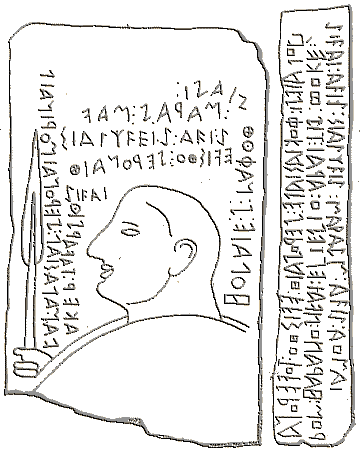
Lemnos stela - a tombstone (stela) with an inscription in a language close to Etruscan . The language is included in a hypothetical Tyrrhenian family .
The stele was found in 1885 on the island of Lemnos , was embedded in the wall of the church in Caminha (the southeastern part of the island), and is currently in the National Museum in Athens .
Content
Dating, alphabet and language inscriptions.
The stele dates back to the VI century BC. e., while the upper limit of dating is considered the annexation of Lemnos Miltiad to Athens in 510 BC. e., after which the population of the island was Hellenized. Herodotus mentions that the Pelasgians ( dr. Greek Πελασγοί ) were the pre-Greek population of Lemnos [1] , Thucydides calls this population Tirsens ( Τυρσηνοί ) [2] - this ethnonym in Greek literature of that time was synonymous with Tirrens, that is, Etruscan . However, it is possible that the Pelasgians and Thiersens were different, albeit related, peoples - for example, Egyptian sources among the " peoples of the sea " mention both Pelasgians (Plst) and Thiersens (Trs).
Herodotus also writes that the Pelasgians expelled the Minoans from Lemnos, however, researchers of the Lemnos stela do not consider the hypothesis of its Minian origin, because, judging by the context of the event described by Herodotus, it occurred in a prehistoric, preliterate period.
The Italian archaeological expedition of 1928 found inscriptions similar to the inscription of the stele on fragments of local ceramics. This finding confirmed that the language (and alphabet) of the stele was distributed in Lemnos of the pre-Greek period and was colloquial, that is, the stele was not brought to Lemnos from another region of the Mediterranean [3] .
Also on Lemnos was found a stone with four words of the same language [4] [5] .
The inscription on the Lemnos stele (in the figure and on the tablet) is considered not translated.
Transliteration
- On the picture
- hολαιε: ζ: ναφοθ: ζιαζι
- μαραζ: μαF
- σιαλχFειζ: αFιζ
- εFισθο: ζεροναιθ
- ζιFαι
- ακερ: ταFαρζιο
- αναλασιαλ: ζεροναι: μοριναιλ
- μαραζ: μαF
- hολαιε: ζ: ναφοθ: ζιαζι
- On the plate
- hολαιεζι: φοκιασιαλε: ζεροναιθ: εFισθο: τοFερονα
- ρομ: hαραλιο: ζιFαι: επτεζιο: αραι: τιζ: φοκε
- ζιFαι: αFιζ: σιαλχFιζ: μαραζμ: αFιζ: αομαι
- ρομ: hαραλιο: ζιFαι: επτεζιο: αραι: τιζ: φοκε
- hολαιεζι: φοκιασιαλε: ζεροναιθ: εFισθο: τοFερονα
Ephesian inscription
- A new Lemnos inscription was found during excavations of Efestia on the island of Lemnos and published by Carlo De Simone . The inscription consists of 26 letters, grouped in two lines; reading is boostrophedon [6] [7] .
Transcription:
- top row (left to right):
- hktaonosi: heloke
- bottom line (right to left):
- soromš: aslaš
Notes
- ↑ Herodotus . History, IV.145; V.26
- ↑ Thucydides . History, IV.109
- ↑ Larissa Bonfante . Reading the Past: Etruscan. British Museum Publications Ltd, 46 Bloomsbury Street, London WC1B 3QQ © 1990 ( ISBN 0-7141-8071-8 ).
- ↑ see below Ephesian inscription
- ↑ Carlo de Simone . "La nuova iscrizione tirsenica di Efestia." Tripodes 11 2009: pp. 3-58.
- ↑ New Lemnian Inscription | Rasenna Blog . Date of treatment March 25, 2013. Archived April 4, 2013.
- ↑ de Simone, Carlo. 2009. La nuova iscrizione tirsenica di Efestia . Tripodes 11.3-58.
Literature
- Carlo De Simone . Tirreni a Lemnos. Evidenza linguistica e tradizioni storiche, Firenze 1996