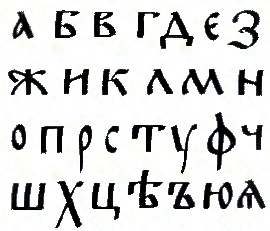

Font ( German: Schrift from schreiben to “write”) - a graphic drawing of the styles of letters and signs that make up a single stylistic and compositional system, a set of characters of a certain size and pattern. In a narrow typographic sense, a font is a set of typographic letters intended for typing.
A group of fonts of different types and pins with the same style, uniform style and design is called a headset .
Content
- 1 Font History
- 1.1 Slavic fonts
- 1.2 Modern fonts
- 2 Key Features
- 2.1 Artistic appearance of fonts
- 3 Printing system of measures
- 4 Density and saturation of the font
- 5 Groups of standard fonts
- 6 typeface
- 7 Fonts
- 8 Readability and font used
- 8.1 Pangram
- 9 Modern Fonts
- 10 See also
- 11 Literature
- 12 Links
- 13 Notes
Font History
- The first written form of the transmission of thought was pictography - drawings on the walls of caves and on rocks.
- Nodal letter .
- Ideography is the next step after pictograms.
- Hieroglyphics of Ancient Egypt , signs and symbols were the forerunners of modern writing. A little later, the hieroglyphs were used to convey the initial sound of the name of the subject , phenomenon , event , but a complete transition to phonetic writing did not occur.
- The first alphabet of phonetic letters was created by the Phoenicians . This alphabet has become the primary source of most alphabets of the world - Greek , Latin , Cyrillic and others.
- The Greeks perfected the Phoenician alphabet by introducing vowel-lettering sounds into it. The letters of his letters are very simple, have clear lines of the same thickness, and consist of simple geometric shapes - a circle , a triangle , a segment . The ancient Greek alphabet became the first alphabet in Europe .
- The Latin and Cyrillic alphabets are built on a single graphic basis and they arose from the ancient Greek inscriptions - capitals .
 Sample Roman capital letter. The inscription on the column of Trajan in Rome
 - Mayuskul was carved on stone slabs, columns, triumphal arches. One type of handwritten majuscule was the writing of a square . Letters of such a letter are characterized by smooth thickenings and serifs. Narrower and more decorative letters are rustic . Another variant of handwritten Roman writing is italics .
- In the VI century , a new writing style appeared - the unzial . The letters of this font were characterized by protrusion of the ends beyond the upper and lower lines of the row. The development of this font is semi-functional . This period was a transition from majuscule to minuscule writing.
- In the 9th century , Carolingian minuscule spreads - a font whose letters are used in our time.
- In the XI - XII centuries , Gothic writing develops. The Gothic font has many varieties according to the style of the style: texture , bastard , rotunda , decorative, Lombard Versailles, and later fracture .
- The round Gothic , Swabian script became the transitional form to the Renaissance writing. At this time, increased attention to everything antique, copies of ancient texts are rewritten in a font called " antique " . At the same time, the first treatises appeared on the construction of letters on the basis of a square, its diagonals and a circle inscribed in a square. The author of the treatise is Luca Pacioli .
- In Geoffrey Tori 's treatise "Flowering Meadow" , the letters are built in a square, with sides divided into 10 parts.
- Albrecht Durer designed his own font, the letters of which also fit into the square.

The letter "A" . Luca Pacioli, 1509 | The letter "A" . Blooming Meadow, Geoffrey Tori , 1526 | The letter "A" . Albrecht Durer, 1528 |
- In the 15th century, printers made new print fonts. Among the pioneers were Nicolas Janson , Ald Manutius and Claude Garamon . Garamon's font has become the basis for many modern fonts. It harmoniously combines low contrast, a smooth transition from the main stroke to the hairstyle, roundness and slope of the axes in the letters O, C, Yu .
Font Nicolas Jeanson | Font Alda Manutius | Claude Garamon Font |
- The art of the font was further developed in the second half of the 18th - early 19th centuries in Dido fonts.The title of the first volume of collections of fragments of Greek historians Mueller. Paris, ed. Dido, 1841.
Slavic fonts
In the XVIII century , along with the European, Russian fonts began to develop, which before that had developed independently, had a Greek base and were called Cyrillic and Glagolitic .
The most ancient fonts - the charter and half-order - were executed with all severity and clarity, following the rule - the charter - from which their names went. With the development of writing, cursive writing appeared, which was distinguished by a quick, free style, with strokes, loops extending far beyond the boundaries of the ranks. Cursive writing becomes the art of calligraphy of the 17th century . She wrote letters and official documents.
Charter, half-seal, cursive, script - these are forms of handwritten font. In the middle of the XVI century , the first books appeared in typographic type. One of these books was The Apostle by Ivan Fedorov , published in 1564 .
The new civilian book font was approved by Peter I and introduced in 1708 . It was clear, rounded and rational - a kind of synthesis of traditional fonts and antiqua .
Modern Fonts
At the turn of the eighteenth and nineteenth centuries , significant changes took place in the art of fonts - various new fonts appeared for different needs (books, newspapers, posters, posters, advertising). A new font was developed - Egyptian , which was distinguished by the same thickness of all lines and serifs. A little later, the grotesque font (chopped) appeared, the lines of the letters of which were the same thickness, but had no serifs. A whole family of grotesque fonts was developed.
The 20th century gave rise to new grotesque and chopped fonts that emphasized a new style in architecture and art - constructivism . Among the new fonts, the futurity of Paul Renner , Peño Cassandra , Erbar-Grotesque Jacob Erbar and the Gill -Grotesque Eric Gill are popular.
Futura Paul Renner | Peño Adolf Cassandra | Erbar-grotesque Jacob Erbar | Gill Grotesque Eric Gill |
Key Font Features
- face: straight, italic ;
- Saturation: light, bold , bold (the ratio of the stroke thickness to the width of the letter space);
- width: normal, narrow , wide, fixed-width font ;
- size ( size ) in points (1 point = 1/72 inch);
- sharpness (clear, blurry);
- contrast
- distinguishability ;
- readability ;
- capacity: (lean, voluminous).
A size is a font parameter that indicates the height of its letters. The size includes the height of the lowercase letter with the longest extension element and a space at the bottom of it. The size of the size is determined by the number of points. The most common pins for text fonts are 6, 7, 8, 10, 11, 12. Fonts 4 and 5 of the pins are very rarely used.
Artistic appearance of fonts
- Decorative
- Dynamic .
- Graceful . Roman capital, antiqua, academic fonts. They are used for literary and art criticism texts, design of architectural projects, writing texts on plaques.
- Italic . It is used for writing texts of certificates of honor, congratulatory addresses, congratulations and invitations.
- Monumental . Chopped poster, squared font and grotesque . It is used to write slogans , posters , banners .
- Free .
- Strict . It is used on charts, diagrams, graphs, technical and production posters, indexes.
- Folklore (Ukrainian, Arabic, etc.).
Printing System of Measures
Font measurement system. It does not coincide with the metric system and uses a point as a unit of measurement. Designed in 1737 by Pierre Simon Fournier . At the end of the XVIII century. refined by Dido ( Firmin Didot ). In 1878, it was once again corrected by Nelson Hawks and was adopted in this form in England and America. Now two measuring systems are used, differing in the size of the point: the Didot system ( Didot point system ), where 1 point is 0.3759 mm, and the Anglo-American point system, where 1 point is 0.3514 mm. In Europe and Russia, the Dido system is traditionally used, but in the computer set, the Anglo-American system is mainly used by default. In many computer layout programs, an item is defined for simplicity as 1/72 of an inch (0.3528 mm). In professional publishing packages, it is possible to choose a measurement system (metric, inch, Dido or Anglo-American).
In printing, along with metric, a printing system of measurements is used. This system was developed in 1785 by the French Dido, and therefore the measurement system is often called the Dido system. The printing system is based on the French inch, since the metric system was not yet adopted during its development. Subsequently, an attempt to bring the typographic measurement system in accordance with the metric was unsuccessful, because, firstly, for this it would have been necessary to replace all the typesetting materials and some parts in printing machines, and secondly, it was problematic, since the smallest unit of the metric system (millimeter) is too large for typographic measurements.
The main units of the printing system of measures are 1 point (1 p.), Equal to 1/72 of the French inch, 1 pica (1 pizz.), Containing 12 p., And 1 square (1 sq.), Containing 4 tsits. or 48 p.
1 p. = 1/2660 m = 0.3759 mm ≈ 0.376 mm; 1 tsit. = 4.512 mm ≈ 4.5 mm; 1 sq. = 18.048 mm ≈ 18 mm.
With computer typing, an Anglo-American typographic point (point) is used, equal to 0.3528 mm. To translate the Anglo-American measurement system into a printing system, use the ratio: 1 points = 0.9348 p .; 1 p. = 1.0697 points. The larger unit of 1 peak (pica) is 12 p. (≈4.22 mm).
Units of the typographic system of measures used to indicate the size. In printing practice, the size of the font size is indicated by the number of points or the corresponding unit of the printing system of measures containing this number of points. When typing texts, tables, formulas, the following font sizes are most widely used: Cicero - size 12 p. (It was the font of this size (cicero) that Cicero's famous speeches were once typed for the first time, and it is recommended as one of the most readable.) Case - size 10 Borges settlement (civilian) - size 9 p. Petit (small) - size 8 p. Nonparel (incomparable) - size 6 p.
Significantly less frequently (only in special types of publications or for headings) the following fonts are used (point size): Diamond (quarter pica) - size 3 p. Diamond (half-loop) - size 4 p. Pearl (pearl) - size 5 p. Mignon ( favorite) - size 7 p. Mittel (middle) - size 14 p. Tertsia (one third of the square) - size 16 p. Text - size 20 p.
A font of this size (text) typed the text of the Gutenberg Bible, one of the first printed books.
Font Density and Saturation
Font density is determined by the ratio of the width of characters such as "n", "p", "and" lowercase to their height (in percent), for normal fonts kg. 10 p. This ratio ranges from 60 to 85%.
Font saturation is determined by the ratio of the thickness of the main stroke of characters to the height of lowercase letters; for light fonts kg. 10 p. This ratio should be no more than 23%.
Standard Font Groups
Fonts according to the nature of their graphic construction (contrast, size and shape of serifs) are divided into six main groups:
- chopped fonts - low contrast, sans serif;
- fonts with barely visible serifs are medium-contrast, with slightly thickened ends of vertical strokes;
- medial - with moderate contrast and small serifs, similar in shape to a triangle; axis of rounded letters with a slight slope;
- ordinary fonts - with contrasting strokes and thin long serifs, connecting with vertical strokes at right angles; the axis of the round letters is vertical;
- bar fonts - low-contrast, with long, thickened serifs in the form of bars, connected to the main strokes at a right angle with barely noticeable curves;
- new low-contrast fonts - with long thickened serifs with rounded ends and connected to the main strokes at right angles with small roundings.
Fonts, the pattern of which is very different from the pattern of the listed font groups, are combined into an additional group.
Font
A typeface is a typographic term that combines a set of fonts that differ in size, type, presence or absence of serifs at the ends of the lines, in terms of the ratio of the height of the capital and lowercase characters, the size of the upper and lower extension elements, the density, i.e. similar in nature and decals of the picture.
Font
The following main types of fonts are distinguished depending on the style: straight, italic, bold, bold, normal, narrow and wide.
- Direct (Roman, Roman) - descended from inscriptions on Roman monuments.
- Italic - based on a handwritten letter that was used in southern European manuscripts, in particular written in the 15th century in Italy.
- Bold (Bold) - differs from the direct one by the greater thickness of the stroke.
- Normal (Regular) - differs from a direct one by a smaller stroke thickness.
- Narrow (Narrow) - a narrowed version of the direct font.
- Wide (Wide) - a wider version of the direct style [1] .
Readability and font used
The speed of perception of individual characters and the text as a whole when reading determines the readability of the font.
Readability depends on almost all font parameters: typeface, size and style; from dialing options: line format and leading; as well as reader qualifications.
For example, the text typed in the font of the large size of the Rublen and Ordinary headsets will have high readability with letter-by-letter and sequential reading, however, when reading the font size by a word and reducing the font size, the readability of these headsets decreases due to the similarity of the style of a number of letters (с, е; з, в ; n, and, k).
The font of the literary headset has good readability in all pins. For the prepared reader, the best readability is characterized by a font of direct normal light typeface, headsets: Bannikovskaya, Novaya Gazeta, Zhurnalnaya and Shkolnaya.
The use of a font of large size and large width improves readability, therefore it is undesirable to get involved in reducing the width of letters in order to increase the capacity of the set. Fonts with a wider point of the same size have better readability, for example, the font of the Kudryashev dictionary typeface (designed specifically for the publication of TSB) kg. 8 p., Has about the same readability as the font of the Academic headset kg. 10 p.
The ratio of the width and height of the point letters also affects readability. The optimal ratio is 3/4.
Increasing the lead improves readability, but reduces the capacity of the dial strip (i.e. the number of characters on the strip).
The size of interword spaces also affects readability, the recommended size of interword space from 1/2 to 3/4 size of a font. Readability is also affected by the ratio of the font size and line format. For example, when typing in kg. 16 p. The most readable line format from 7.5 square meters. and more; when typing in kg. 10 p. It is more convenient to read a line with a format of 4-6.5 square meters, and when typing kg. 8 p. - 3-4 square meters Therefore, the newspaper has the smallest line formats, and the largest for children’s books in large print.
To verify the readability of the font, pangrams are used.
Pangram
A pangram (c. Greek: “every letter”), or a different letter, is a text that uses all or almost all letters of the alphabet. Pangrams are used for demonstrating fonts, checking text transmission over communication lines, testing printing devices, etc.
Without "b":
- My friend is an elf! I used a bird to bring the birds of the southern thickets!
- Would the citrus live in the thickets of the south? Yes, but a fake copy!
Each letter is used once:
- Loving, eat the tongs, - the mayor will sigh, - the buzz is burning.
- The chef is jerked off the tongs with an echo of goodbye Jules.
- Hey redneck! Where is the ace? Hide the young tenants in the closet.
- Ex-Count? Plush removed. We beat alien horsetail prices!
- Oh, a stranger! General price hats (yuft) - to the smallest extent!
Some letters are used more than once:
- Eat more of these soft French rolls, but have some tea - this phrase is used in the Windows control panel when previewing fonts (contains all the letters of the Russian alphabet, except for "w").
- Eat these soft French rolls and drink tea - this easy-to-remember pangram contains all the letters of the Russian alphabet.
In English :
- The quick brown fox jumps over the lazy dog
Modern Fonts
It is characterized by the presence of direct serifs and a sharp contrast. По восприятию данный стиль более строгий по сравнению со старым. Его используют для заголовков и крупных надписей, а для длинных текстов он не особо удобен в силу большого контраста.
пример:
Arial
Helvetica neue
meta
Proxima
Futura
Calibri
See also
- Google Fonts
Literature
- Розета Мус, Ойана Эррера и др. Управление проектом в сфере графического дизайна = A Graphic Design Project from Start to Finish. — М. : Альпина Паблишер , 2013. — 220 с. — ISBN 978-5-9614-2246-7 .
- Кашевский П. А. Шрифты. - Mn. : Літаратура і Мастацтва, 2012. — 192 с.
Links
- Словарь шрифтовых терминов на fonts.ru
- Классификация шрифтов на fonts.ru
- Измерения шрифта. Термины и подробная схема
Notes
- ↑ Р. Мус, О. Эррера и др., 2013 , с. 147.